
 |
Salish Woolly Dog |
|
He is not recognized by the F.C.I. |
Origin |
British Columbia, Canada | |
Translation |
Francis Vandersteen | |
En français, cette race se dit |
 |
Chien laineux Salish |
Diese Norm ist in deutscher Sprache sichtbar |
 |
Salish-Wollhund |
En español, esta raza se dice |
 |
Perro Lanudo Salish |
In het Nederlands, wordt dit ras gezegd |
 |
Salish wollige hond |
This breed is also known as |
Woolly Dog |
|
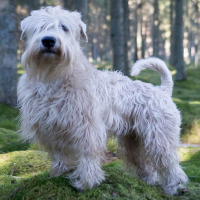
The Salish Woolly Dog played an important role in the lives of the Salish people of the south coast of Vancouver Island, the Strait of Georgia, and Washington State, as its wool was used to weave clothing and blankets. With the increasing arrival of European settlers and the introduction of machine-spun sheep's wool, the Salish Woolly Dog population declined in the 19th century until its extinction around 1900. The Salish Woolly Dog was a small, usually white, long-haired dog with erect ears, a curled tail, a fox-like muzzle, and a thick coat. A little over 14,000 years ago, domestic dogs descended from two distinct wolf populations: one in Asia and the other in Europe. Between 14,000 and 6,400 BCE, humans began bringing Asian domestic dogs westward and crossbreeding them with European domestic dogs. Salish Woolly Dogs lived throughout the Coast Salish territories, including the southern tip of Vancouver Island, the Strait of Juan de Fuca, Puget Sound, the Olympic Peninsula, the Strait of Georgia, and the lower Fraser River. They often lived in packs of 20 to 30 individuals. Their diet consisted of fish and elk tallow (rendered fat) to strengthen their coats and produce wool. To preserve the breed, the Coast Salish people kept the Salish Woolly Dogs separate from other domestic dogs. As a result, these dogs were often confined to small islands around Vancouver Island and the San Juan Islands. On these isolated islands, they were generally left alone during the spring and summer, with their owners returning in the fall to shear them. Among the Twana people of Puget Sound, Salish Woolly Dogs shared wooden houses with their owners, while hunting dogs lived outdoors. Like other domestic dogs, the Salish Woolly Dog likely bred approximately every six months. It is believed that these dogs were raised for their wool, which the Coast Salish peoples mixed with mountain goat hair to make clothing and blankets. When the dogs' coats were long enough, weavers washed them with white clay to remove dirt. They then used a sharp stone or mussel-shell knives to shear the dogs like sheep, cutting the hair close to the skin. The sheared hair was then preserved with dried clay to extract the oil and eliminate parasites. The dogs could molt up to three times a year. Salish Woolly Dogs most likely belonged to influential families in Coast Salish communities. Among the Indigenous nations of the Olympic Peninsula, these dogs were female-owned and passed down through the maternal line. The Salish Woolly Dog population declined throughout the 19th century. The increased presence of Europeans led to crossbreeding between settlers' dogs and Salish Woolly Dogs, decimating the latter's population. In addition, Indigenous populations also declined due to population displacement and diseases brought by colonization. Finally, in the 1820s, fur trading posts introduced inexpensive, machine-made blankets from England. These European blankets made raising these dogs for their fur unnecessary, especially since feeding a flock of dogs required salmon that could have been used to feed humans. By 1900, the long, woolly coat characteristic of the Salish Woolly Dog had disappeared, although a few rare sightings of woolly dogs were reported on reserves until 1940. |



 English (United Kingdom)

Comments