
 |
Hällefors Elkhound |
|
He is not recognized by the F.C.I. |
Origin |
Sweden | |
Translation |
Francis Vandersteen | |
En français, cette race se dit |
 |
Chien d'élan de Hällefors |
Diese Norm ist in deutscher Sprache sichtbar |
 |
Hällefors Elchhund |
En español, esta raza se dice |
 |
Elkhound de Hällefors |
In het Nederlands, wordt dit ras gezegd |
 |
Hällefors Elkhound |
|
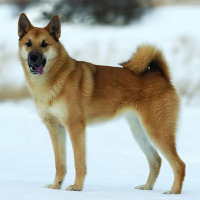
The Hällefors Elkhound is a medium-sized, rectangular-shaped Spitz breed with a tail that is either sickle-shaped or curled. Its thick, harsh, and dense coat is always yellow, ranging from fawn to reddish-orange. The coat is lighter on the chest, belly, legs, and underside of the tail. The average height is 55–63 cm for males and 52–60 cm for females. The Hällefors Elkhound is an energetic, courageous, and persistent dog with a strong character. The breed was developed in Svealand, though its precise origin is a matter of debate. It is claimed that, despite its name, it was not created in Hällefors but in the village of Fredriksberg, located in the neighboring municipality of Ludvika. It was primarily used for hunting deer, and its most notable ancestors are the Finnish Spitz and the Ostyak Laika. The Swedish Kennel Club (Svenska Kennelklubben) recognized the breed in 2000, and it is now also recognized in several other Nordic countries, such as Finland and Norway. The breed belongs to the mitochondrial DNA sub-clade known as d1, which is found exclusively in Northern Scandinavia. It originated from hybridization between a female wolf and a dog that occurred after domestication. The d1 sub-clade emerged between 480 and 3,000 years ago and is found in all breeds associated with the Sami people: the Finnish Lapphund, Swedish Lapphund, Lapponian Herder, Swedish Elkhound, Norwegian Elkhound, Black Norwegian Elkhound, and Hällefors Elkhound. |



 English (United Kingdom)

Comments