 |
Mackenzie River Husky |
|
He is not recognized by the F.C.I. |
Origin |
Canada, U.S.A. | |
Translation |
Francis Vandersteen | |
En français, cette race se dit |
 |
Husky du fleuve Mackenzie |
Diese Norm ist in deutscher Sprache sichtbar |
 |
Mackenzie-River-Husky |
En español, esta raza se dice |
 |
Husky del río Mackenzie |
In het Nederlands, wordt dit ras gezegd |
 |
Mackenzie-rivier Husky |
|
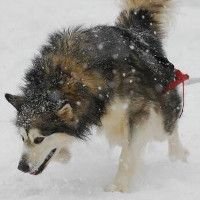
The term "Mackenzie River Husky" refers to several related historical populations of sled dogs from Arctic and sub-Arctic regions, originally bred to support Hudson's Bay Company fur traders and later prospectors during the Klondike Gold Rush. Descended from a cross between Indigenous sled dogs and European freighting dogs, these Huskies were prized for their ability to haul heavy loads over long distances through snow while requiring little maintenance. With the advent of modern mechanized transport in the Arctic, dog-sled freighting became nearly obsolete, and only small populations of these dogs remain. Populations had already begun to dwindle after the Klondike Gold Rush, but the decline of the Mackenzie River Husky accelerated significantly during the 1950s and 1960s, driven by the combined impact of mechanized transport in the Arctic and Canadian government efforts to eradicate Indigenous dog-sledding practices. Today, very few dogs of this breed remain. The Mackenzie River Husky stands between 66 and 74 cm (26 to 29 inches) at the withers and weighs between 29 and 47 kg (63 to 104 pounds). Generally possessing a long coat, they are lean, deep-chested, and long-legged; they are built to haul heavy loads in single file through deep snow. Their colors span the typical range for Nordic dogs: black and white, shades of gray and sable, fawn, blond, and red. Historical sources describe the Mackenzie River Husky as a robust and reliable dog—rarely aggressive toward humans but prone to fighting with other dogs. They make poor guard dogs, yet they enjoy their work as sled dogs. The Mackenzie River Husky breed emerged in the mid-19th century, driven by a need for larger, more powerful sled dogs. At that time, George Simpson, an administrator for the Hudson's Bay Company, encouraged measures to reduce personnel and increase efficiency; this prompted mushers to seek out bigger, stronger dogs capable of covering greater distances and hauling heavier loads. To meet this demand, mushers began deliberately crossing indigenous North American sled dogs with European draft breeds, such as the Mastiff, Newfoundland, Saint Bernard, and similar breeds. The name "Mackenzie River Husky" was applied to various dog populations across the Arctic and sub-Arctic regions of Canada and Alaska. |



 English (United Kingdom)

Comments