 |
Samusky |
|
He is not recognized by the F.C.I. |
Origin |
Northern Russia and Siberia <> Siberia -> North America | |
Translation |
Francis Vandersteen | |
En français, cette race se dit |
 |
Samusky |
Diese Norm ist in deutscher Sprache sichtbar |
 |
Samusky |
En español, esta raza se dice |
 |
Samusky |
In het Nederlands, wordt dit ras gezegd |
 |
Samusky |
This breed is also known as |
Samhusky
|
A brief presentation of the Samusky |
| The "Samusky" is a cross between a Samoyed and a Siberian Husky; it is a magnificent animal, prized for its striking appearance and exuberant personality. It is a hybrid breed intentionally created to produce a dog with a unique character. The Samoyed is often confused with the Siberian Husky. Both breeds feature stunning eyes, a thick coat, and an endearing personality, and both are medium-to-large in size. While crossing these breeds with other dogs is becoming increasingly popular, the specific Samoyed-Husky mix remains a rarer hybrid. Although they are highly energetic and can sometimes be demanding of attention, they make wonderful companions for the right family. |
History of the Samusky |
| Although the Siberian Husky and the Samoyed are both very ancient dog breeds, the Siberian Samoyed is a relatively recent development. This crossbreed likely originated in the United States, given the popularity of both breeds in regions such as Alaska. However, bear in mind that, as with any crossbreed, there is an element of unpredictability regarding appearance and temperament; the dog may resemble one parent more closely or exhibit a blend of traits from both. |
A little of the Samoyed |
||
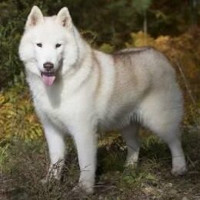
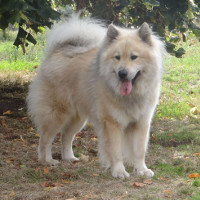
| The Samoyed is an ancient dog breed originating from Siberia. Although they share a genetic heritage similar to that of wolves, they are not wolves themselves. These hardy dogs were accustomed to work; they braved freezing cold and harsh conditions during the day while keeping their owners warm at night. They were specifically bred to lie on their owners and warm them, acting as a naturally heated, living blanket. While they are rarely used as working dogs today, Samoyeds have become highly cherished pets. They are distinguished by their magnificent white coats and expressions that always appear cheerful, as if they were smiling. The Samoyed is a medium-sized dog, weighing between 16 and 30 kg (35 to 65 pounds) and standing 48 to 61 cm (19 to 24 inches) tall at the withers. Purebreds typically sport a coat that is white, cream, "biscuit" (golden-beige), or a combination of white and biscuit. Their coats are always characterized by a shimmering, silvery appearance. Highly energetic and playful, Samoyeds form very close bonds with their owners. Although they make excellent pets, they are not suitable for households unable to provide them with intense daily physical activity and near-constant attention. They are sometimes nicknamed "Smiling Sammy" due to their perpetually cheerful expression. |
||
 |
||
| Standard of the Samoyed |
A little of the Siberian Husky |
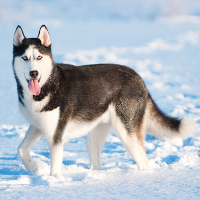
| The Siberian Husky is a breed that often inspires love at first sight. Although their exact origins remain unknown, they are recognized as one of the oldest dog breeds in the world. Siberian Huskies are associated with the Chukchi tribe, a nomadic people from Eastern Siberia. These dogs helped transport supplies and people across ice, snow, and freezing conditions. At night, they served as a source of warmth for the family. Siberian Huskies were introduced to Alaska in 1908 to work with miners during the Gold Rush. Once there, they also distinguished themselves in sled dog racing. One particularly famous group of Huskies covered over 615 miles (approximately 990 km) to deliver a life-saving diphtheria serum to children in Alaska during the 1925 epidemic. While Siberian Huskies are renowned for their endurance, speed, and athletic ability, they are also known for being incredibly clumsy. This trait, combined with their friendly nature, makes them one of the most interactive dog breeds around. Bursting with energy and highly affectionate, they require a home with plenty of space to run and owners willing to devote a great deal of attention to them. Furthermore, although they do not bark, Siberian Huskies are known for howling and whining—often at the most inopportune moments. They are medium-sized dogs weighing between 16 and 27 kg (35 to 60 lbs). They possess powerful musculature and stand between 51 and 60 cm (20 to 23.5 inches) at the withers. They are distinguished by their incredibly thick coats, striking eyes—often a piercing blue—and an intense, wolf-like appearance. |
 |
| Standard of the Siberian Husky |
Appearance of the Samusky |
| Since the Siberian Husky and the Samoyed are similar in size, their offspring can be expected to weigh between 20 and 27 kg (45 to 60 pounds)—or even more—and stand between 50 and 60 cm (20 to 24 inches) tall at the withers. They typically feature prominent triangular ears, a tapered muzzle, a fluffy coat, a black nose, and a striking gaze. Eye color is usually blue, brown, or a mix of both. Regardless of the color, their eyes are captivating and appealing, conveying a friendly expression. In addition to their pointed ears and slender muzzles, they often sport a distinctly curved tail. They resemble both parent breeds and possess a wolf-like physique. Finally, many display a smiling expression that enhances their cheerful charm. Both the Siberian Husky and the Samoyed are renowned for their thick, abundant double coats; the Samusky inherits this trait. They are sure to turn heads with their dense, fluffy fur, which consists of a soft undercoat and a longer, straighter topcoat. The Samusky can come in various colors, including white, cream, biscuit, black, gray, red, agouti, and sable. The coat may be solid-colored or a blend of colors, with the dog often inheriting the characteristic patterns and markings of the Siberian Husky. Due to their abundant fur, they shed a considerable amount of hair year-round. If you adopt one of these furballs, you must be prepared to find hair scattered throughout your home. |
Temperament of the Samusky |
| The Samusky is an intelligent, highly sociable, friendly, and incredibly energetic dog. Since both parent breeds are high-energy, friendly, and have a strong need for companionship, expect your puppy to demand a lot of attention. The Samusky will likely make an excellent watchdog, capable of alerting you to anything unusual. Due to its Husky heritage, your dog is very likely to be quite vocal at times. Samuskies can be wonderful companions, but they have significant needs. They are eager to please but can quickly become overexcited. This crossbreed can also be stubborn and independent. The Samusky is not a dog that can be left alone all day; it requires constant interaction and affection, and a lack thereof can lead to destructive behavior. Possessing a strong pack instinct, they thrive on social interaction and actively seek out company. Separation anxiety can become a major issue if they are left alone for too long. While they can coexist with other animals, keep in mind that they have a strong prey drive. They love to chase things and are both fast and powerful. Living with small dogs or cats can be tricky if your Samusky decides to give chase. However, despite this prey drive toward smaller animals, the Samusky can be incredibly affectionate and gentle with humans, especially children. |
Needs and activities of the Samusky |
| This particular crossbreed is likely one of the most energetic breeds in existence. These dogs need a home where someone is present for the majority of the time; they do not handle boredom well at all. Left alone, they can become destructive and sulky. Puppies from this cross (Samoyed and Husky) are also quite stubborn, so they need an owner capable of setting clear boundaries and sticking to them. A home with a garden is preferable. Your puppy will need frequent outings to burn off all that energy. If you enjoy long walks, hiking, playing frisbee, and exploring the world with a friendly, "smiling-faced" companion, the Samusky is the perfect dog for you. These dogs tolerate the cold well and love being outdoors, but they should not be left outside all day or spend the night there. Their double coat can lead to overheating, so they need plenty of water and access to shade when outdoors. Your Samusky puppy will require vigorous daily exercise. Ideally, you should plan for at least 60 to 90 minutes of activity each day. Try to split this time between brisk walks, stimulating games, and interactive play sessions. Remember that the Samusky can become very destructive if bored, so make sure to provide a variety of toys and distractions. Samusky puppies are incredibly intelligent and eager to please their owners. This intelligence makes training much easier. As long as you are consistent with behavioral expectations and do not tolerate bad behavior, they are capable of learning a wide range of things. Remember that both of these breeds are originally working and sled dogs. They are eager to learn and quickly pick up basic commands and house-training, as well as more complex tricks and games. This crossbreed can be stubborn, so it is essential to begin obedience training and socialization at an early age. Ideally, you should establish rules for good behavior early on and reinforce them consistently. This is particularly important given that the Samusky is both stunning and extremely sociable. They naturally attract attention, so proper training will ensure the safety of both your dog and others. |
Maintenance of the Samusky |
| Samuskies have a thick coat that requires regular maintenance. Daily brushing is ideal for keeping their fur clean, free of debris, and tangle-free. They shed daily, but shedding intensifies twice a year during seasonal changes. Due to their heavy coat, this Husky-Samoyed mix may not be suitable for people with allergies. Make sure to check your dog's nails and trim them about once a month. Regularly inspect their ears and don't forget to clean their teeth. |



 English (United Kingdom)

Comments