 |
Danish Spitz |
|
He is not recognized by the F.C.I. |
Origin |
Denmark | |
Translation |
Francis Vandersteen Authoritative language (DK) |
|
Working |
No working trial required | |
En français, cette race se dit |
 |
Spitz danois |
Diese Norm ist in deutscher Sprache sichtbar |
 |
Dänischer Spitz |
En español, esta raza se dice |
 |
Spitz danés |
In het Nederlands, wordt dit ras gezegd |
 |
Deense Spits |
Usage |
| Farm dog, guard dog, companion dog. |
Brief historical summary |
| The Danish Spitz is an ancient Danish breed that led an inconspicuous existence under names such as Greenland Spitz, Wolf Spitz, and Samoyed Spitz. In 1988, the Danish Kennel Club (Dansk Kennel Klub), with the help of prominent enthusiasts, launched an initiative to establish a foundation for the continued breeding of this charming Spitz. |
General appearance |
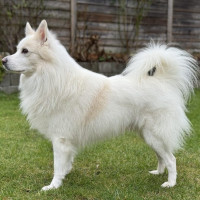
| The Danish Spitz is a typical Spitz, slightly below average in size, with an appearance that is both elegant and sturdy. It has a rectangular body structure with relatively large, erect ears. Sexual dimorphism is marked. |
Important proportions |
| Body length is slightly greater than height at the withers. The muzzle is the same length as the skull. |
Behaviour / temperament |
| Lively, friendly, curious, and courageous. An excellent guard dog. Should not possess a strong hunting instinct. |
Head |
||
Cranial region |
||
Head |
Medium-sized and wedge-shaped, whether viewed from above or in profile. | |
Skull |
Slightly domed with well-defined brow ridges. | |
Stop |
Well-defined. | |
Facial region |
||
Nose |
Black or brown. | |
Muzzle |
The muzzle represents half the length of the head. It tapers well in both height and width towards the tip. | |
Lips |
Tight and pigmented. | |
Nasal bridge |
The bridge of the nose is straight. | |
Jaws and teeth |
Powerful jaws with a well-developed scissor or level bite. | |
Cheeks |
Slightly rounded, without being prominent. | |
Eyes |
Medium-sized and clear, with an expression that is both energetic and calm. Dark brown in colour. Oval-shaped, appearing rounder than almond-shaped. The eyes must not be protruding. Eyelid rims pigmented. | |
Ears |
Erect. Relatively large, triangular, and broad at the base. Set high on the skull. Mobile and constantly in motion. | |
Neck |
| Medium length, powerful and well-defined, with a well-arched nape. Head carried high. No loose skin at the throat. |
Body |
||
Body |
Slightly longer than the height at the withers; sturdy build without being coarse. | |
Topline |
Straight. | |
Withers |
Pronounced. | |
Back |
Medium length and straight. | |
Loin |
Short. | |
Croup |
Short and rounded. | |
Chest |
Spacious—without being excessively wide—with a well-defined forechest. Fairly long and deep, reaching down to the level of the elbows. | |
Underline and belly |
Belly slightly tucked up. | |
Tail |
| Set high and carried curled over the back or slightly tilted to the side. At rest, it may be carried hanging down. |
Limbs |
Forequarters |
||
Generality |
Straight, muscular, and lean. Angulation allows for great freedom of movement. | |
Forefeet |
Slightly oval, with well-arched, tight toes. Well-developed pads. | |
Hindquarters |
||
Generality |
Powerful and muscular, with normal angulation allowing for freedom of movement and ensuring powerful drive. | |
Hind feet |
Identical to the forefeet. | |
Gait and movement |
| Light and efficient. Great endurance. |
Coat |
||
Hair |
Medium-length topcoat, slightly harsh, with a soft, thick undercoat. Coat slightly longer at the ears. Tail coat very full. Topcoat lies flat and must not stand off. | |
Colour |
Off-white to biscuit (yellowish-cream). May also show a slight pinkish tinge, but must not appear light brown. | |
Size and weight |
||
Height at withers |
Males 43–49 cm – ideal size 46 cm. Females 39–46 cm – ideal size 41 cm. |
|
Faults |
| • Any departure from the foregoing points should be considered a fault and the seriousness with which the fault should be regarded should be in exact proportion to its degree and its effect upon the health and welfare of the dog and its ability to perform its traditional work. • Faults listed should be in degree of seriousness. |
General faults |
 Lack of sexual dimorphism. Drooping eyelids. Light-colored eyes. Ears not erect. Light brown or pure white (snow-white) coat. Samoyed-like expression. Lack of sexual dimorphism. Drooping eyelids. Light-colored eyes. Ears not erect. Light brown or pure white (snow-white) coat. Samoyed-like expression. |
Disqualifying faults |
| Aggressiveness or excessive shyness. Overshot or undershot jaw. |
NB : |
| • Any dog clearly showing physical or behavioural abnormalities shall be disqualified. • The above mentioned faults when occurring to a highly marked degree or frequently are disqualifying. • Male animals should have two apparently normal testicles fully descended into the scrotum. • Only functionally and clinically healthy dogs, with breed typical conformation should be used for breeding. |



 English (United Kingdom)

Comments