
 |
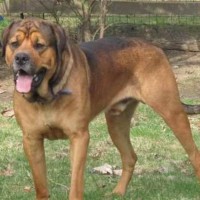
Bull Mastweiler |
|
He is not recognized by the F.C.I. |
Origin |
Great Britain <> Germany -> U.S.A. | |
Translation |
Francis Vandersteen |
A brief presentation of the Bull Mastweiler |
| The Bull Mastweiler is a very big dog, although it stops just short of being a giant. They are a popular cross between two powerful, protective dogs, the Bullmastiff and the Rottweiler. These dogs are family-oriented and naturally protective, but they are very powerful dogs and interactions with small children and animals must be closely supervised to avoid injury from abnormal aggression or, more likely, over-exuberant play behavior. These dogs tend to be fairly intelligent and easy to train, but they can sometimes lean towards the stubborn side, especially if their training is started late in life. This dog should not be confused with the Mastweiler, a cross between the Mastiff and the Rottweiler, which is generally a larger, more sedate hybrid. |
History of the Bull Mastweiler |
| The Bull Mastweiler is a popular hybrid, a cross between a Bullmastiff and a Rottweiler, two large, capable dogs that have traditionally been used as guard dogs and family pets. The Bull Mastweiler is less aggressive and more intelligent than the Bullmastiff, and calmer and less stubborn than the Rottweiler. |
A little of the Bullmastiff |
||
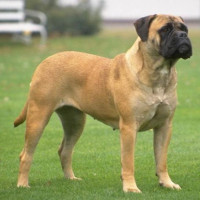
| The Bullmastiff is the only guard dog breed developed in England, originally a crossbreed itself, a combination of the English Bulldog and the English Mastiff. They were developed to guard land and game on the great English estates, protecting them from poachers and thieves. The Mastiff was too big and slow for the job, and the Bulldogs of the time lacked the restraint to prevent maiming by poachers. The Bullmastiff is a smaller, more agile breed than the Mastiff, and a larger, more controlled animal than the Bulldog of the time. | ||
 |
||
| Standard of the Bullmastiff | ||
A little of the Rottweiler |
||
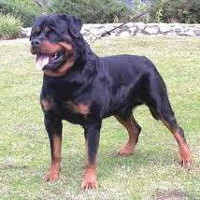
| The Rottweiler is a German dog, a breed old enough that its full origins are obscured by history, although most believe they were descendants of large Roman dogs that drove cattle for breeders and butchers, known as driving dogs, before 700 AD. They were named for the area in which they were developed, a site known as Rottweil for the abundance of red and Roman tiles unearthed there. Although their popularity waned during the Industrial Revolution in the 1800s, it was revived in the 1900s and they were often employed as police or military dogs. | ||
 |
||
| Standard of the Rottweiler |
Appearance of the Bull Mastweiler |
| This cross produces large to very large, well-muscled dogs with an almost square appearance, although the dogs are generally slightly longer than they are tall. Their heads are broad and flat, with round or almond-shaped eyes in dark brown that should have an alert expression, and their ears are V-shaped or triangular, resting high on the head and folding towards the front of the face or the sides of the head. They sport short, dense coats that can have a thick undercoat if they lean towards Rottweiler genetics. The Bull Mastweiler can take its coloration from either side of the family and can come in the traditional Bullmastiff colors of red, fawn or brindle, as well as mixtures of these colors, or they can lean towards the Rottweiler side equation and have black and rust coloration, black and mahogany or black and tan. Many have black, white or brindle markings, and dark masks are also common. |
Temperament of the Bull Mastweiler |
| The Bull Mastweiler was developed from two accomplished guard dogs, and as such also makes a fantastic watchdog. Like the two parent breeds, these dogs are alert, protective animals that are very devoted to their families. They are generally good with children, although interactions need to be closely supervised due to their large size and power, these dogs are playful and can accidentally knock over smaller children, especially if the child or dog is young. In some cases, protectors can become overprotective, and although they are unlikely to intentionally harm a child, they are more likely than other breeds to cause harm to an adult they consider a threat to a child in their family. To prevent aggressive behavior, early socialization and training are essential. This is an intelligent dog that has been bred to work closely with people, and although it can show a certain stubbornness, it tends to pick up training very quickly, especially if it's started when it's young. |
Needs and activities of the Bull Mastweiler |
| Although the Rottweiler is a very active breed, the Bullmastiff generally requires less exercise than average for a dog of its size, so 60 to 90 minutes of vigorous activity a day is usually sufficient. In addition to daily walks, these dogs are adept at tracking and karting, agility training, tracking and obedience. During your dog's formative years, it's important to shorten exercise sessions a little by splitting them up throughout the day, and to make sure your dog doesn't move roughly or jump from great heights, as this can damage bones and joints still in formation. This crossbreed prefers the roominess of a house, but if given 2-3 hours of extra exercise a day, it may be able to adapt to apartment living, as it doesn't tend to bark much. |
Maintenance of the Bull Mastweiler |
| These dogs are fairly easy to handle when it comes to grooming, as this hybrid's short coat is quite manageable. Although they require regular brushing with a curry comb or soft bristle brush to control shedding and distribute their body oils, monthly baths are generally adequate for these dogs. If your dog has inherited the folds or wrinkles commonly seen on Bullmastiffs, precautions should be taken regularly to ensure that the skin folds have not trapped moisture, as this can cause skin irritation and a foul odor may develop. They shed moderately all year round, although Bull Mastweilers with a double coat tend to shed more than those with a single coat. |



 English (United Kingdom)

Comments