Rottweiler

FCI standard Nº 147

Origin
Germany
Translation
Mrs. Chris Seidler
Revised by Peter Friedrich
Group
Group 2 Pinscher and Schnauzer type, Molossian type, Swiss Mountain- and Cattle Dogs
Section
Section 2.1 Molossian type, Mastiff type
Working
With working trial
Acceptance on a definitive basis by the FCI
Saturday 01 January 1955
Publication of the official valid standard
Friday 15 June 2018
Last update
Tuesday 24 July 2018
En français, cette race se dit
Rottweiler
Diese Norm ist in deutscher Sprache sichtbar
Rottweiler
En español, esta raza se dice
Rottweiler
In het Nederlands, wordt dit ras gezegd
Rottweiler

Usage

Companion, service and working dog.

Brief historical summary

The Rottweiler is considered to be one of the oldest dog breeds. Its origin goes back to Roman times. These dogs were kept as herder or driving dogs. They marched over the Alps with the Roman legions, protecting the humans and driving their cattle. In the region of Rottweil, these dogs met and mixed with the native dogs in a natural crossing. The main task of the Rottweiler now became the driving and guarding of the herds of cattle and the defence of their masters and their property. This breed acquired its name from the old free city of Rottweil and was known as the « Rottweil butcher’s dog’ ». The butchers bred this type of dog purely for performance and usefulness. In due course, a first rate watch and driving dog evolved which could also be used as a draught dog. When, at the beginning of the twentieth century, various breeds were needed for police service, the Rottweiler was amongst those tested. It soon became evident that the breed was highly suitable for the tasks set by police service and therefore they were officially recognized as police dogs in 1910.
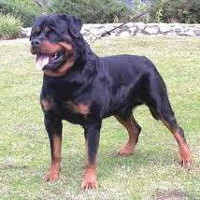
Rottweiler breeders aim at a dog of abundant strength, black coated with clearly defined rich tan markings, whose powerful appearance does not lack nobility and which is exceptionally well suited to being a companion, service, rescue and working dog.

General appearance

The Rottweiler is a medium to large size, stalwart dog, neither heavy nor light and neither leggy nor weedy. His correctly proportioned, compact and powerful build leads to the conclusion of great strength, agility and endurance.

Important proportions

The length of the body, measured from the point of the sternum (breast-bone) to the ischiatic tuberosity, should not exceed the height at the withers by, at most, 15 %.

Behaviour / temperament

The Rottweiler is good-natured, placid in basic disposition, very devoted, obedient, biddable and eager to work. His appearance is natural and rustic, his behaviour self-assured, steady and fearless. He reacts to his surroundings with great alertness and at the same time even-tempered.

Head

Cranial region

Skull
Of medium length, relatively broad between the ears. Forehead line moderately arched as seen from the side. Occipital bone well developed without being conspicuous. 
Stop
Stop relatively strong. Frontal groove not too deep.

Facial region

Nose
Well developed, more broad than round with relatively large nostrils, always black.
Muzzle
The foreface should appear neither elongated nor shortened in relation to the cranial region. The ratio between the length of the muzzle and the length of the skull is about 1 to 1,5.
Lips
Black, close fitting, corner of the mouth not visible, gum as dark as possible.
Nasal bridge
Straight nasal bridge, broad at base, moderately tapered.
Jaws and teeth
Upper and lower jaw strong and broad. Strong, complete dentition (42 teeth) with scissor bite, the upper incisors closely overlapping the lower incisors.
Cheeks
Zygomatic arches pronounced.
Eyes
Of medium size, almond-shaped, dark brown in colour. Eyelids close fitting.
Ears
Medium-sized, pendant, triangular, wide apart, set on high. With the ears laid forward close to the head, the skull appears o be broadened.

Neck

Strong, of fair length, well muscled, slightly arched, clean, free from throatiness, without excessive dewlap.

Body

Back
Straight, strong, firm.
Loin
Short, strong and deep.
Croup
Broad, of medium length, slightly rounded. Neither flat nor falling away.
Chest
Roomy, broad and deep (approximately 50 % of the shoulder height) with well developed forechest and well sprung ribs.
Side
Flanks not tucked up.

Tail

In natural condition, strong, level in extension of the upper line; while paying attention, when exited or while moving it can be carried upward in a light curve; at ease may be hanging. While positioned along the leg, the tail reaches approximately to the hocks or is a bit longer.

Limbs

Forequarters

Generality
Seen from the front, the front legs are straight and not placed too closely to each other. The forearm, seen from the side, stands straight and vertical. The slope of the shoulder blade is about 45 degrees to the horizontal.
Shoulders
Well laid back.
Upper arm
Close fitting to the body.
Forearm
Strongly developed and muscular.
Pastern
Slightly springy, strong, not steep.
Forefeet
Round, tight and well arched; pads hard; nails short, black and strong.

Hindquarters

Generality
Seen from behind, legs straight and not too close together. When standing free, obtuse angles are formed between the dog’s upper thigh and the hip bone, the upper thigh and the lower thigh, and the lower thigh and metatarsal.
Upper thigh
Moderately long, broad and strongly muscled.
Lower thigh
Long, strongly and broadly muscled, sinewy.
Hock
Sturdy, well angulated hocks; not steep.
Hind feet
Slightly longer than the front feet. Toes strong, arched, as tight as front feet.

Gait and movement

The Rottweiler is a trotting dog. In movement the back remains firm and relatively stable. Movement harmonious, steady, full of energy and unrestricted, with good stride.

Skin

Skin on the head: overall tight fitting. When the dog is alert, the forehead may be slightly wrinkled.

Coat

Hair
The coat consists of a top coat and an undercoat. The top coat is of medium length, coarse, dense and flat. The undercoat must not show through the top coat. The hair is a little longer on the hindlegs.
Colour
Black with clearly defined markings of a rich tan on the cheeks, muzzle, throat, chest and legs, as well as over both eyes and under the base of the tail.

Size and weight

Height at withers
For males is 61 - 68 cm. 61 - 62 cm is small, 63 - 64 cm medium height. 65 - 66 cm is large - correct height 67 - 68 cm very large.
For bitches is 56 - 63 cm. 56 - 57 cm is small, 58 - 59 cm medium height. 60 - 61 cm is large - correct height 62 - 63 cm very large.
Weight
For males is 50 kg. For bitches is approximately 42 kg.

Faults

• Any departure from the foregoing points should be considered a fault and the seriousness with which the fault should be regarded should be in exact proportion to its degree and its effect upon the health and welfare of the dog and its ability to perform its traditional work.
• Faults listed should be in degree of seriousness.

General faults

 General appearance : Light, weedy, leggy appearance; light in bone and muscle.
 Head : Hound-type head; narrow, light, too short, long, coarse or excessively molossoid head; excessively broad skull, (lack of stop, too little stop or too strong stop); very deep frontal groove.
 Foreface : Long, pointed or too short muzzle (any muzzle shorter than 40 percent of the length of the head is too short); split nose; roman nose (convex nasal bridge) or dish-faced (concave nasal bridge); acquiline nose; pale or spotted nose (butterfly nose).
 Lips : Pendulous, pink or patchy; corner of lips visible.
 Jaws : Narrow lower jaw.
 Bite : Pincer bite; molars of the underjaw not standing in one line.
 Cheeks : Strongly protruding.
 Eyes : Light, deep set; also too full and round eyes; loose eyelids.
 Ears : Set on too low or too high, heavy, long, slack or turned backwards; also flying ears or ears not carried symmetricaly.
 Neck : Too long, thin, lacking muscle; showing dewlap or throaty.
 Body : Too long, too short or too narrow.
 Back : Too long, weak; sway back or roach back.
 Croup : Too sloping, too short, too flat or too long.
 Chest : Flat-ribbed or barrel-shaped; too narrow behind.
 Tail : Set on too high or too low.
 Forequarters : Narrow, crooked or not parallel standing front legs; steep shoulder placement; loose or out at elbow; too long, too short or too straight in upper arm, weak or steep pastern; splayed feet; too flat or too arched toes; deformed toes; light coloured nails.
 Hindquarters : Flat thighs, hocks too close, cow hocks or barrel hocks; joints with too little or too much angulation; dewclaws.
 Skin : Wrinkles on head.
 Coat : Soft, too short or long; wavy coat; lack of undercoat.
 Colour : Markings of incorrect colour, not clearly defined; markings which are too spread out.

Serious faults

 General appearance : Too molossoid type and heavy general appearance.
 Skin : Skin at the head strongly wrinkled, strong wrinkles in the area of the forehead, the muzzle and the cheeks, strong dewlap.
 Gait : Sluggish action while trotting.

Disqualifying faults

 Behaviour : Aggressive or overly shy dogs; anxious, shy, cowardly, gun-shy, vicious, excessively suspicious, nervous animals.
 General appearance : Distinct reversal of sexual type, feminine dogs or masculine bitches.
 Teeth : Overshot or undershot bite, wry mouth; lack of one incisive tooth, one canine, one premolar or one molar.
 Eyes : Entropion, ectropion, yellow eyes, different coloured eyes.
 Tail : Kink tail, ring-tail, with strong lateral deviation, natural bobtail.
 Hair : Definitely long or wavy coat.
 Colour : Dogs which do not show the typical Rottweiler colouring of black with tan markings; white markings.

NB :

• Any dog clearly showing physical or behavioural abnormalities shall be disqualified.
• The above mentioned faults when occurring to a highly marked degree or frequently are disqualifying.
• Male animals should have two apparently normal testicles fully descended into the scrotum.
• Only functionally and clinically healthy dogs, with breed typical conformation should be used for breeding.

Bibliography

https://www.fci.be/


Detailed history

The Rottweiler, formerly called Rottweiler Metzgerhund (Rottweil's butcher's dog), today the "Rott" for its fans, is the very type of the drover's dog, to its highest degree of perfection. Improved and selected by the Germans, it is today the most widespread and most appreciated Bouviers in the world.

But these are not the only reasons for glory of the German Bouvier. Here and there, its numbers become as numerous as those of the Boxer or Dobermann, and it begins to overshadow the universal German Shepherd. From now on, he is, as well as the aforementioned races, one of the headliners at the box office of the guard and defense races.

What a turnaround for a dog that went unnoticed for many centuries. In his country, it has even been said that almost nothing was known about his ancient history. Until the 1930s, it was virtually unknown outside Germany, and it was not until the sixties that it was truly established in the Anglo-Saxon countries, countries known for their influence on the renown of the races.

An encyclopedia, published in 1971, noted that with 400 births annually in the United States and 200 in Great Britain, the German Mountain Dog was now "guaranteed to survive". Since then, the breed has indeed survived well in these countries, since its number of births has been multiplied by one hundred and fifty respectively. In France, the first specimens appeared only twenty years ago. This long indifference, followed by this belated recognition, is easily explained.

The Rottweiler comes from the "mastiff", a word that we accept by removing, beforehand, the annoying connotation he has taken in French, because this is a dog "strong race", directly from Molosses bred for combat and war, but assigned to more peaceful tasks, for which unshakable courage, power, and agility were indispensable. These tasks were the conduct of cattle, whether on the farm, on the road or with butchers. If this molossoid inheritance was predominant in this dog, because of the work required, no doubt that the requirements of mobility, endurance and receptivity to dressage led to crossbreeding with shepherd breeds, and finally gave him a certain diversity of appearance.

This somewhat common and variable appearance and perhaps the modesty of its owners have led, in dog lovers over the centuries and among the first dogs about a hundred years ago, an almost universal ignorance of this type of dog. . We will not find it in the form of a statue, nor painted by a famous artist, nor described by some great writer. When we were interested in the mastiffs, it was first to the Dogs and mountain dogs, whose templates made an impression, and not to their country derivatives, whose usefulness was yet daily.

And yet, if the German Bouvier has been neglected for so long, it should not be concluded that its origins are indeterminate and obscure. His ancestors are known, and even famous: they are the Roman Molossians, certainly not the Pugnaces Canes who were launched against wild animals in the arena or against the barbarians, but those who kept and led the herds whose armies were accompanied, that is to say, as has been said above, the "mastiffs". Mastiff, it may be recalled, comes from the Latin mansuetus, tamed. The ancestors of the Rottweiler were tamed Molosses. Of course, these mastiffs were able to keep the encampments, a function they actually filled. But the Roman legions, true itinerant cities whose organization is no longer to boast, were followed; stewardship obliges; important herds, hence the need for many safe and effective Cattle Dogs.

Before attacking the restless tribes of Germania, these legions colonized Helvetia by building a network of communication routes throughout the country. Starting from the Gotthard Pass, one reached, after passing the Furka Pass, the present canton of Berne and the Entlebuch; another was heading north by Aargau and Schaffhausen, a third was eastward to the Appenzell. Through these names, we find the regions known to have been the cradle of three of the four Swiss Bouviers, the Bernese, the Entlebucher and the Appenzellois. These dogs are noticeably different from the Rott, but a wise eye can find many things in common. As for the fourth Swiss Bouvier, the Great Swiss Mountain Dog, it has not received a geographically more precise name because of its much wider distribution, and it is also he who is closest to the German Bouvier. As these diverse lineages became established, the Romans pursued further. In particular, they established a vast, permanent military camp at Rottweil (now Baden-Württemberg), which they employed to control the boiling Germans, failing to colonize them. It was dog-dogs that were there that the Rottweiler goes down.

In the Middle Ages, Rottweil became an important commercial center, from the Swiss mountains of course, but also from France and from as far away as Hungary. It is not surprising that cattle traders and butchers have formed strong corporations in Rottweil, and that Bouviers have proliferated in the area. In fact, by the eighteenth century, when the city was the most prosperous, Rottweil's butcher's dogs had gained some renown. However, it can not be said that they aroused great interest among dog lovers of the second half of the nineteenth century. The great naturalist AF Brehm, the "German Buffon", who described many types of dogs of his time, does not mention Rottweil's dogs. Only in the specialized literature of the time, Richard Strebel, in a work published in Munich in 1905, Die Deutscher Hunde und Ihre Abstammung (The German Dog and his genealogy), evokes them quickly. This great lover of molosses connects the Rottweiler Metzgerhund to the Bouviers of Switzerland, although he sees it as a link between them and the Bouviers of Bavaria, which finally only reached a breed status under their hard-boiled variety. (the Giant Schnauzer).

Like many other cattle dogs, the Rottweil dog could have never been on the dog scene. In 1900, in the town of Rottweil, there was only one dog worthy of representing the local type, for the simple reason that there, as in France or England, the driving of large herds was It was already a thing of the past, because it impeded more and more traffic, and the railway had taken over. As for the town of Rottweil, it no longer attracted merchants. In short, the once famous race threatened to disappear.

Fortunately, at the beginning of the century, some resolute connoisseurs created a race club and hastened to define a standard, which was reproduced in 1904 in the monumental work, The Races of Dogs, the Earl of Bylandt. The Rottweiler was then given a decisive boost when the German army experts were interested in the canine species. Thus, like the German Shepherd, the Boxer and the Dobermann, he was asked to contribute to the intense preparations for war. From 1912, Rottweil's rough butcher's dog became the subject of selection for almost exclusively military purposes.

This dog will remain little known little outside his country of origin. It will not arrive in the United States until 1930, and five years later, the American Kennel Club will judge it sufficiently established to give it an official place. In Great Britain, this recognition will not occur until 1966, when the first specimens were presented at the great Cruft exhibition in 1936. France, as we have seen, will take longer to react, since Livre des origines français will write the first subject in 1970.

This start to the least laborious can be explained by the evolution that had previously had to undergo the race. At the beginning of the century, referring to the illustrations contained in Bylandt's work, the Rottweiler resembled, roughly speaking, the Boxer: it showed a similar jig, neither heavy nor light, but a less retracted facies, lines less elegant, with ears left natural, in short, his appearance was rather common, rustic, and especially without the extraordinary power which is now his; impression confirmed by the mention of its weight (about thirty kilos).

In eighty years, the Rott gained twenty pounds. You will also notice the taurine neckline, the exceptional chest width of today's specimens. It now has all the power of the Dogue combined with speed of action and resistance close to those of much lighter breeds. As has often been noted, he is the most powerful of all dogs subjected to work. The German breeders have indeed managed this tour de force to keep the deterrent power of the Dogue, his confidence, his unwavering courage, his stoicism in the face of pain, his tenacity, without ceasing to employ him at work, to meet the demands of its users, armies, police, professional or sport trainers.

Thus, his reputation does not so much to his measurements or to his forbidding and serious aspect than to utilitarian references. Let us judge. It has been adopted by the German police and army, including anti-demonstration brigades; he is still the most employed by the Austrian police; he is used in several American prisons; finally, it is integrated with paratroopers commandos in Brazil. He is therefore not a joker.

Moreover, he can also be an avalanche dog, a disaster dog, he can practice all the sports disciplines, and he is very appreciated as intervention dog and for the surveillance of the warehouses and the premises: one will admit that his possibilities of use are very extensive. Recently, one has even tested his abilities to find truffles. It is conceivable that, if only for its safer side, the individual is tempted to adopt such a dog. The Rottweiler possesses great qualities, but it is necessary to warn the neophyte against the reckless choice of a specimen of this race.

There is not much to see between this dog and a shepherd breed, although they may have substantially the same areas of use. The Rott is a mastiff, and a mastiff, as Raymond Trinquet rightly said, it is "like these weapons that one shows not to have to use them".

In general, the modern breeding of the Dogues has turned towards the selection of extremely powerful dogs, often of large size, with very forbidding facies, and which are therefore in themselves sufficiently dissuasive so that we have not never to solicit their fighting spirit, their tenacity, their courage. The specialists of the Dogues also strongly advise a training in the defense of these dogs and their effective use in this task, because few people would be able to have them perfectly in hand in all circumstances. But if he has kept the psychic characteristics of the Dogue, the Rottweiler is at the same time a working dog, which can not be put in all hands.

That is why, before defining his personality, it is necessary to insist on one point: he needs a master who suits him. This master must naturally have an undeniable authority and, without necessarily being a dog specialist, have a little experience. In addition, it is preferable that he is sensitized to the problems of training. No doubt, a person who really knows how to go about it could choose a Rott from the start, but in many cases it is better to have previously handled one or more dominant dogs. This dog must be able to be controlled, in any case if it is question of a male, who, except exception, is always a truly dominant animal. The female is much more tolerant, less independent, and fits better into a family life. Moreover, she instinctively has a protective feeling developed with regard to children. There are few races in which the difference between the sexes is so marked: the Rottweiler really has two publics, that of the male and that of the female.

Once is not customary, we will first mention the main flaw of the breed: the Rottweiler does not tolerate other dogs well. It is hardly possible to have several Rottweilers at home, except, of course, if it is a couple, or to make the Rott coexist with any other dog. When walking, it is also advisable to keep it firmly on a leash and sometimes to choose quiet routes. It may be objected that the other dogs will not necessarily be so dominant, which would be the very negation of this notion: it is only a leader if there are others. It is true, however, that the Rottweiler breeding has focused on selecting the most dominant subjects and that this characteristic is therefore specific to the breed. In other words, a Rott can submit to a man who has enough grip, but he will rarely support that another dog can dictate his law without breaking it. And he has an innate sense of combat.

If a single word is to define the German Bouvier's temperament, we say that he is of the "choleric" type. This does not mean that the mustard goes up in the nose for the slightest peccadillo. On the contrary, it is strongly emphasized that he is extremely calm and peaceful. He rarely barks (that's why, when he gives voice, it is necessary to go see). Moreover, he knows how to let his master go about his business. But to excite it, to attack it (or rather to attack one of those under its charge), will then mount a terrible, irresistible anger; he will see red and nothing and no one will be able to stop him, because he is inaccessible to fear, makes no mention of threats or blows.

This temperament is particularly noticeable when one is brought to work with him the tests of biting. The training instructor can shake a cuff in front of him, the dog will have no interest in biting for fun. But if his master is attacked, then, there, the Rott will put all his heart. So much so that it will become "undetectable" if one resists it: the problem will be even to obtain that it ceases. The Rottweiler is considered a very big "biter": his jaw is a real vise that takes the "suit" full mouth and does not let go, whatever the efforts of the man of attack.

But, rather than wanting to quickly experience these qualities, it must first go through many training sessions obedience (the "flat" in the jargon. Trainers, sitting, lying, standing, walking on a leash, without a leash , object report, refusal of bait, etc.). Then we will approach the mordant phase, in a sporting spirit, avoiding this mordant "choleric" which is natural to him but which prevents any further progression. A good training specialist Rott is very useful, even essential, to take advantage of this dog. Of course, it should not be applied methods developed for shepherds breeds (which form the majority of canine on the training grounds). It is not a dog early (it does not really mature until the third year). The trainer must be as patient as firm, proceed gradually avoiding saturation. But, as is often said, "what the Rottweiler has learned, he knows."

This lack of precocity does not mean that his education should be started late. On the contrary, as he is not submissive in nature, that he demonstrates a great independence and a tendency to want to decide for himself what to do or not to do, it is better take it in hand at the age of three or four months. But, anyway, we will not make him do anything.

Contrary to what one might think, this tough dog, Germanic in addition, must not receive training "the hard way", be the subject of a quasi-military discipline. He is not of the sensitive kind, although his education requires a good deal of subtlety. To constantly mingle an authoritative manliness and a little sweetness, to alternate burlests and caresses, especially never to point him out, to bully him, to give him the impression of being unjust, such are the indispensable precepts to follow.

Admittedly, the German Bouvier is able to shine in all disciplines, but its imposing size undoubtedly disadvantage in some (the Ring, for example). It is also strongly advised to watch his line closely so that he does not fall asleep. The international program (RCI), very close to the German events (Schutzhund), suits him especially, but also the tracking, which allows him to express his sense of initiative (and his highly developed olfactory abilities). There is no doubt that the Rottweiler was created by and for dressage enthusiasts. In this field, it presents a very interesting weight / aptness ratio. The proportion of subjects who have successfully passed their Defense Certificate is quite remarkable, and this dog is still highly appreciated by professional users.

However, it is not necessary to train him to have an effective dog. Naturally, a solid education will make it manageable in all circumstances and in all places. This born protector is a quiet force on which one can always count, who does not bark needlessly, who is waiting for the last end to act. Its harsh appearance indisputably imposes: no one will have the audacity to cross the gate if a Rott stands behind, even if it remains calm. He has such a determined way of planting his dark and assured gaze into that of the visitor.

The Rottweiler is a very hardy dog, which generally enjoys excellent health: its usual longevity is in a good average (a dozen years), and, despite its weight, it is not affected very often by coxo-femoral dysplasia (the radiological tests carried out in France prove it). In any case, the buyer must demand a puppy from spawners free of dysplasia. Without the need for a lot of exercise, the Rott will definitely appreciate the opportunity to work out in a garden.

Finally, it is not advisable, except in special cases, to buy an adult trained. It is common, especially from Germany, but it is worth noting that this practice allows to value (and commercialize) a subject of average quality. This dog may be a good bodyguard, but above all it will be a "convention" animal; the opposite of a real companion. It is better to get a young person of three or four months and teach him the basics of canine education without delay, in order to make him a member of the family.

This portrait is a little dark and hard. But the Rott is an eminently serious dog, which must never be acquired on a whim, to impress the gallery, or because we urgently need security.

Comments

Latest page updates

  • Toy Trawler Spaniel

    Toy Trawler Spaniel He is not recognized by the F.C.I. Origin United Kingdom Translation Francis Vandersteen En français, cette race se dit Epagneul Miniature Trawler Diese Norm ist in deutscher Sprache sichtbar Miniatur-Trawler-Spaniel En español, esta raza se dice Spaniel de Trawler en miniatura In het Nederlands, wordt dit ras gezegd Miniatuur...
  • Cão de Fila da Terceira

    Cão de Fila da Terceira He is not recognized by the F.C.I. Origin Terceira Island in the Azores Translation Francis Vandersteen The Terceira Mastiff (Portuguese : Cão de Fila da Terceira) is a local Portuguese dog breed, also known as the Rabo Torto (rabo = tail, torto = twisted). Neither the Fédération Cynologique Internationale nor the Local...
  • Talbot Hound

    Talbot Hound He is not recognized by the F.C.I. Origin France Translation Francis Vandersteen En français, cette race se dit Chien de Talbot Diese Norm ist in deutscher Sprache sichtbar Talbot-Hund En español, esta raza se dice Sabueso Talbot In het Nederlands, wordt dit ras gezegd Talbot-hond This breed is also known as Talbot BloodhoundFrench...
  • English Staghound

    English Staghound He is not recognized by the F.C.I. Origin England Translation Francis Vandersteen En français, cette race se dit Staghound anglais Diese Norm ist in deutscher Sprache sichtbar Englischer Staghound En español, esta raza se dice Staghound inglés In het Nederlands, wordt dit ras gezegd Engelse Staghound   The Staghound is an extinct...
  • Southern Hound

    Southern Hound He is not recognized by the F.C.I. Origin Great Britain Translation Francis Vandersteen En français, cette race se dit Chien du Sud Diese Norm ist in deutscher Sprache sichtbar Südlicher Laufhund En español, esta raza se dice Sabueso del sur In het Nederlands, wordt dit ras gezegd Zuidelijke Hond   The Southern Hound was a large...
  • St. John's Water Dog

    St. John's Water Dog He is not recognized by the F.C.I. Origin Canada Translation Francis Vandersteen En français, cette race se dit Chien d’eau de St. John's Diese Norm ist in deutscher Sprache sichtbar St. John's Wasserhund En español, esta raza se dice Perro de aguas de San Juan In het Nederlands, wordt dit ras gezegd St. John's Water Dog The St...
  • Rache Hound

    Rache Hound He is not recognized by the F.C.I. Origin Middle Ages Translation Francis Vandersteen En français, cette race se dit Chien courant Rache Diese Norm ist in deutscher Sprache sichtbar Rache-Laufhund En español, esta raza se dice Sabueso Rache In het Nederlands, wordt dit ras gezegd Rache-hond This breed is also known as RacchRachRatch   The term...
  • Welsh Grey Sheepdog

    Welsh Grey Sheepdog He is not recognized by the F.C.I. Origin Wales Translation Francis Vandersteen En français, cette race se dit Chien de berger gallois gris Diese Norm ist in deutscher Sprache sichtbar Waliser Grauer Schäferhund En español, esta raza se dice Pastor Gris Galés In het Nederlands, wordt dit ras gezegd Welsh Grey Herdershond This breed is...
  • Old Croatian Sighthound

    Old Croatian Sighthound He is not recognized by the F.C.I. Origin Croatia Translation Francis Vandersteen En français, cette race se dit Lévrier croate ancien Diese Norm ist in deutscher Sprache sichtbar Alter kroatischer Windhund En español, esta raza se dice Viejo lebrel croata In het Nederlands, wordt dit ras gezegd Oude Kroatische Windhond This...
  • Norman Hound

    Norman Hound He is not recognized by the F.C.I. Origin France Translation Francis Vandersteen En français, cette race se dit Chien normand Diese Norm ist in deutscher Sprache sichtbar Normannischer Laufhund En español, esta raza se dice Sabueso Normando In het Nederlands, wordt dit ras gezegd Normandische Brak   Little is known about the origins of...
  • Moscow Water Dog

    Moscow Water Dog He is not recognized by the F.C.I. Origin Russia Translation Francis Vandersteen En français, cette race se dit Chien d'eau de Moscou Diese Norm ist in deutscher Sprache sichtbar Moskauer Wasserhund En español, esta raza se dice Perro de agua de Moscú In het Nederlands, wordt dit ras gezegd Moskou-waterhond This breed is also...
  • Tracking Hound

    Tracking Hound He is not recognized by the F.C.I. Origin Middle Ages Translation Francis Vandersteen En français, cette race se dit Chien pisteur Diese Norm ist in deutscher Sprache sichtbar Spürhund En español, esta raza se dice Sabueso de rastro In het Nederlands, wordt dit ras gezegd Speurhond This breed is also known as LimerLymerLyam...
  • Laconian

    Laconian He is not recognized by the F.C.I. Origin Ancient Laconia, Greece Translation Francis Vandersteen En français, cette race se dit Laconien Diese Norm ist in deutscher Sprache sichtbar Lakonier En español, esta raza se dice Laconio In het Nederlands, wordt dit ras gezegd Laconisch This breed is also known as SpartanCastorian   The Laconian is an...
  • Halls Heeler

    Halls Heeler He is not recognized by the F.C.I. Origin Australia Translation Francis Vandersteen En français, cette race se dit Halls Heeler Diese Norm ist in deutscher Sprache sichtbar Halls Heeler En español, esta raza se dice Halls Heeler In het Nederlands, wordt dit ras gezegd Halls Heeler   The Halls Heeler is the presumed ancestor of two...
  • Dogo Cubano

    Dogo Cubano He is not recognized by the F.C.I. Origin Cuba Translation Francis Vandersteen The Dogo Cubano, also known as the Cuban Dogue, Cuban Bloodhound and Cuban Mastiff, is an extinct breed of dog from Cuba. It was of the Bullmastiff type and was used for bull and dog fighting. The breed was introduced to Cuba to capture runaway slaves...
  • Dalbo Dog

    Dalbo Dog He is not recognized by the F.C.I. Origin Sweden Translation Francis Vandersteen En français, cette race se dit Chien de Dalbo Diese Norm ist in deutscher Sprache sichtbar Dalbo-Hund En español, esta raza se dice Perro Dalbo In het Nederlands, wordt dit ras gezegd Dalbo-hond This breed is also known as DalbohundDalsland Mastiff   Icelandic...
  • Cordoba Fighting Dog

    Cordoba Fighting Dog He is not recognized by the F.C.I. Origin Argentina Translation Francis Vandersteen En français, cette race se dit Chien de combat de Cordoue Diese Norm ist in deutscher Sprache sichtbar Córdoba-Kampfhund En español, esta raza se dice Perro de pelea de Córdoba In het Nederlands, wordt dit ras gezegd Cordoba-vechthond This breed is...
  • Celtic Greyhound

    Celtic Greyhound He is not recognized by the F.C.I. Origin Celtic Mythology Translation Francis Vandersteen En français, cette race se dit Lévrier celte Diese Norm ist in deutscher Sprache sichtbar Keltische Windhund En español, esta raza se dice Lebrel celta In het Nederlands, wordt dit ras gezegd Keltische windhond   The Celtic Greyhound is an...
  • Belgian Mastiff

    Belgian Mastiff He is not recognized by the F.C.I. Origin Belgium Translation Francis VandersteenOrigin SRSH-KMSH - Belgian Royal Canine SocietyAuthentic language FR Group Group 2 : Pinscher and Schnauzer - Molossoid and Swiss Mountain and Cattle Dogs Section Section 2.1 : Molossoids, mastiff type Working Without working trial En français, cette...
  • Argentine polar dog

    Argentine polar dog He is not recognized by the F.C.I. Origin Argentina Translation Francis Vandersteen The Argentine polar dog (perro polar argentino) was a breed of Argentine dog that is now extinct. Argentine polar dogs were developed by the Argentine army to provide sled dogs for their Antarctic bases. The breed was the result of a cross...
  • Alaunt

    Alaunt He is not recognized by the F.C.I. Origin Central Asia Translation Francis Vandersteen This breed is also known as Kavkaz AlauntCaucasian AlauntAlan DoggePersian AlauntContinental AlauntEnglish AlauntFrench AlauntSpanish AlauntAlan DogArnaut Dogge The legendary Alaunt is one of the most important Molosse breeds in history, but also one of...
  • Small Dutch Hound

    Small Dutch Hound He is not recognized by the F.C.I. Origin The Netherlands Translation Francis Vandersteen En français, cette race se dit Petit Chien courant néerlandais Diese Norm ist in deutscher Sprache sichtbar Kleiner niederländischer Brackenhund En español, esta raza se dice Sabueso holandés pequeño In het Nederlands, wordt dit ras gezegd Kleine...
  • Sri Lankan Hound

    Sri Lankan Hound He is not recognized by the F.C.I. Origin Sri Lankan Translation Francis Vandersteen En français, cette race se dit Chien courant du Sri Lanka Diese Norm ist in deutscher Sprache sichtbar Sri-Lanka-Hund En español, esta raza se dice Sabueso de Sri Lanka In het Nederlands, wordt dit ras gezegd Sri Lankaanse Brak This breed is also...
  • Bulgarian Tricolour Hound

    Bulgarian Tricolour Hound He is not recognized by the F.C.I. Origin Bulgaria Translation Francis Vandersteen En français, cette race se dit Chien courant tricolore bulgare Diese Norm ist in deutscher Sprache sichtbar Bulgarischer Dreifarbiger Laufhund En español, esta raza se dice Sabueso tricolor búlgaro In het Nederlands, wordt dit ras gezegd Bulgaarse...
  • Međimurje Small Dog

    Međimurje Small Dog He is not recognized by the F.C.I. Origin Northwestern Croatia Translation Francis Vandersteen En français, cette race se dit Petit chien du Međimurje Diese Norm ist in deutscher Sprache sichtbar Međimurje-Kleinhund En español, esta raza se dice Perro pequeño de Međimurje In het Nederlands, wordt dit ras gezegd Međimurje-hondje This...
  • Serbian Yellow Hound

    Serbian Yellow Hound He is not recognized by the F.C.I. Origin Serbia (Balkans, Southeast Europe) Translation Francis Vandersteen En français, cette race se dit Chien jaune serbe Diese Norm ist in deutscher Sprache sichtbar Serbischer Gelber Laufhund En español, esta raza se dice Sabueso Amarillo Serbio In het Nederlands, wordt dit ras gezegd Servische...
  • Gotland Hound

    Gotland Hound He is not recognized by the F.C.I. Origin Sweden Translation Francis Vandersteen En français, cette race se dit Chien de chasse de Gotland Diese Norm ist in deutscher Sprache sichtbar Gotlandhund En español, esta raza se dice Sabueso de Gotland In het Nederlands, wordt dit ras gezegd Gotlandhond This breed is also known as Gotland...
  • Westerwald Mountain Dog

    Westerwald Mountain Dog He is not recognized by the F.C.I. Origin Germany Translation Francis Vandersteen En français, cette race se dit Bouvier du Westerwald Diese Norm ist in deutscher Sprache sichtbar Westerwalder Sennenhund En español, esta raza se dice Perro de Montaña de Westerwald In het Nederlands, wordt dit ras gezegd Westerwaldse...
  • Carnia Hound

    Carnia Hound He is not recognized by the F.C.I. Origin Italy Translation Francis Vandersteen En français, cette race se dit Chien courant de Carnia Diese Norm ist in deutscher Sprache sichtbar Carnia-Hund En español, esta raza se dice Sabueso de Carnia In het Nederlands, wordt dit ras gezegd Carnia-hond This breed is also known as Segugio Carnico   The...
  • Kemmer Feist

    Kemmer Feist He is not recognized by the F.C.I. Origin Southern United States Translation Francis Vandersteen En français, cette race se dit Kemmer Feist Diese Norm ist in deutscher Sprache sichtbar Kemmer Feist En español, esta raza se dice Kemmer Feist In het Nederlands, wordt dit ras gezegd Kemmer Feist   The Kemmer Feist originates from the...
  • Alpine Spaniel

    Alpine Spaniel He is not recognized by the F.C.I. Origin Switzerland Translation Francis Vandersteen En français, cette race se dit Epagneul Alpin Diese Norm ist in deutscher Sprache sichtbar Alpenspaniel En español, esta raza se dice Spaniel Alpino In het Nederlands, wordt dit ras gezegd Alpenspaniël   Alpine Spaniels were bred by canons in Alpine...
  • Alpine Mastiff

    Alpine Mastiff He is not recognized by the F.C.I. Origin Switzerland Translation Francis Vandersteen En français, cette race se dit Mâtin alpin Diese Norm ist in deutscher Sprache sichtbar Alpenmastiff En español, esta raza se dice Mastín Alpino In het Nederlands, wordt dit ras gezegd Alpenmastiff   The Alpine Mastiff was an ancient, giant working...
  • Hairless Chihuahua

    Hairless Chihuahua He is not recognized by the F.C.I. Origin Mexico Translation Francis Vandersteen En français, cette race se dit Chihuahua nu Diese Norm ist in deutscher Sprache sichtbar Nackter Chihuahua En español, esta raza se dice Chihuahua sin pelo In het Nederlands, wordt dit ras gezegd Haarloze Chihuahua   The Chihuahua is a small, lively,...
  • Argentine Pila

    Argentine Pila He is not recognized by the F.C.I. Origin Argentina Translation Francis Vandersteen En français, cette race se dit Pila Argentin Diese Norm ist in deutscher Sprache sichtbar Argentinischer Pila En español, esta raza se dice Pila Argentino In het Nederlands, wordt dit ras gezegd Argentijnse Pila This breed is also known as Perro...
  • Ecuadorian Hairless Dog

    Ecuadorian Hairless Dog He is not recognized by the F.C.I. Origin Ecuador Translation Francis Vandersteen En français, cette race se dit Chien nu équatorien Diese Norm ist in deutscher Sprache sichtbar Ecuadorianischer Nackthund En español, esta raza se dice Perro sin pelo ecuatoriano In het Nederlands, wordt dit ras gezegd Ecuadoriaanse...
  • Tesem

    Tesem He is not recognized by the F.C.I. Origin Egypt Translation Francis Vandersteen En français, cette race se dit Tesem Diese Norm ist in deutscher Sprache sichtbar Tesem En español, esta raza se dice Tesem In het Nederlands, wordt dit ras gezegd Tesem   The Tesem was a hunting dog from ancient Egypt. Now extinct, its ancestry is believed to...
  • Salish Woolly Dog

    Salish Woolly Dog He is not recognized by the F.C.I. Origin British Columbia, Canada Translation Francis Vandersteen En français, cette race se dit Chien laineux Salish Diese Norm ist in deutscher Sprache sichtbar Salish-Wollhund En español, esta raza se dice Perro Lanudo Salish In het Nederlands, wordt dit ras gezegd Salish wollige hond This...
  • Tierra del Fuego Dog

    Tierra del Fuego Dog He is not recognized by the F.C.I. Origin South America Translation Francis Vandersteen En français, cette race se dit Chien de Terre de Feu Diese Norm ist in deutscher Sprache sichtbar Feuerlandhund En español, esta raza se dice Perro de Tierra del Fuego In het Nederlands, wordt dit ras gezegd Tierra del Fuego-hond This...
  • Techichi

    Techichi He is not recognized by the F.C.I. Origin Mexico Translation Francis Vandersteen En français, cette race se dit Techichi Diese Norm ist in deutscher Sprache sichtbar Techichi En español, esta raza se dice Techichi In het Nederlands, wordt dit ras gezegd Techichi   The Techichi was an indigenous dog of Mesoamerica, specifically associated...
  • Hare Indian Dog

    Hare Indian Dog He is not recognized by the F.C.I. Origin Canada Translation Francis Vandersteen The Hare Indian Dog is an extinct domesticated dog; possibly a breed of domestic dog, hybrid coyote/dog or domestic coyote; previously found and originally bred in northern Canada by the Hare Indians for hunting. It had the speed and certain...
  • Tahitian Dog

    Tahitian Dog He is not recognized by the F.C.I. Origin Tahiti Translation Francis Vandersteen En français, cette race se dit Chien de Tahiti Diese Norm ist in deutscher Sprache sichtbar Tahiti-Hund En español, esta raza se dice Perro Tahitiano In het Nederlands, wordt dit ras gezegd Tahitiaanse hond   The Tahitian Dog is an extinct Polynesian breed,...
  • Polynesian Dog

    Polynesian Dog He is not recognized by the F.C.I. Origin Polynesia Translation Francis Vandersteen En français, cette race se dit Chien polynésien Diese Norm ist in deutscher Sprache sichtbar Polynesischer Hund En español, esta raza se dice Perro polinesio In het Nederlands, wordt dit ras gezegd Polynesische hond   The term "Polynesian dog" does...
  • Marquesan Dog

    Marquesan Dog He is not recognized by the F.C.I. Origin Marquesas Islands Translation Francis Vandersteen En français, cette race se dit Chien des Marquises Diese Norm ist in deutscher Sprache sichtbar Marquesas-Hund En español, esta raza se dice Perro Marquesano In het Nederlands, wordt dit ras gezegd De Marquesaanse hond This breed is also...
  • Kuri

    Kuri He is not recognized by the F.C.I. Origin New Zealand, between "Waikava" & Mataura plains, Catlins Translation Francis Vandersteen This breed is also known as Maori dog Kurī, or Pacific dog, were a unique breed, brought to Aotearoa New Zealand by ancestors of Māori. These animals were prized – not necessarily as friends, but as valuable...
  • Chiribaya Dog

    Chiribaya Dog He is not recognized by the F.C.I. Origin Peru Translation Francis Vandersteen The Chiribaya Dog (perro Chiribaya) or Peruvian Shepherd Dog (perro pastor Peruano) was a pre-Columbian breed of dog from southwestern Peru, identified by the 42 mummies discovered by anthropologist Sonia Guillén Oneglio in the Ilo district, Moquegua...
  • Philippine Forest Dog

    Philippine Forest Dog He is not recognized by the F.C.I. Origin Philippines Translation Francis Vandersteen En français, cette race se dit Chien des forêts des Philippines Diese Norm ist in deutscher Sprache sichtbar Philippinischer Waldhund En español, esta raza se dice Perro del Bosque Filipino In het Nederlands, wordt dit ras gezegd Filipijnse...
  • Lai Dog

    Lai Dog He is not recognized by the F.C.I. Origin Vietnam Translation Francis Vandersteen En français, cette race se dit Chien de Lai Diese Norm ist in deutscher Sprache sichtbar Lai-Hund En español, esta raza se dice Perro Lai In het Nederlands, wordt dit ras gezegd Lai-hond   With its unique appearance and hunting dog origins, the Lai Dog is...
  • Pampas Hound

    Pampas Hound He is not recognized by the F.C.I. Origin Brazil, Argentina, and Uruguay Translation Francis Vandersteen En français, cette race se dit Chien de chasse des Pampas Diese Norm ist in deutscher Sprache sichtbar Pampashund En español, esta raza se dice Sabueso de las Pampas In het Nederlands, wordt dit ras gezegd Pampashond   The Pampas Hound...
  • Zerdava

    Zerdava He is not recognized by the F.C.I. Origin Turkey and Georgia Translation Francis Vandersteen En français, cette race se dit Zerdava Diese Norm ist in deutscher Sprache sichtbar Zerdava En español, esta raza se dice Zerdava In het Nederlands, wordt dit ras gezegd Zerdava This breed is also known as Eastern Black Sea SpitzKapi Kopegi   The...
  • I-Twina

    I-Twina He is not recognized by the F.C.I. Origin Southern/Eastern Africa Translation Francis Vandersteen En français, cette race se dit I-Twina Diese Norm ist in deutscher Sprache sichtbar I-Twina En español, esta raza se dice I-Twina In het Nederlands, wordt dit ras gezegd I-Twina   The I-Twina is a specific variety of Africanis, an ancient dog breed...
  • Greek Greyhound

    Greek Greyhound He is not recognized by the F.C.I. Origin Greece Translation Francis Vandersteen En français, cette race se dit Lévrier grec Diese Norm ist in deutscher Sprache sichtbar Griechischer Windhund En español, esta raza se dice Galgo Griego In het Nederlands, wordt dit ras gezegd Griekse Windhond   The Greek Greyhound is medium-sized, and its...
  • Khoikhoi Hottentot Dog

      Khoikhoi Hottentot Dog He is not recognized by the F.C.I. Origin South Africa Translation Francis Vandersteen En français, cette race se dit Chien Khoïkhoï Hottentot Diese Norm ist in deutscher Sprache sichtbar Khoikhoi-Hottentottenhund En español, esta raza se dice Perro Hotentote Khoikhoi In het Nederlands, wordt dit ras gezegd Khoikhoi...
  • Santal Hound

    Santal Hound He is not recognized by the F.C.I. Origin India Translation Francis Vandersteen En français, cette race se dit Chien de chasse Santal Diese Norm ist in deutscher Sprache sichtbar Santal-Hund En español, esta raza se dice Sabueso Santal In het Nederlands, wordt dit ras gezegd Santal jachthond   The Santal Hound is an indigenous Indian...
  • Middle Eastern Village Dog

    Middle Eastern Village Dog He is not recognized by the F.C.I. Origin Middle East Translation Francis Vandersteen En français, cette race se dit Chien de village du Moyen-Orient Diese Norm ist in deutscher Sprache sichtbar Dorfhund aus dem Nahen Osten En español, esta raza se dice Perro de aldea de Oriente Medio In het Nederlands, wordt dit ras...
  • Avuvi

    Avuvi He is not recognized by the F.C.I. Origin Ghana and Togo Translation Francis Vandersteen En français, cette race se dit Avuvi Diese Norm ist in deutscher Sprache sichtbar Avuvi En español, esta raza se dice Avuvi In het Nederlands, wordt dit ras gezegd Avuvi This breed is also known as Ghana Stray Dog   Ghana stray dogs are free-roaming dogs that...
  • Old Spanish Pointer

    Old Spanish Pointer He is not recognized by the F.C.I. Origin Spain Translation Francis Vandersteen En français, cette race se dit Braque espagnol ancien Diese Norm ist in deutscher Sprache sichtbar Altspanischer Vorstehhund En español, esta raza se dice Pointer Español Antiguo In het Nederlands, wordt dit ras gezegd Oude Spaanse Pointer This breed...
  • Paisley Terrier

    Paisley Terrier He is not recognized by the F.C.I. Origin Scotland Translation Francis Vandersteen The Paisley Terrier is a descendant of its ancestor, the Skye Terrier, with a similar temperament and appearance.Records from 1440 use the word terrier, telling us that the Skye Terrier was not the first of this group, although we have little...
  • Blue Bay Shepherd

    Blue Bay Shepherd He is not recognized by the F.C.I. Origin U.S.A. Translation Francis Vandersteen En français, cette race se dit Berger de la Baie Bleue Diese Norm ist in deutscher Sprache sichtbar Blue Bay Schäferhund En español, esta raza se dice Pastor Azul de la Bahía In het Nederlands, wordt dit ras gezegd Blauwe Baai Herdershond   The Blue...
  • Tweed Water Spaniel

    Tweed Water Spaniel He is not recognized by the F.C.I. Origin Great Britain Translation Francis Vandersteen En français, cette race se dit Epagneul d'eau du Tweed Diese Norm ist in deutscher Sprache sichtbar Tweed Wasserspaniel En español, esta raza se dice Spaniel de Agua del Tweed In het Nederlands, wordt dit ras gezegd Tweed Waterspaniël   The...
  • Old English Terrier

    Old English Terrier He is not recognized by the F.C.I. Origin Great Britain Translation Francis Vandersteen En français, cette race se dit Terrier anglais ancien Diese Norm ist in deutscher Sprache sichtbar Alte Englische Terrier En español, esta raza se dice Terrier Inglés Antiguo In het Nederlands, wordt dit ras gezegd Oude Engelse Terriër   Also...
  • Old English Bulldog

    Old English Bulldog He is not recognized by the F.C.I. Origin Great Britain Translation Francis Vandersteen En français, cette race se dit Bouledogue anglais ancien Diese Norm ist in deutscher Sprache sichtbar Altenglische Bulldogge En español, esta raza se dice Bulldog Inglés Antiguo In het Nederlands, wordt dit ras gezegd Oude Engelse Bulldog   When...
  • North Country Beagle

    North Country Beagle He is not recognized by the F.C.I. Origin Great Britain Translation Francis Vandersteen Few records remain describing the appearance of the North Country Beagle, except that it resembled the Southern Hound, the English Foxhound and the modern Harrier. It has been said that the North Country Beagle was shorter than the...
  • Norfolk Spaniel

    Norfolk Spaniel He is not recognized by the F.C.I. Origin Great Britain Translation Francis Vandersteen The Norfolk Spaniel or Shropshire Spaniel is a dog breed that has been extinct since the early 20th century. It was originally thought to have originated from the work of one of the Dukes of Norfolk, but this theory was disproved after being...
  • English White Terrier

    English White Terrier He is not recognized by the F.C.I. Origin Great Britain Translation Francis Vandersteen This breed is also known as White TerrierOlde English White TerrierEnglish WhiteOld White Manchester TerrierBirmingham White Terrier A brief presentation of the English White Terrier The English White Terrier was one of the first, if not...
  • English Water Spaniel

    English Water Spaniel He is not recognized by the F.C.I. Origin Great Britain Translation Francis Vandersteen En français, cette race se dit Epagneul d'eau anglais Diese Norm ist in deutscher Sprache sichtbar Englischer Wasserspaniel En español, esta raza se dice Spaniel de Agua Inglés In het Nederlands, wordt dit ras gezegd Engelse Waterspaniël   The...
  • Cur Dog

    Cur Dog He is not recognized by the F.C.I. Origin U.S.A. Translation Francis Vandersteen En français, cette race se dit Chien Cur Diese Norm ist in deutscher Sprache sichtbar Cur-Hunde En español, esta raza se dice Perros Cur In het Nederlands, wordt dit ras gezegd Curhond   Cur dogs are a diverse group of intelligent, energetic, and loyal working breeds...
  • Cumberland Sheepdog

    Cumberland Sheepdog He is not recognized by the F.C.I. Origin Great Britain Translation Francis Vandersteen En français, cette race se dit Berger de Cumberland Diese Norm ist in deutscher Sprache sichtbar Cumberland Shepherd En español, esta raza se dice Pastor de Cumberland In het Nederlands, wordt dit ras gezegd Cumberland Shepherd   The...
  • Buckhound

    Buckhound He is not recognized by the F.C.I. Origin Great Britain Translation Francis Vandersteen En français, cette race se dit Buckhound Diese Norm ist in deutscher Sprache sichtbar Buckhound En español, esta raza se dice Buckhound In het Nederlands, wordt dit ras gezegd Buckhound   The Buckhound is an extinct breed of English hound, formerly...
  • Miniature Bulldog

    Miniature Bulldog He is not recognized by the F.C.I. Origin Great Britain Translation Francis Vandersteen En français, cette race se dit Bouledogue Miniature Diese Norm ist in deutscher Sprache sichtbar Zwergbulldogge En español, esta raza se dice Bulldog Miniatura In het Nederlands, wordt dit ras gezegd Miniatuur Bulldog   The Toy Bulldog was a...
  • Bullenbeisser

    Bullenbeisser He is not recognized by the F.C.I. Origin Germany and the Netherlands Translation Francis Vandersteen The Bullenbeisser was a Molosser-type dog native to Germany and the Netherlands. Bred for a variety of purposes, the Bullenbeisser specialized in bull-baiting and wild boar hunting. Also known as the Barenbeiszer, Bullenbijter,...
  • Panda German Shepherd

    Panda German Shepherd He is not recognized by the F.C.I. Origin Germany Translation Francis Vandersteen En français, cette race se dit Berger Allemand Panda Diese Norm ist in deutscher Sprache sichtbar Panda-Schäferhund En español, esta raza se dice Pastor Alemán Panda In het Nederlands, wordt dit ras gezegd Panda Duitse Herder   Panda German...
  • Russian Shepherd Dog

    Russian Shepherd Dog He is not recognized by the F.C.I. Origin Russia Translation Francis Vandersteen En français, cette race se dit Chien de berger russe Diese Norm ist in deutscher Sprache sichtbar Russischer Schäferhund En español, esta raza se dice Pastor Ruso In het Nederlands, wordt dit ras gezegd Russische Herdershond This breed is also known...
  • Sulimov Dog

    Sulimov Dog He is not recognized by the F.C.I. Origin Russia Translation Francis Vandersteen En français, cette race se dit Chien Sulimov Diese Norm ist in deutscher Sprache sichtbar Sulimov-Hund En español, esta raza se dice Perro Sulimov In het Nederlands, wordt dit ras gezegd Sulimov-hond This breed is also known as Shalaika   The Sulimov dog is a...
  • Kamchatka Sled Dog

    Kamchatka Sled Dog He is not recognized by the F.C.I. Origin Russia Translation Francis Vandersteen En français, cette race se dit Chien de traîneau du Kamtchatka Diese Norm ist in deutscher Sprache sichtbar Kamtschatka-Schlittenhund En español, esta raza se dice Perro de trineo de Kamchatka In het Nederlands, wordt dit ras gezegd Kamtsjatka-sledehond This...
  • Chukotka Sled Dog

    Chukotka Sled Dog He is not recognized by the F.C.I. Origin Russia Translation Francis Vandersteen En français, cette race se dit Chien de traîneau de Tchoukotka Diese Norm ist in deutscher Sprache sichtbar Tschukotkas Schlittenhund En español, esta raza se dice Perro de Trineo de Chukotka In het Nederlands, wordt dit ras gezegd Tsjoekotka-sledehond   The...
  • Dupuy Pointing Dog

    Dupuy Pointing Dog FCI standard Nº 178 Origin France Translation Mrs. Peggy Davis Group Group 7 Pointing Dogs Section Section 1.1 Continental Pointing Dogs « Braque » Type Working With working trial Acceptance on a definitive basis by the FCI Friday 21 June 1963 Publication of the official valid standard Friday 07 August 1998 En français, cette race...
  • Sanyo Dog

    Sanyo Dog He is not recognized by the F.C.I. Origin Japan Translation Francis Vandersteen En français, cette race se dit Chien de Sanyo Diese Norm ist in deutscher Sprache sichtbar Sanyo-Hund En español, esta raza se dice Perro de Sanyo In het Nederlands, wordt dit ras gezegd Sanyo-hond   The dogs of the Sanyo region more closely resemble those of...
  • Satsuma Dog

    Satsuma Dog He is not recognized by the F.C.I. Origin Japan Translation Francis Vandersteen En français, cette race se dit Chien de Satsuma Diese Norm ist in deutscher Sprache sichtbar Satsuma-Hund En español, esta raza se dice Perro Satsuma In het Nederlands, wordt dit ras gezegd Satsuma-hond   The Satsuma Dog was used as a hunting dog in the...
  • Neri Dog

    Neri Dog He is not recognized by the F.C.I. Origin Japan Translation Francis Vandersteen En français, cette race se dit Chien Neri Diese Norm ist in deutscher Sprache sichtbar Neri-Hund En español, esta raza se dice Perro Neri In het Nederlands, wordt dit ras gezegd Neri-hond   This dog breed originated in the village of Akagin, Tone district...
  • Kumano Dog

    Kumano Dog He is not recognized by the F.C.I. Origin Japan Translation Francis Vandersteen En français, cette race se dit Chien de Kumano Diese Norm ist in deutscher Sprache sichtbar Kumano-Hund En español, esta raza se dice Perro de Kumano In het Nederlands, wordt dit ras gezegd Kumano-hond   This is apparently a map of the estimated distribution...
  • Kurosakaishi Dog

    Kurosakaishi Dog He is not recognized by the F.C.I. Origin Japan Translation Francis Vandersteen En français, cette race se dit Chien de Kurosakaishi Diese Norm ist in deutscher Sprache sichtbar Kurosakaishi-Hund En español, esta raza se dice Perro Kurosakaishi In het Nederlands, wordt dit ras gezegd Kurosakaishi-hond   Three or four ri (12 to 16 km)...
  • Hane Dog

    Hane Dog He is not recognized by the F.C.I. Origin Japan Translation Francis Vandersteen En français, cette race se dit Chien de Hane Diese Norm ist in deutscher Sprache sichtbar Hane-Hund En español, esta raza se dice Perro de Hane In het Nederlands, wordt dit ras gezegd Hane-hond This breed is also known as Hane Inu   A local dog from the city of...
  • Amami Dog

    Amami Dog He is not recognized by the F.C.I. Origin Japan Translation Francis Vandersteen En français, cette race se dit Chien d'Amami Diese Norm ist in deutscher Sprache sichtbar Amami-Hund En español, esta raza se dice Perro de Amami In het Nederlands, wordt dit ras gezegd Amami-hond   Boar hunting is a common practice on the Amami Islands...
  • Iwate Dog

    Iwate Dog He is not recognized by the F.C.I. Origin Japan Translation Francis Vandersteen En français, cette race se dit Chien d'Iwate Diese Norm ist in deutscher Sprache sichtbar Iwate-Hund En español, esta raza se dice Perro de Iwate In het Nederlands, wordt dit ras gezegd Iwate-hond   Historically, the term "Iwate dog" refers to the medium-sized...
  • Yayoi Dog

    Yayoi Dog He is not recognized by the F.C.I. Origin Japan Translation Francis Vandersteen En français, cette race se dit Chien Yayoi Diese Norm ist in deutscher Sprache sichtbar Yayoi-Hund En español, esta raza se dice Perro Yayoi In het Nederlands, wordt dit ras gezegd Yayoi-hond   An ancient breed, the Yayoi is one of the two main ancestors of...
  • Yamakariya Dog

    Yamakariya Dog He is not recognized by the F.C.I. Origin Japan Translation Francis Vandersteen En français, cette race se dit Chien de Yamakariya Diese Norm ist in deutscher Sprache sichtbar Yamakariya-Hund En español, esta raza se dice Perro Yamakariya In het Nederlands, wordt dit ras gezegd Yamakariya-hond This breed is also known as Yamakariya...
  • Yakushima Hound

    Yakushima Hound He is not recognized by the F.C.I. Origin Japan Translation Francis Vandersteen En français, cette race se dit Chien de Yakushima Diese Norm ist in deutscher Sprache sichtbar Yakushima-Hund En español, esta raza se dice Sabueso de Yakushima In het Nederlands, wordt dit ras gezegd Yakushima-hond   Originating from Shimagai Island, where dogs...
  • Tsugaru Dog

    Tsugaru Dog He is not recognized by the F.C.I. Origin Japan Translation Francis Vandersteen En français, cette race se dit Chien de Tsugaru Diese Norm ist in deutscher Sprache sichtbar Tsugaru-Hund En español, esta raza se dice Perro Tsugaru In het Nederlands, wordt dit ras gezegd Tsugaru-hond This breed is also known as Aomori Dog   The Tsugaru...
  • Sendai Dog

    Sendai Dog He is not recognized by the F.C.I. Origin Japan Translation Francis Vandersteen En français, cette race se dit Chien de Sendai Diese Norm ist in deutscher Sprache sichtbar Sendai-Hund En español, esta raza se dice Perro de Sendai In het Nederlands, wordt dit ras gezegd Sendai-hond   The Sendai Dog (from Sendai Prefecture) is a land dog...
  • Sekishu Dog

    Sekishu Dog He is not recognized by the F.C.I. Origin Japan Translation Francis Vandersteen En français, cette race se dit Chien Sekishu Diese Norm ist in deutscher Sprache sichtbar Sekishu-Hund En español, esta raza se dice Perro Sekishu In het Nederlands, wordt dit ras gezegd Sekishu-hond   Originally, the Shiba Inu Sanin consisted of two lines. The...
  • Sanin-Tora

    Sanin-Tora He is not recognized by the F.C.I. Origin Japan Translation Francis Vandersteen En français, cette race se dit Sanin-Tora Diese Norm ist in deutscher Sprache sichtbar Sanin-Tora En español, esta raza se dice Sanin-Tora In het Nederlands, wordt dit ras gezegd Sanin-Tora   The term "Sanin-Tora" refers to the Kai Ken (also called Tora Inu...
  • Mikawa Land Dog

    Mikawa Land Dog He is not recognized by the F.C.I. Origin Japan Translation Francis Vandersteen En français, cette race se dit Chien terrestre de Mikawa Diese Norm ist in deutscher Sprache sichtbar Mikawa-Erdhund En español, esta raza se dice Perro de Tierra de Mikawa In het Nederlands, wordt dit ras gezegd Mikawa Aardhond This breed is also known...
  • Mikawa Dog

    Mikawa Dog He is not recognized by the F.C.I. Origin Japan Translation Francis Vandersteen En français, cette race se dit Chien Mikawa Diese Norm ist in deutscher Sprache sichtbar Mikawa-Hund En español, esta raza se dice Perro Mikawa In het Nederlands, wordt dit ras gezegd Mikawa-hond This breed is also known as Mikawa InuMikawa KenAichi Dog   The...
  • Maeda Dog

    Maeda Dog He is not recognized by the F.C.I. Origin Japan Translation Francis Vandersteen En français, cette race se dit Chien Maeda Diese Norm ist in deutscher Sprache sichtbar Maeda-Hund En español, esta raza se dice Perro Maeda In het Nederlands, wordt dit ras gezegd Maeda-hond This breed is also known as Maeda KenKaga Dog   The Maeda dog is a...
  • Koyasu Dog

    Koyasu Dog He is not recognized by the F.C.I. Origin Japan Translation Francis Vandersteen En français, cette race se dit Chien de Koyasu Diese Norm ist in deutscher Sprache sichtbar Koyasu-Hund En español, esta raza se dice Perro Koyasu In het Nederlands, wordt dit ras gezegd Koyasu-hond This breed is also known as Koyasu InuTakayasu Inu   The...
  • Koshino Dog

    Koshino Dog He is not recognized by the F.C.I. Origin Japan Translation Francis Vandersteen En français, cette race se dit Chien Koshino Diese Norm ist in deutscher Sprache sichtbar Koshino-Hund En español, esta raza se dice Perro Koshino In het Nederlands, wordt dit ras gezegd Koshino-hond This breed is also known as Koshino InuTateyama...
  • Koshikiyama Dog

    Koshikiyama Dog He is not recognized by the F.C.I. Origin Japan Translation Francis Vandersteen En français, cette race se dit Chien de Koshikiyama Diese Norm ist in deutscher Sprache sichtbar Koshikiyama-Hund En español, esta raza se dice Perro Koshikiyama In het Nederlands, wordt dit ras gezegd Koshikiyama-hond   Koshikiyama dogs originated on the...
  • Karafuto Dog

    Karafuto Dog He is not recognized by the F.C.I. Origin Japan Translation Francis Vandersteen En français, cette race se dit Chien de Karafuto Diese Norm ist in deutscher Sprache sichtbar Karafuto-Hund En español, esta raza se dice Perro Karafuto In het Nederlands, wordt dit ras gezegd Karafuto-hond   This breed is a spitz-type dog related to other...
  • Jōmon Dog

    Jōmon Dog He is not recognized by the F.C.I. Origin Japan Translation Francis Vandersteen En français, cette race se dit Chien Jōmon Diese Norm ist in deutscher Sprache sichtbar Jōmon-Hund En español, esta raza se dice Perro Jōmon In het Nederlands, wordt dit ras gezegd Jōmon-hond   The term "Jōmon dog" refers to the ancestral canine ancestor of...
  • Iki Dog

    Iki Dog He is not recognized by the F.C.I. Origin Japan Translation Francis Vandersteen En français, cette race se dit Chien d'Iki Diese Norm ist in deutscher Sprache sichtbar Iki-Hund En español, esta raza se dice Perro Iki In het Nederlands, wordt dit ras gezegd Iki-hond This breed is also known as Iki Inu   An ancient Japanese dog breed. The Iki...
  • Hyuga Dog Okufru Nitta

    Hyuga Dog Okufru Nitta He is not recognized by the F.C.I. Origin Japan Translation Francis Vandersteen En français, cette race se dit Chien Hyuga Okufuru Nitta Diese Norm ist in deutscher Sprache sichtbar Hyuga-Hund Okufru Nitta En español, esta raza se dice Perro Hyuga Okufru Nitta In het Nederlands, wordt dit ras gezegd Hyuga-hond Okufru Nitta   Its...
  • Hinata Dog of Hyuga

    Hinata Dog of Hyuga He is not recognized by the F.C.I. Origin Japan Translation Francis Vandersteen En français, cette race se dit Chien Hinata de Hyuga Diese Norm ist in deutscher Sprache sichtbar Hinata-Hund der Hyuga En español, esta raza se dice Perro Hinata de Hyuga In het Nederlands, wordt dit ras gezegd Hinata-hond van de Hyuga-clan   Probably not...
  • Azusayama Dog

    Azusayama Dog He is not recognized by the F.C.I. Origin Japan Translation Francis Vandersteen En français, cette race se dit Chien d'Azusayama Diese Norm ist in deutscher Sprache sichtbar Azusayama-Hund En español, esta raza se dice Perro Azusayama In het Nederlands, wordt dit ras gezegd Azusayama-hond This breed is also known as Azusayama InuJikkoku...
  • Higo Wolfdog

    Higo Wolfdog He is not recognized by the F.C.I. Origin Japan Translation Francis Vandersteen En français, cette race se dit Chien-loup de Higo Diese Norm ist in deutscher Sprache sichtbar Higo-Wolfshund En español, esta raza se dice Perro lobo de Higo In het Nederlands, wordt dit ras gezegd De Higo-wolfhond This breed is also known as Higo Rou...
  • Ichigo-Shiba

    Ichigo-Shiba He is not recognized by the F.C.I. Origin Japan Translation Francis Vandersteen En français, cette race se dit Ichigo-Shiba Diese Norm ist in deutscher Sprache sichtbar Ichigo-Shiba En español, esta raza se dice Ichigo-Shiba In het Nederlands, wordt dit ras gezegd Ichigo-Shiba   "Ichigo-Shiba" does not refer to a specific dog breed, but...
  • Daito Dog

    Daito Dog He is not recognized by the F.C.I. Origin Japan Translation Francis Vandersteen En français, cette race se dit Chien Daito Diese Norm ist in deutscher Sprache sichtbar Daito-Hund En español, esta raza se dice Perro Daito In het Nederlands, wordt dit ras gezegd Daito-hond This breed is also known as Daito InuDaito Ken   The Daito dog is a...
  • Chichibu Dog

    Chichibu Dog He is not recognized by the F.C.I. Origin Japan Translation Francis Vandersteen En français, cette race se dit Chien de Chichibu Diese Norm ist in deutscher Sprache sichtbar Chichibu-Hund En español, esta raza se dice Perro de Chichibu In het Nederlands, wordt dit ras gezegd Chichibu-hond   Originating from Chichibu, this dog is said to be closely related to the...
  • Ayachi Dog

    Ayachi Dog He is not recognized by the F.C.I. Origin Japan Translation Francis Vandersteen En français, cette race se dit Chien Ayachi Diese Norm ist in deutscher Sprache sichtbar Ayachi-Hund En español, esta raza se dice Perro Ayachi In het Nederlands, wordt dit ras gezegd Ayachi-hond This breed is also known as Ayachi InuAyachi Ken   The "Ayachi Dog"...
  • Awa Dog

    Awa Dog He is not recognized by the F.C.I. Origin Japan Translation Francis Vandersteen En français, cette race se dit Chien Awa Diese Norm ist in deutscher Sprache sichtbar Awa-Hund En español, esta raza se dice Perro Awa In het Nederlands, wordt dit ras gezegd Awa-hond This breed is also known as Awa KenAwa Inu   The Awa dog is a breed...
  • Atsuma Dog

    Atsuma Dog He is not recognized by the F.C.I. Origin Japan Translation Francis Vandersteen En français, cette race se dit Chien Atsuma Diese Norm ist in deutscher Sprache sichtbar Atsuma-Hund En español, esta raza se dice Perro Atsuma In het Nederlands, wordt dit ras gezegd Atsuma-hond   The term « Atsuma dog » most likely refers to the historical Atsuma...
  • Amagi Dog

    Amagi Dog He is not recognized by the F.C.I. Origin Japan Translation Francis Vandersteen En français, cette race se dit Chien Amagi Diese Norm ist in deutscher Sprache sichtbar Amagi-Hund En español, esta raza se dice Perro Amagi In het Nederlands, wordt dit ras gezegd Amagi-hond   The Amagi dog is a rare local breed of dog, originating from the...
  • Akagi dog

    Akagi dog He is not recognized by the F.C.I. Origin Japan Translation Francis Vandersteen En français, cette race se dit Chien Akagi Diese Norm ist in deutscher Sprache sichtbar Akagi-Hund En español, esta raza se dice Perro Akagi In het Nederlands, wordt dit ras gezegd Akagi-hond   Its characteristics were probably similar to those of the Shiba Inu.
  • Aizu Dog

    Aizu Dog He is not recognized by the F.C.I. Origin Japan Translation Francis Vandersteen En français, cette race se dit Chien Aizu Diese Norm ist in deutscher Sprache sichtbar Aizu-Hund En español, esta raza se dice Perro Aizu In het Nederlands, wordt dit ras gezegd Aizu hond This breed is also known as Ainu DogHokkaido Dog   The Aizu is an ancient...
  • The King's White Hound

    The King's White Hound He is not recognized by the F.C.I. Origin France Translation Francis Vandersteen En français, cette race se dit Chien Blanc du Roi Diese Norm ist in deutscher Sprache sichtbar Der Königliche Weiße Hund En español, esta raza se dice El Sabueso Blanco del Rey In het Nederlands, wordt dit ras gezegd De Koningswitte Hond   The...
  • Grey-Hound

      Grey-Hound He is not recognized by the F.C.I.     Origin   France Translation   Francis Vandersteen En français, cette race se dit Chien-gris Diese Norm ist in deutscher Sprache sichtbar Grau-Hund En español, esta raza se dice Perro-Gris In het Nederlands, wordt dit ras gezegd Grijs-hound This breed is also known as   Grey Saint-Louis Hound   The Grey-Hound was...
  • Odate Inu

    Odate Inu He is not recognized by the F.C.I. Origin Japan Translation Francis Vandersteen En français, cette race se dit Odate Inu Diese Norm ist in deutscher Sprache sichtbar Odate Inu En español, esta raza se dice Odate Inu In het Nederlands, wordt dit ras gezegd Odate Inu   The « Odate Inu » refers to a breed of Akita dog, named after the city...
  • Satsuma Inu

    Satsuma Inu He is not recognized by the F.C.I. Origin Japan Translation Francis Vandersteen En français, cette race se dit Satsuma Inu Diese Norm ist in deutscher Sprache sichtbar Satsuma Inu En español, esta raza se dice Satsuma Inu In het Nederlands, wordt dit ras gezegd Satsuma Inu This breed is also known as Satsuma Ken   The Satsuma Inu is a...
  • Sakhalin Husky

    Sakhalin Husky He is not recognized by the F.C.I. Origin Japan Translation Francis Vandersteen En français, cette race se dit Husky de Sakhaline Diese Norm ist in deutscher Sprache sichtbar Sachalin-Husky En español, esta raza se dice Husky de Sajalín In het Nederlands, wordt dit ras gezegd Sachalin Husky This breed is also known as Karafuto Ken   The...
  • Shiba Mino

    Shiba Mino He is not recognized by the F.C.I. Origin Japan Translation Francis Vandersteen En français, cette race se dit Shiba Mino Diese Norm ist in deutscher Sprache sichtbar Shiba Mino En español, esta raza se dice Shiba Mino In het Nederlands, wordt dit ras gezegd Shiba Mino   The Shiba Mino refers to a historical and regional variety of Shiba Inu...
  • Ryukyu Dog

    Ryukyu Dog He is not recognized by the F.C.I. Origin Japan Translation Francis Vandersteen En français, cette race se dit Chien Ryukyu Diese Norm ist in deutscher Sprache sichtbar Ryukyu-Hund En español, esta raza se dice Perro Ryukyu In het Nederlands, wordt dit ras gezegd Ryukyu-hond This breed is also known as Ryukyu KenRyukyu Inu   The Ryukyu...
  • Kawakami Dog

    Kawakami Dog He is not recognized by the F.C.I. Origin Japan Translation Francis Vandersteen En français, cette race se dit Chien Kawakami Diese Norm ist in deutscher Sprache sichtbar Kawakami-Hund En español, esta raza se dice Perro Kawakami In het Nederlands, wordt dit ras gezegd Kawakami-hond This breed is also known as Kawakami KenKawakami...
  • Tugou

    Tugou He is not recognized by the F.C.I. Origin China Translation Francis Vandersteen En français, cette race se dit Tugou Diese Norm ist in deutscher Sprache sichtbar Tugou En español, esta raza se dice Tugou In het Nederlands, wordt dit ras gezegd Tugou   Tugou literally means "earth dog" in Chinese. It is a diverse group of dogs originating in...
  • Fu Quan

    Fu Quan He is not recognized by the F.C.I. Origin China Translation Francis Vandersteen En français, cette race se dit Fu Quan Diese Norm ist in deutscher Sprache sichtbar Fu Quan En español, esta raza se dice Fu Quan In het Nederlands, wordt dit ras gezegd Fu Quan This breed is also known as Xiong QuanLong QuanTian QuanChinese Foo DogChinese Temple...
  • Bone-Mouth

    Bone-Mouth He is not recognized by the F.C.I. Origin China Translation Francis Vandersteen En français, cette race se dit Shar Pei à gueule osseuse Diese Norm ist in deutscher Sprache sichtbar Knochenmaul En español, esta raza se dice Shar Pei de hocico óseo In het Nederlands, wordt dit ras gezegd Botbek This breed is also known as Guzui   Both the Bone-Mouth...
  • Chuandong Hound

    Chuandong Hound He is not recognized by the F.C.I. Origin China Translation Francis Vandersteen En français, cette race se dit Chien courant de Chuandong Diese Norm ist in deutscher Sprache sichtbar Chuandong-Hund En español, esta raza se dice Sabueso Chuandong In het Nederlands, wordt dit ras gezegd Chuandong Hound   The Chuandong Hound is an...
  • Pungsan dog

    Pungsan dog He is not recognized by the F.C.I. Origin North Korea Translation Francis Vandersteen En français, cette race se dit Pungsan dog Diese Norm ist in deutscher Sprache sichtbar Pungsan dog En español, esta raza se dice Pungsan dog In het Nederlands, wordt dit ras gezegd Pungsan dog This breed is also known as PhungsanKorean PhungsanPoongsan...
  • Sanshu

    Sanshu He is not recognized by the F.C.I. Origin Japan Translation Francis Vandersteen En français, cette race se dit Sanshu Diese Norm ist in deutscher Sprache sichtbar Sanshu En español, esta raza se dice Sanshu In het Nederlands, wordt dit ras gezegd Sanshu   The Sanshu was developed in 1912 in Japan and is not recognized by the AKC/FCI. It is...
  • Alaskan Noble Companion Dog

    Alaskan Noble Companion Dog He is not recognized by the F.C.I. Origin Alaska Translation Francis Vandersteen En français, cette race se dit Chien de compagnie noble d'Alaska Diese Norm ist in deutscher Sprache sichtbar Edler Begleithund Alaskas En español, esta raza se dice Perro de Compañía Noble de Alaska In het Nederlands, wordt dit ras gezegd Edele...
  • Smithfield

    Smithfield He is not recognized by the F.C.I. Origin Great Britain, now Australia Translation Francis Vandersteen En français, cette race se dit Smithfield Diese Norm ist in deutscher Sprache sichtbar Smithfield En español, esta raza se dice Smithfield In het Nederlands, wordt dit ras gezegd Smithfield This breed is also known as Smithfield...
  • Perro Leonés de Pastor

    Perro Leonés de Pastor He is not recognized by the F.C.I. Origin Spain Translation Francis Vandersteen En français, cette race se dit Perro Leonés de Pastor Diese Norm ist in deutscher Sprache sichtbar Perro Leonés de Pastor En español, esta raza se dice Perro Leonés de Pastor In het Nederlands, wordt dit ras gezegd Perro Leonés de Pastor This breed...
  • Pencil-tailed Feist

    Pencil-tailed Feist He is not recognized by the F.C.I. Origin U.S.A., Spain Translation Francis Vandersteen En français, cette race se dit Feist à queue de crayon Diese Norm ist in deutscher Sprache sichtbar Bleistiftschwanz-Feist En español, esta raza se dice Lucha de cola de lápiz In het Nederlands, wordt dit ras gezegd Potloodstaart Feist   The...
  • Moscow Dragon

    Moscow Dragon He is not recognized by the F.C.I. Origin Russia Translation Francis Vandersteen En français, cette race se dit Dragon de Moscou Diese Norm ist in deutscher Sprache sichtbar Moskauer Drache En español, esta raza se dice Dragón de Moscú In het Nederlands, wordt dit ras gezegd Moskou Draak   Preambule The breed was created in the...
  • Hameerpura Sikar Sighthound

    Hameerpura Sikar Sighthound He is not recognized by the F.C.I. Origin India Translation Francis Vandersteen En français, cette race se dit Lévrier de Sikar d'Hameerpura Diese Norm ist in deutscher Sprache sichtbar Hameerpura Sikar Windhund En español, esta raza se dice Lebrel Hameerpura Sikar In het Nederlands, wordt dit ras gezegd Hameerpura...
  • Dhangari Kutta

    Dhangari Kutta He is not recognized by the F.C.I. Origin India Translation Francis Vandersteen En français, cette race se dit Dhangari Kutta Diese Norm ist in deutscher Sprache sichtbar Dhangari Kutta En español, esta raza se dice Dhangari Kutta In het Nederlands, wordt dit ras gezegd Dhangari Kutta This breed is also known as Maharashtra Shepherd...
  • Sarail Dog

    Sarail Dog He is not recognized by the F.C.I. Origin Bangladesh Translation Francis Vandersteen En français, cette race se dit Chien de Sarail Diese Norm ist in deutscher Sprache sichtbar Sarail-Hund En español, esta raza se dice Perro Sarail In het Nederlands, wordt dit ras gezegd Sarail Hond This breed is also known as Bengal GreyhoundSoriala...
  • Soneri Kutta

    Soneri Kutta He is not recognized by the F.C.I. Origin India Translation Francis Vandersteen En français, cette race se dit Soneri Kutta Diese Norm ist in deutscher Sprache sichtbar Soneri Kutta En español, esta raza se dice Soneri Kutta In het Nederlands, wordt dit ras gezegd Soneri Kutta   The Soneri Kutta is a rare and endangered Indian breed of...
  • Marwari Shepherd

    Marwari Shepherd He is not recognized by the F.C.I. Origin India Translation Francis Vandersteen En français, cette race se dit Berger Marwari Diese Norm ist in deutscher Sprache sichtbar Marwari-Schäferhund En español, esta raza se dice Pastor Marwari In het Nederlands, wordt dit ras gezegd Marwari Herder This breed is also known as Rajasthan...
  • Vikhan Sheepdog

    Vikhan Sheepdog He is not recognized by the F.C.I. Origin India and Pakistan Translation Francis Vandersteen En français, cette race se dit Chien de berger Vikhan Diese Norm ist in deutscher Sprache sichtbar Vikhan-Schäferhund En español, esta raza se dice Pastor Vikhan In het Nederlands, wordt dit ras gezegd Vikhan Herdershond   The Vikhan...
  • Ramanathapuram Mandai

    Ramanathapuram Mandai He is not recognized by the F.C.I. Origin India Translation Francis Vandersteen En français, cette race se dit Ramanathapuram Mandai Diese Norm ist in deutscher Sprache sichtbar Ramanathapuram Mandai En español, esta raza se dice Ramanathapuram Mandai In het Nederlands, wordt dit ras gezegd Ramanathapuram Mandai   The...
  • Haofa Tangkhul Hui

    Haofa Tangkhul Hui He is not recognized by the F.C.I. Origin India Translation Francis Vandersteen En français, cette race se dit Haofa Tangkhul Hui Diese Norm ist in deutscher Sprache sichtbar Haofa Tangkhul Hui En español, esta raza se dice Haofa Tangkhul Hui In het Nederlands, wordt dit ras gezegd Haofa Tangkhul Hui   The Haofa Tangkhul Hui is a...
  • Miniature Bullmastiff

    Miniature Bullmastiff He is not recognized by the F.C.I. Origin Great Britain Translation Francis Vandersteen En français, cette race se dit Bullmastiff miniature Diese Norm ist in deutscher Sprache sichtbar Miniatur-Bullmastiff En español, esta raza se dice Bullmastiff Miniatura In het Nederlands, wordt dit ras gezegd Miniatuur Bullmastiff   This...
  • Durmitor Shepherd

    Durmitor Shepherd He is not recognized by the F.C.I. Origin Montenegro Translation Francis Vandersteen En français, cette race se dit Berger du Durmitor Diese Norm ist in deutscher Sprache sichtbar Durmitor-Schäferhund En español, esta raza se dice Pastor Durmitor In het Nederlands, wordt dit ras gezegd Durmitor Herdershond This breed is also...
  • Kopaonik Guard Dog

    Kopaonik Guard Dog He is not recognized by the F.C.I. Origin Serbia Translation Francis Vandersteen En français, cette race se dit Chien de garde Kopaonik Diese Norm ist in deutscher Sprache sichtbar Kopaonik-Wachhund En español, esta raza se dice Perro Guardián Kopaonik In het Nederlands, wordt dit ras gezegd Kopaonik waakhond This breed is also...
  • Kurdish Shepherd Dog

    Kurdish Shepherd Dog He is not recognized by the F.C.I. Origin Kurdistan Translation Francis Vandersteen En français, cette race se dit Berger kurde Diese Norm ist in deutscher Sprache sichtbar Kurdischer Schäferhund En español, esta raza se dice Pastor Kurdo In het Nederlands, wordt dit ras gezegd Koerdische Herdershond This breed is also known...
  • Mojee

    Mojee He is not recognized by the F.C.I. Origin China Translation Francis Vandersteen En français, cette race se dit Mojee Diese Norm ist in deutscher Sprache sichtbar Mojee En español, esta raza se dice Mojee In het Nederlands, wordt dit ras gezegd Mojee This breed is also known as Mojee QuanHeilang QuanMojie QuanChinese black wolfdog   The Mojee (or...
  • Mongolian Xigou

    Mongolian Xigou He is not recognized by the F.C.I. Origin China Translation Francis Vandersteen En français, cette race se dit Xigou de Mongolie Diese Norm ist in deutscher Sprache sichtbar Mongolischer Xigou En español, esta raza se dice Xigou mongol In het Nederlands, wordt dit ras gezegd Mongoolse Xigou This breed is also known as Menggu...

© 2026 Groupe Milouchouchou ASBL. Tous droits réservés. En savoir plus

Protected by Copyright01

