 |
Bull-Aussie |
|
He is not recognized by the F.C.I. |
Origin |
Great Britain <> U.S.A. -> U.S.A. | |
Translation |
Francis Vandersteen |
A brief presentation of the Bull-Aussie |
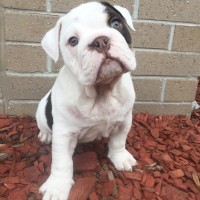
| The Bull-Aussie is the result of crossing an English Bulldog and an Australian Shepherd. Because both parents are purebred, the Bull-Aussie is considered a creative breed. Your Bull-Aussie will be a strong, large dog. His coat will generally be short and dense, and the shedding level will be moderate. It can be very energetic, requiring daily walks, activities and exercise. The Bull-Aussie will be highly intelligent, loyal and faithful. The Bull-Aussie is best suited to an active family, one that can give him plenty of attention and help him broaden his horizons as a dog. |
History of the Bull-Aussie |
| The Bull-Aussie has a short history compared to its parents. The hybrid is thought to have been born in the late 1990s in the USA. There is little recorded information about the Bull-Aussie. However, we can consider the background of its parent breeds. |
A little of the English Bulldog |
||
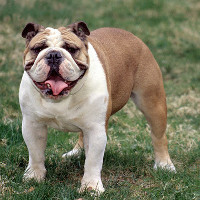
| The English Bulldog is a fairly old breed, and its origins are something of a mystery. Some experts believe they are a descendant of a Mastiff and a Pug, while others think the Mastiff line descended from the English Bulldog. Whatever the case, we know that these dogs were used to control, guard and bait bulls. To this end, the Bulldogs of the time were bred to be much more aggressive and tenacious, with an extremely high pain tolerance. This also made them excellent candidates for fighting other dogs and, because of this trait, they were instrumental in the development of the American Pit Bull Terrier and the American Staffordshire Terrier. When these violent "sports" became illegal in 1885, the breed was maintained by Bulldog enthusiasts who chose to breed for a more pleasurable nature, and today's English Bulldog is generally a docile animal capable of adapting to many situations. | ||
 |
||
| Standard of the English Bulldog | ||
A little of the Australian Shepherd |
||
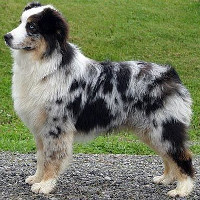
| The Australian Shepherd is thought to have roots in the Basque region of the Pyrenees. They were named after shepherds who came to the USA from Australia in the 1800s. These shepherds brought their flocks of sheep and dogs mainly to the state of California. These dogs were then bred by American rangers. In the 1950s and 60s, the Australian Shepherd became more popular for its ability to perform incredible tricks in rodeos. The breed is still used as a ranch dog. They are also used as guide dogs for the blind, as members of search and rescue teams and for drug detection. They were officially recognized by the American Kennel Club in 1991. | ||
 |
||
| Standard of the Australian Shepherd |
Appearance of the Bull-Aussie |
| The Bull-Aussie will have the characteristics of both the English Bulldog and the Australian Shepherd. It will be a large dog with strong, defined muscles. Its legs will be higher than those of its Bulldog parent. It may have a broad head and medium-sized muzzle. The Bull-Aussie generally has a short, dense coat that is easy to care for. The fur on its neck and chest may be long. Your hybrid will have floppy, folded ears and round, expressive eyes that may be dark or blue. The tail is often naturally curled. Coat colors are usually brindle, black, cream and white. |
Temperament of the Bull-Aussie |
| Early socialization and obedience training is recommended for the Bull-Aussie. They are intelligent and relatively easy to train, but they will do best if they have a firm handler who can demonstrate leadership and consistency. If socialized early, the Bull-Aussie will enjoy meeting and interacting with other dogs. The Australian Shepherd is a high-energy dog that needs a "job" to do. He's happiest when he has a goal. The English Bulldog likes activity but is more laid-back. Consequently, your Bull-Aussie may be a medium-energy dog with a herding instinct and may try to "herd" smaller animals or children. The Bull-Aussie is an affectionate dog, who enjoys being part of an active family. They are generally good with children. Its English Bulldog side can make it mature more slowly, so a little patience is needed. |
Needs and activities of the Bull-Aussie |
| The English Bulldog has a moderate energy level, while the Australian Shepherd is a high-energy dog. Consequently, your Bull-Aussie can be a medium-to-high-energy dog. During the puppy phase, he'll be more playful and active. The Bull-Aussie will enjoy long daily walks and leisure activities. If he takes more after his Australian Shepherd side, he'll enjoy jogging, hiking and climbing. The Bull-Aussie breed is best suited to a home with a large fenced-in yard to play in. The English Bulldog doesn't do well in extreme heat or cold, but the Australian Shepherd tolerates both hot and cold weather. |
Maintenance of the Bull-Aussie |
| The Bull-Aussie should be brushed once a week. Regular brushing will help remove dead hairs, facilitate shedding and keep the coat shiny. A monthly bath with a mild shampoo is recommended. It's important to dry his coat and ears thoroughly so that moisture doesn't build up, leading to infection. If your Bull-Aussie has skin folds, as often seen on the Bulldog, they should be examined, cleaned and dried daily. The Bulldog is prone to skin irritation, so it's essential to stay on top of skin care. The Bull-Aussie's teeth should be brushed with canine toothpaste several times a week to help prevent periodontal disease. Your Bull-Aussie's nails need to be maintained. Get your Bull-Aussie used to the grooming regime as a puppy and he'll learn to love attention and bonding. |



 English (United Kingdom)

Comments