 |
Doxiepoo |
|
He is not recognized by the F.C.I. |
Origin |
Germany <> France -> U.S.A. | |
Translation |
Francis Vandersteen | |
This breed is also known as |
Doodle
|
A brief presentation of the Doxiepoo |
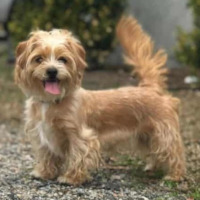
| None of the specific crossbreed dogs demonstrates the randomness of the cross as well as Doxiepoo. Although this Poodle and Dachshund cross has its own nickname, there is very little consistency between individuals, even within litters. The two parent breeds are of different sizes, and the Dachshund even sports three different coats. So you can never be sure of the fate of a Doxiepoos litter. Like all hybrids, the aim of crossbreeding is to promote the virtues of the parents while diminishing their less desirable attributes. However, the opposite can just as easily happen. Although the ideal Doxiepoo is an intelligent, courageous and sociable dog, the reality is that many inherit the worry and sensitivity of the Poodle, as well as the stubbornness and aversion to strangers of the Dachshund, making them an attraction to own. What's more, both parent breeds suffer more than their fair share of health problems, with the result that many of their offspring can develop problems of their own. My advice to anyone looking to buy a Doxiepoo is to carefully research both parents to ensure their good health, and to spend plenty of time observing and handling the litter of puppies before choosing one. Never buy a puppy just because it hasn't been sold yet, and aim to choose one that is outgoing without being a bully to its siblings. The Dachshund's long back is the source of many problems, and for this reason I would also choose a puppy without this exaggerated characteristic. Healthy Doxiepoos can live between 12 and 15 years, and it's important to choose a dog that will be a pleasure to live with for this long period, rather than a burden. |
History of the Doxiepoo |
| Doxiepoos, also sometimes called Doxiedoodles, have been around for ten or fifteen years, at a time when demand for Poodle crosses seemed to know no bounds. Unlike some other hybrids, such as the Pomsky, where the parents were selected because of the similarities between the two breeds, the opposite seems to have been the case with the Doxiepoo, as the Poodle and Dachshund couldn't be more different. In my experience, this crossing produces very unpredictable results, and it's often hard to believe, looking at a litter of puppies, that they all come from the same parents. It's also one of the specific crossbreeding dogs often sold by unethical breeders who have acquired a bad reputation for the quality and health of their pedigree stock. In this situation, they may choose to use their breeding dogs to produce hybrids, which are less closely examined and whose faults can be passed on as normal characteristics in crossbreeding. We may have more confidence in a breeder producing second- or third-generation crosses, but most Doxiepoos appear to be first-generation pedigree mixes. |
A little of the Dachshund |
||
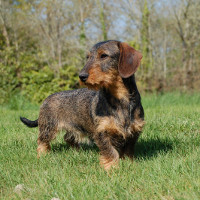
| The Dachshund has German origins and their name translates as hunting dog. This reflects the work they were bred to do, hunting badgers. The breed was developed around the 1500s, using sires including Pinschers, Braque Françaises and Basset Fauve de Bretagne. Of course, the Dachshund's most distinctive feature is its long back mounted on short legs. This made it the ideal size for exploring badger burrows. Some people even maintain that their long, mast-like tail was a deliberate trait to be used as a means of getting a dog out of a badger burrow if it got stuck. The Dachshund's cheeky personality and quirky appearance have made them popular as pets. With Queen Victoria as a fan, their star continued to rise, right up until the Second World War. The breed's undeniable link with Germany meant that it was temporarily unpatriotic and its numbers dwindled. But after the war, their charm and character were reclaimed and they were once again welcome as pets. | ||
 |
||
| Standard of the Dachshund | ||
A little of the Poodle |
||
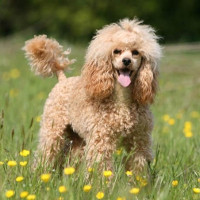
| The Standard Poodle is one of three variants of the Poodle breed, the other two being the Miniature and Toy. The Poodle is undoubtedly the most popular choice of dog for creating specific crossbreeds. This is not only because they come in three different sizes, but also because they tend to have soft fur and a gentle, intelligent nature. Poodles have been around since the 15th century and are descended from the French Barbet, a water dog. Although the Poodle is mistakenly thought to be a French breed in its own right, experts agree that it originated in Germany, where it was used for duck hunting. | ||
 |
||
| Standard of the Poodle |
Appearance of the Doxiepoo |
| No description of appearance can do justice to the range and variety of tendencies the Doxiepoo could adopt. It is invariably a small dog and normally weighs from 5 to 11 kilos. If its size is more like that of the Dachshund, it should not exceed 18 centimeters in height, but most measure around 22 to 25 centimeters. The ideal mix of parental characteristics would give the Doxiepoo a sturdy, compact body and reasonably straight legs. The back should not be too long, as the elongation seen in Dachshunds very often leads to spinal pain and protrusion of the intervertebral disc. The coat can take almost any form of color and texture; some Doxipoos have the dense, coiled coat of the Poodle, others have a long, wavy coat, and still others can have the stiff, coarse coat of the Wirehaired Dachshund. Perceived colors are: black, brown, gray, bronze, apricot, cream, white. In addition, you'll find any combination of the above. Their appearance is often further modified by grooming, with many owners having a preference for a particular clipping style. The Doxiepoo is a master of disguise. |
Temperament of the Doxiepoo |
| The Doxiepoo is generally an enthusiastic, energetic hybrid with a broad, mischievous streak. Ideally, it has the independence and confidence of the Dachshund, yet is as intelligent and affectionate as the Poodle, and should be an entertaining, good-natured pet that can tolerate older children. Unfortunately, some Doxiepoos exhibit the undesirable combination of stubbornness, defiance, distaste for strangers and high intensity, but again, these traits can be identified in very young puppies and particular attention should be paid to how puppies interact with their environment and between each other. Most are very good watchdogs, but can be excessively yappy. |
Needs and activities of the Doxiepoo |
| The Doxiepoo has a moderate to high energy level and needs physical exercise. However, both parent breeds have moderate-intensity requirements, which makes exercise easier. This hybrid doesn't need large spaces for running, but a small backyard is ideal. Walks and trips to the dog park are excursions welcomed by the Doxiepoo. Seeing the world and feeling comfortable in it will offer him ways to broaden his mind and prevent separation anxiety. This hybrid prefers warmer temperatures, but can tolerate any climate. It's not meant to be left alone outside, preferring to be with the family and involved in everything that's going on indoors. |
Maintenance of the Doxiepoo |
| The Doxiepoo is a hypoallergenic dog thanks to its Poodle parent, and sheds very little if its coat resembles that of a Poodle. The Dachshund also handles light shedding. The Doxiepoo's medium to long hair needs daily brushing to avoid tangles and matting. Regular ear cleaning with a vet-approved solution will help you avoid ear infections in the Doxiepoo, whose ears are long and fuzzy with moderate feathering. You should also brush your dog's teeth at least twice a week to prevent dental disease and keep his mouth clean. The Doxiepoo doesn't drool much. Keeping his coat and teeth clean are important elements of pet ownership. |



 English (United Kingdom)

Comments