
 |
Schipper-Poo |
|
He is not recognized by the F.C.I. |
Origin |
Belgium <> France -> U.S.A. | |
Translation |
Francis Vandersteen |
A brief presentation of the Schipper-Poo |
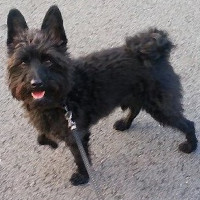
| The Schipper-Poo is a cross between a Schipperke and a Poodle. This hybrid is affectionate and playful, with lots of energy and no aggression. You can expect the Schipper-Poo to be solid black, with a short, soft, smooth to wavy coat and pointed ears. A dog of this hybrid will love attention and affection and, because of its intelligence, will generally be easy to train. Just as the Schipperke can be stubborn, the Schipper-Poo can inherit this quality from its parent breed, resulting in some training difficulties. |
History of the Schipper-Poo |
| The Schipper-Poo is a relatively recent hybrid, although the two breeds that make it up have a long history. |
A little of the Schipperke |
||
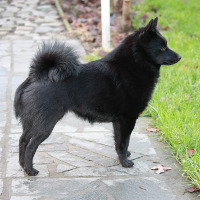
| The Schipperke is thought to be a descendant of the Leauvenaar, a black sheepdog whose function was to guard the boats on the canals between Brussels and Antwerp. These dogs, which were equally at home in the countryside and on boats, were formerly known as Spitske or Spits dogs, but when the breed club was founded in 1888, they were called Schipperke, meaning "little shepherd" or "little captain". The breed's popularity increased after Queen Marie Henriette saw one at the Brussels dog show in 1885. The breed was imported to the United States in 1888. | ||
 |
||
| Standard of the Schipperke |
A little of the Poodle |
| The Poodle is a well-known breed and one of the oldest. The breed is thought to have originated in Germany from a combination of several European breeds and the North African Barbet. Another theory about the Poodle's origins is that it is descended from herding dogs in Asia, or that it has ancestors from the Asian steppes, whose dogs found their way to Portugal after conquering the Berbers of North Africa. Roman artefacts and Egyptian tombs dating from the first century B.C. depict dogs of similar appearance. Smaller versions of the Poodle are thought to have been created in the 1400s by crossing smaller Poodles with each other. The Poodle was used for duck hunting in France. The first Poodle was registered with the American Kennel Club in 1888. |
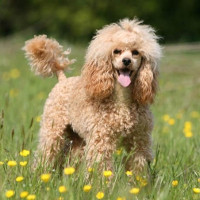 |
| Standard of the Poodle |
Appearance of the Schipper-Poo |
| The Schipper-Poo inherits traits from both its parent breeds; as with all mixed breeds, you can expect it to inherit more physical characteristics from either parent breed, or a relatively equal combination of traits from each. A hybrid dog will typically be small, with a sturdy body and a medium to long, soft coat. Its ears will be pointed, and the Schipper-Poo's facial expression can be described as alert. Depending on the traits inherited from its parents, the Schipper-Poo may have brown or amber eyes and a black or brown nose that rests atop a narrow muzzle. Their coloring is usually black or gray. |
Temperament of the Schipper-Poo |
| The Schipper-Poo inherits behavioral traits from its parent breeds, the Schipperke and the Poodle. The resulting hybrid tends to be a gentle dog that loves attention and affection from its owners and others it meets. The Schipper-Poo is generally intelligent and easy to train, but as the Schipperke can be independent and a bit of a troublemaker, these qualities can also be inherited by your Schipper-Poo. A hybrid dog will be loyal to its humans and behave well with other dogs. Its generally calm temperament makes this wonderful dog an excellent pet for families with children and other pets. |
Needs and activities of the Schipper-Poo |
| The Schipper-Poo's activity requirements vary according to the dog and the traits it inherits from its parents. The Schipper-Poo has a lot of energy and needs daily exercise. A leash is necessary for this curious dog on walks, as it is a fast dog that will chase anything it encounters, ignoring your calls. The Schipper-Poo will enjoy daily walks with its human companion, and joining its family on outings. Other activities include flyball, agility, obedience trials and, of course, leash walking. |
Maintenance of the Schipper-Poo |
| The care of your Schipper-Poo will depend on the coat it inherits from its parent breeds. The hybrid will typically be a medium shedder, with daily grooming recommended and bathing when necessary. The Schipperke is typically a clean breed with low odor emissions, requiring a bath only when it has been in a dirty, smelly place. Regular brushing, perhaps several times a week, will keep your home free of stray hairs. During shedding periods, a warm bath can help loosen dead hairs so they're easier to brush out. Even if the Poodle doesn't shed, it needs grooming every three to six weeks and daily brushing. Its coat should be trimmed regularly and bathed. As this breed often has tear stains, its face and eye area should be wiped daily with a damp washcloth and warm water. Its ears should also be wiped weekly. Whatever coat your Schipper-Poo inherits, it's important to brush his teeth several times a week and trim his nails if necessary. |



 English (United Kingdom)

Comments