 |
Rottbull |
|
He is not recognized by the F.C.I. |
Origin |
Germany <> U.S.A. -> U.S.A. | |
Translation |
Francis Vandersteen |
A brief presentation of the Rottbull |
| The Rottbull is a hybrid dog. Its parent breeds are the Rottweiler and the American Pit Bull Terrier. A large dog with a reputation for being aggressive, he's simply tenacious and tough. He's gentle and affectionate with his family, alert and vigilant around strangers. An excellent watchdog, the Rottbull is strong and can be very intimidating to potential intruders. They are also highly intelligent. Given proper socialization, the Rottbull can get along with other dogs, it is not recommended to live with cats even with socialization. The Rottbull is not a good dog for novice owners, only someone experienced in dealing with dogs willingly should consider choosing a Rottbull. He's best suited to a home with a fenced-in area, although he can live in a larger apartment provided he gets adequate exercise. |
History of the Rottbull |
| The Rottbull is a rare hybrid dog. Very little is known about its origins. To understand its origins, we can look at the history of its parent breeds. |
A little of the Rottweiler |
||
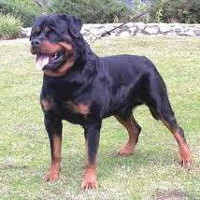
| The Rottweiler has its origins in Germany. This majestic dog is said to be descended from the Molossus mastiff. This dog was a war dog in the Roman army. It was also used to herd cattle. The incredibly strong dog was used by butchers to transport their carts full of meat. At some point, the Rottweiler almost became extinct. In 1901, the Rottweiler and Leonberger Club was founded, and new interest in the breed emerged. Rottweilers have been used as police dogs in Germany and America. In fact, the first Rottweiler was brought to America after the end of the Second World War. By the mid-1990s, the Rottweiler was the most popular dog in America, but bad publicity led to a decline in demand for the breed. | ||
 |
||
| Standard of the Rottweiler |
A little of the American Pit Bull Terrier |
| The American Pit Bull Terrier also has its roots in Europe. The Bull is descended from bull and terrier breeds that were developed for bull and bear baiting. When these events were banned, dog fighting took its place. Unfortunately, this is where the breed's aggression comes in. Although the Bull was bred to be tenacious, it was also bred with a reluctance to bite humans. The Bull came to America with immigrant families, and was widely used as a farm dog. Even today, he makes an excellent wild boar hunter. The American Kennel Club began registering the Bull in the early 1930s, however, it is known as the American Staffordshire Terrier with the organization. |
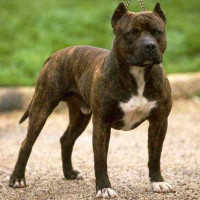 |
| Presentation of the American Pit Bull Terrier |
Appearance of the Rottbull |
| The Rottbull is a big, strong dog. He is slim, but very muscular. Its head will be broad and its ears erect. His muzzle will be of medium length and his jaw powerful. Coat colors will vary, especially according to the breed of the dominant parents. It may be the black and tan of the Rottweiler parent breed, or it may be the fawn, black, red, gray, blue or cream of the Bull parent breed. It can also be brindle. Its tail will be long and slightly curved. Some owners have their dogs' tails docked, as well as their ears. His feet will be large and his legs muscular and powerful. His chest is broad and deep. His eyes are usually a dark brown and his nose is black. If he inherits the color pattern of the Rottweiler parent, he'll have a tan chest, and distinctive tan points above each eye. |
Temperament of the Rottbull |
| The Rottbull may have a reputation for being aggressive, but the truth is that he's a tenacious, courageous dog who protects his territory, your home and his family too. He loves spending time with his family and, if left alone for long periods, can become bored and destructive. He can suffer somewhat from separation anxiety. They are highly intelligent and easily trainable. He's often easy to handle, as long as you're consistent in your routine with him. He can be somewhat stubborn, and sometimes you may have to force him to behave in a certain way. With strangers, he's often aloof. He usually looks at strangers - sizes, if you like. Even if he accepts a stranger, he doesn't go out of his way to be friendly. Males tend to be more exposed, and females tend to be easier to control and more affectionate. |
Needs and activities of the Rottbull |
| The Rottbull needs a moderate amount of activity. Two or three short periods of activity provide an adequate amount of exercise for the Rottbull. He'll appreciate outdoor activity in your yard, but exercise in a fenced-in area is recommended. This is not because he's prone to wandering, but because he can be aggressive with other dogs. An underground fence is not enough to keep the Rottbull on your property. What's more, if other dogs wander into your yard, the Rottbull will hold its ground. For this reason, the Rottbull is also not recommended for the dog park unless kept on a leash. Bear in mind that the Rottbull will become a couch potato if you allow him to. Providing him with toys that promote physical and mental activity will keep him mentally sharp, and he's less likely to be destructive because he's busy. Keep him in peak condition by taking him on short, fast outings every day. |
Maintenance of the Rottbull |
| The Rottbull is susceptible to moderate shedding due to its Rottweiler parent breed. He will tend to shed more in spring and autumn. You'll want to brush him weekly outside the shedding season. In spring and autumn, brush him daily to loosen dead hairs. Bathe him only when necessary. The natural oils in his coat will keep it shiny and healthy. Brush his teeth two or three times a week to prevent tartar build-up and bad breath. However, to avoid tooth decay, brush daily. Trim his nails once every two or three weeks, as long as he doesn't do it alone. Bear in mind that with a dog like the Rottbull, it's a good idea to start a grooming regime at a young age. Rottweilers and breeds of Pit parents are very sensitive to touch, and can be difficult to groom if they're not used to the procedure. |



 English (United Kingdom)

Comments