 |
Rotterman |
|
He is not recognized by the F.C.I. |
Origin |
Germany -> U.S.A. | |
Translation |
Francis Vandersteen |
A brief presentation of the Rotterman |
| With its piercing brown eyes and handsome face, the Rotterman, a cross between a Rottweiler and a Dobermann, is an easy dog to love. Well-muscled and solidly built, these dogs exude power and walk with a genuine air of confidence. They're best known for their handsome black and beige coat, which is short, elegant and very easy to care for. The Rotterman is by no means an easy dog; it takes a lot of hard work and training to become a well-adjusted, well-balanced member of the family. They would not be the best choice for a first-time dog owner, as they would benefit from being trained by someone with a good degree of experience. |
History of the Rotterman |
| Two black and beige German breeds renowned for being loyal and courageous guard dogs, the Rottweiler and the Dobermann have a lot in common. So it's hardly surprising that they were crossed to create the Rotterman, a hybrid believed to have originated in the USA over the last 30 years. With virtually no history to their credit, we need to take a closer look at their ancestry to better understand this fledgling breed. |
A little of the Rottweiler |
||
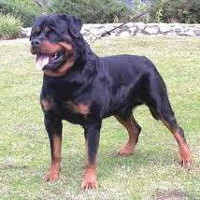
| Rottweilers are known for being gentle giants with their families, although they certainly have the ability to defend them fiercely if called upon to do so. They can be trained to a very high level and will devote themselves to their work. Originating from a town called Rottweil in West Germany, these powerful dogs would have been used to pull carts and drive cattle to market. As dogs became less and less used over the ages, the number of breeds became dangerously low. Fortunately for the Rottweiler, they made superb army dogs and were in great demand at the time of the World Wars. This ensured that the breed never disappeared, and that they remain internationally famous to this day. It cannot be ignored that Rottweilers have a reputation for aggression in some countries, which has more to do with the fact that they are taken in by ill-prepared owners who have not been properly trained. | ||
 |
||
| Standard of the Rottweiler | ||
A little of the Dobermann |
||
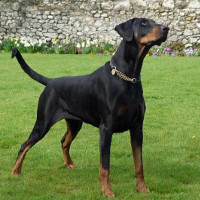
| The Dobermann was only developed in 1890, making it a much more recent breed than the Rottweiler. They were developed by a German named Karl Dobermann in a town called Apolda, in central Germany. Mr. Dobermann's aim was to create a powerful and impressive breed, capable of protecting him and easy to train. When he ran the local dog pound, he had access to a large number of different breeds and it's good that he mixed the likes of the Rottweiler, Beauceron, Weimaraner and German Pinscher, although the exact combination of breeds used is debated. Interestingly, America classified the Dobermann as its official war dog during the Second World War. | ||
 |
||
| Standard of the Dobermann |
Appearance of the Rotterman |
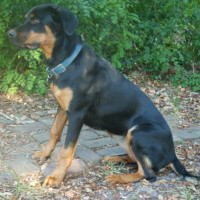
| The Rotterman already has a fairly uniform appearance, as the Rottweiler and Dobermann aren't that different to begin with. Indeed, many say the Rotterman resembles a gangly Dobermann. Their head is solidly built, though thinner and more defined than that of the Rottweiler. Their snout is long and their upper lips hang slightly, giving them a somewhat comical appearance. Their almond-shaped eyes can be amber or brown, and sparkle with intelligence and curiosity. They have compact, well-proportioned bodies, almost square in shape and supported by long, lean limbs. They have a well-developed chest and a slight abdominal fold. They stand proudly and have an undeniably elegant gait that is a pleasure to observe. The Rotterman's coat is the characteristic black and bronze of both parents, and is short and straight. It is often glossy and can look truly magnificent on a healthy dog. A very large dog, an adult Rotterman will measure from 58 to 63 cm. Their strong, powerful body is made up of heavy muscles, enabling them to reach an impressive weight of between 30 and 60 kg. |
Temperament of the Rotterman |
| One of the main attractions of the Rotterman is its affectionate nature and unwavering devotion to its family. Their loyalty knows no bounds, and they would happily sacrifice themselves to save those they love. This attitude can be a double-edged sword, for although it makes them affectionate with their loved ones, they can remain on their guard when new people enter the house or think they've perceived a threat. Rotterman have the ability to live side by side with other pets, as well as children, although they must always be supervised, as they are a powerful and heavy breed. Ideally, they would be socialized at a very young age, and owners should not try to introduce a new pet to an adult Rotterman who has never learned to accept other dogs. Some dogs can be stubborn and need persuasion to do as they're told. Owners should not tolerate any abnormal behavior, such as chewing and jumping, which may seem cute to a puppy, but can become a real problem in an adult Rotterman. |
Needs and activities of the Rotterman |
| A Rotterman is a large dog that needs to get out and exercise daily. They are ideal companions if you enjoy running or cycling, and will happily accompany you throughout your workout. The ideal situation is two walks a day to keep this athletic dog at his best. The Rotterman is best suited to a home with a secure yard, where your dog can run around and enjoy interactive play sessions with you and the family. Although they look tough, these big kids will also love a few toys to play with. They respond well to training, as long as it's fun and you're a strong and firm, but fair, pack leader. They won't respond to harsh methods or tone of voice; they tend to shut down and become uncooperative. Patience and kindness accompanied by one or two portions of praise and affection will see these dogs want to please and obey you. This active dog will love to run and play in his playpen. Make sure he's fully socialized before releasing him with another dog, especially if he's of the same sex, otherwise he may become anxious and threatening to another animal. |
Maintenance of the Rotterman |
| The Rotterman is a low-maintenance dog with a tight-fitting coat. A good brushing with a stiff bristle brush once a week is all you need when you're not in shedding season, but you'll switch to daily brushing when shedding. The coat is naturally shiny and short, making it easy to groom. This is a good time to check your dog's health, looking for cuts or abrasions that could become contagious. Ears are another area; dogs can suffer from inflammation and infection in the ear, which often has a repulsive smell. If infection has set in, a visit to the vet will be necessary to obtain medication. However, gentle ear cleaning and weekly ear drying will help prevent further infection. Your Rotterman will need to have his teeth brushed two or three times a week, using a specialized product for dogs, and bathing is only necessary if at all necessary. A light trim of the nails and your Rotterman will look show-ready. |



 English (United Kingdom)

Comments