 |
Pugottie |
|
He is not recognized by the F.C.I. |
Origin |
China <> Great Britain -> U.S.A. | |
Translation |
Francis Vandersteen |
A brief presentation of the Pugottie |
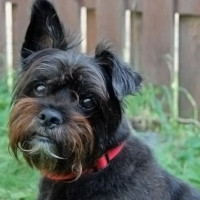
| The Pugottie is a small mixed breed that is a cross between the Scottish Terrier and the Pug. These dogs generally weigh between 7 and 11.5 kilos and can measure around 30.5 centimeters when fully grown. They are generally healthy, happy dogs who make excellent pets, although they can be difficult to train and can be stubborn. They love other pets and children, but should always be supervised in the presence of younger children. They come in many colors and their coats can be short to medium in length. The Pugottie is an excellent watchdog and barks to alert you to anything it thinks is a threat. |
History of the Pugottie |
| The Pugottie has only been around for about 10 years, so they don't yet have a history. However, you can check out the history of their parent breeds, the Pug and the Scottish Terrier. |
A little of the Pug |
||
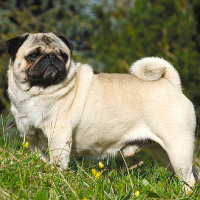
| The Pug was discovered around 200 BC in China and was treated like a king by the Chinese emperors. In fact, during the Han Dynasty, the Pug was even guarded by soldiers because they were so important to the royal families. This little companion dog was bred from the French Mastiff, Bulldog and Pekingese. They were called Mopshond when they were brought to Europe. With names like Mops in Germany, Doguillo in Spain, Pug in France and Caganlino in Italy, they had many aliases. They finally arrived in England in the late 1800s when the British took over the Chinese imperial palace. In Victorian times, the Pug was featured on paintings, figurines and old-fashioned postcards. After the Civil War, the Pug was introduced to the United States, where it became very popular, and in 1885 was recognized by the American Kennel Club. | ||
 |
||
| Standard of the Pug |
A little of the Scottish Terrier |
| The Scottish Terrier originated in Scotland from the West Highland White, Cairn and Skye Terriers for use in hunting badgers, rats, foxes and rabbits. They were nicknamed the Aberdeen Terrier in the 1800s after the town of Aberdeen where they had a number of these dogs keeping their homes and barns free of vermin. The standard for the Scottish Terrier was developed in the USA in 1880 and five years later they were registered with the American Kennel Club where they are now the 58th most popular dog breed. |
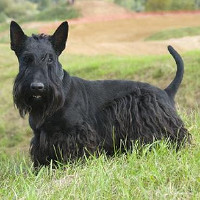 |
| Standard of the Scottish Terrier |
Appearance of the Pugottie |
| The Pugottie is a small dog with fluffy, floppy ears, a small rounded head, round dark-brown eyes and a black nose on a brachycephalic muzzle. They can be just about any color, from beige to black, but are usually black and brown, dark brown or chocolate, gray or salt & pepper, merle, speckled, brindle, spotted, or piebald. Pugottie have short, muscular legs and a tail that curls over their back. Their coat is straight and can be fine to moderately dense and of short to medium length, depending on parentage. They can also have the dark mask of the Pug or the general nervousness of the Scottish Terrier. |
Temperament of the Pugottie |
| The Pugottie's temperament is friendly, alert, curious and lovable. However, they are wary of strangers and make good watchdogs as they will let you know when there is a possible threat to you or your family. They are known to be a little stubborn when it comes to training, so many owners end up choosing obedience classes for their Pugottie. It's important that you let your dog know that you're the boss, as he's very aware of the pecking order. They can be lively with young children who tease or squeeze them, so they need to be supervised when with smaller children. |
Needs and activities of the Pugottie |
| The Pugottie needs moderate activity, so you should take your dog out to play or for a walk for at least 30 to 45 minutes a day. Your dog may develop behavioral problems such as excessive barking or chewing if he doesn't get enough exercise and mental stimulation every day. Going for one or two walks a day and letting your dog play in the yard for about half an hour would be sufficient, but it's best if he sometimes goes out and socializes with other dogs at the dog park. |
Maintenance of the Pugottie |
| The Pug has an easy-care coat, but the Scottish Terrier has a stiff coat with a soft undercoat and beard. If your Pugottie resembles the parent Pug, you should only need to brush it once or twice a week with a smooth brush. However, if he looks more like a Scottish Terrier, you'll need to brush him at least four or five times a week with a pin brush and a metal comb. If he has a beard, be sure to keep it combed and clean. They can be bathed if necessary, but don't shampoo too often or they can get dry, irritated skin. Complete the grooming regime with a teeth cleaning a few times a week and your Pugottie will be in top form. |



 English (United Kingdom)

Comments