 |
Pugland |
|
He is not recognized by the F.C.I. |
Origin |
China <> Great Britain -> U.S.A. | |
Translation |
Francis Vandersteen |
A brief presentation of the Pugland |
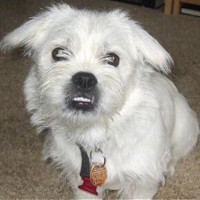
| The Pugland is a hybrid of the Pug and the West Highland White Terrier. Because both breeds are small dogs, the Pugland will also be small. They rarely measure more than 30.5 centimeters, and their average weight is around 7 kilos. This breed is a wonderful family companion and gets on well with other pets. They love children, but need to be supervised with young children as they can become lively if teased or rushed. The Pugland learns quickly and is easy to train, but it can also be stubborn, so it needs positive reinforcement. |
History of the Pugland |
| The Pugland hasn't been around long enough to build a history, so it's best to look at the histories of the Pug and the West Highland White Terrier. |
A little of the Pug |
||
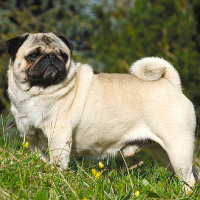
| The Pug originated in China around 200 B.C. during the Han dynasty, and is descended from the French Mastiff, the Bulldog and the Pekingese. The breed was considered royal and belonged only to the emperors of China at the time. They even had their own soldiers to guard them. When the Pug was brought to Europe by Dutch sailors in the 15th century, it was nicknamed Mopshond and became popular with other royal families. Eventually, they became popular with other families and, as they spread around the world, were given different names such as Caganlino in Italy, Doguillo in Spain, Pug in France and Mops in Germany. In the 1800s, there were two breeding lines, the royal dogs of Queen Charlotte and those of Lord and Lady Willoughby of Eresby in Russia and Hungary. In Victorian times, they were featured on paintings, statues and postcards, and became very popular all over the world. In 1885, they were accepted by the American Kennel Club and are the 32nd most popular dog breed in the U.S.A. | ||
 |
||
| Standard of the Pug |
A little of the West Highland White Terrier |
| The West Highland White Terrier originated in Scotland in the 1800s from the Cairn, Dandie Dinmont, Skye and Scottish Terriers. They were used to hunt badgers, foxes and other vermin. The breed was once available in other colors, but was changed to white only after Colonel Malcolm de Poltalloch accidentally mistook his faithful dog for a fox and shot it. Thereafter, the colonel would only allow these Terriers to be bred with white dogs. The breed was introduced to America in 1905 and accepted by the American Kennel Club three years later. The breed is now the 41st most popular breed in the USA. |
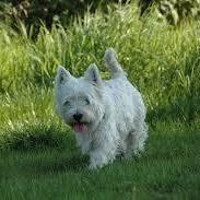 |
| Standard of the West Highland White Terrier |
Appearance of the Pugland |
| Your Pugland is a small dog with short legs, a short torso and a straight tail of medium length. They have a medium to long straight coat of normal density with a soft, plush undercoat. This breed can come in many colors, but is usually white, black or brown. They may have a light-colored beard and chest patch, but not all have these markings. The Pugland breed has a small, rounded head with drooping, triangular ears that are usually hairy. Their large, round eyes are dark brown with a curious expression, and they have a small black nose. |
Temperament of the Pugland |
| Even though the Pugland is a small dog, it can be as confident as a dog five times its size, and will protect its family from anyone or anything it perceives as a threat. They generally don't start fights, but won't back down if they or their family are attacked. Although they enjoy playing with other dogs, they should not be trusted with small animals such as kittens, rabbits or guinea pigs. Training them is usually fairly easy, but you need to be patient and consistent as they can be stubborn or try to test their limits. |
Needs and activities of the Pugland |
| Puglands need around 45 to 60 minutes of vigorous activity a day to stay healthy. If your dog doesn't get enough exercise every day, he may develop behavioral problems or bad habits, such as chewing on objects and excessive barking. Some of Pugland's favorite activities may include a walk, playing with other dogs at the dog park, agility training, flyball, a game of fetch or catch, swimming or simply chasing squirrels and rabbits around the yard or park. However, make sure your Pugland is on a leash when not in a fenced-in area. |
Maintenance of the Pugland |
| Your Pugland should be carefully brushed with a pin brush or stiff bristle brush and metal comb at least four or five times a week. You should spend a lot of time on your dog's belly, tail, under his arms and under his neck and ears. Your dog's ears will also need to be cleaned about once or twice a month, and you should also trim his nails at this time. They only need to be bathed when necessary, and you should use a special medicated shampoo from your vet as this breed has sensitive skin. |



 English (United Kingdom)

Comments