 |
Labradane |
|
He is not recognized by the F.C.I. |
Origin |
Canada <> Germany -> U.S.A. | |
Translation |
Francis Vandersteen |
A brief presentation of the Labradane |
| The Labradane is a hybrid dog breed. Its parent breeds are the Labrador Retriever and the Great Dane. The Labradane is likely to be a large or giant dog, depending on the dominant parent breed. It likes to be active, is very sociable and is very affectionate with every member of its family. He needs a moderate amount of exercise, otherwise he's fairly low-maintenance. He is gentle and loyal, and gets on equally well with young children and older family members. |
History of the Labradane |
| The Labradane hybrid dog breed is the result of a trend in the 1980s when a demand for smaller dogs became fashionable. |
A little of the Labrador Retriever |
||
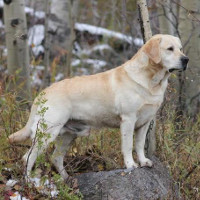
| The Labrador Retriever is a famous Canadian breed that originated in St. John's, Newfoundland, in the 1800s. Labradors are renowned for their water retrieving and swimming skills. These breeds were originally used as fishing net retrievers by the fishermen who owned them. When the Labrador was introduced to the UK, its primary purpose changed to hunting and retrieving wild game. Today, the Labrador is America's most popular breed. These multi-talented dogs now serve a higher purpose as service, guide and police dogs. | ||
 |
||
| Standard of the Labrador Retriever | ||
A little of the Great Dane |
||
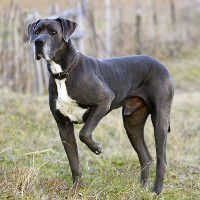
| The Great Dane has its origins in antiquity. Dogs resembling the Great Dane have been found on ancient Egyptian artifacts and in Babylonian works of art. The Assyrians are thought to have exchanged the dog with the Greeks and Romans, and it was crossed with Mastiff-type dogs or perhaps with the Irish Wolfhound or Irish Greyhound to obtain the Great Dane we know today. At this point in history, the Great Dane was known as a "boar dog". In the 1600s, the Great Dane became a favorite of the German nobility. The dog breed was given the name "German Mastiff" when a French naturalist observed a wild boar that was thin like a Greyhound. German breeders continued to develop the breed, and eventually the Great Dane made its way to the United States. | ||
 |
||
| Standard of the Great Dane |
Appearance of the Labradane |
| The Labradane varies in color. It can be black, brown or white, or it can be brindle, mantled or solid. You may find a Harlequin, but this coat color is rare in the Labradane. He will be a very big dog and can weigh up to 82 kilos at maturity. He can tend to put on weight, so exercise is essential. Although he's a big dog, he'll be relatively slender for his bone structure. He will have floppy ears that hang close to his cheeks. He has a short, dense coat that is not subject to much shedding. His coat is generally glossy and thick, rather like that of his parent breed, the Great Dane. He will be well muscled. Its head is broad, with a pronounced stop. It also has a high tail. Although it looks slim, its body is strong and robust. |
Temperament of the Labradane |
| The Labradane is a gentle giant. He's highly intelligent and eager to please his family. It thrives on human interaction. He adores children and gets on well with other dogs. However, some experts warn parents to be careful with small children. The Labradane is a big dog and, while it won't intentionally hurt a child of any age, it can knock a smaller child over. Highly energetic like the Labrador Retriever parent breed, sometimes in his exuberance he forgets his size. He can enjoy agility exercises, working his mind as well as his body will make a happy Labradane. He can be wary of strangers, but generally warms up to them. He can suffer from separation anxiety if left alone for long periods, so keep this in mind if you're traveling a bit. He rarely barks, but his size is so intimidating that most people don't try to enter his territory. He is very protective of his family and is extremely loyal. |
Needs and activities of the Labradane |
| Labradanes need a moderate amount of activity. This is particularly important as it ages. The Labradane can put on weight if allowed to become an inactive adult. He'll enjoy a brisk walk with you, or a trip to the dog park. He might even enjoy a swim. The most important thing to remember is that he gets daily activity to avoid harm and stay healthy. Again, a game that works the Labradane's mind as well as his physical body keeps him happy. You never want your Labradane to get bored, as it may chew furniture or other valuables. |
Maintenance of the Labradane |
| Labradanes are moderate excretors. It sheds lightly throughout the year, with heavier shedding in spring and autumn. He will need brushing at least twice a week. During the shedding season, you may need to brush him daily to minimize loose hairs. He'll need regular cleaning of his floppy ears. Keep in mind that floppy ears are a breeding ground for infection, so at least once a week, wipe his ears with a damp bath cloth. Be sure to check for odor or redness, as this may indicate infection. To prevent tooth decay, brush his teeth at least three times a week. |



 English (United Kingdom)

Comments