
 |
Labradinger |
|
He is not recognized by the F.C.I. |
Origin |
Canada <> Great Britain -> U.S.A. | |
Translation |
Francis Vandersteen |
A brief presentation of the Labradinger |
| The recent blending of the Labrador and Springer Spaniel has given rise to the delightful Labradinger, a breed that is sure to make both parents proud. Although records are lacking, it's likely that this breed was first created in the 1980s and is slowly increasing in popularity over time. Generally smaller and leaner than the Labrador, the Labradinger has the Springer Spaniel's long-furred, floppy ears. Colors can vary, and dogs can be chocolate, yellow or black. Many pedigree dogs will have white patches on their fur. A needy dog, the Labradinger thrives when there are lots of people around, but can become restless if left alone. Highly intelligent, Labradingers can be trained to perform a number of tasks and are happiest when given a job to do. |
History of the Labradinger |
| The charming cross between the Labrador Retriever and the Springer Spaniel is known as the Labradinger or Springador. A recent hybrid mix, this breed is not yet recognized by any kennel club and hasn't recently made its mark on the dog world, but many have heard of it. While the Labradinger has probably only been around for a few decades, with the first records appearing as recently as the 1980s, the dogs from which it is descended are much older and have both made a name for themselves. As well as being social and energetic, Labradingers enjoy spending time outdoors and are full of curiosity and mischief. They can be quite rare and do their best in an active household with active owners. |
A little of the Labrador Retriever |
||
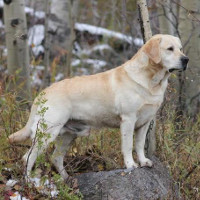
| Despite its name, the Labrador Retriever is not native to Labrador, but is actually thought to have originated in Newfoundland. Most agree that its ancestor is the St. John's Water Dog, an extinct breed originally from Newfoundland and anecdotally more at home in the water than on land. Historically, the Labrador Retriever was used to hunt on both dry and wet land, making it a favorite of local fishermen. Of course, many still use the Labrador Retriever for this purpose today, although the breed has developed into a multitude of other disciplines. Labrador Retrievers can be seen as therapy dogs, guide dogs for the blind and even drug detectors at airports and ferry terminals. In fact, the Labrador Retriever is such a successful breed that it now features in the top ten list of popular dogs in many countries around the world. | ||
 |
||
| Standard of the Labrador Retriever | ||
A little of the English Springer Spaniel |
||
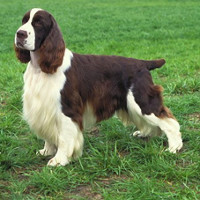
| The English Springer Spaniel is a breed of hunting dog that dates back to 14th-century England, whose purpose was to hunt and retrieve game. Nowadays, however, they are considered a versatile or all-season dog, being an affectionate companion to keep as a pet. Energetic and loving, English Springer Spaniels always seek to please their owners and are ready to take on any task. No wonder they're ranked among the top ten most popular dog breeds in the UK. Yet they can be clingy, and some may have a tendency to dominate or even be aggressive. That's why early socialization is so important, as is meeting their mental and physical needs. | ||
 |
||
| Standard of the English Springer Spaniel |
Appearance of the Labradinger |
| The undeniably handsome Labradinger seems to have inherited the best physical traits from each of its parents, generally having the sleek, silky coat of the Spaniel and the charming mix of colors of the Labrador. As a mixed breed, there will be variation from dog to dog, with some looking more like Spaniels and others taking more after Labradors in their lineage. In general, their beautiful ears are long and floppy, framing the face. Their eyes are alert and curious, and colored brown or green. Their body tends to be smaller and leaner than that of the Labrador, and is often more athletic too. Labradinger coats can be yellow, black or chocolate brown, and white patches are common. Their coats are wavy and dense, and the fur is often longer on the ears, legs, chest and tail. Weighing between 22 and 36 kg, adult Labradingers can vary considerably in size and shape. As adults, they measure between 46 and 61 cm at the withers. |
Temperament of the Labradinger |
| A working dog by nature, the Labradinger loves to be given a job to do, and eagerly carries out any task assigned to it. They have seemingly boundless energy and love to make their masters happy. Leaning on those around them, Labradingers form close bonds with their families and can often look for happiness when they're away. This is not a breed that does well when left alone for long periods. They like to be involved in everything you do, so don't expect a dog to sit in the next room while you're busy, they'll be right next to you with their nose pushed into whatever you're trying to get on with. This boisterous breed can be quite rare and often requires intensive training. For this reason, the Labradinger is best suited to a home with older children. Once properly trained from an early age, they make wonderful pets eager to demonstrate their obedience. As well as sometimes being hyper, this breed can be very vocal, which is something to consider if you like to be in close proximity to a neighbor. These tendencies can be reduced with proper training, daily exercise and mental stimulation. |
Needs and activities of the Labradinger |
| The Labradinger is a dog that likes moderate activity. He will need daily activity. You may choose to go for a brisk walk with the Labradinger, but bear in mind that the breed is highly intelligent. Games that stimulate his mind are perfect for the Labradinger. He'd love to go to the dog park. He also likes to play catch. If you have a fenced-in yard, Labradingers will enjoy using this space to expend excess energy. Don't forget that he's part Labrador Retriever, a dog who likes to work. Sometimes a simple walk with you or a game of fetch isn't enough to keep the Labradinger out of trouble. Games that involve agility or retrieving are stimulating for his mind and physically beneficial for him. |
Maintenance of the Labradinger |
| The Labradinger may have a longer coat than its parent breed, the Labrador Retriever, but it actually requires less maintenance than expected. He's more of a minimal-loss dog. He'll only need brushing once a week. Bathe him only when necessary, as his natural oils will help keep his coat shiny and healthy-looking. He'll need more maintenance when it comes to his ears. Use a damp washcloth to wipe his ears once a week. Be sure to watch for odors or redness, as these are signs of infection. Clip her nails every two weeks. As a general rule, if you hear your dog's nails on the floor, it's time to trim them. Brush your Labradinger's teeth at least three times a week. However, to prevent cavities, brush your dog's teeth every day. |



 English (United Kingdom)

Comments