 |
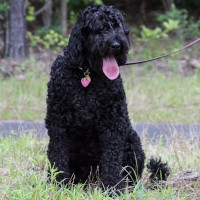
Giant Schnoodle |
|
He is not recognized by the F.C.I. |
Origin |
France <> Germany -> U.S.A. | |
Translation |
Francis Vandersteen |
A brief presentation of the Giant Schnoodle |
| The devoted Giant Schnoodle is a hybrid dog breed where the majestic Giant Schnauzer is crossed with the highly intelligent Poodle. A large dog, this hybrid breed will generally be relaxed with an optimistic personality and plenty of intelligence. The Giant Schnoodle will enjoy being with its people and do well with children. He'll also love to play and participate in brainstorming exercises. Independent by nature, he can be stubborn during training, although as a bright dog, he can easily pick up commands with consistency. |
History of the Giant Schnoodle |
| The hybrid dog breed known as the Giant Schnoodle is a new dog breed with no detailed history. However, the two dog breeds that combine to form the Giant Schnoodle have a long history that can be examined. |
A little of the Poodle |
||
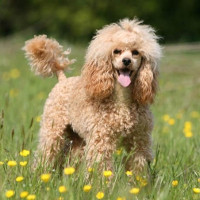
| Considered one of the oldest breeds, the Poodle originated in Germany but became the breed we now know in France from a combination of European dogs and the North African Barbet. It's also possible that the Poodle descended from Asian sheepdogs and became the German Water Dog with the Ostrogoth and German Goth tribes. Another theory is that the Poodle descended from the Asian steppes that found their way to Portugal after defeating the Berbers of North Africa in the 8th century. Originally a water dog, in France the Poodle was known for its duck-hunting abilities. The breed has served man well as a guide dog, guard dog, service dog and performance dog. The American Kennel Club registered its first Poodle in 1888. | ||
 |
||
| Standard of the Poodle | ||
A little of the Giant Schnauzer |
||
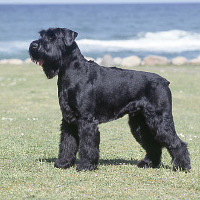
| Although its date of origin is unclear, the Giant Schnauzer derives from the Standard Schnauzer, a dog shown in works of art as early as 1492. The Giant Schnauzer is the result of the Standard Schnauzer bred with larger dogs such as the Black Great Dane. The development of these dogs created a breed to work as shepherds as well as herding cattle. The Giant Schnauzer's initial role was to drive cattle to market. In the early 20th century, the Giant Schnauzer's role changed to guarding breweries, stockyards and butcheries. They were also trained for police work, although due to their size and potential aggression, they are now rarely used for police work in the USA and Europe. The American Kennel Club first recognized the Giant Schnauzer in 1930. | ||
 |
||
| Standard of the Giant Schnauzer |
Appearance of the Giant Schnoodle |
| The Giant Schnoodle is a hybrid breed of dog derived from the Giant Schnauzer and the Standard Poodle, an attractive dog weighing on average between 45 and 55.5 kilos. It will have a thick, wavy coat that doesn't shed and can be seen in mixtures of black as well as silver, beige and white. Like its parent breeds, the Giant Schnoodle will be well-proportioned and strong with an air of dignity and pride. It may have the square muzzle of the Giant Schnauzer parent or the finer, more pointed muzzle of the Poodle. His ears will be folded or perhaps even long enough to hang like a pendant. His eyes will be dark and bright, clearly displaying the intuitiveness he possesses. |
Temperament of the Giant Schnoodle |
| The Giant Schnoodle is generally good at understanding social situations and acting appropriately in response. These hybrid dogs are generally energetic and playful, and the breed's gentle nature makes the Giant Schnoodle an excellent choice for a home with children. The Giant Schnoodle will be easy to distract, especially when a rodent, cat or other dog approaches. The Giant Schnoodle is affectionate and will form a close bond with its owner. This agile dog can be an independent thinker, which means training can be difficult and will require a consistent program. As it ages, a Giant Schnoodle will generally calm down. |
Needs and activities of the Giant Schnoodle |
| As the Giant Schnoodle's parent breeds are both high energy, it's likely that your hybrid will be too. Daily dog walks and time spent playing outdoors will be important for your Giant Schnoodle's physical and mental health. When a dog with an active, inquisitive nature doesn't get the exercise his mind and body need, it can lead to mischievous behavior. This hybrid dog breed can excel in obedience trials if given the opportunity. |
Maintenance of the Giant Schnoodle |
| Maintaining your Giant Schnoodle won't be difficult. We recommend brushing a few times a week and bathing once a month. Professional grooming may be required every three months. The Giant Schnoodle does not shed and is considered hypoallergenic. As with all dogs, we recommend brushing your Giant Schnoodle's teeth several times a week and trimming its nails as needed. Providing your Giant Schnoodle with chew toys can be helpful to keep him busy and from chewing other objects in your home. Being outdoors is important for the Giant Schnoodle, who will benefit from a fenced-in outdoor area. |



 English (United Kingdom)

Comments