
 |
Giant Schnauzer Chin |
|
He is not recognized by the F.C.I. |
Origin |
China <> Germany -> U.S.A. | |
Translation |
Francis Vandersteen |
A brief presentation of the Giant Schnauzer Chin |
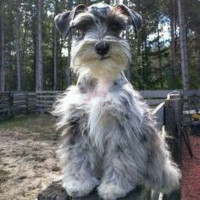
| The Giant Schnauzer Chin is a specific cross between a Japanese Spaniel and a Giant Schnauzer, two dogs of very different sizes, so your pet may vary in size and build depending on which parental breed is more dominant. Common colors are black, salt and pepper, white, red, possibly with tan points. Your hybrid's coat may be wiry, hard and dense like the Giant Schnauzer, or silky and long like the Japanese Spaniel. Your pet will probably need moderate maintenance and may shed a little. A Giant Schnauzer is energetic and intelligent and will need regular exercise, unlike a Japanese Spaniel who will be content with less as long as he's with his family. The Giant Schnauzer Chin is not recommended for people with young children, especially if the hybrid is large and has an exuberant personality. |
History of the Giant Schnauzer Chin |
| The Giant Schnauzer Chin is a specific cross between a Giant Schnauzer and a Japanese Spaniel. |
A little of the Japanese Spaniel |
||
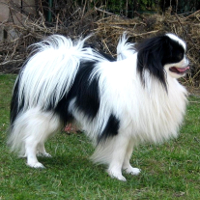
| Despite its name, the Japanese Spaniel's earliest origins lie in China, not Japan. Believed to have originated in the Chinese imperial court, they were highly prized and often given as gifts. Some historians believe that the Pekingese, which also has its origins in China, was developed from the Japanese Spaniel, also known as the Japanese Chin. In Japan, dogs were restricted to those of royal blood. There is evidence that the first Japanese Spaniels were given as gifts by the Emperor of Japan to an American naval officer, Commodore Matthew Perry, in 1853, when he sailed into the port of Uraga near Edo, now Tokyo, and introduced Japan to international trade. He was apparently given seven dogs, two of which survived to return to the USA, where some of the owners included President Franklin Pierce, then Secretary of War Jefferson Davis, and Perry's daughter Caroline Perry Belmont. They were officially recognized by the American Kennel Club in 1888. | ||
 |
||
| Standard of the Japanese Spaniel | ||
A little of the Giant Schnauzer |
||
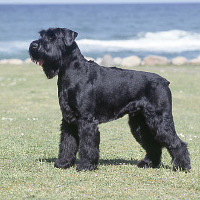
| The Giant Schnauzer was developed in Germany as one of three distinct Schnauzer breeds, Miniature, Standard and Giant. The Giant Schnauzer is thought to have been created by crossing the Standard Schnauzer with the Black Great Dane and possibly the Bouvier des Flandres. Often found working in breweries as guard dogs, they were also bred as farm dogs. In Germany, they were used by the police and as military dogs during both World Wars, and are still used as working dogs today. Giant Schnauzers first arrived in America in the 1930s and were registered by the American Kennel Club in 1930. The Giant Schnauzer Club of America was founded in 1962. | ||
 |
||
| Standard of the Giant Schnauzer |
Appearance of the Giant Schnauzer Chin |
| The Giant Schnauzer Chin is a specific cross between a Japanese Spaniel and a Giant Schnauzer. Common colors are probably black, salt and pepper, white and red, while the coat can be wiry, hard and dense like the Giant Schnauzer or silky and long like the Japanese Spaniel. The two parent breeds are very different, the Giant Schnauzer having a broad, muscular body with a distinct beard and eyebrows. They have oval-shaped eyes that are dark brown and sunken, and tails that are generally docked. The Japanese Spaniel is also quite robust but is much smaller than a Giant Schnauzer, with a short face and large, expressive eyes. They have feathered ears and feathers on the back of the front legs. The tail is feathery. Your hybrid will adopt the most dominant features of the parent, although this hybrid is usually seen with the characteristic eyebrows and beard. |
Temperament of the Giant Schnauzer Chin |
| A Giant Schnauzer Chin is likely to adopt many traits from their parent breeds and is therefore likely to make an excellent pet, preferably in a home with older children. The Giant Schnauzer is very protective of its family and wary of strangers, but is a playful and energetic dog. They are very intelligent dogs, but will need early socialization as they can be aggressive with other dogs and cats. A Japanese Spaniel is a little more difficult to train, especially when it comes to training. They love being with people and are playful, happy dogs. They're a bit like cats in that they love to climb and groom themselves. Japanese Spaniels must be kept on a leash when outdoors, as they hunt other animals. They don't need much exercise and don't like to be left alone for too long. Your hybrid will be a wonderful combination of both, thriving with consistent but patient training. Guidance is welcome and necessary for your hybrid to understand its place in the household. |
Needs and activities of the Giant Schnauzer Chin |
| Depending on the parent breed, the Giant Schnauzer Chin takes after the most, this will depend on the amount of exercise required. A Giant Schnauzer needs at least an hour of intense exercise every day, and can become very destructive if it doesn't get enough. They love to run or go for long walks and, like Japanese Spaniels, must be kept on a leash to avoid chasing other dogs. Japanese Spaniels need very little exercise and are happy as long as their owner is nearby. They do well in an apartment, unlike the Giant Schnauzer, which needs a garden to play in, even though it should always live indoors. Both parent breeds tolerate cold more than heat, so don't walk them when it's too hot. |
Maintenance of the Giant Schnauzer Chin |
| Like the two parent breeds, the Giant Schnauzer Chin will probably need moderate maintenance. The Giant Schnauzer is hypoallergenic, but the Japanese Spaniel is not, so coat care will depend on which your pet takes more. The Giant Schnauzer needs trimming around the eyebrows, beard and body, but the Japanese Spaniel doesn't need trimming, except sometimes around the feet. Your pet won't need much grooming to keep it looking good, and won't shed much either. Like parent breeds, your pet is unlikely to need brushing more than once a week. Try to brush your dog's teeth every day to avoid any dental problems, and check the ears for dirt or wax. If necessary, wipe them gently with damp absorbent cotton. Nails should also be checked to see if they need trimming or grooming. |



 English (United Kingdom)

Comments