
 |
Eskland |
|
He is not recognized by the F.C.I. |
Origin |
U.S.A. <> Great Britain -> U.S.A. | |
Translation |
Francis Vandersteen |
A brief presentation of the Eskland |
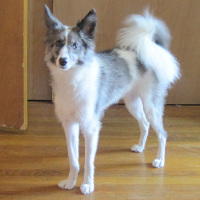
| The Eskland is an energetic hybrid of the American Eskimo Dog and Shetland Sheepdog breeds. Both parent breeds are small to medium-sized and robust with beautiful thick double coats and long hair. The size and weight of your Eskland may vary according to the size of either parent breed. The Eskland is a specific crossbred dog bred as a companion, suitable for families who like to be active. It can be difficult to determine the potential characteristics of this hybrid due to the lack of detailed information, but owners can consult the parent breeds for more details. |
History of the Eskland |
| The Eskland is a hybrid of the American Eskimo Dog and the Shetland Sheepdog. The mix is a specific modern crossbreed designed as a companion dog and does not have a long, well-known history. Owners can consult the histories, health and personalities of the parent breeds to assess the possible dispositions of their Eskland. Today, the Eskland is not a well-known hybrid, and little documentation exists on the mix. The parent American Eskimo Dog is not as popular as the Shetland Sheepdog. The Eskland is currently recognized by the American Canine Hybrid Club, the Designer Dogs Kennel Club, the Dog Registry of America and the International Designer Canine Registry. |
A little of the American Eskimo Dog |
||
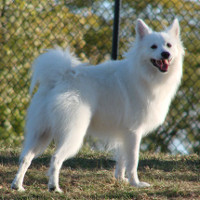
| The American Eskimo Dog, also known as the Eskie, is thought to have been in existence for over 6,000 years, and has long since passed on its guard dog skills to the Eskland hybrid. The White Pomeranian and White Keeshond are also related to the parent American Eskimo Dog. The German Spitz once shared the name with the Eskie, although anti-German sentiment during the World Wars prompted a name change to the American Eskimo Dog. | ||
 |
||
| Presentation of the American Eskimo Dog | ||
A little of the Shetland Sheepdog |
||
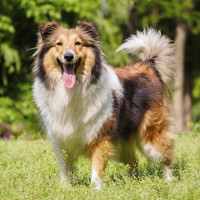
| The Shetland Sheepdog, also known as the Sheltie, is a hardy breed developed on the Shetland Islands between Scotland and Norway. The Sheltie is a small Collie-type dog that shares its ancestry with Border Collies. The Sheltie was originally bred as a farm dog to help move and protect Shetland sheep, but by the 19th century, the Shetland had been crossed with so many other dogs that the original breed was disappearing. Many breeds debated the Sheltie's standard appearance for years, but in 1930 the Scottish and English clubs finally agreed that the Shetland Sheepdog should resemble a miniature version of the long-haired Border Collie, although the American Kennel Club had first recognized the breed in 1911. | ||
 |
||
| Standard of the Shetland Sheepdog |
Appearance of the Eskland |
| Eskland Sheepdogs are sturdy, small to medium-sized dogs. Height and weight can vary between males and females, and the coat often resembles that of the Shetland Sheepdog, but may have a solid color. The head of an Eskland is long with a longer muzzle than that of the American Eskimo Dog and has oval dark brown eyes with a curious, fiery expression, but can also have merle-colored eyes if the coat is gray. The body appears slightly longer than it is tall, and the tail is set high with a curve over the back with extensive feathering. |
Temperament of the Eskland |
| The Eskland is an active, friendly dog that enjoys spending time with its family. This dog is a robust hybrid that loves children, and although the hybrid may be slightly wary of strangers, it warms up quickly. The Eskland accepts dogs and protects all family members, including the cat. However, early and consistent socialization will reinforce these personality traits. The Eskland is an intelligent mix that is easy to train, although this hybrid needs plenty of mental and physical stimulation on a daily basis to keep it happy. |
Needs and activities of the Eskland |
| The Eskland is a high-energy mix of two breeds, and mental stimulation is just as important. Plan to play games or give your Eskland a challenging task to engage its mind. Repetitive tasks can become boring for Eskland, and boredom can lead to destructive behavior. If the Eskland can do all its daily physical and mental exercise, it can adapt to life in an apartment. However, a small yard is ideal for this hybrid. The Eskland adapts well to all climates, but prefers cooler temperatures. Thick coats can lead to overheating in summer, so always watch out for the heat and have plenty of water and shade during the hottest months. |
Maintenance of the Eskland |
| Eskland is not a hypoallergenic hybrid and is known to shed considerably, especially during the moulting season. The Eskland has medium to long hairs that require daily brushing to remove dead hairs and prevent matting of loose hairs. While brushing, carefully clean your Eskland's ears with a solution prescribed by a veterinarian. Avoid bathing your Eskland, and stick to frequent brushing to distribute the natural oils, as this hybrid is prone to skin disorders. In grooming mode, clean your Eskland's teeth. Start young and the procedure will be surprisingly easy. |



 English (United Kingdom)

Comments