
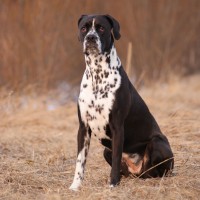
 |
Boxmatian |
|
He is not recognized by the F.C.I. |
Origin |
Germany <> Croatia -> U.S.A. | |
Translation |
Francis Vandersteen | |
This breed is also known as |
Dalmoxer
|
A brief presentation of the Boxmatian |
| With its quirky sense of humor, the Boxmatian is sure to keep you laughing for hours. The breed is descended from interesting parent breeds, the Boxer and the Dalmatian. The origins of the Boxmatian hybrid are largely unknown, but it is suspected that the hybrid was first developed in Europe. The Boxmatian is a relatively healthy breed with minor medical problems. This intelligent dog tends to act like a clown around its family due to its predominantly friendly nature. Early socialization and training are highly recommended, as this dog tends to become aggressive if left unchecked. Adorned with a short coat, the Boxmatian has an easy-to-maintain grooming routine. |
History of the Boxmatian |
| The origins of the Boxmatian breed are not well documented at present. It is suspected that the breed originated in Europe, where the two parent breeds originated. The Boxmatian's parent breeds, the Boxer and the Dalmatian, are thought to have been crossed to create a healthier hybrid breed type. |
A little of the Boxer |
||
| There are conflicting reports on how the Boxer was originally developed. It is reported that the Boxer was developed in Germany to retain the qualities of its ancestors, the Dogue de Bordeaux and the old Tibetan fighting dog. The Boxer continued to be modified in appearance to create a more attractive dog breed. Other research suggests that this breed was developed by now extinct breeds such as the Danziger Bullenbaiser and the Brabenter Bullenbaiser in Central Europe. In the 1830s, German hunters crossed these breeds to develop a new, robust and agile breed. In 1895, the Boxer is said to have been created. The Boxer became a favorite among military and police forces in the 1900s. In 1904, the Boxer was registered with the American Kennel Club. In 1940, the Boxer won the Best in Show award. | ||
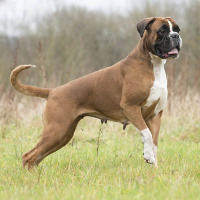 |
||
| Standard of the Boxer | ||
A little of the Dalmatian |
||
| There are various theories as to how the Dalmatian came to be. Some research indicates that the breed originated in Croatia, while other research suggests that it was a dog that existed in the Middle Ages. It is generally thought that the Dalmatian was a smaller version of the Pointer. Over the years, the Dalmatian is thought to have taken on many roles, such as circus dog, ratter, shepherd and military dog. Its most popular task was that of a trainer dog, which meant that the breed protected horses and trainers. After the invention of the automobile, the Dalmatian lost popularity but retained its role in the fire service. The Dalmatian is best known for Disney's "101 Dalmatians", where its popularity rose to the top of the charts. | ||
 |
||
| Standard of the Dalmatian |
Appearance of the Boxmatian |
| The Boxmatian mainly resembles the Dalmatian with its short, thin, spotted coat. Coat colors are predominantly white, but can vary with additional black spots or a spotted belly. The breed is considered a medium-weight athlete with a powerful stance. Its alert, intelligent gaze exudes an air of elegance. Its symmetrical body contains no exaggerations of proportion. This large breed has a straight, short muzzle and no underbite. The tail is long and expressive. The Boxmatian's weight varies from 22.5 to 41 kilos, and its height from 48 to 63.5 centimeters. |
Temperament of the Boxmatian |
| The Boxmatian is a highly energetic hybrid breed that needs plenty of exercise to be satisfied. They love being with their family and find joy in keeping busy. If left to his own devices, your Boxmatian may indulge in property destruction out of sheer boredom. This can be prevented by providing mental and physical stimulation every day. This willing and friendly dog loves to run, play and swim. It's an intelligent breed that requires continual challenge to keep it entertained. Although the Boxmatian barks at strangers, it can be trained to distinguish between friendly strangers and unwelcome intruders. This breed is not recommended for young children due to the Dalmatian's tendency to become aggressive if not properly trained. However, it is affectionate as a rule and aggression can be eliminated if exposed to early intervention and guidance. The Boxmatian will need training to welcome other animals and dogs into its circle. This intelligent dog does best in warmer climates and in a spacious home. |
Needs and activities of the Boxmatian |
| The Boxmatian has high energy levels and requires daily exercise. It's important to provide this breed with at least one hour of exercise a day to maintain its health and weight. It's a guarantee that the Boxmatian won't hesitate to go the extra mile. This hybrid thrives on intense play, such as fetching a ball, running alongside you for miles and swimming. Apartment living is not recommended, as the Boxmatian is large and generally very exuberant, so it's best to adopt this hybrid in a large house with a spacious, secure yard. Be prepared to spend time with your Boxmatian, as bonding and exercise will make for a happy dog. |
Maintenance of the Boxmatian |
| The Boxmatian is not a hypoallergenic breed and sheds moderately. To reduce shedding, daily brushing should be supplemented with a rubber curry brush or a smooth brush, taking care not to brush too hard. Drooling is reduced to a minimum, and there is no significant odor in this breed. Your dog should be bathed every 6 to 8 weeks if necessary. Shampoo and conditioner options vary according to your dog's specific needs. If your dog has skin allergies, it's best to use a hypoallergenic shampoo. Ears should be wiped and cleaned weekly. Teeth should be brushed weekly. Nails should be trimmed or filed every 2 to 3 weeks to prevent proliferation and also to avoid tears and cracks, common in active dogs. |



 English (United Kingdom)

Comments