
 |
Boxmas |
|
He is not recognized by the F.C.I. |
Origin |
Germany <> Great Britain -> U.S.A. | |
Translation |
Francis Vandersteen |
A brief presentation of the Boxmas |
| Affectionate, loyal and devoted to their family, Boxmas are descended from the Boxer and Mastiff breeds. This breed tends to become a one-owner dog if early training is not provided. This dedicated dog is not known for being an annoying barker. Although its history is not well documented, the Boxmas is a hybrid breed that originated in Europe in recent years. This attentive dog is known for being aware of its surroundings and is adept at protecting itself from intruders. Although this breed may seem intimidating, its wonderful personality is enough to convince you. Boxmas have a short, dense coat with water-repellent hair. Maintaining this breed is easy as long as daily exercise is provided with intense play. |
History of the Boxmas |
| Due to its status as a hybrid breed, the history of the Boxmas is not well documented. Its two parent breeds, the Boxer and Mastiff, were developed in Europe. Boxmas are also said to have originated in Europe, although the year is unknown. Hybrid breeds have often been developed to reduce medical illnesses and produce healthier dogs. |
A little of the Boxer |
||
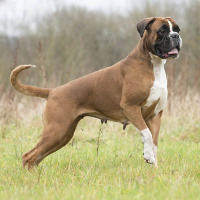
| There are conflicting reports on how the Boxer was originally developed. It is reported that the Boxer was developed in Germany to retain the qualities of its ancestors, the Dogue de Bordeaux and the old Tibetan fighting dog. The Boxer continued to be modified in appearance to create a more attractive dog breed. Other research suggests that this breed was developed by now extinct breeds such as the Danziger Bullenbaiser and the Brabenter Bullenbaiser in Central Europe. In the 1830s, German hunters crossed these breeds to develop a new, robust and agile breed. In 1895, the Boxer is said to have been created. The Boxer became a favorite among military and police forces in the 1900s. In 1904, the Boxer was registered with the American Kennel Club. In 1940, the Boxer won the Best in Show award. | ||
 |
||
| Standard of the Boxer | ||
A little of the Mastiff |
||
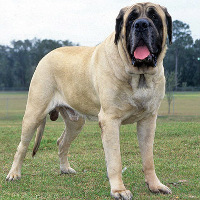
| Boxmas' other parent breed, the Mastiff, was first mentioned in the 6th century BC. The Mastiff became a Roman favorite and was used as a gladiator in the arena. Its massive size enabled it to perform guarding, surveillance and search-and-rescue duties. Sir Piers Legh was one of the most favorite Mastiffs to stand guard during the Battle of Agincourt. This adorable dog was imported to America in the 1800s and almost disappeared in Europe during the Second World War. While its ancestors were trained to protect, today's Mastiff is also a loyal companion ready to please its family. | ||
 |
||
| Standard of the Mastiff |
Appearance of the Boxmas |
| Standing tall, this massive breed may intimidate those unfamiliar with the gentle giant. Their tall body is muscular and strong. Boxmas' legs are long with its large paws. The ears are of medium length and resemble Mastiff features. The tail can be left natural or docked. The coat is short, dense and water-repellent, varying from white to brown to black. When fully grown, these massive dogs weigh between 32 and 45 kilos. The appearance of Boxmas can vary according to their dominant features. As a general rule, this large breed will strongly resemble the Mastiff. |
Temperament of the Boxmas |
| Like other hybrid breeds, the Boxmas' temperament can vary according to the dominant traits it inherits. They may inherit the energetic nature of the Boxer, or develop a more docile disposition. This friendly dog is known for being cheerful, genuine, friendly, loyal, protective and affectionate. Its personality makes it a suitable pet. Early training should be provided so that your Boxmas fully accepts young children. Make sure your dog doesn't become too attached to just one member of the family. Early socialization and interaction with all family members will prevent this from becoming a problem. Your dog may need to learn to distinguish between a friendly stranger and a hostile intruder. Once he understands the difference, he can be affectionate and loving towards others. Providing positive reinforcement is key with Boxmas. It's important to be firm with commands and reward with treats. The Boxmas is considered a highly intelligent breed that wants to accompany its family everywhere. Their energy levels are generally described as high. |
Needs and activities of the Boxmas |
| Boxmas require high instances of stimulation to stay engaged and avoid boredom. This breed is very exuberant and will need intense outdoor play. This active dog is used to being used as a guard dog, protection dog and military/police dog. Staying active ensures that this breed gets the mental work it needs to be satisfied. Boxmas will benefit from activities such as running, tugging, retrieving, obedience classes and plenty of walks totaling at least an hour out every day. With a breed as large as the Boxmas, apartment living should be avoided. Because exercise is a top priority for this breed, a large rural home with a spacious yard would be the best solution. A warm climate is ideal. |
Maintenance of the Boxmas |
| The Boxmas is not a hypoallergenic breed and has high levels of excretion. If you have allergies, this breed may not be the best solution for you. Daily brushing is necessary to remove dead hairs and prevent hair from accumulating around your home. The best brush to use would be a rubber curry brush, although a detangler can sometimes come in handy. This active canine breed contains a moderate odor that can be mitigated with baths every 6 to 8 weeks. Excessive bathing can lead to overproduction of oils in the skin. Ears should be wiped and cleaned at least once a week. Teeth should be brushed, ideally every day, to remove tartar. Nails should be trimmed every 2-3 weeks to prevent overgrowth and discomfort. |



 English (United Kingdom)

Comments