
 |
Boxachi |
|
He is not recognized by the F.C.I. |
Origin |
Germany <> Mexico -> U.S.A. | |
Translation |
Francis Vandersteen |
A brief presentation of the Boxachi |
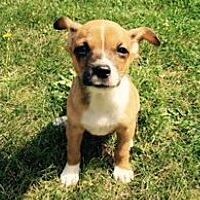
| The Boxachi is a hybrid breed in which the Boxer is crossed with the Chihuahua. Relatively new, there's little information available on the Boxachi. As a Boxachi puppy will inherit traits from both parents, it's best to consider the traits of each parent breed when trying to understand what the hybrid will look like. The Boxer is a large dog that is generally both playful and curious, while the Chihuahua is a very small dog, usually weighing less than 3 kilos. Most likely, your Boxachi will weigh less than 18 kilos. This fun-loving hybrid is known for being devoted to its owner and for its cheeky personality. |
History of the Boxachi |
| The hybrid known as the Boxachi is a new breed of dog with no detailed history. However, the two breeds that combine to create the breed have a long history. |
A little of the Boxer |
||
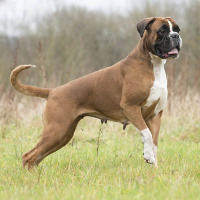
| There is evidence to suggest that the Boxer is one of many descendants of the Bulldog and the fighting dogs of the high valleys of Tibet. Some sources claim that the Boxer is the result of two breeds of dog that were found in Central Europe and no longer exist, the Danziger Bullenbeisser and the Brabanter Bullenbeisser. Known for their hunting and fighting skills, Boxers are thought to have originated in the 1500s. | ||
 |
||
| Standard of the Boxer | ||
A little of the Chihuahua |
||
| There are several theories about the origin of the Chihuahua. One theory is that the breed began in Egypt 3,000 years ago. Another is that the Chihuahua breed began in China and was brought elsewhere by Spanish traders. It is thought that the dog was then crossed with small dogs native to the region. A third theory is that the Chihuahua was created in Central and South America, descended from an indigenous dog called the "Techichi". The Techichi was small and mute, and was sometimes used in sacrificial ceremonies, as a small red dog was believed to have the ability to guide the soul to the underworld. What is certain is that around 1850, three small dogs were found in Chihuahua, Mexico. A small number of dogs were eventually brought to America, though they received little attention. When Xavier Cugat regularly brought his Chihuahua with him in public, the breed began to attract American attention and became very popular. | ||
 |
||
| Standard of the Chihuahua |
Appearance of the Boxachi |
| Your Boxachi may look more like one parent than the other, but it can also have a look all its own. Often, the face of this hybrid more closely resembles that of the Chihuahua, small and with a round chin. The muzzle is generally longer than that of the Boxer parent. The eyes are usually prominent, and the wrinkles we see on the Boxer are often smoothed out, giving the face a look similar to that of the Chihuahua parent. Ears may fold at the tip. His tail will most likely have a curl. A curious look and a gentle smile will define the face. |
Temperament of the Boxachi |
| The Boxachi will inherit its temperament from its parents. The Boxer is playful, curious, attentive and devoted to his family. As dogs of the breed tend to be gentle and patient, the Boxer is a good choice for a family with children. The Boxer can be stubborn, but is also sensitive and will respond well to training. Although the Boxer can be aggressive when meeting strange dogs, it will generally do well with other dogs and pets. The Chihuahua is a cheeky dog that is devoted to its owners. Typically, a Chihuahua will be reserved with those it doesn't know and can become jealous, so early socialization is important to prevent it becoming aggressive with other dogs or fearful of strangers. In general, the Chihuahua will do well with the other dogs and pets it lives with. Known for being temperamental, the Chihuahua will do best with older, gentle children and adults. The Boxachi is intelligent like its parents and will learn quickly if a positive training approach is used. He'll live in harmony with other furry family members, but as with all dogs, don't leave your Boxachi unsupervised in the presence of small animals such as hamsters or ferrets. |
Needs and activities of the Boxachi |
| The Boxachi's activity requirements can be gauged from those of its parents. A Boxer will enjoy a good run, but can meet its exercise needs with a long walk on a leash. Boxers can live happily in an apartment if they get enough exercise, although a medium-sized fenced yard is recommended. Chihuahuas, on the other hand, require moderate levels of activity. Although it's tempting to carry your Chihuahua, it will benefit from walks. Chihuahuas do very well in apartments because of their small size and don't require a garden. The Boxachi will thrive in an active home, taking it for walks (especially if it's in the larger size range), providing an outlet for energy. |
Maintenance of the Boxachi |
| The maintenance of your Boxachi will be moderate and will depend on the coat inherited. The Boxer's coat is short and benefits from occasional brushing with a firm bristle brush. We recommend bathing a Boxer only when absolutely necessary, as this will remove the natural oils from the skin. Considered a clean breed, many Boxers will groom themselves as cats do. The Chihuahua's coat requires minimal maintenance. A Chihuahua with a short coat will benefit from having its coat brushed or wiped with a damp cloth on occasion. For those with long coats, brushing should take place several times a week with a soft bristle brush. As Chihuahuas are sensitive to the cold, a sweater is recommended in cooler weather, and a leash should be used for walking. Whether your Chihuahua has short or long hair, we recommend bathing it once a month. As with any dog, it's important to provide your Boxachi with dental care to ensure long-term dental health. |



 English (United Kingdom)

Comments