
 |
Boxador |
|
He is not recognized by the F.C.I. |
Origin |
Germany <> Canada -> U.S.A. | |
Translation |
Francis Vandersteen |
A brief presentation of the Boxador |
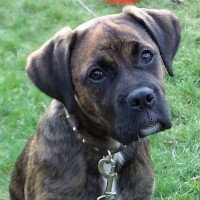
| The Boxador is a specific cross between the Boxer and the Labrador Retriever. Loving, loyal and intelligent, the Boxador is an excellent companion and watchdog. These hybrid dogs are large and energetic, requiring a great deal of exercise. Grooming of the breed is minimal for most of the year and moderate during the moulting seasons. A fenced yard where the Boxador can play safely is ideal for this exuberant, active hybrid. A dog that will excel as a companion once trained, the Boxador is intelligent and eager to please. |
History of the Boxador |
| As a newcomer, the Boxador has no distinct history. Instead, their history is that of their parent breeds. |
A little of the Boxer |
||
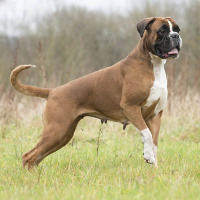
| The Boxer is thought to be a descendant of the Tibetan Mastiff, while other theories place it as a distant relative of the Dogue de Bordeaux. Prized as a hunter and fighter, it has fortunately been allowed to move on to better activities over time. A companion, a military dog and even a show dog were future employments. The Boxer was added to the AKC list in 1904. | ||
 |
||
| Standard of the Boxer | ||
A little of the Labrador Retriever |
||
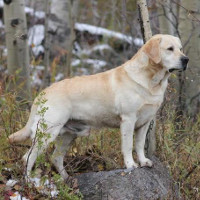
| The Labrador Retriever originated in Newfoundland, Canada, from the original Newfoundland breed. Early Newfoundland dogs were seen in various sizes, the smallest being called the St. John's Newfoundland or Lesser Newfoundland. Early examples of the Labrador breed were black and medium-sized, with significant skills in retrieving game and useful for working with fishermen. The dogs were excellent swimmers, having no problem swimming in the icy waters of the North. As the breed died out in Newfoundland, many Labradors were taken to England in the 1800s. These dogs, along with other crossbreeds, were able to evolve and acquire a reputation for retrieving game in the highlands. The Labrador Retriever was recognized by the American Kennel Club in 1917. | ||
 |
||
| Standard of the Labrador Retriever |
Appearance of the Boxador |
| The Boxador tends to be large, averaging between 22.5 and 50 kilos and 58 to 63 centimeters in height. This breed's coat will be glossy and short, and its color can vary. It can be seen as brindle, black or white, or also in color combinations. The Boxador's head tends to be larger than that of the Labrador Retriever, and will include large jowls. The breed's ears are generally floppy, and its tail will be curled or docked. The Boxador may look more like its Boxer or Labrador Retriever parent, but either way, it's an interesting hybrid that's sure to turn heads. |
Temperament of the Boxador |
| The Boxador is generally intelligent, loving and loyal to its family. Always eager to join in the fun, he can do well as a member of a family of any size. The Boxador will usually have lots of energy and be very playful. Your Boxador will want to please you, and between his desire to please and his desire to work, he'll probably be easy to train. Most Boxadors don't like to be left alone and may suffer from separation anxiety. He should get on well with other animals, although socialization is important. Introduce him at an early age to the other animals in the family, and make sure the children know how to treat the Boxador with respect. |
Needs and activities of the Boxador |
| A large dog, the Boxador will require at least 30 minutes of exercise a day, as well as general playtime. One hour of exercise a day is ideal. Exercise can include running, long walks or hikes, playing Frisbee, catching, fetching or tug-of-war. Time to run and play in a large yard is helpful. In addition to helping maintain your hybrid's health, mental and physical exercise is important to keep your Boxador from acting out and engaging in destructive behavior. Obedience classes can be the ideal way to keep your Boxador's mind occupied. |
Maintenance of the Boxador |
| Boxadors require little to moderate grooming effort. Since shedding will occur seasonally, the frequency with which it is brushed will depend on the moulting season. During periods of heavy shedding, weekly brushing is sufficient. During periods of coat change, daily brushing is useful to remove loose hairs. Bathing is often not necessary, but when it is, be sure to use a shampoo specially formulated for dogs. Boxador's nails should be trimmed if necessary, and his teeth brushed three times a week to ensure long-term dental health. Tartar can easily build up on teeth, leading to cavities. |



 English (United Kingdom)

Comments