
 |
Blue Spaniel |
|
He is not recognized by the F.C.I. |
Origin |
Australia <> Great Britain -> U.S.A. | |
Translation |
Francis Vandersteen | |
This breed is also known as |
Cocker Heeler Spaniel |
A brief presentation of the Blue Spaniel |
| The Blue Spaniel is a cross between an Australian Cattle Dog and an English Cocker Spaniel. They are bred to be active companion dogs. This breed is generally known for being happy, intelligent and energetic. Blues Spaniels come from two athletic parent breeds, so they need regular, vigorous exercise to stay happy. They have an average lifespan of 10 to 14 years, weigh 12.5 to 20.5 kilos and stand 38 to 51 centimeters tall. Their overall size depends on whether they are descended from American or English Cockers, the former being smaller. They generally resemble undersized cattle dogs with English Cocker Spaniel characteristics, including floppy ears and a medium-length wavy coat that requires regular brushing. Because they are a relatively new breed, they are not currently able to join the American Kennel Club's (AKC) list of purebred dogs. |
History of the Blue Spaniel |
| The name Blue Spaniel is a nod to the breed color inherited from the Australian Cattle Dog and the name of its other parent, the English Cocker Spaniel. The union of the Australian Cattle Dog and the English Cocker Spaniel gave rise to the Blue Spaniel, which is a relatively new breed. The size difference between the English Cocker Spaniel and the American Cocker Spaniel explains the breed's wide variation in the average weight and size ranges. Although the personality of the Blue Spaniel has not been stabilized, it is generally known to be pleasant, intelligent and energetic. At present, the Blue Spaniel is not recognized by the AKC. As such, Blue Spaniel breeders should be thoroughly researched if you're considering buying a puppy through them. |
A little of the Australian Cattle Dog |
||
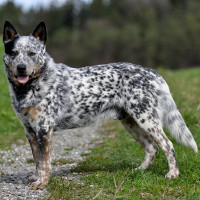
| The Australian Cattle Dog, a descendant of the Collie and Dingo varieties, was bred in Australia in the mid-1800s in herds. Eventually, the mixed breed known for its endurance and work ethic, was bred with Dalmatian and Sheepdog varieties to resemble the Australian Cattle Dog we know today. The AKC recognized the breed in 1980. | ||
 |
||
| Standard of the Australian Cattle Dog | ||
A little of the English Cocker Spaniel |
||
| The Blue Spaniel's other parent, the English Cocker Spaniel, originated in the UK and was bred in the 1800s as a sporting companion. English Cocker Spaniels were gifted at woodcock hunting, from which derived part of their Cocker name. Until 1936, the English Cocker Spaniel and the American Cocker Spaniel, which tends to be smaller than the former, were considered the same breed. American and English breeders, however, began to disagree on how to mate the dog. The result was two varieties: an American and an English. The American Cocker Spaniel is more popular in the USA, while the English Cocker Spaniel is more popular in the rest of the world. | ||
 |
||
| Standard of the English Cocker Spaniel |
Appearance of the Blue Spaniel |
| A Blue Spaniel generally resembles a small Australian Cattle Dog with Cocker ears and coat. They have a compact, athletic build. Size depends on whether the Australian Cattle Dog is crossed with an American or English Cocker Spaniel. In any case, they are generally medium-sized. The average weight is 12.5 to 20.5 kilos and the average height is 38 to 51 centimeters. Their coat is blue (marbled or spotted) or black and white with ochre markings. Blues Spaniels retain the soft, wavy, medium coat of English Cocker Spaniels. They have an alert, intelligent expression, with soft ears, a scissor bite, a dark nose and oval eyes that are usually dark brown or hazel. Their tails are of medium length and tapered, while the legs are round with elastic pads for running. |
Temperament of the Blue Spaniel |
| Blues Spaniels are known to be happy, friendly dogs with occasional aggressive, hunting tendencies. These tendencies are triggered when Blues Spaniels are around groups of dogs or small animals. Blues Spaniels bark occasionally and are known to be sensitive to environmental and routine changes, as well as to the aggressive behavior of others. Fortunately, the breed also responds well to obedience training, given its high level of intelligence and willingness to please its owner. Otherwise, Blues Spaniels can be very playful and eager to participate in games with their owners and most other dogs. Because both parent breeds require physical and mental stimulation, Blues Spaniels need to be exercised and entertained regularly to stay satisfied and healthy. The Blue Spaniel is more like its English Cocker Spaniel ancestry in that it is extremely people-oriented, making it an affectionate and loyal family dog that loves human attention. |
Needs and activities of the Blue Spaniel |
| Blue Spaniels come from two very energetic, inquisitive breeds. As a result, they require constant, daily exercise. Blues Spaniels should have at least one moderate to long walk a day, combined with vigorous play with other dogs or retrieving games with people. Blues Spaniels thrive in cool, temperate environments. They'll do well in warm environments if they're not over-exercised in the heat. Blues Spaniels will be happiest in a suburban or rural home with a large yard in which they can play. Both parent breeds have strong impulses to roam, so Blues Spaniels should be closely supervised if off-leash or in an area that isn't well fenced. Although Blues Spaniels like to be outdoors, they are primarily indoor pets who appreciate downtime with their owners and family. |
Maintenance of the Blue Spaniel |
| Blues Spaniels are moderate excretors and, as a result, require a moderate level of regular grooming. They are not completely hypoallergenic, but produce fewer allergens due to the hair-like coat on their Spaniel side. Owners can reduce shedding and matting by brushing 1-2 times a week and giving the Blue Spaniel its monthly bath. Owners should pay particular attention to cleaning the Blue Spaniel's large, soft ear with each wash. Like all dog breeds, Blues Spaniels should have their teeth brushed daily and their nails trimmed 1-2 times a month to prevent painful overgrowth. Trimming around the head, ears, tail and feet is recommended. |



 English (United Kingdom)

Comments