
 |
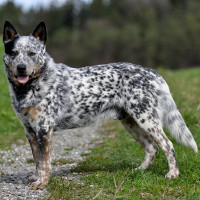
Australian Cattle Dog |
|
FCI standard Nº 287 |
||
Origin |
Australia | |
Group |
Group 1 Sheepdogs and Cattledogs, except Swiss Mountain and Cattledogs | |
Section |
Section 2 Cattledogs | |
Working |
Without working trial | |
Acceptance on a definitive basis by the FCI |
Monday 20 March 1972 | |
Publication of the official valid standard |
Monday 08 October 2012 | |
Last update |
Wednesday 05 December 2012 | |
En français, cette race se dit |
 |
Bouvier australien |
Diese Norm ist in deutscher Sprache sichtbar |
 |
Australischer Treibhund |
En español, esta raza se dice |
 |
Boyero australiano |
In het Nederlands, wordt dit ras gezegd |
 |
Australische veedrijvershond |
Usage |
| Cattledog. |
Brief historical summary |
| The Australian Cattle Dog was developed to assist with establishing the cattle industry in early Australian conditions. The principal requirement was a strong, biting dog, possessing great stamina and capable of mustering and moving wild cattle. Early imported breeds of working dogs did not possess these requirements. The first settlers had a limited availability of labour, this created problems in the control of their herds of cattle and flocks of sheep. Most properties were unfenced and the scrub country had not been cleared. To facilitate the efficient handling of sheep and cattle, they set about creating breeds of dogs to do this work for them. A great deal of research has been undertaken to ascertain the origin of the Australian Cattle Dog, but as early breeders kept very little recorded information, there is a marked divergence of opinion as to the breeds used to develop the purebred dog we see today. It is generally recognised though, that it resulted from the crossing of blue merle, smooth haired Collies with the Dingo, with a later injection of Dalmatian and black and tan Kelpie blood. Other cross breeding was tried, such as a Bull Terrier cross, but all these other crosses proved to be unsuccessful for the working of cattle. |
General appearance |
| The general appearance is that of a strong, compact, symmetrically built working dog, with the ability and willingness to carry out his allotted task however arduous. Its combination of substance, power, balance and hard muscular condition must convey the impression of great agility, strength and endurance. Any tendency to grossness or weediness is a serious fault. |
Important proportions |
| The length of the body from the point of the breast bone, in a straight line to the buttocks, is greater than the height at the withers, as 10 is to 9. |
Behaviour / temperament |
| The Cattle Dog's loyalty and protective instincts make it a self-appointed guardian to the Stockman, his herd and his property. Whilst naturally suspicious of strangers, must be amenable to handling, particularly in the Show ring. Any feature of temperament or structure foreign to a working dog must be regarded as a serious fault. As the name applies the dog’s prime function, and one in which he has no peer, is the control and movement of cattle in both wide open and confined areas. Always alert, extremely intelligent, watchful, courageous and trustworthy, with an implicit devotion to duty making it an ideal working dog. |
Head |
||
Cranial region |
||
Head |
The head is strong and must be in balance with other proportions of the dog and in keeping with its general conformation. | |
Skull |
The broad skull is slightly curved between the ears. | |
Stop |
The skull flattens to a slight but definite stop. | |
Facial region |
||
Nose |
Black. | |
Muzzle |
Broad and well filled in under the eyes, tapering gradually to form a medium length, deep, powerful muzzle with the skull and muzzle on parallel planes. | |
Lips |
Tight and clean. | |
Jaws and teeth |
Strong, deep and well developed underjaw. The teeth should be sound, strong and evenly spaced, gripping with a scissor-bite, the lower incisors close behind and just touching the upper. As the dog is required to move difficult cattle by heeling or biting, teeth which are sound and strong are very important. | |
Cheeks |
Muscular, neither coarse nor prominent. | |
Eyes |
The eyes should be of oval shape and medium size, neither prominent nor sunken and must express alertness and intelligence. Eye colour should be dark brown. A warning or suspicious glint is characteristic when approached by strangers. | |
Ears |
The ears should be of moderate size, preferably small rather than large, broad at the base, muscular, pricked and moderately pointed, neither spoon nor bat eared. The ears are set wide apart on the skull, inclining outwards, sensitive in their use and pricked when alert ; the leather should be thick in texture and the inside of the ear fairly well furnished with hair. | |
Neck |
| The neck is extremely strong, muscular and of medium length broadening to blend into the body and free from throatiness. |
Body |
||
Topline |
Level. | |
Back |
Strong. | |
Loin |
Broad, strong and muscular. Dog strongly coupled and with deep flanks. | |
Croup |
Rather long and sloping. | |
Chest |
Deep, muscular and moderately broad. | |
Ribs |
Ribs well sprung and carried well back, not barrel ribbed. | |
Tail |
| The set on of the tail is moderately low, following the contours of the sloping croup and of length to reach approximately to the hock. At rest, it should hang in a very slight curve. During movement or excitement the tail may be raised, but under no circumstances should any part of the tail be carried past a vertical line drawn through the root. The tail should carry a good brush. |
Limbs |
Forequarters |
||
Generality |
The forelegs have strong, round bone, extending to the feet and should be straight and parallel, viewed from the front. | |
Shoulders |
The shoulders are strong, sloping, muscular and well angulated to the upper arm and should not be too closely set at the point of the withers. Although the shoulders are muscular and the bone is strong, loaded shoulders and heavy fronts will hamper correct movement and limit working ability. | |
Pastern |
Pasterns should show flexibility with a slight angle to the forearm when viewed from the side. | |
Hindquarters |
||
Generality |
The hindquarters are broad, strong and muscular. When viewed from behind, the hind legs, from the hocks to the feet, are straight and placed parallel, neither close nor too wide apart. | |
Upper thigh |
Long, broad and well developed. | |
Stifle |
Well turned. | |
Hock |
Strong and well let down. | |
Feet |
| The feet should be round and the toes, short, strong, well arched and held close together. The pads are hard and deep, and the nails must be short and strong. |
Gait and movement |
| The action is true, free, supple and tireless and the movement of the shoulders and forelegs is in unison with the powerful thrust of the hindquarters. The capability of quick and sudden movement is essential. Soundness is of paramount importance. When trotting the feet tend to come closer together at the ground level as speed increases, but when the dog comes to rest he should stand four square. |
Coat |
||
Hair |
The coat is smooth, a double coat with a short, dense undercoat. The outer coat is close, each hair straight, hard and lying flat, so that it is rain-resisting. Under the body to behind the legs, the coat is longer and forms near the thigh a mild form of breeching. On the head (including the inside of the ears), to the front of the legs and feet, the hair is short. Along the neck it is longer and thicker. A coat either too long or too short is a fault. As an average, the hairs on the body should be from 2,5 to 4 cms in length. | |
Colour |
Blue mottled : The colour should be blue, blue mottled or blue speckled with or without other markings. The permissible markings are black, blue or tan markings on the head, evenly distributed for preference. The forelegs tan midway up the legs and extending up the front to breast and throat, with tan on jaws ; the hindquarters tan on inside of hindlegs, and inside of thighs, showing down the front and the stifles and broadening out to the outside of the hindlegs from hocks to toes. Tan undercoat is permissible on the body providing it does not show through the blue outer coat. Black markings on the body are not desirable. Red speckle : The colour should be of good even red speckle all over, including the undercoat, (neither white nor cream), with or without darker red markings on the head. Even head markings are desirable. Red markings on the body are permissible but not desirable. |
|
Size and weight |
||
Height at withers |
Males : 46 to 51 cms. Females : 43 to 48 cms. | |
Faults |
| • Any departure from the foregoing points should be considered a fault and the seriousness with which the fault should be regarded should be in exact proportion to its degree and its effect upon the health and welfare of the dog and its ability to perform its traditional work. • Faults listed should be in degree of seriousness. |
Serious faults |
 Shoulder that is loaded, slack or straight. Weakness at elbows, pastern or feet. Straight stifles. Cow-or bow hocked. Movement that shows stiltedness. Shoulder that is loaded, slack or straight. Weakness at elbows, pastern or feet. Straight stifles. Cow-or bow hocked. Movement that shows stiltedness. |
Disqualifying faults |
| Aggressive or overly shy dogs. |
NB : |
| • Any dog clearly showing physical or behavioural abnormalities shall be disqualified. • The above mentioned faults when occurring to a highly marked degree or frequently are disqualifying. • Male animals should have two apparently normal testicles fully descended into the scrotum. • Only functionally and clinically healthy dogs, with breed typical conformation should be used for breeding. |
Bibliography |
| https://www.fci.be/ |



 English (United Kingdom)

Comments