
 |
Basset Heeler |
|
He is not recognized by the F.C.I. |
Origin |
Great Britain <> Australia -> U.S.A. | |
Translation |
Francis Vandersteen | |
This breed is also known as |
Australian Battle Dog |
A brief presentation of the Basset Heeler |
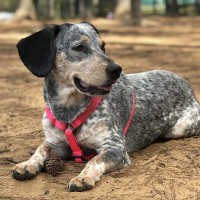
| Devoted and loyal, the Basset Heeler is a medium-sized hybrid breed developed from the Basset Hound and the Australian Cattle Dog (also known as the Blue Heeler). The Basset Heeler is an occasional barker and does not pose a nuisance. The breed's origins are not well documented, but it is suspected that the breed was originally developed to create a dog that was purposeful and dedicated to guarding and protection. The Basset Hound's original purpose was to hunt rabbits, while the Blue Heeler's was to protect against intruders. The Basset Heeler's current purpose is to provide protection and also serve as a companion. The Basset Heeler most closely resembles the Blue Heeler in appearance. Its coat is short and dense like the two parent breeds. The color of its coat is available in a variety of combinations such as blue, blue marbled, blue spotted, red marbled and red spotted. The coat is low-maintenance and easy to care for. |
History of the Basset Heeler |
| Although the exact origin of the Basset Heeler is unknown, it is suspected that the breed originated in the United States. The Basset Heeler is thought to have originated when the idea of hybrid breeds began to gain popularity. The Basset Heeler was created by mixing the Basset Hound and the Blue Heeler. The Basset Hound was bred to be a short, stocky dog with a slow pace for easier hunting. Because of the Basset Heeler's hybrid status, it is not officially recognized by the AKC. |
A little of the Basset Hound |
||
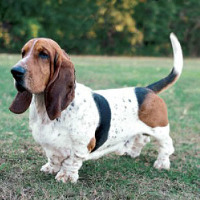
| The Basset Hound dates back to the pre-French Revolution era, when the friars of the French abbey of Saint-Hubert took a keen interest in the breed. After the French Revolution, the Basset Hound continued to gain popularity with commoners and hunters who wanted a breed capable of successfully capturing small game. The Basset Hound's nose was a highly desirable trait in the breed. The Basset Hound was officially recognized by the American Kennel Club in 1935. | ||
 |
||
| Standard of the Basset Hound | ||
A little of the Australian Cattle Dog |
||
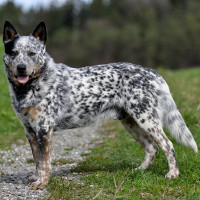
| The Blue Heeler was highly sought after for its ability to cover long distances over rough terrain. The breed was able to control cattle without having to bark. Experts suggest that Blue-merle Highland Collies were crossed with dingoes in the 1840s. The white blaze found on the Blue Heeler's head is said to be the result of breeding. Brothers Jack and Harry Bagust wanted to improve the Blue Heeler because of its efficiency in the field. The breed has undergone several name changes over the years. It was called the Queensland Blue Heeler at one point, then the name was changed to the Australian Heeler. Finally, the name was chosen as Australian Cattle Dog. In 1897, the breed standard was made public. In 1897, Robert Kaleski began breeding the Blue Heeler and showed it in 1897. In 1980, the American Kennel Club officially recognized the Blue Heeler. | ||
 |
||
| Standard of the Australian Cattle Dog |
Appearance of the Basset Heeler |
| The Basset Heeler resembles both of its breed parents, the Basset Hound and the Blue Heeler. It has soft ears, but not as long and pendulous as the Basset Hound. Its color most closely resembles the Blue Heeler, and can come in various combinations such as blue, blue marbled, blue spotted, red marbled and red spotted. Its coat is dense, short, thick and water repellent. Its constitution is muscular and its body defined. With an expression of strength and intelligence, the Basset Heeler has a broad skull that flattens to a stop between the eyes. It has muscular cheeks and a powerful, medium-length muzzle. The ears are small to medium-sized and set apart. The neck and shoulders are strong, and the forelegs are straight and parallel. Feet are rounded and arched, with small, sturdy toes. |
Temperament of the Basset Heeler |
| The Basset Heeler is known as a tenacious, energetic breed with much to offer its family. They are independent and fierce, and require appropriate mental and physical stimulation to avoid boredom. The Basset Heeler requires caution around strangers as it tends to want to protect its family. If early training is not provided, your Basset Heeler will probably act cautiously and may become aggressive towards others. Extra precautions need to be taken when the Basset Heeler is around people. The Basset Heeler also requires early training to enable it to accept children, other animals and other dogs. The Basset Heeler is not recommended for the new owner, as both parent breeds are known to be stubborn in training. Positive reinforcement is strongly recommended to get your Basset Heeler warmed up to learning. The Basset Heeler has high energy levels and needs to be exercised daily. |
Needs and activities of the Basset Heeler |
| Your Basset Heeler has high energy levels and needs the right grip for exercise. Your Basset Heeler would do best with activities such as recuperation, running and several walks a day. Walks can be split throughout the day, and can be brisk to provide bursts of activity that allow for rest in between. The Basset Heeler would do best in a home with a large fenced yard, well contained to prevent him from running off on his own. He can live in both urban and rural areas as long as he gets the recommended amount of exercise a day to burn off energy and stress, 60 minutes should be the minimum, he can take more and will always be ready to go wherever you go. This dog is ready to move. |
Maintenance of the Basset Heeler |
| The Basset Heeler is not considered a hypoallergenic breed and sheds moderately and often. This breed is not known to drool or contain any significant odor. Their coat is short and dense. Daily brushing with a comb or curry brush will keep its coat clean and crisp. If you wish to bathe your Basset Heeler, it's advisable not to bathe him more often than every 6 to 8 weeks to avoid overproduction of oils in his coat. His ears should be wiped and cleaned every week to avoid bacterial build-up, and it's also a good idea to check for mites and ticks. Nails should be trimmed at least every 2 to 3 weeks, more often if they grow quickly or tear easily. Teeth should be brushed every week. |



 English (United Kingdom)

Comments