 |
Basset Hound |
|
FCI Standard No. 163 |
Origin |
Great Britain | |
Group |
Group 6 Scent hounds and related breeds | |
Section |
Section 1.3 Small-sized hounds | |
Working |
With working trial | |
Date of acceptance on a definitive basis by the FCI |
Thursday 28 April 1955 | |
Date of publication of the official valid standard |
Tuesday 08 September 2026 | |
Date of the last update |
Tuesday 06 October 2026 | |
En français, cette race se dit |
 |
Basset Hound |
Diese Norm ist in deutscher Sprache sichtbar |
 |
Basset Hound |
En español, esta raza se dice |
 |
Basset Hound |
In het Nederlands, wordt dit ras gezegd |
 |
Basset Hound |
Usage |
| Scent Hound. |
Brief historical summary |
| The Basset was reputedly bred by monks in France in the Middle Ages to hunt in heavy cover and is able to hold its nose close to the ground. Though closely related to the entire family of French Bassets the breed was developed to perfection in Britain. He is a dog capable of hunting his natural prey, the hare, persistently at a relatively slow pace over prodigious distances. |
General appearance |
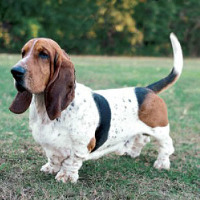
| Short-legged hound of considerable substance, well balanced, full of quality. It is important to bear in mind that this is a working hound and must be fit for purpose therefore should be strong, active and capable of great endurance in the field. |
Behaviour / temperament |
| Tenacious hound of ancient lineage which hunts by scent, possesses a pack instinct and a deep melodious voice. Placid, never aggressive or timid. Affectionate. |
Head |
||
Cranial region |
||
Head |
There may be a small amount of wrinkle at brow and beside eyes. In any event skin of head supple enough as to wrinkle slightly when drawn forward or when head is lowered. | |
Skull |
Domed, with prominent occipital bone, of medium width at brow and tapering slightly to muzzle. | |
Stop |
Moderate. | |
Facial region |
||
Nose |
Entirely black except in light-coloured hounds, when it may be brown or liver. Large and well-opened nostrils, nose may protrude a little beyond lips. | |
Muzzle |
General appearance of foreface lean, not snipy. | |
Lips |
Flews of upper lip overlap lower substantially. | |
Nasal bridge |
Top of muzzle nearly parallel with line from stop to occiput and not much longer than head from stop to occiput. | |
Jaws and teeth |
Jaws strong, with a perfect, regular and complete scissor bite, i.e. the upper teeth closely overlapping the lower teeth and set square to the jaws. | |
Eyes |
Lozenge-shaped, neither prominent nor deep-set, dark but may shade to mid-brown in light-coloured hounds. Expression calm and serious. Light or yellow eye undesirable. | |
Ears |
Set-on low, just below line of eye. Long; reaching only slightly beyond end of muzzle of correct length, but not excessively so. Narrow throughout their length and curling well inwards; very supple, fine and velvety in texture. | |
Neck |
| Muscular, well arched and fairly long with pronounced but not exaggerated dewlap. |
Body |
||
Body |
Long and deep throughout length; withers and quarters of approximately same height. | |
Back |
Rather broad and level. From withers to onset of quarters not unduly long. | |
Loin |
May arch slightly. | |
Chest |
Forechest fitting neatly into crook when viewed from front. Breast bone prominent but chest neither narrow nor unduly deep. | |
Ribs |
Ribs well rounded and sprung, without flange, extending well back. | |
Underline and belly |
There should be adequate clearance between the lowest part of the chest and the ground to allow the hound to move freely over all types of terrain. | |
Tail |
| Well set-on, rather long, strong at base, tapering, with moderate amount of coarse hair underneath. When moving, stern carried well up and curving gently, sabre-fashion, never curling or gay. |
Limbs |
Forequarters |
||
Generality |
Upper forearm inclined slightly inwards, but not to such an extent as to prevent free action or to result in legs touching each other when standing or in action. Some wrinkles of skin may appear on lower legs, but this must on no account be excessive. | |
Shoulders |
Shoulder-blades well laid back; shoulders not heavy. | |
Elbows |
Turning neither in nor out but fitting neatly against side. | |
Forearm |
Forelegs short, powerful and with great bone. | |
Carpal |
Knuckling over highly undesirable. | |
Forefeet |
Large well knuckled up and padded. Forefeet may point straight ahead or be turned slightly outwards but in every case hound always stands perfectly true, weight being borne equally by toes with pads together so that feet would leave an imprint of a large hound and no unpadded areas in contact with ground. | |
Hindquarters |
||
Generality |
Full of muscle and standing out well, giving an almost spherical effect when viewed from rear. Some wrinkles of skin may appear between hock and foot, and at rear of joint a slight pouch of skin may be present, but on no account should any of these be excessive. | |
Stifle |
Well bent. | |
Hock |
Hocks well let down and slightly bent under but turn neither in nor out and just under body when standing naturally. | |
Hind feet |
Large well knuckled up and padded. In every case hound always stands perfectly true, weight being borne equally by toes with pads together so that feet would leave an imprint of a large hound and no unpadded areas in contact with ground. | |
Gait and movement |
| Most important to ensure that the hound is fit for purpose. Smooth, powerful and effortless action with forelegs reaching well forward and hind legs showing powerful thrust, hound moving true both front and rear. Hocks and stifles never stiff in movement, nor must any toes be dragged. |
Skin |
| Supple and elastic without any exaggeration. |
Coat |
||
Hair |
Smooth, short and close without being too fine. Whole outline clean and free from feathering. Long hair, soft coat or feathering highly undesirable. | |
Colour |
Generally black, white and tan (tri-colour); lemon and white (bi-colour); but any recognized hound colour acceptable. Any other colour or combination of colours unacceptable. |
|
Size and weight |
||
Height at withers |
33 - 38 cm. | |
Faults |
| • Any departure from the foregoing points should be considered a fault and the seriousness with which the fault should be regarded should be in exact proportion to its degree and its effect upon the health and welfare of the dog and its ability to perform its traditional work. • Faults listed should be in degree of seriousness. |
Disqualifying faults |
 Aggressive or overly shy. Aggressive or overly shy. |
NB : |
| • Any dog clearly showing physical or behavioural abnormalities shall be disqualified. • The above mentioned faults when occurring to a highly marked degree or frequently are disqualifying. • Male animals should have two apparently normal testicles fully descended into the scrotum. • Only functionally and clinically healthy dogs, with breed typical conformation should be used for breeding. |



 English (United Kingdom)

Comments