
 |
Pugzu |
|
He is not recognized by the F.C.I. |
Origin |
China <> Tibet -> U.S.A. | |
Translation |
Francis Vandersteen |
A brief presentation of the Pugzu |
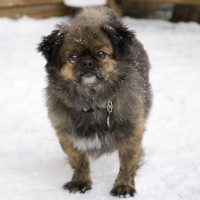
| A combination of the loyal, affectionate Shih Tzu and the confident, clownish Pug, the Pugzu is a delightful crossbreed that has inherited many of the best attributes of each of its parents. A good mix of placid and playful, the Pugzu is equally happy to join in a game or curl up on its owner's lap and relax. Small in size, Pugzus rarely reach heights over 30 centimeters and have long backs, giving them a rectangular shape. Their face is rather squashed and their muzzle is very short indeed. The Pugzu's large, dark eyes give them a calm, noble expression, and they know how to use those beautiful eyes to get what they want. |
History of the Pugzu |
| Take two of the most unique and popular Oriental dog breeds, mix them together and you get the Pugzu. Despite the success of their parents, the Pugzu has not yet become a well-known hybrid and has only been developed relatively recently. With such a short history, we should take a closer look at each of their parent breeds to better understand where they come from. |
A little of the Pug |
||
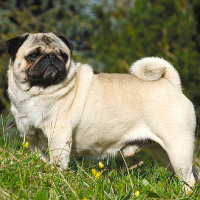
| The Pug is a breed with a long and interesting history. Their origins date back some 2,000 years to ancient China. These flat-faced dogs were a common ancestor for another instantly recognizable dog breed, the Pekingese. The Pug was introduced to Europe in the 16th century by Dutch merchants and quickly became a popular companion dog for aristocrats and royalty. Over the centuries, their appearance has changed somewhat, with the modern dog having a much flatter face than their more robust ancestors. | ||
 |
||
| Standard of the Pug | ||
A little of the Shih Tzu |
||
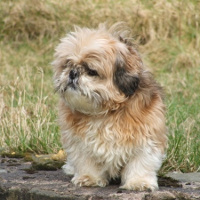
| Shih Tzus are known as little lion dogs and are thought to have originated in Tibet or China, where they are thought to have existed as early as 800 B.C. Both the Lhasa Apso and the Pekingese are thought to have contributed to its genetics. As in the case of the Pug, the Shih Tzu was loved by royalty in ancient China, and the level of respect accorded him is evident in the many portraits and statues found from this period. Many in the UK know the Shih Tzu as the Chrysanthemum Dog, having been given this nickname due to the way their facial fur develops, resembling a flower. Shih Tzu have always made remarkable companion dogs, and some are even used as therapy dogs today. | ||
 |
||
| Standard of the Shih Tzu |
Appearance of the Pugzu |
| Some would say the Pugzu has a face only a mother would love, and it's true that they have a rather unusual look. With their rounded black eyes, domed skull and short muzzle, they look a lot like an Ewok from Star Wars. They have triangular ears that droop and are often set high on the head and wide apart. Their bodies are long and sturdy, making them more robust and powerful than they first appear. They have short, stocky limbs that can bend at an angle. Some will have the Pug's curved tail along their back, but not all. The Pugzu is a small dog measuring between 20 and 30 centimeters and weighing between 4.5 and 10 kilos. The Pugzu's coat is relatively short and should not shed much. Some puppies will shed more after their Pug parent and have shorter coats than others. A variety of coat colors are possible, including fawn, black, red, white and cream. Although solid colors are common, it's not unusual to see a Pug with two colors, such as fawn and black. |
Temperament of the Pugzu |
| It's never easy to predict the temperament of a crossbreed, but the Pugzu tends to have a fairly uniform character. An affectionate, big-hearted dog, the Pugzu needs companionship and relies on its family for support and comfort. They will show great affection and will always be loyal to those they love. They will form good relationships with the whole family, although they may choose a particular person to devote themselves to. Great fun to have around children, the Pugzu knows how to be gentle and has a lot of patience. They're happiest at play and will keep the little ones entertained for hours. Pugzu are so tolerant of people and are poor watchdogs. Even if they give one or two lively greetings, they'll soon be asking the newcomer to make friends. One of the Pugzu's main problems is that they are prone to separation anxiety and can be very difficult to keep alone. They become anxious if left alone for long periods. They would therefore not be suited to a household that is often left empty. Occasional indoor training can help, and there should be plenty to keep them entertained when no one else is around. |
Needs and activities of the Pugzu |
| The Pugzu is relatively active, given its small size. Your gentle Pugzu will need at least 30 minutes of activity a day, which may include a walk outdoors, a stroll in the dog park or fenced yard and indoor play. An apartment will suffice for the Pugzu depending on its small size, assuming it gets the activity it needs. When you're outside in hot weather, you want to make sure your Pugzu doesn't get overexcited, as this can cause him to overheat. It's likely that your Pugzu will prefer to lie still at times, however, it's important that he gets the physical activity he needs. |
Maintenance of the Pugzu |
| The amount of shedding you can expect from a Pugzu will vary, just as it can with the Pug's parent breed, which can shed little to frequently. Pugzu's long coats will need daily cleaning, as his coat can tangle very easily. It's a good idea to take him to the groomer for regular trimming. The Pugzu should only be bathed when necessary, and with a dog shampoo to avoid damaging its natural oils. When Pugzus have longer hair, it may get into their eyes and need to be clipped or tied back. Pugzus that inherit shorter coats will require less maintenance, but whatever the length of his coat, you'll need to brush his teeth regularly, check his ears every week and trim his nails if necessary. |



 English (United Kingdom)

Comments