 |
Great Danoodle |
|
He is not recognized by the F.C.I. |
Origin |
Germany <> France -> U.S.A. | |
Translation |
Francis Vandersteen | |
This breed is also known as |
Great Daneoodle
|
A brief presentation of the Great Danoodle |
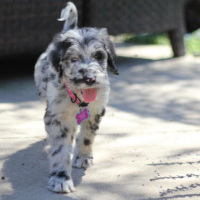
| Also known as the Great Daneoodle or Danepoo, the Great Danoodle is a specific larger-than-life crossbreed dog with a gentle temperament and a desire to please its owner. Although not as large as the Great Dane, they still reach impressive heights and have remarkably long, muscular limbs. Their wavy coat, similar to that of their Poodle relative, can appear a little hairy when allowed to grow, a trait that only adds to their charming appearance. Docile and quick to learn, owners should see rapid results from training sessions. These big dogs don't need a lot of exercise if they're lucky enough to be outdoors. Curious, handsome and good-humored, they're sure to be one of the most popular dogs at the local dog park. |
History of the Great Danoodle |
| While it's true that the Great Danoodle looks more like a famous 19th-century magician, it's actually an emerging breed of specific cross-breed dog conceived by mixing the great Great Dane with the very popular Poodle. This is a rare hybrid dog that is not commonly seen and only exists in small numbers. It has probably only been around for a decade or two, and we expect its population size to increase slowly but steadily. |
A little of the Great Dane |
||
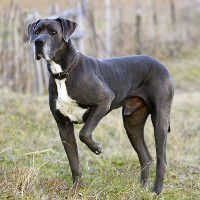
| The Great Dane is reputed to be the world's largest dog, which is quite a prestigious title. Unfortunately, being so large has meant that many Great Danes have a short lifespan and suffer from a number of size-related medical conditions, as well as joint disease and heart disease. The Great Dane is an ancient dog that has been around for over two thousand years, although the original Great Dane would have been shorter and more in proportion than its modern-day equivalent. Their ancestors comprise the English Mastiff and Irish Wolfhound and they were traditionally kept as hunters, pursuing large prey, including wild boar and deer. They were also allowed to sleep in their owners' bedrooms, offering protection from nocturnal intruders. | ||
 |
||
| Standard of the Great Dane | ||
A little of the Poodle |
||
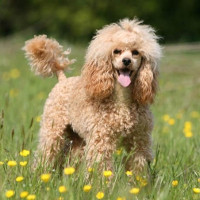
| The Standard Poodle is one of three variants of the Poodle breed, the other two being the Miniature and Toy. The Poodle is undoubtedly the most popular choice of dog for creating specific crossbreeds. This is not only because they come in three different sizes, but also because they tend to have soft fur and a gentle, intelligent nature. Poodles have been around since the 15th century and are descended from the French Barbet, a water dog. Although the Poodle is mistakenly thought to be a French breed in its own right, experts agree that it originated in Germany, where it was used for duck hunting. | ||
 |
||
| Standard of the Poodle |
Appearance of the Great Danoodle |
| It's no easy task to predict what a cross-breed will look like, as there can be a great deal of variation, with some inheriting more genes from their Poodle parent and others taking on the appearance of their Great Dane parent. As a general rule, Great Danoodles are fairly tall, measuring between 56 and 76 cm and weighing between 31 and 45 kg. They often retain the elegant silhouette of the Poodle and carry themselves with pride. They have a large skull with a long muzzle and dark, pensive eyes that give them a sombre appearance. Their dislocated, triangular ears hang from the face, rarely reaching beyond the chin. Their limbs are long and straight, and they should have good abdominal tucking and a long tail that can curl at the top. The Great Danoodle's coat comes in all sorts of types and can be straight, wavy or curly. Most have short or medium coats. Coat colors are highly varied and comprise : white, black, gray, blue, fawn, cream and silver. Although dogs may have a plain coat, many will have a multicolored coat with different patches and markings. |
Temperament of the Great Danoodle |
| A confident dog with a laid-back personality, the Great Danoodle is a breed that loves to interact with people and always likes to please, happiest when its owner is happy. Thanks to their intelligence, they can create a well-trained, sensible household companion, listening carefully to all signals given. Most can be taught to live happily alongside children and other dogs, but it can be difficult to stop them chasing certain pets. like rabbits and cats, so it's best to keep them away from these smaller animals. While the Great Danoodle is generally relaxed in its own environment, it makes a good watchdog and will inform its owner of any new arrival with a powerful guttural bark. They are rarely hostile and are too gentle to make guard dogs. Affectionate and gentle with not only their own family, but virtually anyone who shows them attention, these dogs love company and don't like to be left alone for too long. In fact, if left alone for long periods, the Great Danoodle is likely to develop separation anxiety and start messing things up, causing havoc when no one's home. To combat this, owners need to go to great lengths to ensure that there is normally someone at home. |
Needs and activities of the Great Danoodle |
| The Great Danoodle requires moderate daily exercise in the form of walks, strolls in the park and play sessions with furry friends for around 30 to 45 minutes a day. Beyond that, the Great Danoodle likes to stretch out around the house and snuggle with its owners. Although the Great Danoodle is suited to all types of environment, it should not be over-exercised in extreme heat or cold. Because of its size, this breed may do best in a larger home with a decent-sized yard. However, as long as Great Danoodles get enough exercise and affection, they'll be happy, healthy dogs. |
Maintenance of the Great Danoodle |
| This breed is not completely hypoallergenic, but the Great Danoodle with its long, curly, poodle-like coat will produce fewer allergens than a normal dog. Nevertheless, owners suffering from allergies may not be comfortable with this breed. The Great Danoodle will also shed moderately throughout the year, which can be controlled by weekly brushing. Brushing will keep the coat shiny and the long hair clean and tangle-free. Owners should bathe their Great Danoodle once a month and brush their teeth daily. This breed should also have its nails trimmed at least once a month and ears regularly checked for wax and debris to avoid infection. |



 English (United Kingdom)

Comments