Alusky

He is not recognized by the F.C.I.

Origin
U.S.A. <> Siberia -> U.S.A.
Translation
Francis Vandersteen

A brief presentation of the Alusky

The Alusky dog is descended from the Alaskan Malamute and the Siberian Husky. Both these dogs were originally bred as sled dogs, and the Alusky is known to be quite good at this, among other things. These dogs are very active and perfectly suited to owners who like to take their dogs for walks or hikes. However, you must be careful not to exercise them in extreme heat, as they are better suited to colder climates. Due to their high level of intelligence, these dogs are fairly easy to train and can assimilate concepts quickly. The only problem could be their stubbornness, which makes them a challenge for new dog owners.

History of the Alusky

The Alusky is a cross between a Siberian Husky and an Alaskan Malamute. This hybrid breed claims the characteristics of its parents and, as with all creative breeds, it's difficult to predict how much of each parent the dog will have. These two dogs gave birth to the Alusky, which today is often used for sledding, carting, search and rescue, freighting and racing.
        

A little of the Alaskan Malamute

        
The Alaskan Malamute is an ancient breed believed to be descended from the wolfhounds that accompanied Paleolithic hunters across the Bering Strait over 4,000 years ago. It eventually acquired the name "Malamute" in reference to the Innu tribe of Mahlemuts that inhabited the northwest coast of present-day Alaska. Alaskan Malamutes were first bred to hunt big game and pull sledges over icy terrain. In the 1800s, foreign explorers began importing Alaskan Malamutes into the United States as working dogs for gold rush expeditions in the western part of the country. Eventually, American breeders began mating Alaskan Malamutes with smaller dogs for racing and entertainment purposes. This initiative destabilized the breed's lineage for many years. In the 1920s, however, a successful effort was made to revive the purebred brand. Today, the Alaskan Malamute is the official state dog of Alaska and is recognized by the AKC.
Standard of the Alaskan Malamute

A little of the Siberian Husky

Siberian Huskies are medium-sized, intelligent, gentle and friendly dogs. They were originally bred by the Chukchi Indians in the Soviet Arctic and provided them with an essential means of survival, serving both as transport sled dogs and hunting aids. Today, they continue to be used as sled dogs, but are also excellent companions for active households, as they have great stamina and need plenty of exercise. The Husky is an alert dog, but not at all aggressive. They are also known to be good with children, as their friendly nature was a key characteristic initially chosen. This means they learn quickly and training is generally not a problem, but if they don't get enough exercise, they can develop destructive behaviors. They have a thick, insulating coat, which doesn't require special grooming, but can shed a lot at certain times of year. The breed is relatively healthy, but they can still suffer from health problems.
Standard of the Siberian Husky

Appearance of the Alusky

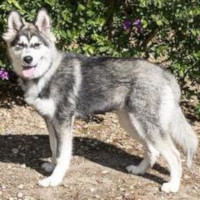
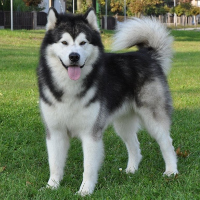
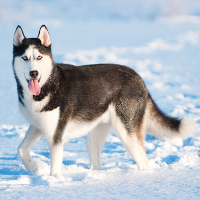
The Alusky is a medium to large dog, with a compact but robust body, generally longer than it is tall. The eyes are deep-set and almond-shaped, brown or sometimes blue if they take on the striking eyes of the Siberian Husky. They have large, wedge-shaped upright ears and long, narrow muzzles that can resemble those of a wolf. These dogs have dark noses and bushy tails. Alusky dogs have strong, muscular legs. The double coat is thick and dense, with the possibility of many color combinations. The Alusky can have a red, brown, cream, white, silver, light brown, gray, gold or salt-and-pepper coat, or can be found in combinations of these colors. Some Alusky dogs may have slightly different characteristics, as they may take on more of the appearance of one parent than the other.

Temperament of the Alusky

The Alusky is a very social dog, getting on well with someone they've just met. They're also good with children. Playful and energetic, the Alusky is an intelligent and friendly dog, eager to please and also acting charmingly and affectionately. Aluskys are loyal dogs, but, like their parents, they are strays. So beware of unfenced gardens or grounds, as they tend to wander and get lost.
Despite their social nature, they are generally quiet dogs, and don't mind being surrounded by lots of noise and activity. They have a pack mentality, requiring owners to adopt the role of pack leader so that their relationship can run smoothly. Aluskys can sometimes be quite independent in their thinking. They can become stubborn, headstrong and a little temperamental. They are also known for their good memory, which can prevent them from forgetting unpleasant situations or being mistreated for undesirable behavior. They are also highly sensitive and intuitive, with strong instincts. This can lead Aluskies to hunt small animals they consider prey. So it's extremely important to socialize them from an early age and teach them boundaries relating to other animals, especially those that can be mistaken for small prey (cats, rabbits, etc.).
Aluskies don't make good guard dogs, due to their ability to get along well with strangers. Moreover, they rarely bark. They do, however, have a tendency to howl, which is linked to their pack instinct. This tendency should be taken into account if you want to own an Alusky in a densely populated area or building. Aluskys love humans and enjoy their company. Therefore, despite the importance of providing them with outdoor space, they prefer to sleep indoors, next to their people. What's more, they can suffer from being alone for long periods. When left alone for long periods, they can become destructive due to boredom. They need a lot of attention and must be included in family activities.
Aluskys have stamina and endurance. They are energetic and need an outlet for all their energy, both physical and mental. Dog sports and games, especially those that most closely resemble their original purpose, such as sledding or racing, are a good idea. They'll also be happier if they have access to a fenced-in yard and an area where they can dig freely.

Needs and activities of the Alusky

These dogs are large and energetic, and for the safety of children, they should not be in a home with children or should be supervised with youngsters at all times. The Alusky is intelligent and, if you have experience, can be moderately easy to train. If this is your first dog, however, its stubbornness could prove difficult. They're also known to be independent, so consistency and firmness are needed to prove to them that you're the pack leader, not the other way around. These dogs respond best to positive measures, such as treats and praise for good behavior, and avoid using harsh tones. They're loyal, affectionate and playful pets who love meeting new people, and they're too nice to be guard dogs. They have a hunting instinct, so you need to be careful when out walking and around small pets, as they may go after them. The Alusky can become destructive when left alone for long periods, as it is overly social and wants to be surrounded by its family.

Maintenance of the Alusky

These dogs love to dig, which is why fences should ideally be sunk deep into the ground. Giving them a sandbox to dig in can help avoid holes in the yard. As he gets bored if he's not busy, you need to make sure your Alusky has toys available to him at all times. To keep his dense coat healthy, you'll need to brush him several times a week. However, during the shedding season, in spring and summer, you can brush him every day to help eliminate shedding. Moulting is frequent and seasonal. Apart from grooming, you'll only need to bathe him when he's dirty, and check his ears often. Like all dogs, the Alusky will benefit from early and appropriate socialization. He also needs his teeth brushed two or three times a week and his nails trimmed once or twice a month. Because of their size and energy, these dogs need a reasonably-sized home with a garden. Apartment living will not suit them, nor will living with someone who is unable to provide the exercise they need.

Comments

Latest page updates

  • Telomian

    Telomian He is not recognized by the F.C.I. Origin Malaysia Translation Francis Vandersteen A brief presentation of the Telomian The Telomian is a very rare breed of dog, and the only one native to Malaysia to have been bred outside the country. They were originally bred by the indigenous people of Malaysia to combat parasites such as snakes, rats,...
  • King Wheaten -- Cavalier King Charles Spaniel X Irish Soft Coated Wheaten Terrier

    King Wheaten He is not recognized by the F.C.I. Origin Great Britain <> Ireland -> U.S.A. Translation Francis Vandersteen A brief presentation of the King Wheaten The King Wheaten is a small dog with a heart this big and a playful disposition. Borrowing the energy and soft-coated waves of the Irish Soft Coated Wheaten Terrier and the size and...
  • Spanierd -- English Springer Spaniel X German Shepherd

    Spanierd He is not recognized by the F.C.I. Origin Great Britain <> Germany -> U.S.A. Translation Francis Vandersteen A brief presentation of the Spanierd The Spanierd is a hybrid dog. Its parent breeds are the English Springer Spaniel and the German Shepherd. They have an affable personality. He's known for entertaining family and friends with his...
  • Alaskan Goldenmute -- Alaskan Malamute X Golden Retriever

    Alaskan Goldenmute He is not recognized by the F.C.I. Origin U.S.A. <> Great Britain -> U.S.A. Translation Francis Vandersteen This breed is also known as Alaskan GoldenGoldenmuteAlaskan Gold Retriever     A brief presentation of the Alaskan Goldenmute The Alaskan Goldenmute is a descendant of two great dog breeds: the Alaskan Malamute and the Golden...
  • French pointing dog Pyrenean type

    French pointing dog Pyrenean type FCI standard Nº 134 Origin France Translation Mrs. Peggy Davis Group Group 7 Pointing Dogs Section Section 1.1 Continental Pointing Dogs « Braque » Type Working With working trial Acceptance on a definitive basis by the FCI Tuesday 18 January 1955 Publication of the official valid standard Tuesday 01 August 2023 Last...
  • French pointing dog Gascogne type

    French pointing dog Gascogne type FCI standard Nº 133 Origin France Translation Mrs. Peggy Davis Group Group 7 Pointing Dogs Section Section 1.1 Continental Pointing Dogs « Braque » Type Working With working trial Acceptance on a definitive basis by the FCI Monday 17 January 1955 Publication of the official valid standard Tuesday 01 August 2023 Last...
  • Vucciriscu

    Vucciriscu He is not recognized by the F.C.I. Origin Sicily Translation Francis Vandersteen En français, cette race se dit Vucciriscu Diese Norm ist in deutscher Sprache sichtbar Vucciriscu En español, esta raza se dice Vucciriscu In het Nederlands, wordt dit ras gezegd Vucciriscu This breed is also known as Sicilian Vucciriscu Sicilian Butcher...

© 2026 Groupe Milouchouchou ASBL. Tous droits réservés. En savoir plus

Protected by Copyright01
We use cookies

We use cookies on our website. Some of them are essential for the operation of the site, while others help us to improve this site and the user experience (tracking cookies). You can decide for yourself whether you want to allow cookies or not. Please note that if you reject them, you may not be able to use all the functionalities of the site.

Ok