 |
Staffie Bullweiler |
|
He is not recognized by the F.C.I. |
Origin |
Great Britain <> Germany -> U.S.A. | |
Translation |
Francis Vandersteen |
A brief presentation of the Staffie Bullweiler |
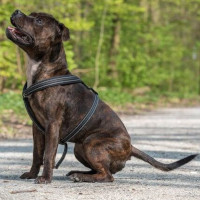
| The Staffie Bullweiler is a mixed breed whose parents are a Staffordshire Bull Terrier and a Rottweiler. These dogs are smaller than a Rottweiler, but just as strong and protective. The Staffie Bullweiler will get along with children and other dogs if socialized early. They are intelligent, loyal and playful. It has a short, coarse coat that can be black, brown or brindle. It can have the same tan facial markings as the Rottweiler. This hybrid is not recommended for novice owners, as prior owner experience is required to train him correctly. The best environment for him is indoors in a house with a fenced yard to run around in. |
History of the Staffie Bullweiler |
| The Staffie Bullweiler is a cross between a Staffordshire Bull Terrier and a Rottweiler. Other than that, little is known about this hybrid. |
A little of the Staffordshire Bull Terrier |
||
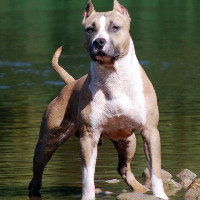
| The Staffordshire Bull Terrier is descended from the Bulldog. The breed is thought to be a cross between the Bulldog and the Manchester Terrier. The Staffordshire Bull Terrier was developed with the intention of creating a dog that was smaller and faster in the ring, but would be gentle with people. The first breed standard was drawn up in the late 1830s, after the first Staffordshire Bull Terrier club was founded in England. The American Kennel Club recognized the Staffordshire Bull Terrier in 1975. | ||
 |
||
| Standard of the Staffordshire Bull Terrier |
A little of the Rottweiler |
| The Rottweiler originated in Germany. The breed is descended from the Molosse, a Mastiff-type dog used by the Romans to drive cattle on their way to Germany. The Rottweiler is the result of crossing these Molosses with dogs native to southern Germany. The Romans established colonies in southern Germany, where the climate and soil were ideal for agriculture. Here, they built red-tiled villas which, 600 years later, were discovered during an excavation. The town was given the name "das Rote Wil" (the red tile) and soon afterwards adopted the name "Rottweiler". The town was popular with farmers and butchers, who used Rottweiler dogs to drive cattle, keep money safe and pull carts loaded with meat. Eventually, the railroads came along and the dogs were no longer needed. The breed was almost extinct until the first Rottweiler club was founded in 1901 and the first breed standard created. The breed arrived in America with German immigration in the late 1920s and quickly became popular. The Rottweiler was recognized by the American Kennel Club in 1931. |
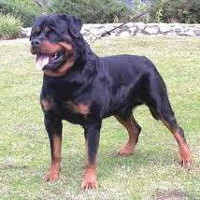 |
| Standard of the Rottweiler |
Appearance of the Staffie Bullweiler |
| The Staffie Bullweiler is a large mixed breed. They measure between 48 and 61 centimeters, and generally weigh between 27 and 40 kilos. It has a short, straight coat, which can be black, brown or brindle, and can have white markings on the chest and face. This hybrid may also have the same tan markings as the Rottweiler; markings above the eyes, around the muzzle, cheeks, chest and legs. This dog has a muscular complexion, a compact body with broad shoulders and a strong tail. It tends to be smaller than a Rottweiler, with shorter legs. Its head is broad and short, with a flat muzzle and hanging ears. It has almond-shaped brown eyes and a broad, black nose. This hybrid has powerful jaw muscles, and the teeth come together in a scissor bite. |
Temperament of the Staffie Bullweiler |
| The Staffie Bullweiler is cheerful, loyal and intelligent. These dogs are very protective of their family and possessions. They'll follow commands and are easy to train, but you need to be firm, as they can be stubborn from time to time. It's important to give your Staffie Bullweiler early socialization to ensure he'll be friendly with children and other animals. In general, this hybrid is very friendly with other dogs and is always looking for new friends. But if he takes after his Rottweiler parent, he can be aggressive towards dogs. Nevertheless, these dogs are very sensitive and caring. To be happy, they need to spend time with their family, playing and being handled and adored. They don't like to be left alone for long periods, and if they're excluded, they can become hostile and a nuisance. They are also energetic, playful dogs. |
Needs and activities of the Staffie Bullweiler |
| This mixed breed is very energetic and has a high level of stamina. They also tend to overeat and put on weight easily, so daily exercise is essential. Two or three 30-minute walks a day will keep them in shape. They also enjoy running off-leash in a yard or park, digging, hiking, and some dogs love to swim. Having a kiddie pool or taking them to a lake to splash around is fantastic fun for them. These dogs are not meant to live outdoors, especially in hot, humid climates that could affect their breathing. The best environment for them is inside a house, preferably in a cool climate or with access to a cool space on hot days, with a fenced yard for playing and digging. |
Maintenance of the Staffie Bullweiler |
| Both parents of the Staffie Bullweiler shed moderately, so it's safe to say that he will too. However, shedding may increase once or twice a year. Its coat is short and straight, making it easy to brush off dirt. Brush his coat weekly to remove loose hairs and distribute skin oils. These dogs don't tend to smell bad, so only bathe him if necessary to avoid drying out his skin. You should also brush his teeth two or three times a week to remove tartar deposits and bacteria. Trim his nails once or twice a month if they're too long. Check his ears every week for redness, debris or inflammation. You can clean his ears with a cotton ball and ear cleaner. |



 English (United Kingdom)

Comments