
 |
St. Weiler |
|
He is not recognized by the F.C.I. |
Origin |
Switzerland <> Germany -> U.S.A. | |
Translation |
Francis Vandersteen |
A brief presentation of the St. Weiler |
| The St. Weiler is a giant dog weighing between 45 and 81.5 kilos. This mixed breed is a cross between a St. Bernard and a Rottweiler. They are affectionate, loyal, protective, calm and friendly. These hybrid dogs have a strong tendency to drool, like the parent St. Bernard, and generally shed moderately. St. Weilers gain weight easily, so they need regular exercise to stay fit and healthy. These dogs are excellent property guardians and will alert you to the presence of an intruder. They are also adorable family members and get on well with children when exposed to them from infancy. |
History of the St. Weiler |
| The St. Weiler is a cross between a St. Bernard and a Rottweiler. |
A little of the St. Bernard |
||
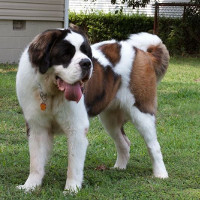
| The St. Bernard originated in Switzerland, along with the Bernese Mountain Dog, Entlebucher Mountain Dog, Appenzell Mountain Dog and Great Swiss Mountain Dog. The breed is thought to be descended from the Molosse, the Roman Mastiff-type dog, crossed with dogs native to the Alps. Dogs in Switzerland were originally divided into two categories: Valley dogs, called Talhund, and farm dogs, called Bauernhund. The St. Bernard began to be separated from these breeds when archdeacon Bernard de Menthon arrived at the St. Bernard Pass in 962 A.D. and founded a hospice to help travelers. St. Bernard dogs were used to guard the land and protect the monks. As a result, these dogs developed a great tolerance for the rigors of the cold and a capacity for search and rescue. Over the course of three centuries, St. Bernards have helped save more than 2,000 people. St. Bernards were taken to England, where they were known as Sacred Dogs, with the aim of improving the English Mastiff breed. Finally, in 1880, the breed received its official name, the St. Bernard Dog. As a result of cross-breeding, they became taller and thinner in other countries. In 1887, the first breed standard was established at the International Congress in Zurich. The American Kennel Club recognized the St. Bernard in 1885. | ||
 |
||
| Standard of the St. Bernard |
A little of the Rottweiler |
| The Rottweiler is also a descendant of the Molosser, which the Romans took with them to drive cattle on their journey to Germany. The Molosse bred with other dogs in Germany, creating new breeds, which is how the Rottweiler originated. This breed takes its name from the village it comes from, Rote Wil, in southern Germany. Rottweilers were used to drive cattle and protect money from thieves, as their owners tied it around the dog's neck. Rottweilers also helped pull meat carts, until the advent of the railroad. After that, they virtually disappeared, until the first breed standard was drawn up in 1901. Rottweilers became very popular for police work, thanks to their great working ability. The breed was brought to America in the late 1920s by German emigrants. The Rottweiler was recognized by the American Kennel Club in 1931. |
 |
| Standard of the Rottweiler |
Appearance of the St. Weiler |
| This giant-sized dog measures between 56 and 71 centimeters, and weighs between 45 and 81.5 kilos. Its head is broad, with floppy ears and almond-shaped eyes, and its muzzle, though narrower than its head, is broad and flat. It has a muscular body with long, sturdy legs and strong paws. Its tail is thick, long and hangs low. The St. Weiler's coat can vary according to the parent it most resembles; it can have a longer, silky coat or a shorter, coarser coat. Its coat can be brown, tan, red, black, white or a combination of these colors. It can have the facial markings that characterize the Rottweiler, namely tan markings above the eyes and around the muzzle. |
Temperament of the St. Weiler |
| The St. Weiler is calm, protective and alert. They are highly intelligent dogs who like to please their owners. He gets on well with children and other animals if properly trained; interaction should begin at an early age. However, if they take after their Rottweiler parent, they can be aggressive towards other dogs. They also need early socialization to avoid shyness. These dogs love to work, and are ideal for property guarding, police work, search and rescue. They are gentle, kind dogs who enjoy spending time with their families and don't take well to being alone for long periods. He will bark when an intruder is on the property, but other than that, he rarely does. |
Needs and activities of the St. Weiler |
| The St. Weiler has high stamina and energy levels, so it needs plenty of exercise to stay healthy. He also gains weight easily, so intense activity is necessary to keep him healthy and fit. Two 30-minute walks or jogs a day, plus time to run off-leash and play in a park or yard will keep him happy, especially if there's a lake or pond for him to swim in, as he loves water. The St. Weiler also enjoys a good hike, so if you have the opportunity to take him hiking, he'll be delighted to join you. These are giant dogs that live best in a house with a garden, and prefer cool weather as they don't cope well with high temperatures. If they live in an apartment, these dogs will need to go out several times a day. |
Maintenance of the St. Weiler |
| The grooming needs of the St. Weiler depend on each dog's coat. If it has a long coat, you'll need to brush it daily to remove loose hairs and prevent tangles. Similarly, your long-haired St. Weiler may need regular visits to the groomer for trimming. These dogs shed moderately, but this can increase during certain seasons. Short-haired dogs require less maintenance. A weekly brushing to remove loose hair and distribute skin oils will do them good. In any case, bathe your St. Weiler only when necessary, to avoid drying out the skin. You should also brush his teeth three times a week to remove tartar and prevent bad breath. Likewise, his ears need to be checked and cleaned every week to avoid infections that could occur if dirt or moisture accumulates. If his nails become too long, they should be trimmed; this will be necessary once or twice a month. |



 English (United Kingdom)

Comments