
 |
Smooth Poxer |
|
He is not recognized by the F.C.I. |
Origin |
Great Britain <> China -> U.S.A. | |
Translation |
Francis Vandersteen |
A brief presentation of the Smooth Poxer |
| The Smooth Poxer is a hybrid dog. Its parent breeds are the Fox Terrier Smooth and the Pug. Smooth Poxers are small to medium-sized dogs. Playful and amusing, the Smooth Poxer will be both loyal and affectionate with its family. It never meets strangers, so even if it's noisy when strangers pass, the Smooth Poxer will approach them immediately. He gets on well with other animals, especially other dogs. However, early socialization is the best way to teach him exactly the behavior you expect from him. The Smooth Poxer is an excellent companion for any household, whether you're a single person, an older couple or a family with children. |
History of the Smooth Poxer |
| The Smooth Poxer is a rare hybrid breed. Little is known about its origins, so to understand the history of the Smooth Poxer, we can study its parent breeds, the Fox Terrier Smooth and the Pug. |
A little of the Fox Terrier Smooth |
||
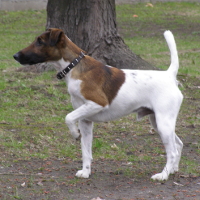
| The Fox Terrier Smooth was also the companion of the royal family. It has also been a circus performer, and is known as the breed that has won the Westminster Dog Show more often than any other breed. A foxhunter at heart, the Fox Terrier Smooth became highly prized for its ability to "go to ground" (enter the foxhole) and flush out prey for hunters. The Fox Terrier Smooth is thought to be a combination of Beagles, Black and Tan Terriers, Bull Terriers and Greyhounds. However, there are no precise records to support this theory. King Edward owned a Fox Terrier Smooth named Caesar; the dog wore a collar that read "I am Caesar; I belong to the King". Caesar followed his beloved master's coffin when the king passed away. The first Fox Terrier was registered by the American Kennel Club in 1885. The Fox Terrier Smooth is also quite recognizable as the dog depicted on any RCA product during the twentieth century. | ||
 |
||
| Standard of the Fox Terrier Smooth |
A little of the Pug |
| The Pug originated in China. He was a favorite of the imperial family, and is said to have lived in luxury and enjoyed the protection of imperial guards. Many believe it is descended from the Tibetan Mastiff. When the Chinese began trading with Europeans, the Pug also began to populate regions other than the Orient. As they were favored by royalty in China, they were also often members of royal families in Europe. In Victorian times, the Pug was depicted in famous paintings, postcards and figurines. A black Pug, considered rare at the time, was also featured in this work of art. Marie-Antoinette owned a Pug before the French Revolution. Queen Victoria is also said to have appreciated the breed, and is thought to have been partly responsible for breeding the Pug to its present small size. |
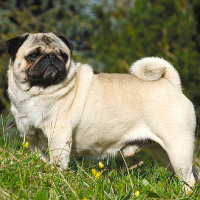 |
| Standard of the Pug |
Appearance of the Smooth Poxer |
| The Smooth Poxer often has the stocky body of its parent breed, the Pug. Their coloring, however, varies widely. They can be cream or tan. They can be white with brown markings. It can be black or gray. He will generally have the black markings on his face of the parent breed Pug. He will probably also have the curly tail of the Pug parent breed. His tail is placed on the top of his back. It may or may not have a longer, shaggy coat. His chest is broad and deep. They may inherit the brachycephalic muzzle of the parent breed Pug. If so, you'll need to be careful when exercising your Smooth Poxer. It may also inherit the wrinkled face of the Pug. This will pose another maintenance problem. Its ears are likely to be somewhat floppy. |
Temperament of the Smooth Poxer |
| The Smooth Poxer is a gentle, lively little dog that will amuse you daily with its antics. He never meets strangers, even if he barks at people he doesn't know. He's great with family members of all ages, but is especially gentle with children. If given the opportunity to grow up together, the Smooth Poxer will be particularly protective of children. He's been known to follow family members from room to room, just so he can get in on the action. He's an excellent cuddle buddy, but also enjoys spending time outdoors with his family. He gets on well with other pets, especially if given plenty of early socialization opportunities. He's easy to train, but can be a bit stubborn when it comes to potty training. Patience will pay off in the end. Give him treats to reward his good behavior, and he'll do all he can to please you. |
Needs and activities of the Smooth Poxer |
| The Smooth Poxer is a fairly active dog. However, they may inherit the brachycephalic muzzle of their Pug parent. If this is the case, you'll need to be careful when giving him playtime. If he gets too hot or overworked, he could go into cardiac arrest from lack of air. Keep water bottles handy in hot weather to keep him hydrated and prevent hyperventilation. He'll appreciate short, brisk walks with you around the neighborhood. Outings to the dog park will give him plenty of opportunity for exercise. He'll also love playing outside in a fenced-in garden, but don't forget that he'll need supervision. It's not a good idea to leave him outside for hours on end. Keep plenty of toys to give him physical and mental exercise. |
Maintenance of the Smooth Poxer |
| Smooth Poxer maintenance will depend largely on the type of characteristics it inherits from its parent breeds. If he inherits the wrinkled face of the parent breed Pug, you'll need to clean his wrinkles with a damp cloth every day. You'll also need to wipe the wrinkles to prevent water from accumulating in the wrinkles and irritating the Smooth Poxer's skin. If he has floppy ears, you'll need to wipe them weekly with a damp cotton pad. Make sure there's no redness or stench, both signs of an ear infection. You'll need to brush him every week and check for any signs of allergy, such as missing hairs. He doesn't tend to shed much, but he certainly will in spring and autumn. You may want to brush him daily then. Brush his teeth two or three times a week to prevent tartar build-up and bad breath. Brush his teeth every day to prevent tooth decay. Clip his nails every two weeks, unless he wears them out on his own. As a general rule, if you hear his nails clicking on a tile or granite floor, it's time to trim them. |



 English (United Kingdom)

Comments