
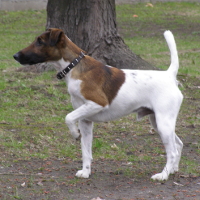
Fox Terrier Smooth

FCI standard Nº 12

Origin
Great Britain
Group
Group Terriers
Section
Section 1 Large and medium sized Terriers
Working
Working trial optional
Acceptance on a definitive basis by the FCI
Wednesday 26 June 1963
Publication of the official valid standard
Sunday 30 October 2016
Last update
Tuesday 07 February 2017
En français, cette race se dit
Fox Terrier à poil lisse
Diese Norm ist in deutscher Sprache sichtbar
Fox Terrier Glatthaar
En español, esta raza se dice
Fox Terrier Pelo liso
In het Nederlands, wordt dit ras gezegd
Fox Terrier Gladhaar

Usage

Terrier.

Brief historical summary

The Fox Terrier in booth forms, Smooth and Wire, is from British origins and probably owes its existence to the same types of dog which produced both the Bull Terrier and the Black and Tan (now Manchester) Terrier. Uniformity of type was established in the late 1800s and the original standard for the Fox Terrier drawn up in 1876.
One of the most lively and alert of terriers, refinement to his present show excellence has not allowed him to become unsound. Capable of standing up to any amount of exercise, always ready to deal with rats, rabbits, and, of course, foxes.

General appearance

Active and lively, bone and strength in small compass, never cloddy or coarse. Neither leggy nor too short in the leg, standing like a well made, short-backed hunter, covering a lot of ground.

Behaviour / temperament

Alert, quick of movement, keen of expression, on tiptoe of expectation. Friendly, forthcoming and fearless.

Head

Cranial region

Skull
Flat, moderately narrow. Gradually decreasing in width to eyes. 
Stop
A little stop apparent.

Facial region

Nose
Black.
Muzzle
Jaws, upper and lower, strong and muscular, falling away only slightly below eyes. This portion of foreface moderately chiselled out, so as not to go down in a straight line like a wedge.
Jaws and teeth
Jaws strong with a perfect, regular and complete scissor bite, i.e. upper teeth closely overlapping the lower teeth and set square to the jaws.
Cheeks
Never full.
Eyes
Dark, moderately small, as near as possible circular in shape but not prominent. Expression bright and intelligent.
Ears
Small, V-shaped and dropping forward close to cheek, not hanging by side of head. Fold of ear above level of skull. Leather of moderate thickness.

Neck

Clean and muscular, without throatiness, of fair length and gradually widening to shoulders.

Body

Back
Short, level and strong without slackness.
Loin
Powerful, very slightly arched.
Chest
Deep, not broad. Fore ribs moderately sprung, back ribs deep.

Tail

Previously customarily docked.
Docked: Set on rather high and carried gaily but not over back or curled. Of good strength.
Undocked: Set on rather high and carried gaily but not over back. As straight as possible. Tail of moderate length to give balance to the dog.

Limbs

Forequarters

Shoulders
Long and sloping, well laid back, fine at points, cleanly cut at withers.
Forearm
Legs from any angle must be straight showing little or no appearance of an ankle in front. They should be strong in bone throughout.
Forefeet
Small, round and compact. Pads hard and tough, toes moderately arched and turning neither in nor out.

Hindquarters

Generality
Strong and muscular, quite free from droop or crouch.
Upper thigh
Long and powerful.
Stifle
Good turn of stifle.
Hock
Hocks well let down.
Hind feet
Small, round and compact. Pads hard and tough, toes moderately arched and turning neither in nor out.

Gait and movement

Fore- and hindlegs carried straight forward and parallel. Elbows move perpendicular to body, working free of sides, stifles neither turning in nor out and hocks not close. Good drive coming from well flexing hindquarters.

Coat

Hair
Straight, flat, smooth, hard, dense and abundant. Belly and underside of thighs not bare.
Colour
White should predominate, all white, white with tan, black and tan or black markings. Brindle, red or liver markings highly undesirable.

Size and weight

Height at withers
Not exceeding 39 cm in dogs, bitches slightly less.
Weight
Males 7,5 ­- 8 kgs, females 7 - 7,5 kgs.

Faults

• Any departure from the foregoing points should be considered a fault and the seriousness with which the fault should be regarded should be in exact proportion to its degree and its effect upon the health and welfare of the dog and its ability to perform its traditional work.
• Faults listed should be in degree of seriousness.

Disqualifying faults

 Aggressive or overly shy dogs.

NB :

• Any dog clearly showing physical or behavioural abnormalities shall be disqualified.
• The above mentioned faults when occurring to a highly marked degree or frequently are disqualifying.
• Male animals should have two apparently normal testicles fully descended into the scrotum.
• Only functionally and clinically healthy dogs, with breed typical conformation should be used for breeding.

Bibliography

https://www.fci.be/


Detailed history

The Fox Terrier is the most prominent representative of an essentially British canine family: Terriers. It is also the first of them that was well defined, which is not to harm its prestige.

Pliny the Elder, in his Natural History, mentioned the existence of small dogs pursuing their prey to the ground, which he called "Agassins." The Romans had also been able to observe these dogs by approaching Brittany - the Great - in the 1st century AD It is therefore possible that the Terriers are truly from the British Isles.

However, Terrier-like dogs, similar to Bassets or Basenji-type dogs, have been noted on Egyptian frescoes from the Middle Kingdom period, from which it can easily be deduced that this type of dog would be much older than the "Agassins". The British Isles, rich in tin needed to make bronze, maintained regular relations with the countries of the Mediterranean basin. So it is not impossible that Phoenician navigators who acted as intermediaries in the trade with the Anglo-Saxons have made known to the latter various breeds of dogs, such as the Mastiffs, the Greyhounds and the ancestors of the Terriers. Egypt was perhaps the cradle of Terriers, although we had too little evidence to confirm this thesis.

Still, the Terriers were well established in Britain in the sixteenth century. Indeed, their existence is reported in 1570 by Johannes Caius, the physician of Queen Elizabeth Ire, who completed the work of the Swiss naturalist Conrad Gesner, Historia animalium, describing the types of dogs that were then widespread in England. Canibus Britannicis, a modest contribution in principle, was a great success, both with the queen and the lords, and with a large number of simple subjects, since the work, which had been written in Latin, was translated into English from 1576 and constantly republished until 1880, which shows the very high quality of the descriptions provided by Dr. Joannes Caius - or John Keys of his English name.

About the Terrier, the scholar wrote: "There are also dogs for fox or badger hunting, and we call them" terrars "because they get into the ground by terrifying, exciting, and biting. game, until they cut it in pieces with their teeth, even within the earth; or they draw it by force from the dark meanders of the damp dens and the closed caves; or they are so frightened that they push him to suddenly leave the refuge to seek another that is not attacked; and the animal, fox, badger or whatever, is finally trapped in the instruments and nets arranged for this purpose next to the opening of the burrow. And Joannes Caius classified the "terrars" among the gentlemen's dogs, alongside hounds and greyhounds.

Underground hunting, it should be pointed out, was not only practiced in Britain, but also in other countries. Indeed, in a Merovingian text dated 630, we find the mention of a dog hunting underground called Bibarhund and which was to be considered as a race of great value since his death (by hand of man) was punished by a heavy fine. Moreover, in the fourteenth century, Gaston Phoebus also evoked hunting underground and Henri de Ferrieres spoke of the "dog tanier" which "jut out" the fox of his den.

The first description of the digging is also French. It is found in the famous Traité de la Vénerie, published in 1550 and written by Jacques du Fouilloux, a Poitevin lord. Later, in 1683) Jacques Epée de Sélincourt did another one in his work Le Parfait Chasseur. As to George Turberville's treat- ment published in 1575) he expressly stated (joining J. Caius) that in Great Britain, as in France, the land was an integral part of the art of venery. Let us note in passing that this last treatise (Noble Art of Hunting or Hunting), although written by an English author, was written in the French language, which suggests that venery was then an essentially French art. We also know that James I of England sent about 1600 Terriers to the court of France.

However, we do not know what type of dog was used for digging. If there are any indications that it was in France basset dogs from common dogs, it seems, according to Turberville, that the English preferred smaller dogs more lively and more biting. In fact, all these "terrars" had to vary considerably from one terroir to another, which would also explain the scarcity of ancient descriptions of these dogs, while the presentations on the digging abound from the early Middle Ages. René Depoux, a great specialist in underground hunting, suggests that this activity should not be an adequate reason for selection, as very diverse dogs could be successfully used for digging, provided, however, that their size should be as small as possible. that their courage was great.

This hunt was dangerous and made many wounded, not to mention the dead, and it was often necessary to use the dogs of the populace like ratiers and other dogs of modest size, to avoid that the more noble breeds are decimated.

The digging, long and often exhausting work, was finally only one of the minor branches of the hunt, and he found himself somewhat neglected by the great lords monopolized by the big game. On the other hand, the little gentle countrymen, among whom the most passionate hunters were recruited, often practiced the digging with, besides, the concern to preserve the game on their grounds and thus to destroy the predators.

The Burrow was progressively promoted in England, when, as a result of the rarefaction of the deer, the hunt began to evolve towards the foxhunting, which is a sort of speed race started between Master Goupil and the hounds and followed by the gentry, who had the opportunity to jump all sorts of obstacles and to gallop through the countryside. The fox, quick and smart, managed to reach his burrow more often, and it was necessary to dislodge it as soon as possible, so as not to interrupt the hunt and allow the riders to continue their equestrian exercise.

We have many writings on this evolution of the landslide - as an auxiliary but indispensable activity of the fox's run -, notably those of Nicholas Cox, in The Gentleman's Recreation (1677), Jacobs (Compleate Sportsman, 1718), as well as the Sporting Dictionary of 1803.

Two primordial types of Terriers were used: Basset Terriers, with a thick, shaggy coat, were found in rugged and wild areas, where the masters followed their dogs on foot, while the longer-legged Terriers were employed. where horse-hunting was practiced and where these dogs had to be able to follow the sustained hound train.

Thomas Bell, in his History a] British Quadrupeds, published in 1837, confirms the existence of these two types, and he describes on the one hand an English Terrier, with smooth hair, of symmetrical and fine forms, with black dress and fire and, on the other hand, a Scottish Terrier, whose limbs are short, thick, with rough hair, of varied colors, but most often dirty white or gray.

The true selection of the Fox Terrier began in earnest towards the end of the 18th century, despite what Reverend Rosselyn Bruce, one of the earliest specialists in the breed, said he had no information about this breed. Before 1850, no doubt, Bruce had not noticed, for example, a painting by Sartorius the Elder dating back to 1796, which unquestionably represents a black and fire Fox Terrier, just as he had no knowledge of a memoir by Peter Beckford who, before 1800, claimed to have possessed Black and White, Black and Fire Terriers.

The Fox Terriers are from the Old English Black and Tan Terriers, who were also at the origin of the Manchester Terrier, which were crossed with Beagles, White Terriers that are also known under the name of Old English White Terriers, and probably with the old Bulldog type, then very different from the one we know today and which was often small (besides, we were then working to eliminate the physical characteristics fighting dog). These crosses were essentially to give the dog a predominantly white dress, more identifiable and avoiding unpleasant confusion with the fox. They also tended to produce a small dog, with a lot of "guts", but also built for speed and having bottom, able to support the train of hell imposed on him by the Fox Hounds, Moreover, the Terriers had to demonstrate insurance and courage to be respected hounds that do not spare them.

The current Fox Terrier comes directly from these dogs working in the packs of current dogs: the big ancestors come from almost all. So, Old Jock came from the Grove Hunt crew, his father, Jack, belonged to Captain Percy William, master of the Rufford crew, and his mother, Grove Pepper, was the bitch's quill Jack Morgan, of the crew Grove Hunt. Old Trap came from Oackley Hunt, Joe from Belvoir Hunt, and Nettie, one of the females that had a very strong influence on the breed, came from Grove Hunt. Finally, there is only Tartar, another great ancestor of the race, who appears to be of uncertain origin; we think it was part of the breeding of Mr. Stevenson, specializing in the Bull Terrier.

The Smooth Hair Fox Terriers were the first to be showcased and recognized as early as 1863 in Birmingham, as they had the advantage of being prized by chic people, most of them fox hunting enthusiasts. Thanks to the breed historian Desmond O'Connel, who published a well-documented chapter in The New Book of the Dog in 1907, the first breeders of this breed can be accurately known, and the case is rare enough to deserve to be underlined. There was a certain Mr. Murchison who bought Old Jock and exhibited it in 1862; Mr. Gibson owned Tyke and Old Foiler; Mr. Luck Turner owned dogs from Belvoir Hunt and produced the first champions: Joe, Olive and Spice.

A first standard for the Fox Terrier (including both varieties) was born in 1876 and the Fox Terrier Club was created the same year on the initiative of Mr. Harding Cox. It is also one of the oldest special clubs, and among its founding members are breeders who subsequently enjoyed a great reputation, as was the case of Mr. Burbridge (affix Hutton): at his death in 1892, the hundred and thirty terriers of his kennel were auctioned off, and a colossal sum was collected: the Hutton Tartar champion, in particular, was awarded for a record price. We must also mention Mr. Clarck, Mr. Redmond and Mr. Vicary, these breeders who engaged a fight as fierce as courteous to produce champions of great price, without forgetting Conan Doyle, who was a breeder emeritus, when Sherlock Holmes and Moriarty leave him time!

The Fox Terrier in Poil Lisse, since it is of this type that we are talking about so far, participated, parallel to his career dog, to a somewhat forgotten episode, the rabbit coursing, dog sport for which it was required in because of its velocity. However, we tried to increase his speed even further, and to do this, a breeder had the idea of crossing his Fox with small Greyhounds, giving birth to really unbeatable subjects. The results of these crosses produced dogs more and more "Greyhounds" and less and less "Fox", which were called "cohippets". The Whippet (whose first Kennel Club records date back to 1892) was soon to be born, and our Fox is indisputably one of its ancestors.

The Fox Terrier at Poil Dur, like his counterpart in Poil Lisse, also has his own historian, Walter S. Glynn, who wrote a chapter on race in The New Book of the Dog of 1907. At the time of the first exhibitions, this dog was less honored than the Fox in Poil Lisse, because it was first selected by modest breeders, especially in the north of England, who did not have the opportunity to make him a great publicity. The recognition of the Hard Coat came only ten years after that of Poil Lisse, but it was the starting point of a reputation that would take him far.

Among the first great breeders of Fox in Poil Dur, it is necessary to quote MM. Maxwell and Cassel, Carrick, George Raper, Warton, and the Duchess of Newcastle (affix of Notts), who contributed to the success of Le Poil Dur, including a "fashioriable" dog, and who produced the first great champion, Cackler of Notts.

Until the end of the First World War, Fox Smooth Hair retained the palm of popularity, before the Fox Hairy does not take it in 1920: the trimming, which gives it its characteristic silhouette, had indeed been developed, which did not fail to enthuse the general public and the amateurs of exhibitions which had thus matter to demonstrate their know-how.

By the end of the last century, the Fox Terriers were probably the most widespread dogs in the Channel, constituting less hunting aids than companion dogs, as can be seen in particular from reading the writings (published in 1899 ) of Alfred de Sauvenière, to whom we owe a lot of information about the rabbit coursing, which he introduced with some success in our country. "Everywhere in the streets, in the parks, on the walks, we see these little quadrupeds, adorned with beautiful necklaces of white or yellow leather, clean, shiny hair, lively and clear, the eye and the eye. ears alert, trotting behind their masters as favorite friends, much more than in submissive servants, "he wrote. And this specialist of the rabbit coursing also affirmed that "the Fox Terrier is the most favored quadruped that has ever existed". This statement only referred to Fox's impact on the good society, which makes it a bit premature.

But the Fox quickly exceeded this status of dog chic to become, especially after the 1920s, a very popular animal, enjoying an international aura. The United States, Belgium, Italy and France, indeed, had not long to give it a large place. In France, the Fox was regularly imported in 1892, its introduction being favored by Anglophilia very popular in the good society. In fact, the Fox's fashion was confirmed in the circles of the horse and the hunt which were in permanent relation with the English. It was also the time when the rabbit coursing was practiced: the coaches and the jockeys, in particular at Chantilly, bet on the Fox, the companions of the thoroughbreds and fierce deviators, whom they only had to leave the stables to be able to launch them.

In 1906, the first French Fox specialists created the Fox Terriers Reunion (RAF). Most of these founders used their dogs for hunting underground, so they did not hesitate to import high quality subjects from the English Channel, for example, looking for hard-haired Fox, for example, dogs bearing the affix of Notts.

The French breeding of the Fox started under the motto "beautiful and good at the same time". Indeed, beauty trials were started with "artificial burrows" to select the natural qualities of Terriers. Thus, in the inter-war years, was born the beautiful fame of the French breeders, among whom we must mention MM. André Bazin, Joannès Carret, Louis de Lachomette, Max Ecorcheville and Julien Dormeuil.

After the Second World War, following the same guideline, the French breeding reimported quality dogs, always having in mind the use of the race for the unearthing. In this period, the breeding of Mrs. de Mental (affix of Libron and his crew Rallye of Croc-farm) and that of Mrs. Soudée, long president of the RAF (affix of Malvau, crew Chop the Vilaine Beast), were undoubtedly among the most famous. But this quality dog breeding was then only part of the breeding, because, meanwhile, the breed had met with great popularity that would not stop growing until the sixties.

This Fox vogue, which began after the First World War, was that of the Fox à Poil Dur. The Fox at Poil Lisse, meanwhile, was still a hunting dog appreciated by the diggers - because of its much less restrictive maintenance - as well as an exhibition dog.

Hard Dog was for ten years the most fashionable dog in Britain, and Stanley Dangerfield severely judged the consequences of such an aura: "During this time, not only is it recognized that his temperament slightly deteriorated but still many people, slaves of fashion, discovered that they had a companion whom they did not understand and with whom they hardly agreed. This craze crossed the Channel, but the best subjects did not arrive in France where few owners could take into account the requirements of grooming.

This "sculptured" dog, with a really new silhouette, somewhat "cubist", corresponded to the changing tastes of the society between the two wars, and he also became one of the first dogs of city company, to because of its small size, even if the "real" breeds of company remained luxury and sleeve dogs.

The caricaturist Pol Rab with his hero Ric, a white Fox, facetious commentator of the events of the time with Rac, a black Scottish, well symbolized this popularity. Another cartoonist, Hergé, illustrated the second wave of Fox fashion as a pet dog with his famous Snowy, faithful companion and friend of Tintin since 1929.

The Fox is certainly one of the breeds that changed the most between 1862, when it was first exhibited, and the time when it was at the height of its glory, in the 20s and 30. This evolution does not appear in the standard of the breed, written for the first time in 1876, because the English standards are sufficiently vague and imprecise to allow to modify the silhouette of the dog without it being necessary to transform a line from his official description. The oldest photographs we have show us a dog with fairly square lines, but with a short, shallow neckline and a rather common head, with a wide and deep rib cage, in short, an animal very different from the one we know. today.

The selection has strived to make the Fox a dog built like a small horse, hunter more precisely, who is a hunting horse. The drafting of the standard is quite explicit on this subject, and it can be noted with curiosity that, for the high society, the references to dog breeds were Fox Hounds and Greyhounds. The Fox gradually lost his round skull, his short and pointed muzzle; his neck and head became very long, his back shorter and his chest less "exploded". The English breeders have even exaggerated this silhouette by producing very short dogs with limbs and stiff and straight joints, which give a jumping gait: they are caricatures. The size of the Fox also gave rise to many controversies, as this dog, like many, has tended to grow thanks to the progress of breeding and feeding, to the point of meeting certain difficulties to penetrate and move in a terrier, which is his original work, and it was not always easy to get a dog both "hunter-built" and small enough.

The Fox is nevertheless a superb athlete, where compactness and robustness combine harmoniously with elegance and finesse. This dog is a very good jumper, very fast - he is the fastest of the small dogs -, extremely resistant and armed with a formidable jaw.

Comments

Latest page updates

  • Samusky

    Samusky He is not recognized by the F.C.I. Origin Northern Russia and Siberia <> Siberia -> North America Translation Francis Vandersteen En français, cette race se dit Samusky Diese Norm ist in deutscher Sprache sichtbar Samusky En español, esta raza se dice Samusky In het Nederlands, wordt dit ras gezegd Samusky This breed is also known as SamhuskySamsky     A...
  • Agouti Husky

    Agouti Husky FCI standard Nº 270 Origin Siberian Translation Francis Vandersteen En français, cette race se dit Husky Agouti Diese Norm ist in deutscher Sprache sichtbar Agouti-Husky En español, esta raza se dice Husky Agouti In het Nederlands, wordt dit ras gezegd Agouti Husky   The "Agouti" Husky is not a distinct breed but a rare color variant...
  • White Husky

    White Husky   FCI standard Nº 270       Origin Siberia Translation Francis Vandersteen En français, cette race se dit Husky blanc Diese Norm ist in deutscher Sprache sichtbar Weißer Husky En español, esta raza se dice Husky blanco In het Nederlands, wordt dit ras gezegd Witte Husky   The white Husky is not a distinct breed, but rather a rare and striking...
  • Taimyr Wolf

    Taimyr Wolf He is not recognized by the F.C.I. Origin Siberia Translation Francis Vandersteen En français, cette race se dit Loup de Taïmyr Diese Norm ist in deutscher Sprache sichtbar Taimyr-Wolf En español, esta raza se dice Lobo de Taimyr In het Nederlands, wordt dit ras gezegd Taimyr-wolf   The Taimyr Wolf is no longer an extant breed, but it...
  • Manchurian Spitz

    Manchurian Spitz He is not recognized by the F.C.I. Origin Manchuria and Siberia region Translation Francis Vandersteen En français, cette race se dit Spitz de Mandchourie Diese Norm ist in deutscher Sprache sichtbar Mandschurischer Spitz En español, esta raza se dice Spitz de Manchuria In het Nederlands, wordt dit ras gezegd Mantsjoerije-spits   The...
  • White Swedish Elkhound

    White Swedish Elkhound He is not recognized by the F.C.I. Origin Sweden Translation Francis Vandersteen En français, cette race se dit Chien d'élan suédois blanc Diese Norm ist in deutscher Sprache sichtbar Schwedischer weißer Elchhund En español, esta raza se dice Perro de alce sueco blanco In het Nederlands, wordt dit ras gezegd Witte Zweedse...
  • Turkish Spitz

    Turkish Spitz He is not recognized by the F.C.I. Origin Turkey Translation Francis Vandersteen En français, cette race se dit Spitz turc Diese Norm ist in deutscher Sprache sichtbar Türkischer Spitz En español, esta raza se dice Spitz turco In het Nederlands, wordt dit ras gezegd Turkse spits This breed is also known as Tonya FinosuFino TonyaKobi   The Tonya...
  • Hunters Creek Feist

    Hunters Creek Feist He is not recognized by the F.C.I. Origin U.S.A. Translation Francis Vandersteen En français, cette race se dit Hunters Creek Feist Diese Norm ist in deutscher Sprache sichtbar Hunters Creek Feist En español, esta raza se dice Hunters Creek Feist In het Nederlands, wordt dit ras gezegd Hunters Creek Feist   The Hunters Creek Feist is...
  • Gray’s Mountain Feist

    Gray’s Mountain Feist He is not recognized by the F.C.I. Origin U.S.A. Translation Francis Vandersteen En français, cette race se dit Gray’s Mountain Feist Diese Norm ist in deutscher Sprache sichtbar Gray’s Mountain Feist En español, esta raza se dice Gray’s Mountain Feist In het Nederlands, wordt dit ras gezegd Gray’s Mountain Feist   The Gray’s...
  • Thornburg Feist

    Thornburg Feist He is not recognized by the F.C.I. Origin U.S.A. Translation Francis Vandersteen En français, cette race se dit Thornburg Feist Diese Norm ist in deutscher Sprache sichtbar Thornburg Feist En español, esta raza se dice Thornburg Feist In het Nederlands, wordt dit ras gezegd Thornburg Feist   The Thornburg Feist is a specialized line of...
  • Mullins Feist

    Mullins Feist He is not recognized by the F.C.I. Origin U.S.A. Translation Francis Vandersteen En français, cette race se dit Mullins Feist Diese Norm ist in deutscher Sprache sichtbar Mullins Feist En español, esta raza se dice Mullins Feist In het Nederlands, wordt dit ras gezegd Mullins Feist   The Mullins Feist is an American hunting dog breed...
  • Kemmer Stock Hybrid Squirrel Dog

    Kemmer Stock Hybrid Squirrel Dog He is not recognized by the F.C.I. Origin U.S.A. Translation Francis Vandersteen En français, cette race se dit Kemmer Stock Hybrid Squirrel Dog Diese Norm ist in deutscher Sprache sichtbar Kemmer Stock Hybrid Squirrel Dog En español, esta raza se dice Kemmer Stock Hybrid Squirrel Dog In het Nederlands, wordt dit...
  • Buckley Mountain Feist

    Buckley Mountain Feist He is not recognized by the F.C.I. Origin U.S.A. Translation Francis Vandersteen En français, cette race se dit Buckley Mountain Feist Diese Norm ist in deutscher Sprache sichtbar Buckley Mountain Feist En español, esta raza se dice Buckley Mountain Feist In het Nederlands, wordt dit ras gezegd Buckley Mountain Feist   The...
  • Charlie Feist

    Charlie Feist He is not recognized by the F.C.I. Origin United Kingdom, U.S.A. Translation Francis Vandersteen En français, cette race se dit Charlie Feist Diese Norm ist in deutscher Sprache sichtbar Charlie Feist En español, esta raza se dice Charlie Feist In het Nederlands, wordt dit ras gezegd Charlie Feist   The charming Charlie Feist is one of...
  • Barger Stock Feist

    Barger Stock Feist He is not recognized by the F.C.I. Origin U.S.A. Translation Francis Vandersteen En français, cette race se dit Barger Stock Feist Diese Norm ist in deutscher Sprache sichtbar Barger Stock Feist En español, esta raza se dice Barger Stock Feist In het Nederlands, wordt dit ras gezegd Barger Stock Feist   The Barger Stock Feist is a...
  • Toy Manchester Terrier

    Toy Manchester Terrier He is not recognized by the F.C.I. Origin U.S.A. Translation Francis Vandersteen En français, cette race se dit Manchester Terrier miniature Diese Norm ist in deutscher Sprache sichtbar Miniatur-Manchester-Terrier En español, esta raza se dice Manchester Terrier miniatura In het Nederlands, wordt dit ras gezegd Miniatuur-Manchesterterriër   The Toy...
  • Donggyeongi

    Donggyeongi He is not recognized by the F.C.I. Origin South Korea Translation Francis Vandersteen En français, cette race se dit Donggyeongi Diese Norm ist in deutscher Sprache sichtbar Donggyeongi En español, esta raza se dice Donggyeongi In het Nederlands, wordt dit ras gezegd Donggyeongi This breed is also known as Daeng GyeonDonggyeong Gae   The...
  • Mackenzie River Husky

    Mackenzie River Husky He is not recognized by the F.C.I. Origin Canada, U.S.A. Translation Francis Vandersteen En français, cette race se dit Husky du fleuve Mackenzie Diese Norm ist in deutscher Sprache sichtbar Mackenzie-River-Husky En español, esta raza se dice Husky del río Mackenzie In het Nederlands, wordt dit ras gezegd Mackenzie-rivier...
  • Danish Spitz

    Danish Spitz He is not recognized by the F.C.I. Origin Denmark Translation Francis VandersteenAuthoritative language (DK) Working No working trial required En français, cette race se dit Spitz danois Diese Norm ist in deutscher Sprache sichtbar Dänischer Spitz En español, esta raza se dice Spitz danés In het Nederlands, wordt dit ras gezegd Deense...
  • Hällefors Elkhound

    Hällefors Elkhound He is not recognized by the F.C.I. Origin Sweden Translation Francis Vandersteen En français, cette race se dit Chien d'élan de Hällefors Diese Norm ist in deutscher Sprache sichtbar Hällefors Elchhund En español, esta raza se dice Elkhound de Hällefors In het Nederlands, wordt dit ras gezegd Hällefors Elkhound   The Hällefors...
  • Great Fauve of Brittany

    Great Fauve of Brittany He is not recognized by the F.C.I. Origin France Translation Francis Vandersteen En français, cette race se dit Grand Fauve de Bretagne Diese Norm ist in deutscher Sprache sichtbar Großer Fauve der Bretagne En español, esta raza se dice Gran Fauve de Bretaña In het Nederlands, wordt dit ras gezegd Grote Fauvist van...
  • Timmon’s Biter Herding Dog

    Timmon’s Biter Herding Dog He is not recognized by the F.C.I. Origin Australia Translation Francis Vandersteen En français, cette race se dit Chien de berger Timmon’s Biter Diese Norm ist in deutscher Sprache sichtbar Timmon’s-Biter-Schäferhund En español, esta raza se dice Perro pastor Timmon’s Biter In het Nederlands, wordt dit ras gezegd Timmon’s...
  • Montemboeuf Dog

    Montemboeuf Dog He is not recognized by the F.C.I. Origin France Translation Francis Vandersteen En français, cette race se dit Chien Montemboeuf Diese Norm ist in deutscher Sprache sichtbar Montemboeuf-Hund En español, esta raza se dice Perro Montemboeuf In het Nederlands, wordt dit ras gezegd Montemboeuf-hond   The Montemboeuf is an extinct dog breed, developed...
  • Leauvenaar Dog

    Leauvenaar Dog He is not recognized by the F.C.I. Origin Belgium Translation Francis Vandersteen En français, cette race se dit Chien Leauvenaar Diese Norm ist in deutscher Sprache sichtbar Leauvenaar-Hund En español, esta raza se dice Perro Leauvenaar In het Nederlands, wordt dit ras gezegd Leauvenaar Hond   The Leauvenaar is an extinct dog breed that...
  • Larye Dog

    Larye Dog He is not recognized by the F.C.I. Origin France Translation Francis Vandersteen En français, cette race se dit Chien de Larye Diese Norm ist in deutscher Sprache sichtbar Larye-Hund En español, esta raza se dice Perro de Larye In het Nederlands, wordt dit ras gezegd Larye-hond This breed is also known as Layrre   The Larye is a...
  • Happa Dog

    Happa Dog He is not recognized by the F.C.I. Origin China Translation Francis Vandersteen En français, cette race se dit Chien Happa Diese Norm ist in deutscher Sprache sichtbar Happa-Hund En español, esta raza se dice Perro Happa In het Nederlands, wordt dit ras gezegd Happa-hond   The Happa Dog was a dog breed originating in China. Closely...
  • Han Epoch Dog

    Han Epoch Dog He is not recognized by the F.C.I. Origin China Translation Francis Vandersteen En français, cette race se dit Chien de l'époque Han Diese Norm ist in deutscher Sprache sichtbar Hund der Han-Zeit En español, esta raza se dice Perro de la época Han In het Nederlands, wordt dit ras gezegd Hond uit de Han-periode This breed is also known...
  • Stable Griffon

    Stable Griffon He is not recognized by the F.C.I. Origin Belgium Translation Francis Vandersteen En français, cette race se dit Griffon d’écurie Diese Norm ist in deutscher Sprache sichtbar Stallgriffon En español, esta raza se dice Grifón de establo In het Nederlands, wordt dit ras gezegd Stalgriffon   The Stable Griffon was developed to hunt rats...
  • Red Decoy Dog

    Red Decoy Dog He is not recognized by the F.C.I. Origin England Translation Francis Vandersteen En français, cette race se dit Chien d'appel rouge Diese Norm ist in deutscher Sprache sichtbar Roter Lockhund En español, esta raza se dice Perro de reclamo rojo In het Nederlands, wordt dit ras gezegd Lokjachthond This breed is also known as Decoy...
  • Coton from Réunion

    Coton from Réunion He is not recognized by the F.C.I. Origin Réunion Island En français, cette race se dit Coton de Réunion Diese Norm ist in deutscher Sprache sichtbar Coton von Réunion En español, esta raza se dice Cotón de Reunión In het Nederlands, wordt dit ras gezegd Coton van Réunion This breed is also known as Réunion Dog   The Coton from...
  • Céris Dog

    Céris Dog He is not recognized by the F.C.I. Origin France Translation Francis Vandersteen En français, cette race se dit Chien Céris Diese Norm ist in deutscher Sprache sichtbar Céris Hund En español, esta raza se dice Perro Céris In het Nederlands, wordt dit ras gezegd Céris Hond   The Céris is an extinct dog breed, created in France by Monsieur de...
  • Roulers Cattle Dog

    Roulers Cattle Dog He is not recognized by the F.C.I. Origin Belgium Translation Francis Vandersteen En français, cette race se dit Bouvier des Roulers Diese Norm ist in deutscher Sprache sichtbar Roulers Treibhund En español, esta raza se dice Boyero de Roulers In het Nederlands, wordt dit ras gezegd Roulers Koehond   The Roulers Cattle Dog was...
  • Paret Cattle Dog

    Paret Cattle Dog He is not recognized by the F.C.I. Origin Belgium Translation Francis Vandersteen En français, cette race se dit Bouvier des Paret Diese Norm ist in deutscher Sprache sichtbar Paret Treibhund En español, esta raza se dice Boyero de Paret In het Nederlands, wordt dit ras gezegd Paret Koehond   The Paret Cattle Dog was one of five...
  • Moerman Cattle Dog

    Moerman Cattle Dog He is not recognized by the F.C.I. Origin Belgium Translation Francis Vandersteen En français, cette race se dit Bouvier des Moerman Diese Norm ist in deutscher Sprache sichtbar Moerman Treibhund En español, esta raza se dice Boyero de Moerman In het Nederlands, wordt dit ras gezegd Moerman Koehond   The Moerman Cattle Dog was...
  • Blanquito de la Habana

    Blanquito de la Habana He is not recognized by the F.C.I. Origin Cuba Translation Francis Vandersteen En français, cette race se dit Blanquito de la Habana Diese Norm ist in deutscher Sprache sichtbar Blanquito de la Habana En español, esta raza se dice Blanquito de La Habana In het Nederlands, wordt dit ras gezegd Blanquito de la Habana   The...
  • Black and Tan Terrier

    Black and Tan Terrier He is not recognized by the F.C.I. Origin United Kingdom Translation Francis Vandersteen En français, cette race se dit Terrier noir et feu Diese Norm ist in deutscher Sprache sichtbar Schwarzer und feuriger Terrier En español, esta raza se dice Terrier Negro y Fuego In het Nederlands, wordt dit ras gezegd Zwart-bruine...
  • Saintonge Hound

    Saintonge Hound He is not recognized by the F.C.I. Origin France Translation Francis Vandersteen En français, cette race se dit Chien de Saintonge Diese Norm ist in deutscher Sprache sichtbar Saintonge-Laufhund En español, esta raza se dice Perro de Saintonge In het Nederlands, wordt dit ras gezegd Saintonge-hond   The Saintonge Hound is an extinct breed that...
  • Basset Saintongeois

    Basset Saintongeois He is not recognized by the F.C.I. Origin France Translation Francis Vandersteen En français, cette race se dit Basset saintongeois Diese Norm ist in deutscher Sprache sichtbar Basset Saintongeois En español, esta raza se dice Basset saintongeois In het Nederlands, wordt dit ras gezegd Basset Saintongeois   The Basset...
  • Basset Normand

    Basset Normand He is not recognized by the F.C.I. Origin France Translation Francis Vandersteen En français, cette race se dit Basset normand Diese Norm ist in deutscher Sprache sichtbar Basset Normand En español, esta raza se dice Basset normando In het Nederlands, wordt dit ras gezegd Basset Normand   The Basset Normand was a Basset-type hound...
  • Basset d'Artois

    Basset d'Artois He is not recognized by the F.C.I. Origin France Translation Francis Vandersteen En français, cette race se dit Basset d'Artois Diese Norm ist in deutscher Sprache sichtbar Basset d’Artois En español, esta raza se dice Basset de Artois In het Nederlands, wordt dit ras gezegd Basset d'Artois   The Basset d’Artois was a basset-type hound...
  • Tenerife Dog

    Tenerife Dog He is not recognized by the F.C.I. Origin Island of Tenerife (Canary Islands) Translation Francis Vandersteen En français, cette race se dit Chien de Tenerife Diese Norm ist in deutscher Sprache sichtbar Teneriffa-Hund En español, esta raza se dice Perro de Tenerife In het Nederlands, wordt dit ras gezegd Tenerife-hond This breed is also known...
  • Welsh Hillman

    Welsh Hillman He is not recognized by the F.C.I. Origin Wales Translation Francis Vandersteen En français, cette race se dit Welsh Hillman Diese Norm ist in deutscher Sprache sichtbar Welsh Hillman En español, esta raza se dice Welsh Hillman In het Nederlands, wordt dit ras gezegd Welsh Hillman   The Welsh Hillman was an old local breed or type of...
  • Turnspit Dog

    Turnspit Dog He is not recognized by the F.C.I. Origin United Kingdom Translation Francis Vandersteen En français, cette race se dit Chien de tournebroche Diese Norm ist in deutscher Sprache sichtbar Rotisserie-Hund En español, esta raza se dice Perro asador In het Nederlands, wordt dit ras gezegd Turnspit-hond   The Turnspit dog was a...
  • Toy Trawler Spaniel

    Toy Trawler Spaniel He is not recognized by the F.C.I. Origin United Kingdom Translation Francis Vandersteen En français, cette race se dit Epagneul Miniature Trawler Diese Norm ist in deutscher Sprache sichtbar Miniatur-Trawler-Spaniel En español, esta raza se dice Spaniel de Trawler en miniatura In het Nederlands, wordt dit ras gezegd Miniatuur...
  • Cão de Fila da Terceira

    Cão de Fila da Terceira He is not recognized by the F.C.I. Origin Terceira Island in the Azores Translation Francis Vandersteen The Terceira Mastiff (Portuguese : Cão de Fila da Terceira) is a local Portuguese dog breed, also known as the Rabo Torto (rabo = tail, torto = twisted). Neither the Fédération Cynologique Internationale nor the Local...
  • Talbot Hound

    Talbot Hound He is not recognized by the F.C.I. Origin France Translation Francis Vandersteen En français, cette race se dit Chien de Talbot Diese Norm ist in deutscher Sprache sichtbar Talbot-Hund En español, esta raza se dice Sabueso Talbot In het Nederlands, wordt dit ras gezegd Talbot-hond This breed is also known as Talbot BloodhoundFrench...
  • English Staghound

    English Staghound He is not recognized by the F.C.I. Origin England Translation Francis Vandersteen En français, cette race se dit Staghound anglais Diese Norm ist in deutscher Sprache sichtbar Englischer Staghound En español, esta raza se dice Staghound inglés In het Nederlands, wordt dit ras gezegd Engelse Staghound   The Staghound is an extinct...
  • Southern Hound

    Southern Hound He is not recognized by the F.C.I. Origin Great Britain Translation Francis Vandersteen En français, cette race se dit Chien du Sud Diese Norm ist in deutscher Sprache sichtbar Südlicher Laufhund En español, esta raza se dice Sabueso del sur In het Nederlands, wordt dit ras gezegd Zuidelijke Hond   The Southern Hound was a large...
  • St. John's Water Dog

    St. John's Water Dog He is not recognized by the F.C.I. Origin Canada Translation Francis Vandersteen En français, cette race se dit Chien d’eau de St. John's Diese Norm ist in deutscher Sprache sichtbar St. John's Wasserhund En español, esta raza se dice Perro de aguas de San Juan In het Nederlands, wordt dit ras gezegd St. John's Water Dog The St...
  • Rache Hound

    Rache Hound He is not recognized by the F.C.I. Origin Middle Ages Translation Francis Vandersteen En français, cette race se dit Chien courant Rache Diese Norm ist in deutscher Sprache sichtbar Rache-Laufhund En español, esta raza se dice Sabueso Rache In het Nederlands, wordt dit ras gezegd Rache-hond This breed is also known as RacchRachRatch   The term...
  • Welsh Grey Sheepdog

    Welsh Grey Sheepdog He is not recognized by the F.C.I. Origin Wales Translation Francis Vandersteen En français, cette race se dit Chien de berger gallois gris Diese Norm ist in deutscher Sprache sichtbar Waliser Grauer Schäferhund En español, esta raza se dice Pastor Gris Galés In het Nederlands, wordt dit ras gezegd Welsh Grey Herdershond This breed is...
  • Old Croatian Sighthound

    Old Croatian Sighthound He is not recognized by the F.C.I. Origin Croatia Translation Francis Vandersteen En français, cette race se dit Lévrier croate ancien Diese Norm ist in deutscher Sprache sichtbar Alter kroatischer Windhund En español, esta raza se dice Viejo lebrel croata In het Nederlands, wordt dit ras gezegd Oude Kroatische Windhond This...
  • Norman Hound

    Norman Hound He is not recognized by the F.C.I. Origin France Translation Francis Vandersteen En français, cette race se dit Chien normand Diese Norm ist in deutscher Sprache sichtbar Normannischer Laufhund En español, esta raza se dice Sabueso Normando In het Nederlands, wordt dit ras gezegd Normandische Brak   Little is known about the origins of...
  • Moscow Water Dog

    Moscow Water Dog He is not recognized by the F.C.I. Origin Russia Translation Francis Vandersteen En français, cette race se dit Chien d'eau de Moscou Diese Norm ist in deutscher Sprache sichtbar Moskauer Wasserhund En español, esta raza se dice Perro de agua de Moscú In het Nederlands, wordt dit ras gezegd Moskou-waterhond This breed is also...
  • Tracking Hound

    Tracking Hound He is not recognized by the F.C.I. Origin Middle Ages Translation Francis Vandersteen En français, cette race se dit Chien pisteur Diese Norm ist in deutscher Sprache sichtbar Spürhund En español, esta raza se dice Sabueso de rastro In het Nederlands, wordt dit ras gezegd Speurhond This breed is also known as LimerLymerLyam...
  • Laconian

    Laconian He is not recognized by the F.C.I. Origin Ancient Laconia, Greece Translation Francis Vandersteen En français, cette race se dit Laconien Diese Norm ist in deutscher Sprache sichtbar Lakonier En español, esta raza se dice Laconio In het Nederlands, wordt dit ras gezegd Laconisch This breed is also known as SpartanCastorian   The Laconian is an...
  • Halls Heeler

    Halls Heeler He is not recognized by the F.C.I. Origin Australia Translation Francis Vandersteen En français, cette race se dit Halls Heeler Diese Norm ist in deutscher Sprache sichtbar Halls Heeler En español, esta raza se dice Halls Heeler In het Nederlands, wordt dit ras gezegd Halls Heeler   The Halls Heeler is the presumed ancestor of two...
  • Dogo Cubano

    Dogo Cubano He is not recognized by the F.C.I. Origin Cuba Translation Francis Vandersteen The Dogo Cubano, also known as the Cuban Dogue, Cuban Bloodhound and Cuban Mastiff, is an extinct breed of dog from Cuba. It was of the Bullmastiff type and was used for bull and dog fighting. The breed was introduced to Cuba to capture runaway slaves...
  • Dalbo Dog

    Dalbo Dog He is not recognized by the F.C.I. Origin Sweden Translation Francis Vandersteen En français, cette race se dit Chien de Dalbo Diese Norm ist in deutscher Sprache sichtbar Dalbo-Hund En español, esta raza se dice Perro Dalbo In het Nederlands, wordt dit ras gezegd Dalbo-hond This breed is also known as DalbohundDalsland Mastiff   Icelandic...
  • Cordoba Fighting Dog

    Cordoba Fighting Dog He is not recognized by the F.C.I. Origin Argentina Translation Francis Vandersteen En français, cette race se dit Chien de combat de Cordoue Diese Norm ist in deutscher Sprache sichtbar Córdoba-Kampfhund En español, esta raza se dice Perro de pelea de Córdoba In het Nederlands, wordt dit ras gezegd Cordoba-vechthond This breed is...
  • Celtic Greyhound

    Celtic Greyhound He is not recognized by the F.C.I. Origin Celtic Mythology Translation Francis Vandersteen En français, cette race se dit Lévrier celte Diese Norm ist in deutscher Sprache sichtbar Keltische Windhund En español, esta raza se dice Lebrel celta In het Nederlands, wordt dit ras gezegd Keltische windhond   The Celtic Greyhound is an...
  • Belgian Mastiff

    Belgian Mastiff He is not recognized by the F.C.I. Origin Belgium Translation Francis VandersteenOrigin SRSH-KMSH - Belgian Royal Canine SocietyAuthentic language FR Group Group 2 : Pinscher and Schnauzer - Molossoid and Swiss Mountain and Cattle Dogs Section Section 2.1 : Molossoids, mastiff type Working Without working trial En français, cette...
  • Argentine polar dog

    Argentine polar dog He is not recognized by the F.C.I. Origin Argentina Translation Francis Vandersteen The Argentine polar dog (perro polar argentino) was a breed of Argentine dog that is now extinct. Argentine polar dogs were developed by the Argentine army to provide sled dogs for their Antarctic bases. The breed was the result of a cross...
  • Alaunt

    Alaunt He is not recognized by the F.C.I. Origin Central Asia Translation Francis Vandersteen This breed is also known as Kavkaz AlauntCaucasian AlauntAlan DoggePersian AlauntContinental AlauntEnglish AlauntFrench AlauntSpanish AlauntAlan DogArnaut Dogge The legendary Alaunt is one of the most important Molosse breeds in history, but also one of...
  • Small Dutch Hound

    Small Dutch Hound He is not recognized by the F.C.I. Origin The Netherlands Translation Francis Vandersteen En français, cette race se dit Petit Chien courant néerlandais Diese Norm ist in deutscher Sprache sichtbar Kleiner niederländischer Brackenhund En español, esta raza se dice Sabueso holandés pequeño In het Nederlands, wordt dit ras gezegd Kleine...
  • Sri Lankan Hound

    Sri Lankan Hound He is not recognized by the F.C.I. Origin Sri Lankan Translation Francis Vandersteen En français, cette race se dit Chien courant du Sri Lanka Diese Norm ist in deutscher Sprache sichtbar Sri-Lanka-Hund En español, esta raza se dice Sabueso de Sri Lanka In het Nederlands, wordt dit ras gezegd Sri Lankaanse Brak This breed is also...
  • Bulgarian Tricolour Hound

    Bulgarian Tricolour Hound He is not recognized by the F.C.I. Origin Bulgaria Translation Francis Vandersteen En français, cette race se dit Chien courant tricolore bulgare Diese Norm ist in deutscher Sprache sichtbar Bulgarischer Dreifarbiger Laufhund En español, esta raza se dice Sabueso tricolor búlgaro In het Nederlands, wordt dit ras gezegd Bulgaarse...
  • Međimurje Small Dog

    Međimurje Small Dog He is not recognized by the F.C.I. Origin Northwestern Croatia Translation Francis Vandersteen En français, cette race se dit Petit chien du Međimurje Diese Norm ist in deutscher Sprache sichtbar Međimurje-Kleinhund En español, esta raza se dice Perro pequeño de Međimurje In het Nederlands, wordt dit ras gezegd Međimurje-hondje This...
  • Serbian Yellow Hound

    Serbian Yellow Hound He is not recognized by the F.C.I. Origin Serbia (Balkans, Southeast Europe) Translation Francis Vandersteen En français, cette race se dit Chien jaune serbe Diese Norm ist in deutscher Sprache sichtbar Serbischer Gelber Laufhund En español, esta raza se dice Sabueso Amarillo Serbio In het Nederlands, wordt dit ras gezegd Servische...
  • Gotland Hound

    Gotland Hound He is not recognized by the F.C.I. Origin Sweden Translation Francis Vandersteen En français, cette race se dit Chien de chasse de Gotland Diese Norm ist in deutscher Sprache sichtbar Gotlandhund En español, esta raza se dice Sabueso de Gotland In het Nederlands, wordt dit ras gezegd Gotlandhond This breed is also known as Gotland...
  • Westerwald Mountain Dog

    Westerwald Mountain Dog He is not recognized by the F.C.I. Origin Germany Translation Francis Vandersteen En français, cette race se dit Bouvier du Westerwald Diese Norm ist in deutscher Sprache sichtbar Westerwalder Sennenhund En español, esta raza se dice Perro de Montaña de Westerwald In het Nederlands, wordt dit ras gezegd Westerwaldse...
  • Carnia Hound

    Carnia Hound He is not recognized by the F.C.I. Origin Italy Translation Francis Vandersteen En français, cette race se dit Chien courant de Carnia Diese Norm ist in deutscher Sprache sichtbar Carnia-Hund En español, esta raza se dice Sabueso de Carnia In het Nederlands, wordt dit ras gezegd Carnia-hond This breed is also known as Segugio Carnico   The...
  • Kemmer Feist

    Kemmer Feist He is not recognized by the F.C.I. Origin Southern United States Translation Francis Vandersteen En français, cette race se dit Kemmer Feist Diese Norm ist in deutscher Sprache sichtbar Kemmer Feist En español, esta raza se dice Kemmer Feist In het Nederlands, wordt dit ras gezegd Kemmer Feist   The Kemmer Feist originates from the...
  • Alpine Spaniel

    Alpine Spaniel He is not recognized by the F.C.I. Origin Switzerland Translation Francis Vandersteen En français, cette race se dit Epagneul Alpin Diese Norm ist in deutscher Sprache sichtbar Alpenspaniel En español, esta raza se dice Spaniel Alpino In het Nederlands, wordt dit ras gezegd Alpenspaniël   Alpine Spaniels were bred by canons in Alpine...
  • Alpine Mastiff

    Alpine Mastiff He is not recognized by the F.C.I. Origin Switzerland Translation Francis Vandersteen En français, cette race se dit Mâtin alpin Diese Norm ist in deutscher Sprache sichtbar Alpenmastiff En español, esta raza se dice Mastín Alpino In het Nederlands, wordt dit ras gezegd Alpenmastiff   The Alpine Mastiff was an ancient, giant working...
  • Hairless Chihuahua

    Hairless Chihuahua He is not recognized by the F.C.I. Origin Mexico Translation Francis Vandersteen En français, cette race se dit Chihuahua nu Diese Norm ist in deutscher Sprache sichtbar Nackter Chihuahua En español, esta raza se dice Chihuahua sin pelo In het Nederlands, wordt dit ras gezegd Haarloze Chihuahua   The Chihuahua is a small, lively,...
  • Argentine Pila

    Argentine Pila He is not recognized by the F.C.I. Origin Argentina Translation Francis Vandersteen En français, cette race se dit Pila Argentin Diese Norm ist in deutscher Sprache sichtbar Argentinischer Pila En español, esta raza se dice Pila Argentino In het Nederlands, wordt dit ras gezegd Argentijnse Pila This breed is also known as Perro...
  • Ecuadorian Hairless Dog

    Ecuadorian Hairless Dog He is not recognized by the F.C.I. Origin Ecuador Translation Francis Vandersteen En français, cette race se dit Chien nu équatorien Diese Norm ist in deutscher Sprache sichtbar Ecuadorianischer Nackthund En español, esta raza se dice Perro sin pelo ecuatoriano In het Nederlands, wordt dit ras gezegd Ecuadoriaanse...
  • Tesem

    Tesem He is not recognized by the F.C.I. Origin Egypt Translation Francis Vandersteen En français, cette race se dit Tesem Diese Norm ist in deutscher Sprache sichtbar Tesem En español, esta raza se dice Tesem In het Nederlands, wordt dit ras gezegd Tesem   The Tesem was a hunting dog from ancient Egypt. Now extinct, its ancestry is believed to...
  • Salish Woolly Dog

    Salish Woolly Dog He is not recognized by the F.C.I. Origin British Columbia, Canada Translation Francis Vandersteen En français, cette race se dit Chien laineux Salish Diese Norm ist in deutscher Sprache sichtbar Salish-Wollhund En español, esta raza se dice Perro Lanudo Salish In het Nederlands, wordt dit ras gezegd Salish wollige hond This...
  • Tierra del Fuego Dog

    Tierra del Fuego Dog He is not recognized by the F.C.I. Origin South America Translation Francis Vandersteen En français, cette race se dit Chien de Terre de Feu Diese Norm ist in deutscher Sprache sichtbar Feuerlandhund En español, esta raza se dice Perro de Tierra del Fuego In het Nederlands, wordt dit ras gezegd Tierra del Fuego-hond This...
  • Techichi

    Techichi He is not recognized by the F.C.I. Origin Mexico Translation Francis Vandersteen En français, cette race se dit Techichi Diese Norm ist in deutscher Sprache sichtbar Techichi En español, esta raza se dice Techichi In het Nederlands, wordt dit ras gezegd Techichi   The Techichi was an indigenous dog of Mesoamerica, specifically associated...
  • Hare Indian Dog

    Hare Indian Dog He is not recognized by the F.C.I. Origin Canada Translation Francis Vandersteen The Hare Indian Dog is an extinct domesticated dog; possibly a breed of domestic dog, hybrid coyote/dog or domestic coyote; previously found and originally bred in northern Canada by the Hare Indians for hunting. It had the speed and certain...
  • Tahitian Dog

    Tahitian Dog He is not recognized by the F.C.I. Origin Tahiti Translation Francis Vandersteen En français, cette race se dit Chien de Tahiti Diese Norm ist in deutscher Sprache sichtbar Tahiti-Hund En español, esta raza se dice Perro Tahitiano In het Nederlands, wordt dit ras gezegd Tahitiaanse hond   The Tahitian Dog is an extinct Polynesian breed,...
  • Polynesian Dog

    Polynesian Dog He is not recognized by the F.C.I. Origin Polynesia Translation Francis Vandersteen En français, cette race se dit Chien polynésien Diese Norm ist in deutscher Sprache sichtbar Polynesischer Hund En español, esta raza se dice Perro polinesio In het Nederlands, wordt dit ras gezegd Polynesische hond   The term "Polynesian dog" does...
  • Marquesan Dog

    Marquesan Dog He is not recognized by the F.C.I. Origin Marquesas Islands Translation Francis Vandersteen En français, cette race se dit Chien des Marquises Diese Norm ist in deutscher Sprache sichtbar Marquesas-Hund En español, esta raza se dice Perro Marquesano In het Nederlands, wordt dit ras gezegd De Marquesaanse hond This breed is also...
  • Kuri

    Kuri He is not recognized by the F.C.I. Origin New Zealand, between "Waikava" & Mataura plains, Catlins Translation Francis Vandersteen This breed is also known as Maori dog Kurī, or Pacific dog, were a unique breed, brought to Aotearoa New Zealand by ancestors of Māori. These animals were prized – not necessarily as friends, but as valuable...
  • Chiribaya Dog

    Chiribaya Dog He is not recognized by the F.C.I. Origin Peru Translation Francis Vandersteen The Chiribaya Dog (perro Chiribaya) or Peruvian Shepherd Dog (perro pastor Peruano) was a pre-Columbian breed of dog from southwestern Peru, identified by the 42 mummies discovered by anthropologist Sonia Guillén Oneglio in the Ilo district, Moquegua...
  • Philippine Forest Dog

    Philippine Forest Dog He is not recognized by the F.C.I. Origin Philippines Translation Francis Vandersteen En français, cette race se dit Chien des forêts des Philippines Diese Norm ist in deutscher Sprache sichtbar Philippinischer Waldhund En español, esta raza se dice Perro del Bosque Filipino In het Nederlands, wordt dit ras gezegd Filipijnse...
  • Lai Dog

    Lai Dog He is not recognized by the F.C.I. Origin Vietnam Translation Francis Vandersteen En français, cette race se dit Chien de Lai Diese Norm ist in deutscher Sprache sichtbar Lai-Hund En español, esta raza se dice Perro Lai In het Nederlands, wordt dit ras gezegd Lai-hond   With its unique appearance and hunting dog origins, the Lai Dog is...
  • Pampas Hound

    Pampas Hound He is not recognized by the F.C.I. Origin Brazil, Argentina, and Uruguay Translation Francis Vandersteen En français, cette race se dit Chien de chasse des Pampas Diese Norm ist in deutscher Sprache sichtbar Pampashund En español, esta raza se dice Sabueso de las Pampas In het Nederlands, wordt dit ras gezegd Pampashond   The Pampas Hound...
  • Zerdava

    Zerdava He is not recognized by the F.C.I. Origin Turkey and Georgia Translation Francis Vandersteen En français, cette race se dit Zerdava Diese Norm ist in deutscher Sprache sichtbar Zerdava En español, esta raza se dice Zerdava In het Nederlands, wordt dit ras gezegd Zerdava This breed is also known as Eastern Black Sea SpitzKapi Kopegi   The...
  • I-Twina

    I-Twina He is not recognized by the F.C.I. Origin Southern/Eastern Africa Translation Francis Vandersteen En français, cette race se dit I-Twina Diese Norm ist in deutscher Sprache sichtbar I-Twina En español, esta raza se dice I-Twina In het Nederlands, wordt dit ras gezegd I-Twina   The I-Twina is a specific variety of Africanis, an ancient dog breed...
  • Greek Greyhound

    Greek Greyhound He is not recognized by the F.C.I. Origin Greece Translation Francis Vandersteen En français, cette race se dit Lévrier grec Diese Norm ist in deutscher Sprache sichtbar Griechischer Windhund En español, esta raza se dice Galgo Griego In het Nederlands, wordt dit ras gezegd Griekse Windhond   The Greek Greyhound is medium-sized, and its...
  • Khoikhoi Hottentot Dog

      Khoikhoi Hottentot Dog He is not recognized by the F.C.I. Origin South Africa Translation Francis Vandersteen En français, cette race se dit Chien Khoïkhoï Hottentot Diese Norm ist in deutscher Sprache sichtbar Khoikhoi-Hottentottenhund En español, esta raza se dice Perro Hotentote Khoikhoi In het Nederlands, wordt dit ras gezegd Khoikhoi...
  • Santal Hound

    Santal Hound He is not recognized by the F.C.I. Origin India Translation Francis Vandersteen En français, cette race se dit Chien de chasse Santal Diese Norm ist in deutscher Sprache sichtbar Santal-Hund En español, esta raza se dice Sabueso Santal In het Nederlands, wordt dit ras gezegd Santal jachthond   The Santal Hound is an indigenous Indian...
  • Middle Eastern Village Dog

    Middle Eastern Village Dog He is not recognized by the F.C.I. Origin Middle East Translation Francis Vandersteen En français, cette race se dit Chien de village du Moyen-Orient Diese Norm ist in deutscher Sprache sichtbar Dorfhund aus dem Nahen Osten En español, esta raza se dice Perro de aldea de Oriente Medio In het Nederlands, wordt dit ras...
  • Avuvi

    Avuvi He is not recognized by the F.C.I. Origin Ghana and Togo Translation Francis Vandersteen En français, cette race se dit Avuvi Diese Norm ist in deutscher Sprache sichtbar Avuvi En español, esta raza se dice Avuvi In het Nederlands, wordt dit ras gezegd Avuvi This breed is also known as Ghana Stray Dog   Ghana stray dogs are free-roaming dogs that...
  • Old Spanish Pointer

    Old Spanish Pointer He is not recognized by the F.C.I. Origin Spain Translation Francis Vandersteen En français, cette race se dit Braque espagnol ancien Diese Norm ist in deutscher Sprache sichtbar Altspanischer Vorstehhund En español, esta raza se dice Pointer Español Antiguo In het Nederlands, wordt dit ras gezegd Oude Spaanse Pointer This breed...
  • Paisley Terrier

    Paisley Terrier He is not recognized by the F.C.I. Origin Scotland Translation Francis Vandersteen The Paisley Terrier is a descendant of its ancestor, the Skye Terrier, with a similar temperament and appearance.Records from 1440 use the word terrier, telling us that the Skye Terrier was not the first of this group, although we have little...
  • Blue Bay Shepherd

    Blue Bay Shepherd He is not recognized by the F.C.I. Origin U.S.A. Translation Francis Vandersteen En français, cette race se dit Berger de la Baie Bleue Diese Norm ist in deutscher Sprache sichtbar Blue Bay Schäferhund En español, esta raza se dice Pastor Azul de la Bahía In het Nederlands, wordt dit ras gezegd Blauwe Baai Herdershond   The Blue...
  • Tweed Water Spaniel

    Tweed Water Spaniel He is not recognized by the F.C.I. Origin Great Britain Translation Francis Vandersteen En français, cette race se dit Epagneul d'eau du Tweed Diese Norm ist in deutscher Sprache sichtbar Tweed Wasserspaniel En español, esta raza se dice Spaniel de Agua del Tweed In het Nederlands, wordt dit ras gezegd Tweed Waterspaniël   The...
  • Old English Terrier

    Old English Terrier He is not recognized by the F.C.I. Origin Great Britain Translation Francis Vandersteen En français, cette race se dit Terrier anglais ancien Diese Norm ist in deutscher Sprache sichtbar Alte Englische Terrier En español, esta raza se dice Terrier Inglés Antiguo In het Nederlands, wordt dit ras gezegd Oude Engelse Terriër   Also...

© 2026 Groupe Milouchouchou ASBL. Tous droits réservés. En savoir plus

Protected by Copyright01

