
 |
Silky-Pin |
|
He is not recognized by the F.C.I. |
Origin |
Australia <> Germany -> U.S.A. | |
Translation |
Francis Vandersteen |
A brief presentation of the Silky-Pin |
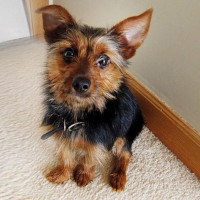
| The Silky-Pin is a mix of the Australian Silky Terrier and Miniature Pinscher breeds. They are small dogs, weighing no more than 7 kilos and measuring around 30 centimeters. They are very healthy and can live up to 14 years or more. As a small dog, they're full of energy and drive, without realizing how small they are. In fact, they can be ferocious when it comes to protecting their family. In fact, this makes them very good watchdogs, and their adorable nature also makes them excellent family pets when properly socialized and trained. |
History of the Silky-Pin |
| The history of the Silky-Pin is still unknown, as it is a newly conceived breed. However, it is possible to deduce a history by examining the backgrounds of the parent breeds, the Australian Silky Terrier and the Miniature Pinscher. |
A little of the Australian Silky Terrier |
||
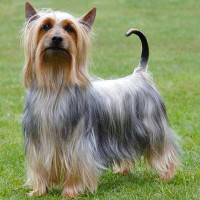
| Originating in Australia, the Australian Silky Terrier derived from the Yorkshire Terrier and Australian Terrier in the 19th century to create the perfect pet. With their silky coats, they are considered hypoallergenic and ideal for allergy sufferers. They make great pets, but can be surly if irritated, so young children should be closely supervised. The Australian Silky Terrier was introduced to America by soldiers returning from World War II and became popular. The Silky Terrier Club of America was founded in 1955 and the breed was recognized by the AKC four years later. Today, the Australian Silky Terrier is the 100th most common breed in the United States. | ||
 |
||
| Standard of the Australian Silky Terrier |
A little of the Miniature Pinscher |
| The Miniature Pinscher originated in Germany in the 1600s, when breeders tried to perfect a rat-hunting dog that could drive vermin from their hiding places. It was bred from German Pinschers, Dachshunds and Italian Greyhounds, and is in no way related to the Dobermann, even though it looks and sounds alike. Some believe that the Miniature Pinscher originated over 2,000 years ago, but there is no record of its existence at that time. In the 1900s, the breed was shown at the German Dog Show in Stuttgart and, some twenty years later, became popular in the United States. The Miniature Pinscher Club of America was founded in 1929 and accepted by the American Kennel Club the same year. Today, they are the 68th most popular breed in America. |
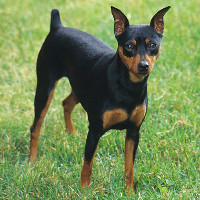 |
| Standard of the Miniature Pinscher |
Appearance of the Silky-Pin |
| The Silky-Pin is a small hybrid breed with a fine coat of medium to long, straight, silky hair, which can come in a variety of colors. Available colors include brindle, silver, gray, sable, blue, fawn, isabella, fawn, red, chocolate, black, although the most common color is black, chocolate and white. They have pointed, upright ears, a long muzzle on a small head, brown eyes, black lips, a scissor bite and a black or brown nose. Its legs are long and strong, and its tail is short to medium-length, and may be hairless or feathered. |
Temperament of the Silky-Pin |
| Your Silky-Pin has a courageous, slightly bossy personality that makes him hope to be king of the castle. While this is a good thing in some cases, you need to make it clear to him that you are the leader of the pack, so that he knows he has to listen to you. Once this is clear, your Silky-Pin should be obedient to you and the rest of the family. They tend to be aloof with strangers and should be introduced to visitors to avoid excessive barking and aggression. However, as long as your dog is properly trained and socialized, there should be no problems. |
Needs and activities of the Silky-Pin |
| Silky-Pins need plenty of activity every day to prevent boredom and anxiety. In fact, he should have about an hour to 90 minutes of exercise a day. Many dogs who don't get enough exercise can end up with aggravating habits, such as excessive barking or chewing on objects. Your Silky-Pin generally enjoys vigorous activities such as chasing local wildlife like rabbits and squirrels, playing with other dogs at the dog park, going for walks, hiking in the woods, swimming, playing games of skill with you or another family member, and is even good at agility classes. Ideally, this hybrid needs a home with a well-fenced yard. |
Maintenance of the Silky-Pin |
| The Silky-Pin's coat is fine and can tangle easily, so it needs to be brushed daily. Use a comb and a stiff bristle brush to comb your dog's coat down to the skin to prevent tangling. The coat should be washed with a conditioning detangling shampoo to prevent the hair from becoming frizzy or dry with split ends. As the coat is similar to human hair, it needs to be trimmed regularly. Once a month, you should trim your dog's nails with nail clippers to prevent them from cracking or splitting. Teeth are also an important part of the routine; brush them daily if you can to prevent plaque and tartar build-up. |



 English (United Kingdom)

Comments