 |
Miniature Pinscher |
|
FCI standard Nº 185 |
||
Origin |
Germany | |
Translation |
Mrs C. Seidler | |
Group |
Group 2 Pinscher and Schnauzer- Molossian breeds - Swiss Mountain and Cattle Dogs | |
Section |
Section 1 Pinscher and Schnauzer type | |
Working |
Without working trial | |
Acceptance on a definitive basis by the FCI |
Thursday 14 July 1955 | |
Publication of the official valid standard |
Tuesday 06 March 2007 | |
Last update |
Wednesday 18 April 2007 | |
En français, cette race se dit |
 |
Pinscher nain |
Diese Norm ist in deutscher Sprache sichtbar |
 |
Zwergpinscher |
En español, esta raza se dice |
 |
Pinscher miniatura |
In het Nederlands, wordt dit ras gezegd |
 |
Duitse Dwergpinscher |
Usage |
| House and Companion Dog. |
Brief historical summary |
| Miniature Pinschers were kept in large numbers around the turn of the century already and the Stud Book for 1925 records no less than 1300 entries. Like with the German Pinscher, from the numerous colour variations, only the colours black with lighter markings and solid red to red-brown were thorough-bred. |
General appearance |
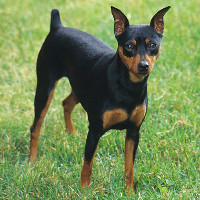
| The Miniature Pinscher is a reduced image of the German Pinscher without the draw-backs of a dwarfed appearance. His elegant square build is clearly visible due to his short smooth coat. |
Important proportions |
| · The ratio from length to height shall make his build appear as square as possible. · The length of the head (measured fom the tip of the nose to the occiput) corresponds to half the length of the topline (measured from the withers to the set on of the tail). |
Behaviour / temperament |
| Lively, spirited, self assured and evenly tempered. These qualities make him an agreeable family and companion dog. |
Head |
||
Cranial region |
||
Skull |
Strong, elongated without markedly protruding occiput. The forehead is flat without wrinkles, running parallel to the bridge of nose. | |
Stop |
Slight, yet clearly defined. | |
Facial region |
||
Nose |
Noseleather well developed and black. | |
Muzzle |
Ending in a blunt wedge. Bridge of nose straight. | |
Lips |
Black, smooth and tight-fitting to the jaw. Corners of lips closed. | |
Jaws and teeth |
Strong upper and lower jaw. The complete scissor bite (42 pure white teeth according to the dentition formula), is strong and firmly closing. The chewing muscles are strongly developed without pronounced cheeks interfering with the smooth outline. | |
Eyes |
Dark, oval, with black pigmented close fitting eyelids. | |
Ears |
Prick ears ; drop ears, set high, V-shaped with the inner edges lying close to the cheeks, turned forward towards temples. Folds parallel, should not be above the top of the skull. | |
Neck |
| Nobly curved, not too short. Blending smoothly into the withers without any marked set on. Dry without dewlap or throatiness. Throat skin tight-fitting without folds. |
Body |
||
Topline |
Slightly sloping from withers towards rear. | |
Withers |
Forming the highest point in topline. | |
Back |
Strong, short and taut. | |
Loin |
Strong. The distance from last rib to hip is short to make the dog appear compact. | |
Croup |
Slightly rounded, imperceptibly blending into tail set on. | |
Chest |
Moderately broad, oval in diameter, reaching to elbows. The forechest is distinctly marked by the point of the sternum. | |
Underline and belly |
Flanks not too tucked up, forming a nicely curved line with the underside of the brisket. | |
Tail |
| Natural; a sabre or sickle carriage is sought after. |
Limbs |
Forequarters |
||
Generality |
Seen from the front, the front legs are strong, straight and not close together. Seen from the side, the forearms are straight. | |
Shoulders |
The shoulder blade lies close against the ribcage and is well muscled on both sides of the shoulder bone, protruding over the points of the thoracic vertebrae. As sloping as possible and well laid back, forming an angle of appr. 50° to the horizontal. | |
Upper arm |
Lying close to the body, strong and well muscled, forming an angle of 95° to 100° to the shoulder blade. | |
Elbows |
Correctly fitting, turning neither in nor out. | |
Forearm |
Strongly developed and well muscled. Completely straight seen from the front and the side. | |
Carpal |
Strong and firm. | |
Pastern |
Strong and springy. Seen from the front,vertical, seen from the side, slightly sloping towards the ground. | |
Forefeet |
Short and round, toes well-knit and arched (cat feet), pads resistant, nails short, black and strong. | |
Hindquarters |
||
Generality |
Standing obliquely, when seen from the side, standing parallel but not close together seen from the rear. | |
Upper thigh |
Moderately long, broad, strongly muscled. | |
Lower thigh |
Long and strong, sinewy, running into a strong hock. | |
Stifle |
Turning neither in nor out. | |
Metatarsus |
Vertical to the ground. | |
Hock |
Markedly angulated, strong, firm, turning neither in nor out. | |
Hind feet |
Somewhat longer than forefeet. Toes well-knit and arched. Nails short and black. | |
Gait and movement |
| The Miniature Pinscher is a trotter. His back remains firm and rather steady in movement. The movement is harmonious, sure, powerful and uninhibited with good length of stride. Typical of the trot is a ground covering, relaxed, fluent movement with strong drive and free front extension. |
Skin |
| Tight fitting over the whole body. |
Coat |
||
Hair |
Short and dense, smooth, close and shiny without bald patches. | |
Colour |
· Self coloured : Deer red, reddish-brown to dark red brown. · Black and Tan : Lacquer black with red or brown markings. The aim is for markings as dark, as rich and as clearly defined as possible. The markings are distributed as follows: Above the eyes, at the underside of the throat, on the pasterns, on the feet, at the inside of the hind legs and under the root of the tail. Two even, clearly separated triangles on the chest. |
|
Size and weight |
||
Height at withers |
Dogs and bitches: 25 to 30 cm. | |
Weight |
Dogs and bitches: 4 to 6 kg. | |
Faults |
| • Any departure from the foregoing points should be considered a fault and the seriousness with which the fault should be regarded should be in exact proportion to its degree and its effect upon the health and welfare of the dog and its ability to perform its traditional work. • Faults listed should be in degree of seriousness. |
General faults |
 Clumsy or light in build. Too low or too high on leg. Heavy or round skull. Wrinkles on forehead. Short, pointed or narrow muzzle. Pincer bite. Light, too small or too large eyes. Ears set low or very long, unevenly carried. Throatiness. Too long, tucked up or soft back. Roach back. Croup falling away. Long feet. Pacing movement. Hackney gait. Thin coat. Roans; black trace on the back, dark saddle and lightened or pale coat. Over- or undersize up to 1 cm. Clumsy or light in build. Too low or too high on leg. Heavy or round skull. Wrinkles on forehead. Short, pointed or narrow muzzle. Pincer bite. Light, too small or too large eyes. Ears set low or very long, unevenly carried. Throatiness. Too long, tucked up or soft back. Roach back. Croup falling away. Long feet. Pacing movement. Hackney gait. Thin coat. Roans; black trace on the back, dark saddle and lightened or pale coat. Over- or undersize up to 1 cm. |
Serious faults |
| Lack of sexual type (ie doggy bitch). Light appearance. Apple head. Lines of head not parallel. Elbows turning out. Hindlegs standing under the body. Straight or open hocked hindlegs. Hocks turning out. Over- or undersize by more than 1 cm but less than 2 cm. |
Disqualifying faults |
| Aggressive or overly shy dogs. Malformation of any kind. Lack of breed type. Faults in mouth, such as over- or undershot or wry mouth. Severe faults in individual parts, such as faults in structure, coat or colour. Over- or undersize by more than 2 cm. |
NB : |
| • Any dog clearly showing physical or behavioural abnormalities shall be disqualified. • The above mentioned faults when occurring to a highly marked degree or frequently are disqualifying. • Male animals should have two apparently normal testicles fully descended into the scrotum. • Only functionally and clinically healthy dogs, with breed typical conformation should be used for breeding. |
Bibliography |
| https://www.fci.be/ |



 English (United Kingdom)

Comments