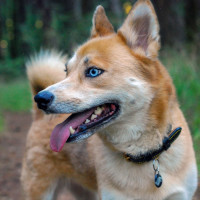
 |
Siberian Shiba |
|
He is not recognized by the F.C.I. |
Origin |
Siberia <> Japan -> U.S.A. | |
Translation |
Francis Vandersteen |
A brief presentation of the Siberian Shiba |
| The Siberian Shiba is an adorable little dog created from a Siberian Husky and a Shiba. Although it can vary from one individual to another, most Siberian Shiba need attention and can be depressed if they don't get enough. They are generally very friendly pets, but if they are not properly socialized as puppies, they need to be supervised in the presence of other dogs. They prefer cooler climates and should not be over-exercised in extreme heat. With its strong, cunning personality, the Siberian Shiba is not a dog for everyone. However, when matched with the right home, this dog makes an excellent companion. |
History of the Siberian Shiba |
| The Siberian Shiba's origins are very recent, with a Siberian Husky parent and a Shiba parent. |
A little of the Siberian Husky |
||
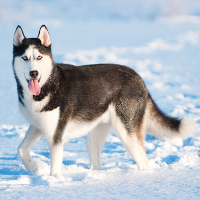
| Siberian Huskies originate from Yatsuk, a remote region in the far northeast of Siberia. They were developed by the inhabitants of this region, known as the Chukchi people. They were mainly used as endurance sled dogs, as they were the most common means of transport. The Siberian Husky was perfect for this job, as it was able to run at moderate speed over long distances and pull the weight of the sleds, even in cold weather. In order to genetically improve the dogs over the generations, all but the best were castrated. They were never crossed and, as a result, for over 3,000 years, the pedigrees remained pure. Women took care of this breed, allowing the dogs to gain experience with children. These dogs were introduced to America in the 20th century by an explorer and fur trader named Olaf Swenson. Siberian Huskies competed in the All-Alaska Sweepstakes, where a team of this breed led by Norwegian Leonhard Seppala won in 1915, 1916 and 1917. In the winter of 1925, the same man was the driver of one of the many Siberian Husky teams used to deliver serum to Nome, Alaska, helping to avert a diphtheria epidemic. | ||
 |
||
| Standard of the Siberian Husky |
A little of the Shiba |
| The Shiba is a fairly recent breed, only introduced to America around 60 years ago, and still growing in popularity. They originated in Japan and, although small, were used to flush out birds and hunt small prey, as well as wild boar and bears. The breed takes its name from the Japanese word Shiba, meaning “brush” and “small”, while Inu means “dog”. The breed fell on hard times during the Second World War, but was brought back thanks to several breeding programs. |
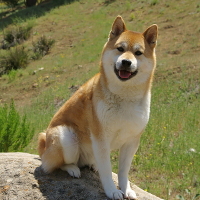 |
| Standard of the Shiba |
Appearance of the Siberian Shiba |
| Siberian Shiba have physical traits derived from both the Siberian Husky and the Shiba. It can be difficult to determine which characteristics will be developed from each parent, as some dogs will adopt different traits from others. Overall, the Siberian Shiba is a compact, proportionate dog with plenty of muscle. It is sometimes described as a wolf or fox, with intelligent eyes and erect ears. They usually have a bushy tail and an expressive face. The eyes are almond-shaped, small and can be different colors, with some dogs having eyes of two different colors. Siberian Shiba ears are triangular, erect and small, though proportionate to the size of the body and head. They are well set and inclined forward at an angle that corresponds to the arched neck. The body, which is distinctly male or female, is not as tall as it is long. Their feet have arched toes and are compact and feline with thick pads. |
Temperament of the Siberian Shiba |
| The Siberian Shiba is a magnificent breed, but it can sometimes be difficult to handle, especially if owners are unfamiliar with its parent breeds. Both the Siberian Husky and Shiba breeds are very independent dogs that also have a very strong propensity for hunting. They are also highly intelligent and good at escaping. As a result, the Siberian Shiba should always be kept on a leash or in a secure area. This breed can also be inquisitive, like its Husky relative. It can be difficult to determine with certainty certain traits of this designer breed, as some aspects of the Siberian Husky and the Shiba are opposites. For example, the Shiba is very independent and doesn't generally crave affection. The Siberian Husky, on the other hand, needs constant human companionship and can become upset when left alone. This hybrid breed is generally suited to homes with children, although it should be supervised in the presence of young children. |
Needs and activities of the Siberian Shiba |
| Based on the activity levels of the Siberian Shiba's parent breeds, we can conclude that these dogs will be very active. This means they'll need to exercise for around 60 to 90 minutes a day. As this is a highly intelligent breed, it also needs some mental stimulation throughout the day. These dogs absolutely need obedience training, as they are very strong mentally. To teach these dogs, you need to be confident and firm, but not aggressive. They prefer cold weather and should not be over-exercised in hot weather. Not at all suited to apartment living, they need a safe enclosure in which to play - ideally a fenced garden where they can get fresh air several times a day. |
Maintenance of the Siberian Shiba |
| This hybrid breed will certainly need frequent brushing. This is obvious, as Shibas shed a lot and Siberian Huskies even more. So be prepared to spend some time brushing your dog, and don't be surprised if you have to vacuum often. Siberian Huskies need to be brushed at least once a week, but don't need to be bathed regularly, as they're clean enough and wash themselves. The Shiba will need brushing and bathing from time to time, but maintenance is fairly straightforward. Other needs include brushing your dog's teeth, which should be done at least two or three times a week. This simple but essential task will prevent teeth decay and gums from becoming sensitive. Ears should be cleaned weekly to prevent ear infections, and nails trimmed once or twice a month. How often your dog needs his nails trimmed depends on his lifestyle and activity level. |



 English (United Kingdom)

Comments