Siberian Pinscher

He is not recognized by the F.C.I.

Origin
Siberia <> Germany -> U.S.A.
Translation
Francis Vandersteen
This breed is also known as
Dobsky

A brief presentation of the Siberian Pinscher

The Siberian Pinscher is a hybrid of the Siberian Husky and the Dobermann. The Siberian Husky is easy-going and outgoing, capable of fulfilling a variety of roles, from sled dog to therapy dog to pet. The Dobermann is a strong, fast dog that will be both friend and protector to its human family. Medium-sized, both breeds are intelligent and have excellent stamina, qualities that will probably be passed on to their hybrid offspring.

History of the Siberian Pinscher

The Siberian Pinscher is the result of breeding a Dobermann and a Siberian Husky. The two breeds are common, so the Siberian Pinscher mix won't be hard to find. However, it will be difficult to know what your puppy will look like, and he may have more dominant personalities than others. One thing's for sure though, the mix combines the excellent traits of both sides. If there's one thing that's certain, it's that these two breeds make one hell of a dog.


A little of the Siberian Husky

        
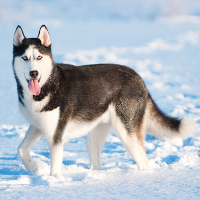
The Chukchi, a tribe indigenous to Russia, developed the Siberian Husky at some point in prehistoric times. These dogs were probably used for hunting, as well as pulling the sleds of those they lived with. Also bred to be a good companion, the Siberian Husky was a key element in the daily life of the Chukchi people. In the early 1900s, this breed of dog was brought to Alaska and entered in the All Alaska Sweepstakes, where it did very well; some teams made up of Siberian Huskies won the annual competition until it was cancelled when the United States entered the First World War. In the winter of 1925, a diphtheria epidemic infected the town of Nome, endangering around 10,000 people in the area. So that the necessary serum could be distributed to the villagers, twenty sled drivers and over 100 dogs, most of them Siberian Huskies, made the arduous 1100-kilometer journey to Nulato to obtain the medicine and bring it back to Nome. Instead of taking twenty-five days, the dogs managed to make the journey in just under six days, despite terrible conditions. On the last leg of the journey, conditions were so bad that the handlers couldn't see, but the dogs managed to return with the serum. In 1930, the breed was recognized by the American Kennel Club.
Standard of the Siberian Husky


A little of the Dobermann

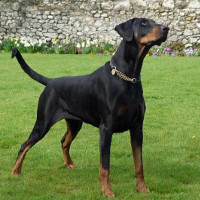
The Dobermann dog was found in Germany in the 1800s. The breed was actually developed by a tax collector named Karl Friedrich Louis Dobermann. This, of course, is where the breed got its name. Karl's aim was to create a dog that could protect him while he visited dangerous neighborhoods, as well as intimidate people who wanted to evade tax payments. He had access to the local animal shelter and could therefore have used a variety of dogs to create this breed. As he didn't keep proper documentation of the breeds he used, it's unclear exactly how this dog came to be. Some breeds that would have been used were Shorthaired Sheepdogs, Black and Tan Terriers, German Pinschers and Rottweilers. There's also the possibility of the Beauceron, Braque de Weimar, Greyhound and Black and Tan Manchester Terrier. The breed quickly gained in popularity and was found in Europe, Russia, the USA and South Africa in the 1920s. Today, the breed is known the world over.
Standard of the Dobermann

Appearance of the Siberian Pinscher

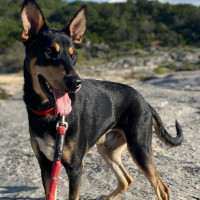
The Siberian Pinscher is a large dog, weighing between 18 and 41 kilos and measuring between 56 and 66 centimeters at the withers. His appearance will generally be an equal blend of his two parents, but you can be sure he'll be strong and athletic. His face will be a pleasing blend of a no-nonsense dog and a cheeky Siberian Husky smile. His eyes may be brown or blue, or perhaps a little of both. His ears will be large and triangular, and his muzzle and tail will be long. The Siberian Pinscher inherits any combination of coat colors from either parent, be it black and rust or gray and white, and it may inherit markings from either parent, be it the Siberian Husky mask or the Dobermann eyebrows. His double coat will be thick-textured and straight, and will generally take on a length in the middle of that of both parents, so you should expect him to have a medium-length coat. He will shed moderately throughout the year, and will undergo a full molt each molting season.

Temperament of the Siberian Pinscher

The Siberian Pinscher is a loyal, protective dog who loves his family more than anything else in the world. At first, he'll be aloof with strangers and bark to warn you of their presence, but once he understands that his family wants them around, his sociable Siberian Husky nature will take over and he'll want to make friends with them in no time. This mixed breed offers an excellent balance between sociability and the protection of both parents. Because he loves you so much, you can be sure he'll be an intense dog who wants to spend every minute in your company. This is a good thing if you like this trait in a canine companion, but for people who prefer a more independent dog, you may want to consider another breed. But if you're looking for a canine shade that will shower you with kisses and affection, then look no further than this dog. Because of his needy nature, he can suffer from separation anxiety, so he needs to be placed with a family who can guarantee to be home with him most of the day. This is a problem that will have to be resolved during the puppy's training. Fortunately, every minute spent with the Siberian Pinscher will be full of laughter and fun, and you can be sure that you'll never be bored with this dog. He'll always be up for a game of fetch, a long hike or entertaining you with his talkative personality. Just make sure you have plenty of energy to give him back.

Needs and activities of the Siberian Pinscher

Like most Siberian Husky crosses, the Siberian Pinscher will need 60 to 90 minutes of intense exercise every day. It should therefore be placed in an active family that can guarantee this level of exercise. Don't underestimate this dog's energy, because if he doesn't get what he needs, he'll become destructive and behavioral problems will start to appear. But if you can do this, then you'll make an ideal couple, that's for sure. As a large dog with a lot of energy, the Siberian Pinscher needs to be placed in a home with plenty of space inside and out. His garden should be reinforced by high fences, because if this dog takes after his Siberian Husky parent, he'll climb those fences with ease. As long as he's well socialized as a puppy, he'll be happy to live with other pets. Thanks to the calmer behavior of its Dobermann parent at home, this dog is also suitable for homes with children, but be sure to supervise it as you would any other dog. The Siberian Pinscher has the potential to become very overprotective of its family, and this is something that needs to be taken seriously during puppy training. Firstly, he needs to be socialized with dogs of all shapes and sizes, other animals and humans outside the family unit, so that he understands that most other beings are friends. The Siberian Pinscher would benefit from obedience training so that he understands who's boss and doesn't challenge your authority as master. Take a look at these tips for socializing an overprotective dog, which, when used as a dog, can prevent him from becoming overprotective in the first place. Because there's a good chance he'll become anxious when separated from his family, it's important to crate train him as a puppy, as this will not only give him a safe space when he's on his own, but also peace of mind when you need to leave him to his own devices. Choosing a crate for a more anxious dog is a good idea, as you won't have to worry about him becoming destructive.

Maintenance of the Siberian Pinscher

The Siberian Pinscher has a thick double coat that requires thorough brushing 2-3 times a week. If its coat resembles that of its Dobermann parent, it may be less, and if its coat more closely resembles that of its Siberian Husky parent, it may be more. As this is a generally clean breed of dog, you should only bathe the Siberian Pinscher once every 2 or 3 months. If he gets very dirty between washes, don't be afraid to rinse off the dirt, but avoid using products too often, as you risk damaging the natural oils in his coat. His large ears should be cleaned once a week to prevent bacteria build-up, and be sure to keep a regular eye on his eyes, given the eye health problems described above. You should also trim his nails regularly if necessary.

Comments

Latest page updates

  • Telomian

    Telomian He is not recognized by the F.C.I. Origin Malaysia Translation Francis Vandersteen A brief presentation of the Telomian The Telomian is a very rare breed of dog, and the only one native to Malaysia to have been bred outside the country. They were originally bred by the indigenous people of Malaysia to combat parasites such as snakes, rats,...
  • King Wheaten -- Cavalier King Charles Spaniel X Irish Soft Coated Wheaten Terrier

    King Wheaten He is not recognized by the F.C.I. Origin Great Britain <> Ireland -> U.S.A. Translation Francis Vandersteen A brief presentation of the King Wheaten The King Wheaten is a small dog with a heart this big and a playful disposition. Borrowing the energy and soft-coated waves of the Irish Soft Coated Wheaten Terrier and the size and...
  • Spanierd -- English Springer Spaniel X German Shepherd

    Spanierd He is not recognized by the F.C.I. Origin Great Britain <> Germany -> U.S.A. Translation Francis Vandersteen A brief presentation of the Spanierd The Spanierd is a hybrid dog. Its parent breeds are the English Springer Spaniel and the German Shepherd. They have an affable personality. He's known for entertaining family and friends with his...
  • Alaskan Goldenmute -- Alaskan Malamute X Golden Retriever

    Alaskan Goldenmute He is not recognized by the F.C.I. Origin U.S.A. <> Great Britain -> U.S.A. Translation Francis Vandersteen This breed is also known as Alaskan GoldenGoldenmuteAlaskan Gold Retriever     A brief presentation of the Alaskan Goldenmute The Alaskan Goldenmute is a descendant of two great dog breeds: the Alaskan Malamute and the Golden...
  • French pointing dog Pyrenean type

    French pointing dog Pyrenean type FCI standard Nº 134 Origin France Translation Mrs. Peggy Davis Group Group 7 Pointing Dogs Section Section 1.1 Continental Pointing Dogs « Braque » Type Working With working trial Acceptance on a definitive basis by the FCI Tuesday 18 January 1955 Publication of the official valid standard Tuesday 01 August 2023 Last...
  • French pointing dog Gascogne type

    French pointing dog Gascogne type FCI standard Nº 133 Origin France Translation Mrs. Peggy Davis Group Group 7 Pointing Dogs Section Section 1.1 Continental Pointing Dogs « Braque » Type Working With working trial Acceptance on a definitive basis by the FCI Monday 17 January 1955 Publication of the official valid standard Tuesday 01 August 2023 Last...
  • Vucciriscu

    Vucciriscu He is not recognized by the F.C.I. Origin Sicily Translation Francis Vandersteen En français, cette race se dit Vucciriscu Diese Norm ist in deutscher Sprache sichtbar Vucciriscu En español, esta raza se dice Vucciriscu In het Nederlands, wordt dit ras gezegd Vucciriscu This breed is also known as Sicilian Vucciriscu Sicilian Butcher...

© 2026 Groupe Milouchouchou ASBL. Tous droits réservés. En savoir plus

Protected by Copyright01
We use cookies

We use cookies on our website. Some of them are essential for the operation of the site, while others help us to improve this site and the user experience (tracking cookies). You can decide for yourself whether you want to allow cookies or not. Please note that if you reject them, you may not be able to use all the functionalities of the site.

Ok