English Bulldog

FCI Standard No. 149

Origin
Great Britain
Group
Group 2 Pinscher and Schnauzer Molossoid breeds-Swiss Mountain and Cattle Dogs
Section
Section 2.1 Molossoid breeds, Mastiff Type
Working
Without working trial
Date of acceptance on a definitive basis by the FCI
Monday 14 March 1955
Date of publication of the official valid standard
Tuesday 08 September 2026
Date of the last update
Tuesday 06 October 2026
En français, cette race se dit
Bulldog anglais
Diese Norm ist in deutscher Sprache sichtbar
Englische Bulldogge
En español, esta raza se dice
Bulldog Inglés
In het Nederlands, wordt dit ras gezegd
Engelse Bulldog

Usage

Dissuasion and Companion Dog.
 

Brief historical summary

The Bulldog was first classified as such in the 1630s though there is earlier mention of similar types referred to as bandogs, a term reserved today for a type of fighting dog. Used originally for bull-baiting, the Bulldog also fought its way through the dog pits but after 1835 began to evolve into the shorter faced, more squat version we now know. It entered the show ring in 1860 and the ensuing years saw a big personality change. A delightfully ugly dog with a pugilistic expression, which belies a loving, affectionate nature to family and friends. One of the oldest indigenous breeds, known as the national dog of Great Britain, and associated throughout the world with British determination and the legendary John Bull.

General appearance

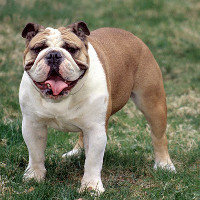
Smooth-coated, fairly thick set, rather low in stature, broad, powerful and compact. Head fairly large in proportion to size, but no point so much in excess of others as to destroy the general symmetry, or make the dog appear deformed, or interfere with its powers of motion. Face relatively short, muzzle broad, blunt and inclined slightly upwards, although not excessively so.
Dogs showing respiratory distress or making excessive respiratory noise is unacceptable. Body fairly short, well knit, limbs stout, well muscled and in hard condition with no tendency towards obesity. Hindquarters high and strong. Bitches not so grand or well-developed as dogs.

Behaviour / temperament

Conveys impression of determination, strength and activity. Alert, bold, loyal, dependable, courageous, fierce in appearance, but possessed of affectionate nature.

Head

Cranial region

Head
Viewed from side, head appears very high and moderately short from back to point of nose. Forehead flat with skin on and about head, slightly loose and finely wrinkled without excess, neither prominent nor overhanging face. Face from front of cheek bone to nose, relatively short, skin may be slightly wrinkled. Distance from inner corner of eye (or from centre of stop between eyes) to extreme tip of nose should not be less than the distance from tip of the nose to edge of the underlip.
Skull
Skull relatively large in circumference. Viewed from front appears high from corner of lower jaw to apex of skull; also broad and square. From stop, a furrow, extending to middle of skull being traceable to apex.
Stop
Defined.

Facial region

Foreface
Viewed from front, the various properties of the face must be equally balanced on either side of an imaginary line down centre.
Nose
Nose and nostrils large, broad and black, under no circumstances liver colour, red or brown. Nostrils large wide and open, with well-defined vertical straight line between.
Muzzle
Muzzle short, broad, turned upwards and deep from corner of eye to corner of mouth. Over nose wrinkle, if present, whole or broken, must never adversely affect or obscure eyes or nose. Pinched nostrils and heavy over nose roll are unacceptable and should be heavily penalised.
Lips
Flews (chops) thick, broad and deep, covering lower jaws at sides, but joining underlip in front. Teeth not visible.
Jaws and teeth
Jaws broad, strong and square, lower jaw slightly projecting in front of upper, with moderate turn up. Jaws broad and square with six small front teeth between canines in an even row. Canines wide apart. Teeth large and strong not seen when mouth closed. When viewed from front under jaw directly under upper jaw and parallel.
Cheeks
Cheeks well rounded and extended sideways beyond eyes.
Eyes
Seen from front, situated low down in skull, well away from ears. Eyes and stop in same straight line, at right angles to furrow. Wide apart, but outer corners within the outline of cheeks. Round, of moderate size, neither sunken nor prominent, in colour very dark- almost black- showing no white when looking directly forward. Free from obvious eye problems.
Ears
Set high - i.e. front edge of each ear (as viewed from front) joins outline of skull at top corner of such outline, so as to place them as wide apart, as high and as far from eyes as possible. Small and thin. “Rose ear” correct, i.e. folding inwards back, upper or front inner edge curving outwards and backwards, showing part of inside of burr.

Neck

Moderate in length, thick, deep and strong. Well-arched at back, with some loose, thick and wrinkled skin about throat, forming slight dewlap on each side.

Body

Topline
Slight fall to back close behind shoulders (lowest part) whence spine should rise to loins (top higher than top of shoulder), curving again more suddenly to tail, forming slight arch - a distinctive characteristic of breed.
Back
Short, strong, broad at shoulders.
Chest
Wide, prominent and deep. Body well-ribbed up behind. Brisket, round and deep. Well let down between forelegs. Ribs not flat-sided, but well-rounded.
Underline and belly
Belly tucked up and not pendulous.

Tail

Set on low, jutting out rather straight and then turning downwards. Round, smooth and devoid of fringe or coarse hair. Moderate in length - rather short than long - thick at root, tapering quickly to a fine point. Downward carriage (not having a decided upward curve at end) and never carried above back. Lack of tail, inverted or extremely tight tails are highly undesirable.

Limbs

Forequarters

Generality
Forelegs short in proportion to hindlegs, but not so short as to make back appear long, or detract from dog’s activity.
Shoulders
Broad, sloping and deep, very powerful and muscular giving appearance of being “tacked on” body.
Elbows
Elbows low and standing well away from ribs.
Forearm
Forelegs very stout and strong, well-developed, set wide apart, thick, muscular and straight, bones of legs large and straight, not bandy nor curved.
Pastern
Short, straight and strong.
Forefeet
Straight and turning very slightly outward; of medium size and moderately round. Toes compact and thick, well split up, making knuckles prominent and high.

Hindquarters

Generality
Legs large and muscular, slightly longer in proportion than forelegs. Legs long and muscular from loins to hock.
Stifle
Hocks slightly bent, well let down.
Hock
Stifles turned very slightly outwards away from body.
Hind feet
Round and compact. Toes compact and thick, well split up, making knuckles prominent and high.

Gait and movement

Appearing to walk with short, quick steps on tips of toes, hind feet not lifted high, appearing to skim ground, running with one or other shoulder rather advanced. Soundness of movement of the utmost importance.

Coat

Hair
Fine texture, short, close and smooth (hard only from shortness and closeness, not wiry).
Colour
Whole or smut, (i.e. whole colour with black mask or muzzle).
Whole colours are red, fawn, white.
Red or fawn may have white markings i.e. red and white, fawn and white.
Brindle – solid background colour marked with darker stripes :
Red brindle, fawn brindle. Brindles may have white markings, i.e. red brindle and white, fawn brindle and white.
Pied – white background with markings of any of the above listed colours.
Colours should be brilliant. Any of the colours listed may have dark tips or ticking. Any other colour or combination of colours unacceptable.

Size and weight

Weight
Males : 25 kgs. Females : 23 kgs.

Faults

• Any departure from the foregoing points should be considered a fault and the seriousness with which the fault should be regarded should be in exact proportion to its degree and its effect upon the health and welfare of the dog and its ability to perform its traditional work.
• Faults listed should be in degree of seriousness.
 

Disqualifying faults

Aggressive or overly shy.

NB :

• Any dog clearly showing physical or behavioural abnormalities shall be disqualified.
• The above mentioned faults when occurring to a highly marked degree or frequently are disqualifying.
• Male animals should have two apparently normal testicles fully descended into the scrotum.
• Only functionally and clinically healthy dogs, with breed typical conformation should be used for breeding.

Detailed history

The Bulldog is one of the most extraordinary representatives of the canine species. This veteran of bulls, full of courage and pugnacity; two qualities that, over the years, breeders have endeavored to develop; has become the symbol of the British nation.

His name tells us that this dog, before becoming the inseparable companion of John Bull, was a bull dog, according to the tradition, very old, which had for primary purpose the improvement of the quality of the meat, the chevrons being aware that it was softer and tastier if the bull had been run before slaughtering it. To this end, butchers used strong mastiffs, dogs brave enough to oppose bullfighting, and in Britain this role was vested in the ancestors of the Mastiff.

The ancient origins of the Mastiff divide the cynophiles. Some of them, indeed, think that the Phoenicians and the Romans would have implanted it in Great Britain during their wanderings in Northern Europe. If this hypothesis may seem at first interesting, it must be admitted that it is contrary to the words of Caesar himself, especially in his Commentaries, about the conquest of Brittany (let us say Great Britain), where he said that Celtic Molossians had been launched to attack the Roman legions and had largely contributed to spreading panic among their ranks. It is therefore more probable that such Molosses already existed in Great Britain; and this from the Celtic expansion; and that the Romans imported them to make them fight in the circuses, rather than to make known to the populations of the British islands their pugnaces of Epire. This explanation is all the more plausible because the Roman chronicler Gratius Faliscus indicates, in the year 8 BC, that the latter had been brought especially to Great Britain to be confronted with the Molosses of Cornwall (Cornwall), which always came out victorious. In addition, the Celtic tribes which devastated the Greek and Roman cities were helped by dogs of impressive size. At the Museum of Copenhagen, moreover, are exhibited some very beautiful pieces of Celtic art, including cauldrons on which are represented Molosses with monstrous appearance.

Be that as it may, the clashes between bulls and dogs soon turned into the most exciting entertainment of the Middle Ages, so much so that they were elevated to the rank of sporting events. However, from this time, the nobility was to reserve the exclusivity of the use of the Mastiff, the "Laws of the forest" enacted in 1272 even providing for the amputation of three fingers of the forepaws of every morning of high body build belonging to the villains. Therefore, all those who did not have the honor of belonging to the British upper classes had no other solution, to continue to organize bull baitings, than to use dogs of smaller size, but no less combative for that: from this initiative was born the Bulldog.

Thus, Edward de Langley (1344 - 1412), officer of King Henry IV and in charge of "the courts, bulls and Mastiffs", reports in the Mayster of Cam a "second category Mastiff" spotted, with ears hanging and eyes little ones, who had the reputation of never letting go of the beast capped by him. An animal that actually announced the Bulldog. From the beginning of the sixteenth century, mention is made of the exploits of the Bold-Dog; dog full of daring; while in 1586 Willy Harrison told the Band-Dog that it was "a dog with a powerful body, a bloody and frightening face, a weird, stubborn character, [and what four dogs were enough to liquidate a powerful bear" reported by Dhers and Rufer). Whatever the denominations of the time, the existence of the Bulldog in the sixteenth century no longer makes any doubt; an animal whose essential role is to fight the most diverse animals.

It was not until 1632, however, that the term Bulldog appeared for the first time. A certain Preston Eaton, based in San Sebastián, Spain, asks his London friend, George Willighan, by mail to send him "a Mastiff and two big Bulldogs" to compare the exploits of English dogs with those of the famous Burgos Mastiffs, also valiant fighters of the bulls.

The animal fights actually became a real institution under the reign of Elizabeth I (1558 - 1603). The sovereign had also made Tuesday the day dedicated to these festivities and missed every opportunity to go every week to encourage his Mastiffs struggling with bulls, bears, lions and other big cats. These fights are not unanimous, however. If, for Cromwell, it is a "sweet and comforting recreation for the entertainment of a peaceful people," for Samuel Pepys, a 1660-1669 editor of a London life journal, "this is a brutal and disgusting pleasure. So, little by little, and even though their national dog arouses pride in some, such poet Christopher Smart that "of all dogs, they are the best," the Bulldog is more and more hated by some of the British population. A British Field Sport journalist goes so far as to write in 1818 that this dog is "devoted only to the most barbarous and detestable purposes, that he is the shame of his species, that one can not invoke its utility, its humanity, or even simple common sense, in a word that the disappearance of the race is to be desired ".

In 1835, the British Parliament banned bull baiting, and even though this sport did not disappear completely from the most remote counties of London before the end of the 19th century, the breeding of the Bulldog was gradually abandoned. Only in dog fighting; they too are forbidden but can be more easily carried out in backyards of pubs, barns or private cellars; that some subjects are reconverted. But they are not very adapted to this kind of sport; without their aggression and courage being blamed, they are criticized for not being spectacular enough and we prefer Bull Terriers from Bulldogs and Terriers.

In the middle of the nineteenth century, the Bulldog was endangered and in 1859 the breed was absent from the first dog show. It was not until the Birmingham exhibition, the following year, and then at Sheffield and London, that subjects were presented for the first time. This was a great victory, which pushed some breeders and amateurs of Bulldogs to found a club, in 1864. Under the pseudonym of "Philo Kuon" (the Friend of the dog), they wrote a standard which was published the following year by Club Treasurer Sam Wickens.

If the standard clearly described a Bulldog of this time, that is to say a large and compact animal close to the Boxer, it is just as certain that the editors had as ideal a rather different animal. Therefore, the breeders, who had not known the old fighting dogs and who followed the standard to the letter, would move to another type of dog, more leggy, even more compact, shorter, to the head more massive and the muzzle erased. This transformation was at the heart of a long debate, which is still not closed.

Thus, in 1893, in his seminal work Non-Sporting Dogs, Rawdon Lee wrote: "Time can wreak havoc on historical monuments, but never before has it degraded something as burlesque as our national symbol: the British Bulldog. Selected for a specific purpose (now long removed), current topics are the result of a selection of things not found in any other dog. There is nothing to support the claim that they are raised today as they were sixty years ago. "

What was so vehemently reproached for the first breeders to be compared to vandal burlesque? Simply to make this dog like no other the opposite of all dogs. In other words, to make a monster intended to personify courage and power, but blowing and groaning as soon as it had to provide the slightest effort. And it is true that the danger of turning him into a cripple, by wishing him ever more typical, is constantly on this dog. But perhaps this is also what passionate breeders: manage to produce an animal as large, massive, compact and short as possible without sacrificing much to his health.

Oddly enough, the Bulldog standard has remained largely the same; only a few modifications were made: in 1950, the weight was raised from 22.7 to 25 kg; in 1987, some adjectives and adverbs were added with the intention of putting a stop to outrageous interpretations. However, the Bulldog of 1875 does not look much like that of the twenties, itself considered too high on legs, not large enough, with a head too small when showing reproductions to current breeders. The fame of this dog having grown up despite the efforts of some "reasonable" cynophiles like Rawdon Lee, to criticize the modern Bulldog, is the symbol that the British used to recall the qualities of good old England at the time of its darkest hours. It is no coincidence that Churchill himself adopted such a dog.

The Bulldog is today one of the most popular breeds in Britain and the United States. In other countries, it is a little less esteemed, but we bet that the few enthusiasts of this particular dog will appreciate it.

In his serious, perpetually concerned manner, the Bulldog puppy is in fact a true clown full of vitality, frolicking, jumping, then, for no apparent reason, sprawling on his stomach and falling asleep, almost smug. In adulthood, he remains this dog happy to live, under a severe and grumpy mask, say the English, that is to say "scowling". The Bulldog is in fact attentive to everything that is happening around him and sensitive: it is unfairly argued, and he will be upset for the rest of the day. He, former fighting dog, he can not stand brutality; He seeks above all human affection, fearing solitude more than anything. It is necessary to surround him with tenderness and to seek very soon to bloom his excellent character, educating him gently and appealing to all the resources of his intelligence.

With children, he is one of the most complacent and the most patient. This heavyweight knows perfectly how to dose his power; it is only necessary to beware that the games do not go so far as to exhaust it. If he plays the clowns without condescending in the intimacy of his family, he also knows how to be serious and dignified when the circumstances require it: a stranger arises, he will become a determined and vigilant animal (without aggression, however); and that this stranger is welcomed by his master, then he will not be outdone to express his friendship, in his own way, that is to say, grumbling and frowning. The Bulldog is still a patient animal, kind and peaceful but by no means servile, proud or obsequious. He is one of the dogs with a sense of humor. He also knows how to be calm, never noisy, barking little but always wisely, and being tolerant with his congeners as long as they do not attack him.

As much as his amazing physique; some grant him the beauty of the ugly; Bulldog enthusiasts value his sure temperament, in turn debonair or vigilant. During the French National Breeding Club, there is a test of character, to check and preserve the balance of the dog, which consists in attacking his master by a stranger: without showing any fear, on the contrary, the animal must show authority. Finally, the Bulldog is endowed with an endearing temperament and, if only for that, he deserves all our respect. It has been denigrated, almost always wrongly, but it is also because it arouses passions. The owner of a Bulldog, who must be warned of the peculiarities of the breed, must let him exercise, without forcing or overworking him, respecting his rhythm, so as to strengthen his muscles and allow him to increase its respiratory capacity. It is necessary to avoid this dog to excite himself excessively; stress is frequent for him; and especially to expose him to heat, his main enemy against whom he is not armed. In a word, it's a dog for connoisseur.

Comments

Latest page updates

  • Yorkshire Terrier

    Yorkshire Terrier FCI Standard No. 86 Origin Great Britain Group Group 3 Terriers Section Section 4 Toy Terriers Working Without working trial Date of acceptance on a definitive basis by the FCI Saturday 30 October 1954 Date of publication of the official valid standard Tuesday 08 September 2026 Date of the last update Tuesday 06 October 2026 En...
  • West Highland White Terrier

    West Highland White Terrier FCI Standard No. 85 Origin Great Britain Group Group 3 Terriers Section Section 2 Small-sized Terriers Working Without working trial Date of acceptance on a definitive basis by the FCI Friday 29 October 1954 Date of publication of the official valid standard Tuesday 08 September 2026 Date of the last update Tuesday 06...
  • Welsh Terrier

    Welsh Terrier FCI Standard No. 78 Origin Great Britain Group Group 3 Terriers Section Section 1 Large- and medium sized Terriers Working Without working trial Date of acceptance on a definitive basis by the FCI Saturday 23 October 1954 Date of publication of the official valid standard Tuesday 08 September 2026 Date of the last update Tuesday 06...
  • Welsh Springer Spaniel

    Welsh Springer Spaniel FCI Standard No. 126 Origin Great Britain Group Group 8 Retrievers-Flushing Dogs-Water Dogs Section Section 2 Flushing Dogs Working With working trial Date of acceptance on a definitive basis by the FCI Thursday 30 December 1954 Date of publication of the official valid standard Tuesday 08 September 2026 Date of the last...
  • Welsh Corgi Pembroke

    Welsh Corgi Pembroke FCI Standard No. 39 Origin Great Britain Group Group 1 Sheepdogs and Cattle Dogs (except Swiss Cattle Dogs) Section Section 2 Cattledogs (except Swiss Cattledogs) Working Without working trial Date of acceptance on a definitive basis by the FCI Wednesday 13 November 1963 Date of publication of the official valid standard Tuesday 08...
  • Welsh Corgi Cardigan

    Welsh Corgi Cardigan FCI Standard No. 38 Origin Great Britain Group Group 1 Sheepdogs and Cattle Dogs (except Swiss Cattle Dogs) Section Section 2 Cattledogs (except Swiss Cattledogs) Working Without working trial Date of acceptance on a definitive basis by the FCI Tuesday 12 November 1963 Date of publication of the official valid standard Tuesday 08...
  • Sussex Spaniel

    Sussex Spaniel FCI Standard No. 127 Origin Great Britain Group Group 8 Retrievers, Flushing dogs, Water dogs. Section Section 2 Flushing dogs Working With working trial Date of acceptance on a definitive basis by the FCI Friday 31 December 1954 Date of publication of the official valid standard Tuesday 08 September 2026 Date of the last update Tuesday 06...
  • Staffordshire Bull Terrier

    Staffordshire Bull Terrier FCI Standard No. 76 Origin Great Britain Group Group 3 Terriers Section Section 3 Bull type Terriers Working Without working trial Date of acceptance on a definitive basis by the FCI Thursday 21 October 1954 Date of publication of the official valid standard Tuesday 08 September 2026 Date of the last update Tuesday 06...
  • Skye Terrier

    Skye Terrier FCI Standard No. 75 Origin Great Britain Group Group 3 Terriers Section Section 2 Small-sized Terriers Working Without working trial Date of acceptance on a definitive basis by the FCI Wednesday 20 October 1954 Date of publication of the official valid standard Tuesday 08 September 2026 Date of the last update Tuesday 06 October 2026 En...
  • Shetland Sheepdog

    Shetland Sheepdog FCI Standard No. 88 Origin Great Britain Group Group 1 Sheepdogs and Cattle Dogs Section Section 1 Sheepdogs Working Without working trial Date of acceptance on a definitive basis by the FCI Tuesday 09 November 1954 Date of publication of the official valid standard Tuesday 08 September 2026 Date of the last update Tuesday 06...
  • Sealyham Terrier

    Sealyham Terrier FCI Standard No. 74 Origin Great Britain Group Group 3 Terriers Section Section 2 Small sized Terriers Working Without working trial Date of acceptance on a definitive basis by the FCI Tuesday 19 October 1954 Date of publication of the official valid standard Tuesday 08 September 2026 Date of the last update Tuesday 06 October...
  • Scottish Terrier

    Scottish Terrier FCI Standard No. 73 Origin Great Britain Group Group 3 Terriers Section Section 2 Small-sized Terriers Working Without working trial Date of acceptance on a definitive basis by the FCI Monday 18 October 1954 Date of publication of the official valid standard Tuesday 08 September 2026 Date of the last update Tuesday 06 October...
  • Old English Sheepdog (Bobtail)

      Old English Sheepdog (Bobtail) FCI Standard No. 16     Origin   Great Britain Group   Group 1 Sheepdogs and Cattle Dogs (except Swiss Cattle Dogs) Section   Section 1 Sheepdogs Working   Without working trial Date of acceptance on a definitive basis by the FCI   Monday 25 November 1963 Date of publication of the official valid standard   Tuesday 08 September...
  • Norwich Terrier

    Norwich Terrier FCI Standard No. 72 Origin Great Britain Group Group 3 Terriers Section Section 2 Small-sized Terriers Working Without working trial Date of acceptance on a definitive basis by the FCI Saturday 16 October 1954 Date of publication of the official valid standard Tuesday 08 September 2026 Date of the last update Tuesday 06 October...
  • Norfolk Terrier

    Norfolk Terrier FCI Standard No. 272 Origin Great Britain Group Group 3 Terriers Section Section 2 Small-sized Terriers Working Without working trial Date of acceptance on a definitive basis by the FCI Saturday 01 October 1966 Date of publication of the official valid standard Tuesday 08 September 2026 Date of the last update Tuesday 06 October...
  • Manchester Terrier

    Manchester Terrier FCI Standard No. 71 Origin Great Britain Group Group 3 Terriers Section Section 1 Large and medium sized Terriers Working Without working trial Date of acceptance on a definitive basis by the FCI Friday 15 October 1954 Date of publication of the official valid standard Tuesday 08 September 2026 Date of the last update Tuesday 06 October...
  • Lakeland Terrier

    Lakeland Terrier FCI Standard No. 70 Origin Great Britain Group Group 3 Terriers Section Section 1 Large and medium-sized Terriers Working Without working trial Date of acceptance on a definitive basis by the FCI Thursday 14 October 1954 Date of publication of the official valid standard Tuesday 08 September 2026 Date of the last update Tuesday 06 October...
  • Labrador Retriever

      Labrador Retriever FCI Standard No. 122     Origin   Canada Group   Group 8 Retrievers, Flushing dogs, Water dogs Section   Section 1 Retrievers Working   With working trial Date of acceptance on a definitive basis by the FCI   Friday 24 December 1954 Date of publication of the official valid standard   Tuesday 08 September 2026 Date of the last update   Tuesday 06...
  • King Charles Spaniel

    King Charles Spaniel FCI Standard No. 128 Origin Great Britain Group Group 9 Companion and Toy Dogs Section Section 7 English Toy Spaniels Working Without working trial Date of acceptance on a definitive basis by the FCI Monday 03 January 1955 Date of publication of the official valid standard Tuesday 08 September 2026 Date of the last update Tuesday 06...
  • Harrier

      Harrier FCI Standard No. 295     Origin   Great Britain Translation   Mrs. Peggy Davis, brought up to day by Dr. Paschoud Group   Group 6 Scenthounds and related breeds Section   Section 1.2 Medium-sized Hounds Working   With working trial Date of acceptance on a definitive basis by the FCI   Wednesday 27 November 1974 Date of publication of the official valid...
  • Greyhound

    Greyhound FCI Standard No. 158 Origin Great Britain Group Group 10 Sighthounds Section Section 3 Short-haired sighthounds Working Without working trial Date of acceptance on a definitive basis by the FCI Saturday 23 April 1955 Date of publication of the official valid standard Tuesday 08 September 2026 Date of the last update Tuesday 06 October...
  • Gordon Setter

    Gordon Setter FCI Standard No. 6 Origin Great Britain Group Group 7 Pointing Dogs Section Section 2.2 British and Irish Pointers and Setters; Setters Working With working trial Date of acceptance on a definitive basis by the FCI Tuesday 28 May 1963 Date of publication of the official valid standard Tuesday 08 September 2026 Date of the last...
  • Golden Retriever

    Golden Retriever FCI Standard No. 111 Origin Great Britain Group Group 8 Retrievers, Flushing Dogs, Water Dogs Section Section 1 Retrievers Working With working trial Date of acceptance on a definitive basis by the FCI Thursday 02 December 1954 Date of publication of the official valid standard Tuesday 28 July 2009 Date of the last update Wednesday...
  • Fox Terrier Wire

    Fox Terrier Wire FCI Standard No. 169 Origin Great Britain Group Group 3 Terriers Section Section 1 Large and medium-sized Terriers Working Working trial optional Date of acceptance on a definitive basis by the FCI Friday 13 May 1955 Date of publication of the official valid standard Tuesday 08 September 2026 Date of the last update Tuesday 06...
  • Fox Terrier Smooth

    Fox Terrier Smooth FCI Standard No. 12 Origin Great Britain Group Group Terriers Section Section 1 Large and medium sized Terriers Working Working trial optional Date of acceptance on a definitive basis by the FCI Wednesday 26 June 1963 Date of publication of the official valid standard Tuesday 08 September 2026 Date of the last update Tuesday 06...
  • Flat Coated Retriever

    Flat Coated Retriever FCI Standard No. 121 Origin Great Britain Group Group 8 Retrievers-Flushing Dogs-Water Dogs Section Section 1 Retrievers Working With working trial Date of acceptance on a definitive basis by the FCI Thursday 23 December 1954 Date of publication of the official valid standard Tuesday 08 September 2026 Date of the last update Tuesday...
  • Field Spaniel

    Field Spaniel FCI Standard No. 123 Origin Great-Britain Group Group 8 Retrievers, Flushing Dogs, Water Dogs Section Section 2 Flushing Dogs Working With working trial Date of acceptance on a definitive basis by the FCI Monday 27 December 1954 Date of publication of the official valid standard Tuesday 08 September 2026 Date of the last update Tuesday...
  • English Toy Terrier

    English Toy Terrier FCI Standard No. 13 Origin Great Britain Group Group 3 Terriers Section Section 4 Toy Terriers Working Without working trial Date of acceptance on a definitive basis by the FCI Tuesday 17 September 1963 Date of publication of the official valid standard Tuesday 08 September 2026 Date of the last update Tuesday 06 October 2026 En...
  • English Springer Spaniel

    English Springer Spaniel FCI Standard No. 125 Origin Great Britain Group Group 8 Retrievers-Flushing Dogs-Water Dogs Section Section 2 Flushing Dogs Working With working trial Date of acceptance on a definitive basis by the FCI Wednesday 29 December 1954 Date of publication of the official valid standard Tuesday 08 September 2026 Date of the last...
  • English Setter

    English Setter FCI Standard No. 2 Origin Great Britain Group Group 7 Pointing Dogs Section Section 2.2 British and Irish Pointers and Setters, Setter Working With working trial Date of acceptance on a definitive basis by the FCI Wednesday 06 March 1963 Date of publication of the official valid standard Tuesday 08 September 2026 Date of the last...
  • English Pointer

    English Pointer FCI Standard No. 1 Origin Great Britain Group Group 7 Pointing Dogs Section Section 2.1 British and Irish Pointers and Setters, Pointer Working With working trial Date of acceptance on a definitive basis by the FCI Tuesday 05 March 1963 Date of publication of the official valid standard Tuesday 08 September 2026 Date of the last...
  • English Foxhound

    English Foxhound FCI Standard No. 159 Origin Great Britain Group Group 6 Scenthounds and related breeds Section Section 1.1 Large-sized Scent hounds Working With working trial Date of acceptance on a definitive basis by the FCI Monday 25 April 1955 Date of publication of the official valid standard Thursday 26 March 2009 Date of the last update Wednesday...
  • English Cocker Spaniel

    English Cocker Spaniel FCI Standard No. 5 Origin Great Britain Group Group 8 Retrievers, Flushing Dogs, Water Dogs Section Section 2 Flushing dogs Working With working trial Date of acceptance on a definitive basis by the FCI Wednesday 10 April 1963 Date of publication of the official valid standard Tuesday 08 September 2026 Date of the last...
  • Tibetan Mastiff

    Tibetan Mastiff FCI Standard No. 230 Origin Tibet (China)Patronage FCI Group Group 2 Pinscher and Schnauzer- Molossoid breeds- Swiss Mountain and Cattle Dogs Section Section 2.2 Molossoid breeds, Mountain type Working Without working trial Date of acceptance on a definitive basis by the FCI Tuesday 22 August 1961 Date of publication of the...
  • Deerhound

    Deerhound FCI Standard No. 164 Origin Great Britain Group Group 10 Sighthounds Section Section 2 Rough-haired Sighthounds Working Without working trial Date of acceptance on a definitive basis by the FCI Friday 29 April 1955 Date of publication of the official valid standard Tuesday 08 September 2026 Date of the last update Tuesday 06 October...
  • Dandie Dinmont Terrier

    Dandie Dinmont Terrier FCI Standard No. 168 Origin Great Britain Group Group 3 Terriers Section Section 2 Small-sized Terriers Working Without working trial Date of acceptance on a definitive basis by the FCI Thursday 12 May 1955 Date of publication of the official valid standard Tuesday 08 September 2026 Date of the last update Tuesday 06...
  • Curly Coated Retriever

    Curly Coated Retriever FCI Standard No. 110 Origin Great Britain Group Group 8 Retrievers, Flushing Dogs, Water Dogs Section Section 1 Retrievers Working With working trial Date of acceptance on a definitive basis by the FCI Friday 10 December 1954 Date of publication of the official valid standard Tuesday 08 September 2026 Date of the last...
  • Collie Smooth

    Collie Smooth FCI Standard No. 296 Origin Great Britain Group Group 1 Sheepdogs and Cattle Dogs (except Swiss Cattle Dogs) Section Section 1 Sheepdogs Working Without working trial Date of acceptance on a definitive basis by the FCI Wednesday 18 December 1974 Date of publication of the official valid standard Tuesday 08 September 2026 Date of the...
  • Collie Rough

    Collie Rough FCI Standard No. 156 Origin Great Britain Group Group 1 Sheepdogs and Cattle Dogs (except Swiss Cattle Dogs) Section Section 1 Sheepdogs Working Without working trial Date of acceptance on a definitive basis by the FCI Wednesday 13 April 1955 Date of publication of the official valid standard Tuesday 08 September 2026 Date of the...
  • Clumber Spaniel

    Clumber Spaniel FCI Standard No. 109 Origin Great Britain Group Group 8 Retrievers, Flushing dogs, Water dogs Section Section 2 Flushing dogs Working With working trial Date of acceptance on a definitive basis by the FCI Thursday 09 December 1954 Date of publication of the official valid standard Tuesday 08 September 2026 Date of the last update Tuesday...
  • Chow Chow

    Chow Chow FCI Standard No. 205 Origin China, patronage : Great Britain Group Group 5 Spitz and primitive type Section Section 5 Asian Spitz and related breeds Working Without working trial Date of acceptance on a definitive basis by the FCI Tuesday 10 December 1957 Date of publication of the official valid standard Tuesday 08 September 2026 Date...
  • Chinese Crested Dog

    Chinese Crested Dog FCI Standard No. 288 Origin China, patronage Great Britain Group Group 9 Companion and Toy Dogs Section Section 4 Hairless breeds Working Without working trial Date of acceptance on a definitive basis by the FCI Monday 17 July 1972 Date of publication of the official valid standard Tuesday 08 September 2026 Date of the last...
  • Cairn Terrier

    Cairn Terrier FCI Standard No. 4 Origin Great Britain Group Group 3 Terriers Section Section 2 Small-sized Terriers Working Without working trial Date of acceptance on a definitive basis by the FCI Saturday 06 April 1963 Date of publication of the official valid standard Tuesday 08 September 2026 Date of the last update Tuesday 06 October 2026 En...
  • Bullmastiff

    Bullmastiff FCI Standard No. 157 Origin Great Britain Group Group 2 Pinscher and Schnauzer Molossoid breeds - Swiss Mountain and Cattle Dogs Section Section 2.1 Molossoid breeds, Mastiff Type Working Without working trial Date of acceptance on a definitive basis by the FCI Saturday 23 April 1955 Date of publication of the official valid standard Tuesday...
  • Bull Terrier

    Bull Terrier FCI Standard No. 11 Origin Grande-Bretagne Group Group 3 Terriers Section Section 3 Bull type Terriers Working Working trial optional Date of acceptance on a definitive basis by the FCI Saturday 26 June 1993 Date of publication of the official valid standard Tuesday 08 September 2026 Date of the last update Tuesday 06 October 2026 En...
  • Border Terrier

    Border Terrier FCI Standard No. 10 Origin Great Britain Group Group 3 Terriers Section Section 1 Large and medium-sized terriers Working Without working trial Date of acceptance on a definitive basis by the FCI Wednesday 26 June 1963 Date of publication of the official valid standard Tuesday 08 September 2026 Date of the last update Tuesday 06...
  • Bedlington Terrier

    Bedlington Terrier FCI Standard No. 9 Origin Great Britain Group Group 3 Terriers Section Section 1 Large and medium sized Terriers Working Without working trial Date of acceptance on a definitive basis by the FCI Thursday 20 June 1963 Date of publication of the official valid standard Tuesday 08 September 2026 Date of the last update Tuesday 06...
  • Bearded Collie

    Bearded Collie FCI Standard No. 271 Origin Great-Britain Group Group 1 Sheepdogs and Cattle Dogs (except Swiss Cattle Dogs) Section Section 1 Sheepdogs Working Without working trial Date of acceptance on a definitive basis by the FCI Wednesday 30 August 1967 Date of publication of the official valid standard Tuesday 08 September 2026 Date of the...
  • Beagle

    Beagle FCI Standard No. 161 Origin Great Britain Translation Prof. R. Triquet Group Group 6 Scent hounds and related breeds Section Section 1.3 Small-sized hounds Date of acceptance on a definitive basis by the FCI Tuesday 26 April 1955 Date of publication of the official valid standard Tuesday 08 September 2026 Date of the last update Tuesday 06...
  • Basset Hound

    Basset Hound FCI Standard No. 163 Origin Great Britain Group Group 6 Scent hounds and related breeds Section Section 1.3 Small-sized hounds Working With working trial Date of acceptance on a definitive basis by the FCI Thursday 28 April 1955 Date of publication of the official valid standard Tuesday 08 September 2026 Date of the last update Tuesday...
  • Basenji

    Basenji FCI Standard No. 43 Origin Democratic Republic of Congo, under the patronage of Great Britain Group Group 5 Spitz and primitive types Section Section 6 Primitive type Working Without working trial Date of acceptance on a definitive basis by the FCI Thursday 26 March 1964 Date of publication of the official valid standard Tuesday 08...
  • Airedale Terrier

    Airedale Terrier FCI Standard No. 7 Origin Great Britain Group Group 3 Terriers Section Section 1 Large and medium sized Terriers Working Working trial optional Date of acceptance on a definitive basis by the FCI Tuesday 28 May 1963 Date of publication of the official valid standard Tuesday 08 September 2026 Date of the last update Tuesday 06...
  • Afghan Hound

    Afghan Hound FCI Standard No. 228 Origin AfghanistanPatronage Great Britain Group Group 10 Sighthounds Section Section 1 Long-haired or fringed sighthounds Working Without working trial Date of acceptance on a definitive basis by the FCI Tuesday 12 December 1961 Date of publication of the official valid standard Tuesday 08 September 2026 Date of the...
  • Romagna Water Dog

    Romagna Water Dog FCI Standard No. 298 Origin Italy Translation Antonio Morsiani, Renée Sporre-Willes and Prof. R. TriquetRevised by ENCI and Renée Sporre-WillesRevised by the FCI Head OfficeOfficial language (EN). Group Group 8 Retrievers –Flushing Dogs –Water Dogs Section Section 3 Water Dogs Working Working trial optional Date of acceptance on a...
  • Whippet

    Whippet FCI Standard No. 162 Origin Great Britain Group Group 10 Sighthounds Section Section 3 Short-haired Sighthounds Working Without working trial Date of acceptance on a definitive basis by the FCI Wednesday 27 April 1955 Date of publication of the official valid standard Tuesday 08 September 2026 Date of the last update Tuesday 06 October...
  • Tibetan Terrier

    Tibetan Terrier FCI Standard No. 209 Origin Tibet, patronage Great Britain Group Group 9 Companion and Toy Dogs Section Section 5 Tibetan breeds Working Without working trial Date of acceptance on a definitive basis by the FCI Wednesday 18 December 1957 Date of publication of the official valid standard Tuesday 08 September 2026 Date of the last...
  • Tibetan Spaniel

    Tibetan Spaniel FCI Standard No. 231 Origin Tibet (China)Patronage Great Britain Group Group 9 Companion and Toy Dogs Section Section 5 Tibetan breeds Working Without working trial Date of acceptance on a definitive basis by the FCI Tuesday 22 August 1961 Date of publication of the official valid standard Tuesday 08 September 2026 Date of the...
  • Shih Tzu

    Shih Tzu FCI Standard No. 208 Origin Tibet, patronage Great Britain Group Group 9 Companion and Toy Dogs Section Section 5 Tibetan breeds Working Without working trial Date of acceptance on a definitive basis by the FCI Monday 16 December 1957 Date of publication of the official valid standard Tuesday 08 September 2026 Date of the last update Tuesday 06...
  • Pug

    Pug FCI Standard No. 253 Origin China, patronage Great Britain Group Group 9 Companion and Toy Dogs Section Section 11 Small Molossian type dogs Working Without working trial Date of acceptance on a definitive basis by the FCI Friday 04 November 1966 Date of publication of the official valid standard Tuesday 08 September 2026 Date of the last...
  • Pharaoh Hound

    Pharaoh Hound FCI Standard No. 248 Origin Malta, patronage Great Britain Group Group 5 Spitz and primitive types Section Section 6 Primitive type Working Without working trial Date of acceptance on a definitive basis by the FCI Friday 09 August 1963 Date of publication of the official valid standard Tuesday 08 September 2026 Date of the last...
  • Pekingese

    Pekingese FCI Standard No. 207 Origin China, patronage Great Britain Group Group 9 Companion and Toy Dogs Section Section 8 Japan Chin and Pekingese Working Without working trial Date of acceptance on a definitive basis by the FCI Thursday 03 November 1966 Date of publication of the official valid standard Tuesday 08 September 2026 Date of the last...
  • Parson Russell Terrier

    Parson Russell Terrier FCI Standard No. 339 Origin Great Britain Group Group 3 Terriers Section Section 1 Large and medium sized Terriers Working Working trial optional Date of acceptance on a definitive basis by the FCI Monday 04 June 2001 Date of acceptance on a provisional basis by the FCI Monday 02 July 1990 Date of publication of the...
  • Otterhound

    Otterhound FCI Standard No. 294 Origin Great Britain Group Group 6 Scenthounds and related breeds Section Section 1.1 Large-sized hounds Working Without working trial Date of acceptance on a definitive basis by the FCI Thursday 12 September 1974 Date of publication of the official valid standard Tuesday 08 September 2026 Date of the last update Tuesday 06...
  • Miniature Bull Terrier

    Miniature Bull Terrier FCI Standard No. 359 Origin Grande-Bretagne Group Group 3 Terriers Section Section 3 Bull type Terriers Working Working trial optional Date of acceptance on a definitive basis by the FCI Tuesday 05 July 2011 Date of acceptance on a provisional basis by the FCI Tuesday 05 July 2011 Date of publication of the official valid...
  • Mastiff

    Mastiff FCI Standard No. 264 Origin Great Britain Group Group 2 Pinscher and Schnauzer – Molossoid breeds - Swiss Mountain and Cattle Dogs Section Section 2.1 Molossoid breeds, Mastiff Type Working Without working trial Date of acceptance on a definitive basis by the FCI Thursday 05 November 1964 Date of publication of the official valid standard Tuesday 08...
  • Lhassa Apso

    Lhassa Apso FCI Standard No. 227 Origin Tibet (China)Patronage Great Britain Group Group 9 Companion and Toy Dogs Section Section 5 Tibetan breeds Working Without working trial Date of acceptance on a definitive basis by the FCI Saturday 19 November 1960 Date of publication of the official valid standard Tuesday 08 September 2026 Date of the last...
  • Lancashire-Heeler

    Lancashire-Heeler FCI Standard No. 360 Origin England, patronage : FCI Group Group 1 Sheepdogs and Cattle Dogs (except Swiss Cattle Dogs) Section Section 1 Sheepdogs Working Without working trial Date of acceptance on a provisional basis by the FCI Sunday 01 May 2016 Date of publication of the official valid standard Tuesday 08 September 2026 Date...

© 2026 Groupe Milouchouchou ASBL. Tous droits réservés. En savoir plus

Protected by Copyright01
