English Cocker Spaniel

FCI Standard No. 5

Origin
Great Britain
Group
Group 8 Retrievers, Flushing Dogs, Water Dogs
Section
Section 2 Flushing dogs
Working
With working trial
Date of acceptance on a definitive basis by the FCI
Wednesday 10 April 1963
Date of publication of the official valid standard
Tuesday 08 September 2026
Date of the last update
Tuesday 06 October 2026
En français, cette race se dit
Cocker Spaniel anglais
Diese Norm ist in deutscher Sprache sichtbar
Englischer Cocker Spaniel
En español, esta raza se dice
Cocker spaniel inglés
In het Nederlands, wordt dit ras gezegd
Engelse Cocker Spaniel

Usage

Flushing dog.
 

Brief historical summary

Cocker Spaniels were recognized as a separate breed from Field and Springer Spaniels soon after the formation of the Kennel Club in 1873. He originated as the ‘cocking spaniel’, and derived this name from flushing woodcock. As with a number of gundog breeds there is nowadays a difference between those used for work and those used for show: the show Cocker is a sturdier, heavier version of his working counterpart.

General appearance

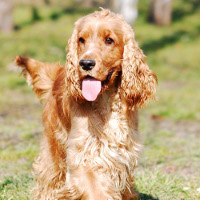
Merry, sturdy, sporting; well balanced; compact.

Important proportions

Measuring approximately the same from withers to ground as from withers to root of tail.

Behaviour / temperament

Merry nature with ever-wagging tail shows a typical bustling movement, particularly when following scent, fearless of heavy cover. Gentle and affectionate, yet full of life and exuberance.

Head

Cranial region

Skull
Well developed, cleanly chiselled, neither too fine nor too coarse.
Stop
Distinct, set midway between tip of nose and occiput.

Facial region

Nose
Sufficiently wide for acute scenting power.
Muzzle
Square.
Jaws and teeth
Jaws strong with a perfect, regular and complete scissor bite, i.e. upper teeth closely overlapping lower teeth and set square to the jaws.
Cheeks
Not prominent.
Eyes
Full, but not prominent. Dark brown or brown, never light, but in the case of liver, liver roan and liver and white, dark hazel to harmonize with coat; with expression of intelligence and gentleness but wide awake, bright and merry; rims tight.
Ears
Lobular, set low on level with eyes. Fine leathers extending to nose tip. Well clothed with long, straight silky hair.

Neck

Moderate in length, muscular. Set neatly into fine sloping shoulders. Clean throat.

Body

Body
Strong, compact.
Topline
Firm, level, gently sloping downwards to tail from end of loin to set on of tail.
Loin
Short, wide.
Chest
Well developed and brisket deep; neither too wide nor too narrow in front. Ribs well sprung.

Tail

Set on slightly lower than line of back. Must be merry in action and carried level, never cocked up. Previously customarily docked.
Docked : Never too short to hide, nor too long to interfere with, the incessant merry action when working.
Undocked : Slightly curved, of moderate length, proportionate to size of body giving an overall balanced appearance; ideally not reaching below the hock. Strong at the root and tapering to a fine tip; well feathered in keeping with the coat. Lively in action, carried on a plane not higher than level of back and never so low as to indicate timidity.

Limbs

Forequarters

Generality
Legs well boned, straight, sufficiently short for concentrated power. Not too short to interfere with tremendous exertions expected from this grand, sporting dog.
Shoulders
Sloping and fine.
Forefeet
Firm, thickly padded, cat-like.

Hindquarters

Generality
Wide, well rounded, very muscular; legs well boned.
Stifle
Good bend.
Metatarsus
Short below the hock joint, allowing for plenty of drive.
Hind feet
Firm, thickly padded, cat-like.

Gait and movement

True through action with great drive covering ground well.

Coat

Hair
Flat, silky in texture, never wiry or wavy, not too profuse and never curly. Well feathered forelegs, body and hind legs above hocks.
Colour
Solid colours: Black; red; golden; liver (chocolate); black and tan; liver and tan. In all above solid colours, a small amount of white on chest tolerated, but white in any other location highly undesirable.
Particolours: Bicolours; Black and white; orange and white; liver and white; lemon and white. All with or without ticking. Tricolours: Black, white and tan; liver, white and tan.
Roans: Blue roan; orange roan; lemon roan; liver roan; blue roan and tan; liver roan and tan.
Any colour or marking other than the above is undesirable.
Any other colour or combination of colours unacceptable.

Size and weight

Height at withers
Height approximately : males 39 - 41 cms, females 38 - 39 cms
Weight
Weight approximately 13 - 14, 5 kgs

Faults

• Any departure from the foregoing points should be considered a fault and the seriousness with which the fault should be regarded should be in exact proportion to its degree and its effect upon the health and welfare of the dog and its ability to perform its traditional work.
• Faults listed should be in degree of seriousness.
 

Disqualifying faults

Aggressive or overly shy.

NB :

• Any dog clearly showing physical or behavioural abnormalities shall be disqualified.
• The above mentioned faults when occurring to a highly marked degree or frequently are disqualifying.
• Male animals should have two apparently normal testicles fully descended into the scrotum.
• Only functionally and clinically healthy dogs, with breed typical conformation should be used for breeding.


Detailed history

The English Cocker Spaniel, commonly known as the Cocker Spaniel and, in France, the Cocker, belongs to the large family of Spaniels and Continental Spaniels, these Oysel Chieps and wadding dogs known since the Middle Ages to have replaced the common dogs, with bloodhounds and Brachets, deemed not very effective for hunting birds. It was at this time, in fact, that the Spaniel was started to raise the game birds, so that the lord could let go of his hawk or the valets throw their leaden nets.

For a long time, the very name Epagneul - Spaniel for the English - has sparked endless debates within the cynologists. Is it linked to a Spanish origin, as Gaston Phoebus said in the Middle Ages, "so that this nature comes from Spain, how many there are in other countries? This seems unlikely inasmuch as there has never been, it seems, any Spaniel in the Iberian Peninsula. Max Siber, overcomes this difficulty by considering that the reference to Spain does not concern the origins of the dog but the hunting methods for which it was used, methods that would have been, on the other side of the Pyrenees, a legacy of the Romans for net hunting, and Arabs for falconry. Another hypothesis, perhaps more convincing, is based on the verb "s'espagner", an old synonym for "to lie down", used to describe the action of dogs that flatten on the ground so as not to hinder the hunters throwing their snare.

Clearly, therefore, the origins of Spaniel, like those of many other races, are very controversial. What is proven, however, is the age of the presence of such dogs in Britain. Edward de Langley (1344-1412), grand master of the hunts and dogs of Henry IV of England, praised the hunting qualities of the Spaniels in his Mayster if Came published in 1406; the poet Chaucer, author of the famous Tales of Canterbury, boldly compares the behavior of the woman towards man to that of the Spaniel, because as a Spaniel, she wants to jump after him, and to ensure, for good measure, that the Spaniel is a very affectionate dog, as much as a woman in search of a husband.

As for Dr. Caius, personal physician of Queen Elizabeth I, he expressly designates them in his book De Canibus Britannicis, published in 1570: They are commonly called Spaniels as if these dogs came from Spain. It is also known that Elizabeth I had, in addition to Greyhounds, Spaniels which were considered by P. Sidney as "the gentlemen of the royal packs"

All these elements support the opinion of Paul Caillard - to whom we owe the introduction of the race in France at the end of the nineteenth century - according to which the presence of Spaniels across the Channel dates back at least to the fourteenth century. This eminent specialist ensures, indeed, that paintings and engravings of this time, in particular in Scottish castles, stage Spaniels.

As for the appearance of Cocker Spaniel proper, it is of course much less old. It must be known that, for a long time, the amateurs were satisfied with the only name of Spaniel to designate a whole range of dogs, more or less big, heavy or light, of hunting or luxury, whereas it existed, next to the common Spaniels of which the most direct descendant is the current Springer, smaller Spaniels and truly miniature Spaniels (toys) and considered as hounds. British dog breeds could only distinguish Land Spaniels (employed on land) and Water Spaniels (working on water). If the latter type is no longer represented by only one breed (Irish), the Land Spaniel would stop to diversify until the twentieth century.

From 1859, things were going to be more precise: many amateurs, at least in the exhibitions, separated the Land Spaniels into two groups: the Land Spaniels proper and the Field Spaniels. However, it was not until 1883 that the Cocker was recognized as a race in its own right. The weight criterion then played a fundamental role, since that of the Cocker Spaniel had to be less than 25 pounds, whereas that of the Field Spaniel could only be higher. But there was another element of differentiation: while the Cocker, thanks to its small size, could penetrate the thickest thickets and hedges, the field was devolving the open fields. With the effects of growing fashion in Britain, where exhibitions became worldly events, the Field Spaniel quickly evolved into a low-legged, long-bodied type, more like a Basset than a Spaniel. morphology that made him unfit for hunting while not making him a pet, so he almost disappeared in the aftermath of the First World War, the Kennel Club even suspending the inscriptions in 1919.

At the same time, the Cocker was going to make a beautiful place for himself in the sun: a very active, passionate, eriduring, "swarming" hunter - to use the expression that characterizes his temperament - he was quickly appreciated by many British, both to hunt game and to be a charming companion at home.

It is clear that the Cocker has benefited from the hard work done by British breeders at the end of the last century and the beginning of ours, in order to accentuate and fix the characteristics clearly differentiating each Spaniel. Some breeders played a major role in this selection work, including Ted Obo, born in 1879 and owned by Mr. Farrow, who did a lot for the development of the breed. In the United States, where a club was founded in 1881, many subjects were imported, among which were prominent descendants of the already famous Obo. The rapidity and scale of the Cocker's success in the United States and Canada also led to some disagreements on the evolution of the breed between English and American breeders, the latter seeing the Cocker only as a show dog. company. Rejecting the American point of view, the British wanted to give the Cocker his dual role of hunter and companion. To do this, they had to assure him a solid official position, appealing, in particular, to the authorities who watched over the future of the canine world: in 1893, the Kennel Club began to register representatives of the breed, and around 1900 a standard was defined. The Cocker quickly demonstrated his qualities, trusting the successes in the first field-trials, where all the Spaniels competed. One club was founded in 1904. Among the first to be listed were Bebbe, the alleged ancestor of the Red Cockers, and the subjects of the breeder HS Lloyd, whose affix "of Ware" remained famous.

France was not left out to adopt the little Cocker: the first specimens were registered with the LOF since 1885. Then, in 1898, around Paul Caillard, fervent promoter of the race, the French Spaniel Club was created (which is thus revealed one of the oldest breed associations still in existence today), and in 1904 a standard was drafted.

The amateurs of the time, very Anglophiles, were raving about the English races, with some reason since, in the first field-trials organized in France, they demonstrated in a striking way of obvious qualities, in particular a quest fast and very fine nose. Because of its versatility, the Cocker has attracted many French hunters who, unlike their colleagues from across the Channel, can not usually afford to have both a dog and another to the report, even a dog for the plain and another for the wood.

For a long time, the Cockers most common on our soil were white and brown or white and black, first of all because the white dress was the most visible (detail of importance for a dog intended, during the hunting periods, to evolve in thickets). The blue and black were however very appreciated by the amateurs of exhibition, which did not prevent them from participating in the field-trials. These dogs were also very small, the famous cynologist Paul Mégnin writing in 1923 that they did not exceed 30 centimeters at the withers (which corresponds to the 25 pounds already indicated!).

The Cocker's size, however, was gradually growing, particularly in Great Britain, thanks to a more complete diet but also for the sake of efficiency in field trials. So much so that, after World War II, the French breeders who wanted to import British subjects to raise their decimated livestock found that these dogs were 45 centimeters at the withers, or more.

The president of the French Spaniel Club, Dr. Paul, then asked the British authorities to review the size standard (downward), so that the Cocker could really earn his reputation as "the smallest hunting Spaniel". This was done, thus avoiding the Cocker to become, as Rene Gravigny feared, a Setter in reduction.

Today, the Cocker has conquered the world: popular in all countries of Western Europe, it is also in the east, and even in the Soviet Union. J. Guerville-Sevin, often called to judge abroad, was able to note that, during exhibitions held in Moscow and Poland, the Cocker classes had between 100 and 300 subjects - that is, as many as if not more than in our countries! The Cocker is perfectly adapted in distant lands, since it is one of the two or three favorite breeds in Argentina and Australia.

Comments

Latest page updates

  • Yorkshire Terrier

    Yorkshire Terrier FCI Standard No. 86 Origin Great Britain Group Group 3 Terriers Section Section 4 Toy Terriers Working Without working trial Date of acceptance on a definitive basis by the FCI Saturday 30 October 1954 Date of publication of the official valid standard Tuesday 08 September 2026 Date of the last update Tuesday 06 October 2026 En...
  • West Highland White Terrier

    West Highland White Terrier FCI Standard No. 85 Origin Great Britain Group Group 3 Terriers Section Section 2 Small-sized Terriers Working Without working trial Date of acceptance on a definitive basis by the FCI Friday 29 October 1954 Date of publication of the official valid standard Tuesday 08 September 2026 Date of the last update Tuesday 06...
  • Welsh Terrier

    Welsh Terrier FCI Standard No. 78 Origin Great Britain Group Group 3 Terriers Section Section 1 Large- and medium sized Terriers Working Without working trial Date of acceptance on a definitive basis by the FCI Saturday 23 October 1954 Date of publication of the official valid standard Tuesday 08 September 2026 Date of the last update Tuesday 06...
  • Welsh Springer Spaniel

    Welsh Springer Spaniel FCI Standard No. 126 Origin Great Britain Group Group 8 Retrievers-Flushing Dogs-Water Dogs Section Section 2 Flushing Dogs Working With working trial Date of acceptance on a definitive basis by the FCI Thursday 30 December 1954 Date of publication of the official valid standard Tuesday 08 September 2026 Date of the last...
  • Welsh Corgi Pembroke

    Welsh Corgi Pembroke FCI Standard No. 39 Origin Great Britain Group Group 1 Sheepdogs and Cattle Dogs (except Swiss Cattle Dogs) Section Section 2 Cattledogs (except Swiss Cattledogs) Working Without working trial Date of acceptance on a definitive basis by the FCI Wednesday 13 November 1963 Date of publication of the official valid standard Tuesday 08...
  • Welsh Corgi Cardigan

    Welsh Corgi Cardigan FCI Standard No. 38 Origin Great Britain Group Group 1 Sheepdogs and Cattle Dogs (except Swiss Cattle Dogs) Section Section 2 Cattledogs (except Swiss Cattledogs) Working Without working trial Date of acceptance on a definitive basis by the FCI Tuesday 12 November 1963 Date of publication of the official valid standard Tuesday 08...
  • Sussex Spaniel

    Sussex Spaniel FCI Standard No. 127 Origin Great Britain Group Group 8 Retrievers, Flushing dogs, Water dogs. Section Section 2 Flushing dogs Working With working trial Date of acceptance on a definitive basis by the FCI Friday 31 December 1954 Date of publication of the official valid standard Tuesday 08 September 2026 Date of the last update Tuesday 06...
  • Staffordshire Bull Terrier

    Staffordshire Bull Terrier FCI Standard No. 76 Origin Great Britain Group Group 3 Terriers Section Section 3 Bull type Terriers Working Without working trial Date of acceptance on a definitive basis by the FCI Thursday 21 October 1954 Date of publication of the official valid standard Tuesday 08 September 2026 Date of the last update Tuesday 06...
  • Skye Terrier

    Skye Terrier FCI Standard No. 75 Origin Great Britain Group Group 3 Terriers Section Section 2 Small-sized Terriers Working Without working trial Date of acceptance on a definitive basis by the FCI Wednesday 20 October 1954 Date of publication of the official valid standard Tuesday 08 September 2026 Date of the last update Tuesday 06 October 2026 En...
  • Shetland Sheepdog

    Shetland Sheepdog FCI Standard No. 88 Origin Great Britain Group Group 1 Sheepdogs and Cattle Dogs Section Section 1 Sheepdogs Working Without working trial Date of acceptance on a definitive basis by the FCI Tuesday 09 November 1954 Date of publication of the official valid standard Tuesday 08 September 2026 Date of the last update Tuesday 06...
  • Sealyham Terrier

    Sealyham Terrier FCI Standard No. 74 Origin Great Britain Group Group 3 Terriers Section Section 2 Small sized Terriers Working Without working trial Date of acceptance on a definitive basis by the FCI Tuesday 19 October 1954 Date of publication of the official valid standard Tuesday 08 September 2026 Date of the last update Tuesday 06 October...
  • Scottish Terrier

    Scottish Terrier FCI Standard No. 73 Origin Great Britain Group Group 3 Terriers Section Section 2 Small-sized Terriers Working Without working trial Date of acceptance on a definitive basis by the FCI Monday 18 October 1954 Date of publication of the official valid standard Tuesday 08 September 2026 Date of the last update Tuesday 06 October...
  • Old English Sheepdog (Bobtail)

      Old English Sheepdog (Bobtail) FCI Standard No. 16     Origin   Great Britain Group   Group 1 Sheepdogs and Cattle Dogs (except Swiss Cattle Dogs) Section   Section 1 Sheepdogs Working   Without working trial Date of acceptance on a definitive basis by the FCI   Monday 25 November 1963 Date of publication of the official valid standard   Tuesday 08 September...
  • Norwich Terrier

    Norwich Terrier FCI Standard No. 72 Origin Great Britain Group Group 3 Terriers Section Section 2 Small-sized Terriers Working Without working trial Date of acceptance on a definitive basis by the FCI Saturday 16 October 1954 Date of publication of the official valid standard Tuesday 08 September 2026 Date of the last update Tuesday 06 October...
  • Norfolk Terrier

    Norfolk Terrier FCI Standard No. 272 Origin Great Britain Group Group 3 Terriers Section Section 2 Small-sized Terriers Working Without working trial Date of acceptance on a definitive basis by the FCI Saturday 01 October 1966 Date of publication of the official valid standard Tuesday 08 September 2026 Date of the last update Tuesday 06 October...
  • Manchester Terrier

    Manchester Terrier FCI Standard No. 71 Origin Great Britain Group Group 3 Terriers Section Section 1 Large and medium sized Terriers Working Without working trial Date of acceptance on a definitive basis by the FCI Friday 15 October 1954 Date of publication of the official valid standard Tuesday 08 September 2026 Date of the last update Tuesday 06 October...
  • Lakeland Terrier

    Lakeland Terrier FCI Standard No. 70 Origin Great Britain Group Group 3 Terriers Section Section 1 Large and medium-sized Terriers Working Without working trial Date of acceptance on a definitive basis by the FCI Thursday 14 October 1954 Date of publication of the official valid standard Tuesday 08 September 2026 Date of the last update Tuesday 06 October...
  • Labrador Retriever

      Labrador Retriever FCI Standard No. 122     Origin   Canada Group   Group 8 Retrievers, Flushing dogs, Water dogs Section   Section 1 Retrievers Working   With working trial Date of acceptance on a definitive basis by the FCI   Friday 24 December 1954 Date of publication of the official valid standard   Tuesday 08 September 2026 Date of the last update   Tuesday 06...
  • King Charles Spaniel

    King Charles Spaniel FCI Standard No. 128 Origin Great Britain Group Group 9 Companion and Toy Dogs Section Section 7 English Toy Spaniels Working Without working trial Date of acceptance on a definitive basis by the FCI Monday 03 January 1955 Date of publication of the official valid standard Tuesday 08 September 2026 Date of the last update Tuesday 06...
  • Harrier

      Harrier FCI Standard No. 295     Origin   Great Britain Translation   Mrs. Peggy Davis, brought up to day by Dr. Paschoud Group   Group 6 Scenthounds and related breeds Section   Section 1.2 Medium-sized Hounds Working   With working trial Date of acceptance on a definitive basis by the FCI   Wednesday 27 November 1974 Date of publication of the official valid...
  • Greyhound

    Greyhound FCI Standard No. 158 Origin Great Britain Group Group 10 Sighthounds Section Section 3 Short-haired sighthounds Working Without working trial Date of acceptance on a definitive basis by the FCI Saturday 23 April 1955 Date of publication of the official valid standard Tuesday 08 September 2026 Date of the last update Tuesday 06 October...
  • Gordon Setter

    Gordon Setter FCI Standard No. 6 Origin Great Britain Group Group 7 Pointing Dogs Section Section 2.2 British and Irish Pointers and Setters; Setters Working With working trial Date of acceptance on a definitive basis by the FCI Tuesday 28 May 1963 Date of publication of the official valid standard Tuesday 08 September 2026 Date of the last...
  • Golden Retriever

    Golden Retriever FCI Standard No. 111 Origin Great Britain Group Group 8 Retrievers, Flushing Dogs, Water Dogs Section Section 1 Retrievers Working With working trial Date of acceptance on a definitive basis by the FCI Thursday 02 December 1954 Date of publication of the official valid standard Tuesday 28 July 2009 Date of the last update Wednesday...
  • Fox Terrier Wire

    Fox Terrier Wire FCI Standard No. 169 Origin Great Britain Group Group 3 Terriers Section Section 1 Large and medium-sized Terriers Working Working trial optional Date of acceptance on a definitive basis by the FCI Friday 13 May 1955 Date of publication of the official valid standard Tuesday 08 September 2026 Date of the last update Tuesday 06...
  • Fox Terrier Smooth

    Fox Terrier Smooth FCI Standard No. 12 Origin Great Britain Group Group Terriers Section Section 1 Large and medium sized Terriers Working Working trial optional Date of acceptance on a definitive basis by the FCI Wednesday 26 June 1963 Date of publication of the official valid standard Tuesday 08 September 2026 Date of the last update Tuesday 06...
  • Flat Coated Retriever

    Flat Coated Retriever FCI Standard No. 121 Origin Great Britain Group Group 8 Retrievers-Flushing Dogs-Water Dogs Section Section 1 Retrievers Working With working trial Date of acceptance on a definitive basis by the FCI Thursday 23 December 1954 Date of publication of the official valid standard Tuesday 08 September 2026 Date of the last update Tuesday...
  • Field Spaniel

    Field Spaniel FCI Standard No. 123 Origin Great-Britain Group Group 8 Retrievers, Flushing Dogs, Water Dogs Section Section 2 Flushing Dogs Working With working trial Date of acceptance on a definitive basis by the FCI Monday 27 December 1954 Date of publication of the official valid standard Tuesday 08 September 2026 Date of the last update Tuesday...
  • English Toy Terrier

    English Toy Terrier FCI Standard No. 13 Origin Great Britain Group Group 3 Terriers Section Section 4 Toy Terriers Working Without working trial Date of acceptance on a definitive basis by the FCI Tuesday 17 September 1963 Date of publication of the official valid standard Tuesday 08 September 2026 Date of the last update Tuesday 06 October 2026 En...
  • English Springer Spaniel

    English Springer Spaniel FCI Standard No. 125 Origin Great Britain Group Group 8 Retrievers-Flushing Dogs-Water Dogs Section Section 2 Flushing Dogs Working With working trial Date of acceptance on a definitive basis by the FCI Wednesday 29 December 1954 Date of publication of the official valid standard Tuesday 08 September 2026 Date of the last...
  • English Setter

    English Setter FCI Standard No. 2 Origin Great Britain Group Group 7 Pointing Dogs Section Section 2.2 British and Irish Pointers and Setters, Setter Working With working trial Date of acceptance on a definitive basis by the FCI Wednesday 06 March 1963 Date of publication of the official valid standard Tuesday 08 September 2026 Date of the last...
  • English Pointer

    English Pointer FCI Standard No. 1 Origin Great Britain Group Group 7 Pointing Dogs Section Section 2.1 British and Irish Pointers and Setters, Pointer Working With working trial Date of acceptance on a definitive basis by the FCI Tuesday 05 March 1963 Date of publication of the official valid standard Tuesday 08 September 2026 Date of the last...
  • English Foxhound

    English Foxhound FCI Standard No. 159 Origin Great Britain Group Group 6 Scenthounds and related breeds Section Section 1.1 Large-sized Scent hounds Working With working trial Date of acceptance on a definitive basis by the FCI Monday 25 April 1955 Date of publication of the official valid standard Thursday 26 March 2009 Date of the last update Wednesday...
  • Tibetan Mastiff

    Tibetan Mastiff FCI Standard No. 230 Origin Tibet (China)Patronage FCI Group Group 2 Pinscher and Schnauzer- Molossoid breeds- Swiss Mountain and Cattle Dogs Section Section 2.2 Molossoid breeds, Mountain type Working Without working trial Date of acceptance on a definitive basis by the FCI Tuesday 22 August 1961 Date of publication of the...
  • Deerhound

    Deerhound FCI Standard No. 164 Origin Great Britain Group Group 10 Sighthounds Section Section 2 Rough-haired Sighthounds Working Without working trial Date of acceptance on a definitive basis by the FCI Friday 29 April 1955 Date of publication of the official valid standard Tuesday 08 September 2026 Date of the last update Tuesday 06 October...
  • Dandie Dinmont Terrier

    Dandie Dinmont Terrier FCI Standard No. 168 Origin Great Britain Group Group 3 Terriers Section Section 2 Small-sized Terriers Working Without working trial Date of acceptance on a definitive basis by the FCI Thursday 12 May 1955 Date of publication of the official valid standard Tuesday 08 September 2026 Date of the last update Tuesday 06...
  • Curly Coated Retriever

    Curly Coated Retriever FCI Standard No. 110 Origin Great Britain Group Group 8 Retrievers, Flushing Dogs, Water Dogs Section Section 1 Retrievers Working With working trial Date of acceptance on a definitive basis by the FCI Friday 10 December 1954 Date of publication of the official valid standard Tuesday 08 September 2026 Date of the last...
  • Collie Smooth

    Collie Smooth FCI Standard No. 296 Origin Great Britain Group Group 1 Sheepdogs and Cattle Dogs (except Swiss Cattle Dogs) Section Section 1 Sheepdogs Working Without working trial Date of acceptance on a definitive basis by the FCI Wednesday 18 December 1974 Date of publication of the official valid standard Tuesday 08 September 2026 Date of the...
  • Collie Rough

    Collie Rough FCI Standard No. 156 Origin Great Britain Group Group 1 Sheepdogs and Cattle Dogs (except Swiss Cattle Dogs) Section Section 1 Sheepdogs Working Without working trial Date of acceptance on a definitive basis by the FCI Wednesday 13 April 1955 Date of publication of the official valid standard Tuesday 08 September 2026 Date of the...
  • Clumber Spaniel

    Clumber Spaniel FCI Standard No. 109 Origin Great Britain Group Group 8 Retrievers, Flushing dogs, Water dogs Section Section 2 Flushing dogs Working With working trial Date of acceptance on a definitive basis by the FCI Thursday 09 December 1954 Date of publication of the official valid standard Tuesday 08 September 2026 Date of the last update Tuesday...
  • Chow Chow

    Chow Chow FCI Standard No. 205 Origin China, patronage : Great Britain Group Group 5 Spitz and primitive type Section Section 5 Asian Spitz and related breeds Working Without working trial Date of acceptance on a definitive basis by the FCI Tuesday 10 December 1957 Date of publication of the official valid standard Tuesday 08 September 2026 Date...
  • Chinese Crested Dog

    Chinese Crested Dog FCI Standard No. 288 Origin China, patronage Great Britain Group Group 9 Companion and Toy Dogs Section Section 4 Hairless breeds Working Without working trial Date of acceptance on a definitive basis by the FCI Monday 17 July 1972 Date of publication of the official valid standard Tuesday 08 September 2026 Date of the last...
  • Cairn Terrier

    Cairn Terrier FCI Standard No. 4 Origin Great Britain Group Group 3 Terriers Section Section 2 Small-sized Terriers Working Without working trial Date of acceptance on a definitive basis by the FCI Saturday 06 April 1963 Date of publication of the official valid standard Tuesday 08 September 2026 Date of the last update Tuesday 06 October 2026 En...
  • Bullmastiff

    Bullmastiff FCI Standard No. 157 Origin Great Britain Group Group 2 Pinscher and Schnauzer Molossoid breeds - Swiss Mountain and Cattle Dogs Section Section 2.1 Molossoid breeds, Mastiff Type Working Without working trial Date of acceptance on a definitive basis by the FCI Saturday 23 April 1955 Date of publication of the official valid standard Tuesday...
  • English Bulldog

    English Bulldog FCI Standard No. 149 Origin Great Britain Group Group 2 Pinscher and Schnauzer Molossoid breeds-Swiss Mountain and Cattle Dogs Section Section 2.1 Molossoid breeds, Mastiff Type Working Without working trial Date of acceptance on a definitive basis by the FCI Monday 14 March 1955 Date of publication of the official valid standard Tuesday...
  • Bull Terrier

    Bull Terrier FCI Standard No. 11 Origin Grande-Bretagne Group Group 3 Terriers Section Section 3 Bull type Terriers Working Working trial optional Date of acceptance on a definitive basis by the FCI Saturday 26 June 1993 Date of publication of the official valid standard Tuesday 08 September 2026 Date of the last update Tuesday 06 October 2026 En...
  • Border Terrier

    Border Terrier FCI Standard No. 10 Origin Great Britain Group Group 3 Terriers Section Section 1 Large and medium-sized terriers Working Without working trial Date of acceptance on a definitive basis by the FCI Wednesday 26 June 1963 Date of publication of the official valid standard Tuesday 08 September 2026 Date of the last update Tuesday 06...
  • Bedlington Terrier

    Bedlington Terrier FCI Standard No. 9 Origin Great Britain Group Group 3 Terriers Section Section 1 Large and medium sized Terriers Working Without working trial Date of acceptance on a definitive basis by the FCI Thursday 20 June 1963 Date of publication of the official valid standard Tuesday 08 September 2026 Date of the last update Tuesday 06...
  • Bearded Collie

    Bearded Collie FCI Standard No. 271 Origin Great-Britain Group Group 1 Sheepdogs and Cattle Dogs (except Swiss Cattle Dogs) Section Section 1 Sheepdogs Working Without working trial Date of acceptance on a definitive basis by the FCI Wednesday 30 August 1967 Date of publication of the official valid standard Tuesday 08 September 2026 Date of the...
  • Beagle

    Beagle FCI Standard No. 161 Origin Great Britain Translation Prof. R. Triquet Group Group 6 Scent hounds and related breeds Section Section 1.3 Small-sized hounds Date of acceptance on a definitive basis by the FCI Tuesday 26 April 1955 Date of publication of the official valid standard Tuesday 08 September 2026 Date of the last update Tuesday 06...
  • Basset Hound

    Basset Hound FCI Standard No. 163 Origin Great Britain Group Group 6 Scent hounds and related breeds Section Section 1.3 Small-sized hounds Working With working trial Date of acceptance on a definitive basis by the FCI Thursday 28 April 1955 Date of publication of the official valid standard Tuesday 08 September 2026 Date of the last update Tuesday...
  • Basenji

    Basenji FCI Standard No. 43 Origin Democratic Republic of Congo, under the patronage of Great Britain Group Group 5 Spitz and primitive types Section Section 6 Primitive type Working Without working trial Date of acceptance on a definitive basis by the FCI Thursday 26 March 1964 Date of publication of the official valid standard Tuesday 08...
  • Airedale Terrier

    Airedale Terrier FCI Standard No. 7 Origin Great Britain Group Group 3 Terriers Section Section 1 Large and medium sized Terriers Working Working trial optional Date of acceptance on a definitive basis by the FCI Tuesday 28 May 1963 Date of publication of the official valid standard Tuesday 08 September 2026 Date of the last update Tuesday 06...
  • Afghan Hound

    Afghan Hound FCI Standard No. 228 Origin AfghanistanPatronage Great Britain Group Group 10 Sighthounds Section Section 1 Long-haired or fringed sighthounds Working Without working trial Date of acceptance on a definitive basis by the FCI Tuesday 12 December 1961 Date of publication of the official valid standard Tuesday 08 September 2026 Date of the...
  • Romagna Water Dog

    Romagna Water Dog FCI Standard No. 298 Origin Italy Translation Antonio Morsiani, Renée Sporre-Willes and Prof. R. TriquetRevised by ENCI and Renée Sporre-WillesRevised by the FCI Head OfficeOfficial language (EN). Group Group 8 Retrievers –Flushing Dogs –Water Dogs Section Section 3 Water Dogs Working Working trial optional Date of acceptance on a...
  • Whippet

    Whippet FCI Standard No. 162 Origin Great Britain Group Group 10 Sighthounds Section Section 3 Short-haired Sighthounds Working Without working trial Date of acceptance on a definitive basis by the FCI Wednesday 27 April 1955 Date of publication of the official valid standard Tuesday 08 September 2026 Date of the last update Tuesday 06 October...
  • Tibetan Terrier

    Tibetan Terrier FCI Standard No. 209 Origin Tibet, patronage Great Britain Group Group 9 Companion and Toy Dogs Section Section 5 Tibetan breeds Working Without working trial Date of acceptance on a definitive basis by the FCI Wednesday 18 December 1957 Date of publication of the official valid standard Tuesday 08 September 2026 Date of the last...
  • Tibetan Spaniel

    Tibetan Spaniel FCI Standard No. 231 Origin Tibet (China)Patronage Great Britain Group Group 9 Companion and Toy Dogs Section Section 5 Tibetan breeds Working Without working trial Date of acceptance on a definitive basis by the FCI Tuesday 22 August 1961 Date of publication of the official valid standard Tuesday 08 September 2026 Date of the...
  • Shih Tzu

    Shih Tzu FCI Standard No. 208 Origin Tibet, patronage Great Britain Group Group 9 Companion and Toy Dogs Section Section 5 Tibetan breeds Working Without working trial Date of acceptance on a definitive basis by the FCI Monday 16 December 1957 Date of publication of the official valid standard Tuesday 08 September 2026 Date of the last update Tuesday 06...
  • Pug

    Pug FCI Standard No. 253 Origin China, patronage Great Britain Group Group 9 Companion and Toy Dogs Section Section 11 Small Molossian type dogs Working Without working trial Date of acceptance on a definitive basis by the FCI Friday 04 November 1966 Date of publication of the official valid standard Tuesday 08 September 2026 Date of the last...
  • Pharaoh Hound

    Pharaoh Hound FCI Standard No. 248 Origin Malta, patronage Great Britain Group Group 5 Spitz and primitive types Section Section 6 Primitive type Working Without working trial Date of acceptance on a definitive basis by the FCI Friday 09 August 1963 Date of publication of the official valid standard Tuesday 08 September 2026 Date of the last...
  • Pekingese

    Pekingese FCI Standard No. 207 Origin China, patronage Great Britain Group Group 9 Companion and Toy Dogs Section Section 8 Japan Chin and Pekingese Working Without working trial Date of acceptance on a definitive basis by the FCI Thursday 03 November 1966 Date of publication of the official valid standard Tuesday 08 September 2026 Date of the last...
  • Parson Russell Terrier

    Parson Russell Terrier FCI Standard No. 339 Origin Great Britain Group Group 3 Terriers Section Section 1 Large and medium sized Terriers Working Working trial optional Date of acceptance on a definitive basis by the FCI Monday 04 June 2001 Date of acceptance on a provisional basis by the FCI Monday 02 July 1990 Date of publication of the...
  • Otterhound

    Otterhound FCI Standard No. 294 Origin Great Britain Group Group 6 Scenthounds and related breeds Section Section 1.1 Large-sized hounds Working Without working trial Date of acceptance on a definitive basis by the FCI Thursday 12 September 1974 Date of publication of the official valid standard Tuesday 08 September 2026 Date of the last update Tuesday 06...
  • Miniature Bull Terrier

    Miniature Bull Terrier FCI Standard No. 359 Origin Grande-Bretagne Group Group 3 Terriers Section Section 3 Bull type Terriers Working Working trial optional Date of acceptance on a definitive basis by the FCI Tuesday 05 July 2011 Date of acceptance on a provisional basis by the FCI Tuesday 05 July 2011 Date of publication of the official valid...
  • Mastiff

    Mastiff FCI Standard No. 264 Origin Great Britain Group Group 2 Pinscher and Schnauzer – Molossoid breeds - Swiss Mountain and Cattle Dogs Section Section 2.1 Molossoid breeds, Mastiff Type Working Without working trial Date of acceptance on a definitive basis by the FCI Thursday 05 November 1964 Date of publication of the official valid standard Tuesday 08...
  • Lhassa Apso

    Lhassa Apso FCI Standard No. 227 Origin Tibet (China)Patronage Great Britain Group Group 9 Companion and Toy Dogs Section Section 5 Tibetan breeds Working Without working trial Date of acceptance on a definitive basis by the FCI Saturday 19 November 1960 Date of publication of the official valid standard Tuesday 08 September 2026 Date of the last...
  • Lancashire-Heeler

    Lancashire-Heeler FCI Standard No. 360 Origin England, patronage : FCI Group Group 1 Sheepdogs and Cattle Dogs (except Swiss Cattle Dogs) Section Section 1 Sheepdogs Working Without working trial Date of acceptance on a provisional basis by the FCI Sunday 01 May 2016 Date of publication of the official valid standard Tuesday 08 September 2026 Date...

© 2026 Groupe Milouchouchou ASBL. Tous droits réservés. En savoir plus

Protected by Copyright01
