St. Bernard

FCI standard Nº 61

Origin
Switzerland
Translation
Mrs. C. Seidler and Mrs. Pepper
Group
Group 2 Pinscher and Schnauzer type, Molossians, Swiss Mountain-and Cattledogs
Section
Section 2.2 Molossian type, Mountain type
Working
Without working trial
Acceptance on a definitive basis by the FCI
Saturday 28 August 1954
Publication of the official valid standard
Monday 04 April 2016
Last update
Friday 03 June 2016
En français, cette race se dit
Chien du Saint-Bernard
Diese Norm ist in deutscher Sprache sichtbar
St. Bernardshund
En español, esta raza se dice
Perro San Bernardo
In het Nederlands, wordt dit ras gezegd
Sint Bernard

Usage

Companion-, watch- and farmdog.

Brief historical summary

At the height of the Great St. Bernard Pass, 2469 metres above sea level, a hospice was founded by monks in the 11th century as a place of refuge for travellers and pilgrims. There, large mountain dogs have been kept since the middle of the 17th century for guarding and protection. The existence of such dogs has been documented pictorially since 1695 and in a written document at the hospice in the year 1707. The dogs were soon in use as companion dogs and specially as rescue dogs for travellers lost in snow and fog. The chronicles about the numerous human lives saved by these dogs from the « white death », published in many languages, and the verbal reports of the soldiers who crossed the pass with Bonaparte’s army in 1800, spread the fame of the St. Bernard, called Barry-dog at that time, throughout Europe during the 19th century. The legendary dog « Barry » became the epitome of the rescue dog. The direct ancestors of the St. Bernard were the large farm dogs common in that region. Within a few generations and aiming to a defined ideal type, these dogs were developed to the present day type of breed. Heinrich Schumacher from Holligen near Bern was the first who began to issue genealogical documents for his dogs in 1867. In February 1884 the "Schweizerisches Hundestammbuch"(SHSB), the Swiss Dog Stud Book, was started. The very first entry was the St.Bernard "Leon", and the following 28 registrations also concerned St.Bernards. On the 15th March 1884, the Swiss St.Bernards-Club was founded in Basle. On the occasion of an international Canine Congress on June 2nd 1887, the St. Bernard dog was officially recognized as a Swiss breed and the breed standard was declared as binding. Since then , the St.Bernard has been regarded as the Swiss national dog.

General appearance

There are two varieties of the St.Bernard :
Short-haired variety (double coat, “Stockhaar”) and Long-haired variety.
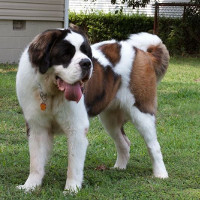
Both varieties are of considerable size and of impressive general apperance. They have a balanced, powerful, sturdy, muscular body with impressive head and an alert facial expression.

Important proportions

Ideal relation of height at withers to length of body (measured from the point of the shoulder to the point of buttocks) = 9 : 10.
Ideal relation of height at withers to depth of chest see sketch below.
The total length of the head is slightly more than one third of the height at withers.
The relation of depth of muzzle (measured at its root) to length of muzzle is almost 2:1.
Length of muzzle slightly longer than one third of the total length of the head.

Behaviour / temperament

Friendly by nature. Temperament calm to lively; watchful.

Head

Cranial region

Head
Powerful, imposing and very expressive.
Skull
Strong, broad, seen in profile and from the front slightly rounded. When the dog is alert, the set-on of the ears and the top of the skull form a straight line which slopes at the sides in a gentle curve to the strongly developed high cheek bones. Forehead falling away steeply towards the muzzle. Occipital bone only moderately developed, superciliary ridges strongly developed. The frontal furrow, which starts at the base of the forehead, is distinctly developed and runs up right in the middle of the skull. The skin of the forehead forms slight wrinkles above the eyes that converge towards the frontal furrow. When the dog is at attention, they are moderately visible; otherwise they are rather inconspicuous. 
Stop
Dinstinctly pronounced.

Facial region

Nose
Black, broad and square. Nostrils well opened.
Muzzle
Of even width. Nasal bridge straight, with slight groove.
Lips
Edge of lips black pigmented. Flews of upper jaw strongly developed, firm and not too pendulous, forming a wide curve towards the nose. Corners of mouth remain visible.
Jaws and teeth
Upper and lower jaw strong, broad, equal in length. Well developed, regular and complete scissor or pincer bite. Close fitting undershot mouth without any space between the lower and the upper incisors acceptable. Absence of PM 1 (premolar 1) and M3 tolerated.
Eyes
Of medium size. Colour dark brown to nut-brown. Moderately deep set with a friendly expression. Natural tightness of lids desired. A small angular fold on the lower lids with the haws only slightly visible as well as a small fold on the upper lids are permitted. Eyerims completely pigmented.
Ears
Of medium size, set on high and wide. Strongly developed burrs. Flaps pliable, triangular with rounded tips. The rear edges slightly standing off, the front edges lying closely to the cheeks.

Neck

Strong and of sufficient length. Dewlap and loose skin on the neck moderately developed.

Body

Body
General appearance imposing, balanced, impressive and well muscled.
Withers
Well defined.
Back
Broad, strong, firm. Topline straight and horizontal up to the loins.
Croup
Long, hardly sloping, merging gently with the root of the tail.
Chest
Brisket moderately deep with well sprung ribs, but not barrel-shaped. Not projecting below elbow level.
Underline and belly
Slight tuck up towards rear.

Tail

Set-on broad and strong. Tail long and heavy. The last vertebra reaching at least to the hock joint. When in repose, the tail hangs straight down or slightly upturned in the lower third. When animated, it is carried higher.

Limbs

Forequarters

Generality
Forelegs straight and parallel seen from the front. Standing moderately broad.
Shoulders
Shoulder blades oblique, muscular and well attached to the chest wall.
Upper arm
Longer than the shoulder blade. Angle between shoulder blade and upper arm not too blunt.
Elbows
Close fitting.
Forearm
Straight, strong in bone, with lean musculature.
Pastern
Seen from the front vertical in prolongation of the forearms; slightly oblique seen from the side.
Forefeet
Broad, with strong, tight, well arched toes.

Hindquarters

Generality
Muscular with moderate angulation. Seen from the back, hind legs are parallel, not standing closely together.
Upper thigh
Strong, muscular, broad.
Lower thigh
Slanting and rather long.
Stifle
Well angulated, turning neither in nor out.
Metatarsus
Straight and parallel when seen from behind.
Hock
Slightly angulated, firm.
Hind feet
Broad, with strong, tight, well arched toes. Dewclaws tolerated if they do not hinder the movement.

Gait and movement

Harmonious far reaching movement with good drive from the hindquarters, the back remaining stable and firm. Front and hind feet move forward in a straight line.

Coat

Hair
Short-haired variety (Stockhaar, double coat) : Topcoat dense, smooth; close-lying and coarse. Plenty of undercoat. Thighs with slight breeches. Tail covered with dense hair.
Long-haired variety : Topcoat plain, of medium length with plenty of undercoat. Short hair on face and ear; hair over the haunches and the croup usually somewhat wavy. Front legs feathered. Thighs with good breeches. Bushy tail.
Colour
Primary colour white with smaller or larger reddish-brown patches (splash-coated dogs) up to an unbroken reddish-brown mantle covering back and flanks (mantle dogs). A broken reddish-brown mantle is of equal value. A brindle reddish-brown colour permissible. Brownish-yellow tolerated. Dark shadings on head desirable. Slight touch of black on body tolerated.
Required white markings : Chest, feet, tip of tail, muzzle band, blaze and patch on neck.
Desirable markings : White collar. Symmetrical dark mask.

Size and weight

Height at withers
For dogs minimum 70 cm, for bitches minimum 65 cm.
For dogs maximum 90 cm, for bitches maximum 80 cm.
Dogs which exceed the maximum height will not be penalised, provided their general appearance is balanced and their movement is correct.

Faults

• Any departure from the foregoing points should be considered a fault and the seriousness with which the fault should be regarded should be in exact proportion to its degree and its effect upon the health and welfare of the dog and its ability to perform its traditional work.
• Faults listed should be in degree of seriousness.

General faults

 Lack of sexual characteristics.
 Unbalanced general appearance.
 Too short legs in relation to size (short-legged).
 Heavy folds on head and neck.
 Muzzle too short or too long.
 Flews of the lower jaw turning outwards.
 Missing teeth other than PM 1 (premolar 1) and M3.
 Small teeth (especially incisors).
 Slightly undershot mouth.
 Light eyes.
 Eyelids too loose.
 Sway back or roach back.
 Croup higher than withers or falling away.
 Tail carried curled on the back.
 Absence of required markings.
 Crooked or severely turned out front legs.
 Poorly angulated, open-hocked or cow-hocked hindquarters.
 Faulty movement.
 Curly coat.
 Incomplete or totally absent pigmentation on nose leather, around the nose, on the lips or the eyelids.
 Faulty primary colour e g reddish-brown dots or ticks in the white.

Disqualifying faults

 Weak temperament, aggressiveness.
 Overshot mouth, distinctly undershot mouth.
 Wall eye.
 Ectropion, entropion.
 Solid white or solid reddish-brown coat (absence of the primary colour).
 Coat of any other colour.
 Height at withers below minimum size.

NB :

• Any dog clearly showing physical or behavioural abnormalities shall be disqualified.
• The above mentioned faults when occurring to a highly marked degree or frequently are disqualifying.
• Male animals should have two apparently normal testicles fully descended into the scrotum.
• Only functionally and clinically healthy dogs, with breed typical conformation should be used for breeding.

Bibliography

https://www.fci.be/


Detailed history

Few breeds can boast a reputation as legendary and as romantic as the St. Bernard. The good Barry and his cask of rum are legendary, so much so that, in a survey, to the question asking what is needed most of a skier in the mountains, many people answered without hesitation: a Saint Bernard!

But where does this snow lord come from? The wildest rumors have long run on his account: it is said that he would come from a single beautifully prolific couple, or that Saint Bernard himself would have had as a companion. One thing is certain: although the current name of the dog is relatively recent, the hospice of the Great St. Bernard played a decisive role in the evolution of the breed. But the story of love that unites the Saint Bernard for centuries with the hospice that gave it its name includes a prologue, which began more than two thousand five hundred years ago, in Upper Assyria.

The Assyrian mastiffs traveled to Greece, then to Italy. Once in Rome, they were named "Molosses". When the Roman legions crossed the Alps to join Helvetia, they were accompanied by the famous Molosses, who moved in groups with the soldiers, and who, especially at night, guarded the entrance to the passes; but they could still lead the flocks of the settlers. These mastiffs gradually spread throughout Switzerland, especially in the cantons of Valais and Vaud, as well as in the Bernese Oberland. The harsh climate and extreme isolation of these valleys no doubt contributed to the establishment and development of a pure race characterized by its hardiness. In 962, the Sieur Bernard de Menthon, having fled his Savoyard castle, took refuge with the bishop of Aosta, and was soon named archdeacon. For the future Saint Bernard would then begin a hard life of mountain man, who would see him, from one valley to another, bring the good word and the comfort to the poor populations. The passes of the Alps had a terrible reputation at that time; it is true that the local bandits had long since transformed them into veritable cut-throats. To remedy this situation, the Sieur de Menthon founded, in the tenth century, two hospices whose vocation was to collect all exhausted travelers. Passes eventually became safer, and thousands of soldiers, merchants and pilgrims could again pass in peace.

The oldest records of the hospice and convent of the Great St. Bernard and its rescue mission having been destroyed in a fire, one can only assume that large dogs were mentioned from the beginning. Today, visitors admire on site a painting dating from 1695, representing a white dog with dark spots, presumably a Saint Bernard. It would be around 1660 that the monks of the Grand St. Bernard would have started to be helped by dogs, to whom they gave a first role: the guard of the hospice. The monks, by tradition, were indiscriminately welcoming all the travelers who solicited their hospitality; they were bound to open their doors to more or less disguised brigands. The dogs were then a much appreciated protection. The case of thirty bandits who, in 1787, demanded to be opened the safe of the hospice, after having first benefited from the reception of the good canons. The only sight of the dogs that were dropped on them was enough to make them run away.

The St. Bernard did not open their snow-salvage career until about the middle of the 18th century. Each year, the monks hired a valet called "hospitable" or "horse chestnut", which was to go down every day to Bourg-Saint-Pierre, from where he guided all those who crossed the mountain. If he learned that travelers were in trouble, exhausted or surprised by an avalanche, the chestnut tree went in search of them. Many lives were saved every winter. Unfortunately, it happened that we could not find the victims, too deeply buried under the snow or lost in the crooked passes. Thus, in 1750, one of these hospitaliers had the idea to train the dogs who guarded the hospice, in order to make them able to contribute to its hard task of lifeguard. Their highly developed flair allowed them to thwart the fog as well as the storm and find the unfortunate. Sometimes the latter could no longer walk: then the chestnut tree comforted them while his auxiliaries went to seek help. The dogs even started rescuing on their own when they felt a person in distress.

There is also evidence from this period, that of Horace Benedict de Saussure, famous Swiss geologist, who wrote in 1789: "The chestnut is accompanied by one or two large dogs who are trained to recognize the path in the fog , storms and big snows, as well as discovering the passengers who are lost there. When the victims are not too deep in the snow, the dogs easily discover them, but their instinct and their sense of smell can not penetrate to a great depth; then the religious probe the avalanche with large poles, from place to place. These methods of rescue appear already very modern, hardly different from those employed today. Pastor Bridel, of the country of Vaud, also praises "these famous dogs all over Europe, of a race so admirable and so precious, with an extremely mild character; they never bite, and rarely bark at the arrival of travelers. They often go alone to meet them at the foot of the mountain, they caress, guide them and bring them to the convent. "

Whoever says St. Bernard on a mission says a barrel of rum, is at least what the image of Epinal wants. The dogs would have been supposed to make the half-frozen travelers drink to revive them. As is often the case, the reality is less romantic than the legend, and the St. Bernard of the hospital have never worn the famous keg. On the one hand, the ethics of the monks might have opposed, on the other hand, alcohol is far from being indicated for anyone who seriously suffers from the cold. If we find the small cask at many Saint-Bernard owners, it's only for the decor. In fact, the mission of the dogs was, first of all, to identify the victims lost in the snow or the storm, then to trace, with the help of their chest, a furrow in the powder and to pack it under their feet.

The most neophyte of the cynophiles, even if he does not know anything about St. Bernard, knows who Barry was. It is partly thanks to this exceptional rescuer, world famous, that the breed has acquired its nobility. The name "Barry" has its history. It comes indeed the word of German patois bari, coming from bar itself which means bear. The famous Barry had to be predestined, because his birth coincided almost with the passage of Napoleon Bonaparte by the Great-Saint-Bernard pass, in May 1800. Barry was very quickly naturally gifted for the work in mountain, which was not to amaze the monks, who knew it from an old family of rescuers. Meissner testified in 1916 in the Alpenrosen: "For twelve years he worked and was faithful to his service to the poor. He alone has saved more than forty people during his lifetime. The zeal he displayed was extraordinary. We never needed to urge him to work.

Did he feel a man in danger, he went to his aid; if he could do nothing, he went back to the convent and asked for help by his barking and his attitudes. His best-known feat is probably the rescue of this little boy that he pulled from sleep by licking it and brought it back to the hospital ... on his back! The anecdote that Barry died while trying to save a traveler does not correspond to reality. In fact, the prior of the hospital, having realized that he had become too old to continue his task, sent him to Bern, where he died in 1814, after two years of well-deserved retirement. In 1815 he was exhibited, stuffed, at the Bern Museum. Recently, his taxidermized remains were replaced by a cast made from nature, which is that of a large dog, fairly light in constitution compared to the subjects of today, but whose massive head and the whole of the conformation fit well with the current standard. Other monuments were raised to him, in particular in the cemetery of the dogs of Asnières, not far from Paris.

The tradition was not extinguished with Barry, since Barry II and Barry III succeeded him. The first, born in the early twentieth century, was a remarkable animal, very large. The second died during a mission on August 30, 1910, when a treacherous ice sheet sent him into a ravine. Other valiant Saint Bernard nevertheless took up the torch. However, the losses were numerous, because of the terrible winters, the epidemics or the problems of sterility (due to the very close consanguinity). Thus, the mid-nineteenth century marked a difficult period for the breed.

Already, in 1820, the king of Denmark had offered rescuer dogs to the monks who were lacking. But in July 1855, the situation became particularly alarming since there was only one couple left in the hospice. Attempts to breed a litter remaining unsuccessful, the choice was simple: introduce new blood or lose race. The second solution being unacceptable, the first was used. A Newfoundland couple of the black and white variety (Landseer) was chosen. Coming from Stuttgart, these dogs were selected on the one hand for their magpie dress (the monks hoping to obtain puppies similar to pure St. Bernard) and, on the other hand, for their ability to rescue in the mountains (they were indeed successfully used in neighboring passes). Maman Saint-Bernard and Papa Newfoundland (or vice versa) had two litters of ten pups, two of them woolly-haired (reminiscent of the long haired gene due to the Newfoundland blood supply). As after the previous crossings, the monks kept only the subjects with short hair, the long hair annoying the dog in mountain, because of the snow which agglutine there. On the other hand, the long-haired Saint-Bernard had a lot of success in the valleys, but their owners did not neglect to re-cross them with those of the hospice, to preserve the type of the race.

At the time, the St. Bernard did not yet bear this name. They were called sacred dogs, mountain dogs, alpine mastiffs, hospice dogs or even butchers' dogs (for their impressive appetite). When Barry's exploits were known all over the world, Barry-dogs became their most common name. It was during the dog show in Birmingham in 1862 that they were called Saint-Bernard, a name that became official in 1880. Then, in 1887, Henri Schumacher, the breeder who was the true artisan of the rescue of the race, Obtained his official recognition and admitted his Swiss nationality to the International Congress of Race Clubs, which was held in Zurich.

This legendary Saint Bernard had a very eventful history. Yet he has remained simple and has not changed much since his heroic days at the hospice. In Europe, breeders and breed clubs seek to promote a healthy and robust dog without exaggerating size or weight. On the other hand, since 1815, when they began to take an interest in the race, the Anglo-Saxons have tried to obtain larger and larger subjects, while being annoyingly inclined to neglect the colors and to consecrate without complex "Champion" dogs that do not have the indispensable white band around the nose. However, they really appreciate the breed, since among more than 8,000 competitors, a St. Bernard won the title of Best in Show in 1974 at the prestigious Cruft's exhibition. It was Ch. Burtonswood Bossyboots, owned by Miss Hinde.

And what happens to the hospice dogs? Whether lovers of tradition are reassured, the monks of the Great St. Bernard always raise these snow giants. Of course, today's travelers are more likely to borrow the tunnel dug under the mountain than the pass itself, and dogs have few tired pilgrims to drive in the snow. About twenty St. Bernard still live at the hospital. Tourists flock from all countries to the pass to admire these legendary rescuers. The demand for puppies from the hospice is so great that buyers must first register on a long waiting list. These sales are a significant source of income for the congregation. Proof that, when they no longer have to fulfill their traditional mission, the St. Bernard still know how to make themselves useful!

Strolling the mountain, spotting travelers lost in the storm, digging a furrow in the snow with his chest in the manner of a snowplow, all this requires strength and rusticity, but also a sacred character! If you ask an owner of St. Bernard what has driven him to buy a dog as big, as big, as bulky, he will answer that it is (among other reasons) his so endearing personality. Many breeds have unconditional followers, but the adoration that the owners of St. Bernard have for their dog is unusual. Is it his teddy side? Or is the legend of the dog Barry still convincing and dreaming?

A St. Bernard, by definition, is big and big. One would be tempted to think that his psyche is in the image of his physical: thick. "False! say the amateurs, the Saint-Bernard is endowed with a very fine intelligence and, moreover, is very delicate for a dog of his size. This means that he is aware of his mass and that he is not the type to go crazy in the living room or to waltz the trinkets with a tail stroke. Gifted with a calm and calm character, he tries to be "very small", as soon as the environment requires him. Count Henri de Bylandt, the eminent Belgian cynologist, said of the Leonberg that he was "a great dog ... with whom, apart from grandeur, all exaggeration is excluded". This comment may well apply to St. Bernard, because in the molossoids, this weighted attitude is almost a second nature.

So, one would be tempted to ask, can it prove to be an effective guardian? Anyone who once had a Saint Bernard guarding their home will answer in the affirmative. Even if it does not correspond to the breeds called "of guard and defense" (it can not take part in the tests of work in contest), this dog has a developed sense of the territory. On the deterrent side, no problem. A "Saint" well planted on his legs that looks straight into your eyes does not make you laugh. And if his warnings were not enough, we must not doubt that he would take action without hesitation. The most difficult thing would be to make him let go of his unfortunate victim ... Because the jaw of a Saint-Bernard is something! We must not forget that his ancestors fought with the Roman soldiers, and that the Great Dane is one of his cousins, distant, certainly, but all the same.

Fortunately, this snow giant does not come out of its hinges unless he is really pushed to the end. It is true that some lines have, in the past, produced susceptible subjects, but a rigorous selection made it possible to eliminate this defect. The St. Bernard does not bark too much, and he uses his good big voice instead when he found a wounded man in the snow. The rest of the time, he is not very talkative, and his roar, particularly deaf and disturbing, is generally enough to make run away the undesirables: here is a dog to whom one can trust, and this in all circumstances.

It may be said that what characterizes him most is the boundless attachment which binds him to his masters. Very sensitive and affectionate, he loves to spend hours, his huge head on your lap, to have his head scratched. He also enjoys long naps, which pushes some bad languages to treat him as a lazy. This is nothing, as evidenced by the long hikes he makes without showing any sign of fatigue. It is true, however, that he has nothing of the shepherd dog that has to trot for hours to feel better. The great ballads are pleasant, but not essential, and his teachers can leave him at home without much remorse. On the other hand, it would be cruel to put him in the tie or in the kennel. For if he is very accommodating when it comes to satisfying his master, he can not stand to be removed from it. Even a clean, well-screened enclosure can not satisfy it, and the chain is not about it. The presence of his master is the number one condition of his well-being.

This portrait should not push some city dwellers living in apartments to acquire this giant. Veterinarians say it needs space. Otherwise, he does not talk well, may suffer from breathing difficulties (we will not forget his pronounced stop and short nose) and skin diseases. The central heating available in most buildings can promote the appearance of eczema. Finally, the dog does not flourish psychologically when his living space is restricted. So air, and place!

Side human relations, no problem. Apart from his natural reactions of protecting the masters, the Saint Bernard shows no aggression. If that were the case, its size and strength would make it too formidable; that's why breeders are committed to producing balanced and calm subjects. It can thus be said that, as a rule, the St. Bernard is the friend of man. But where he reveals his true qualities of heart is with children. This huge powerful beast suddenly knows how to be gentle even, in front of a little badly insured. Moreover, if he sometimes looks serious in the company of adults, he exteriorizes his cheerful nature, even mischievous, in front of children. All wisdom, all seriousness having disappeared, it is then a Saint-Bernard transfigured that one can observe, full of life and energy. However, he never lets himself go to brutality and is always aware of his strength. It is their walks, and the nanny of the little ones, assisting them in their sometimes unsafe journeys. How many children of breeders have made their first steps, clinging to the fur of an attentive St. Bernard? And did we forget the big wet dog of the Walt Disney movie Peter Pan? He was none other than our good St. Bernard.

If he is naturally an ardent defender of his teachers and a marvelous companion for their children, the Saint Bernard must also learn certain things by means of education. The first is cleanliness. It's a chance, the St. Bernard puppy is relatively clean, and, moreover, he learns quickly. It is therefore necessary to take advantage of these two dispositions to teach him, as soon as he arrives at home, the good manners of hygiene. When you have a garden, everything is facilitated. The best solution is to take him out as soon as his meal is over, and also when he comes to drink, play or wake up. In the apartment, it is on newspaper sheets spread out for this purpose that it will be taken at designated times. Warm congratulations when he performed in the right place will make his learning easier.

As for the leash and the collar, we will proceed smoothly and in stages. The Saint Bernard being particularly sensitive, all his education should be done in tranquility, regularity and understanding. If his masters wish to subject him to further training, the Saint is generally cooperating. He is docile and of good will, and asks only to understand what is expected of him. Dog training novices will be able to join a specialized club where they will receive excellent advice. As he obeys only to please his masters, the Saint Bernard should not be "harassed" by a voluntary dog ??handler. Gentleness is with him more effective than brutality, and it is better to avoid asking too much of it. Unlike the shepherd dogs who are constantly waiting for the boss's requests, the mastiffs are great calms who must be given moments of recreation. However, given the power of an adult St. Bernard, it is essential that the masters have full control of their dog. For this, they must dominate the puppy, gently but firmly, from an early age. He should not be the boss, something he would tend to do if he was not careful. Attention also to accidents, the shock with a car would not be without consequences. The Saint must always be on a leash and educated to the recall as soon as possible.

Here is a dog intelligent, talented, and desperate to please his masters. The Saint Bernard gains to be known and will reveal to those who want to discover them treasures of tenderness and complicity. As long as you are as sensitive as him, living with this dog can be a real paradise. Normal, for a saint.

Comments

Latest page updates

  • Southern Hound

    Southern Hound He is not recognized by the F.C.I. Origin Great Britain Translation Francis Vandersteen En français, cette race se dit Chien du Sud Diese Norm ist in deutscher Sprache sichtbar Südlicher Laufhund En español, esta raza se dice Sabueso del sur In het Nederlands, wordt dit ras gezegd Zuidelijke Hond   The Southern Hound was a large...
  • St. John's Water Dog

    St. John's Water Dog He is not recognized by the F.C.I. Origin Canada Translation Francis Vandersteen En français, cette race se dit Chien d’eau de St. John's Diese Norm ist in deutscher Sprache sichtbar St. John's Wasserhund En español, esta raza se dice Perro de aguas de San Juan In het Nederlands, wordt dit ras gezegd St. John's Water Dog The St...
  • Rache Hound

    Rache Hound He is not recognized by the F.C.I. Origin Middle Ages Translation Francis Vandersteen En français, cette race se dit Chien courant Rache Diese Norm ist in deutscher Sprache sichtbar Rache-Laufhund En español, esta raza se dice Sabueso Rache In het Nederlands, wordt dit ras gezegd Rache-hond This breed is also known as RacchRachRatch   The term...
  • Welsh Grey Sheepdog

    Welsh Grey Sheepdog He is not recognized by the F.C.I. Origin Wales Translation Francis Vandersteen En français, cette race se dit Chien de berger gallois gris Diese Norm ist in deutscher Sprache sichtbar Waliser Grauer Schäferhund En español, esta raza se dice Pastor Gris Galés In het Nederlands, wordt dit ras gezegd Welsh Grey Herdershond This breed is...
  • Old Croatian Sighthound

    Old Croatian Sighthound He is not recognized by the F.C.I. Origin Croatia Translation Francis Vandersteen En français, cette race se dit Lévrier croate ancien Diese Norm ist in deutscher Sprache sichtbar Alter kroatischer Windhund En español, esta raza se dice Viejo lebrel croata In het Nederlands, wordt dit ras gezegd Oude Kroatische Windhond This...
  • Norman Hound

    Norman Hound He is not recognized by the F.C.I. Origin France Translation Francis Vandersteen En français, cette race se dit Chien normand Diese Norm ist in deutscher Sprache sichtbar Normannischer Laufhund En español, esta raza se dice Sabueso Normando In het Nederlands, wordt dit ras gezegd Normandische Brak   Little is known about the origins of...
  • Moscow Water Dog

    Moscow Water Dog He is not recognized by the F.C.I. Origin Russia Translation Francis Vandersteen En français, cette race se dit Chien d'eau de Moscou Diese Norm ist in deutscher Sprache sichtbar Moskauer Wasserhund En español, esta raza se dice Perro de agua de Moscú In het Nederlands, wordt dit ras gezegd Moskou-waterhond This breed is also...
  • Tracking Hound

    Tracking Hound He is not recognized by the F.C.I. Origin Middle Ages Translation Francis Vandersteen En français, cette race se dit Chien pisteur Diese Norm ist in deutscher Sprache sichtbar Spürhund En español, esta raza se dice Sabueso de rastro In het Nederlands, wordt dit ras gezegd Speurhond This breed is also known as LimerLymerLyam...
  • Laconian

    Laconian He is not recognized by the F.C.I. Origin Ancient Laconia, Greece Translation Francis Vandersteen En français, cette race se dit Laconien Diese Norm ist in deutscher Sprache sichtbar Lakonier En español, esta raza se dice Laconio In het Nederlands, wordt dit ras gezegd Laconisch This breed is also known as SpartanCastorian   The Laconian is an...
  • Halls Heeler

    Halls Heeler He is not recognized by the F.C.I. Origin Australia Translation Francis Vandersteen En français, cette race se dit Halls Heeler Diese Norm ist in deutscher Sprache sichtbar Halls Heeler En español, esta raza se dice Halls Heeler In het Nederlands, wordt dit ras gezegd Halls Heeler   The Halls Heeler is the presumed ancestor of two...
  • Dogo Cubano

    Dogo Cubano He is not recognized by the F.C.I. Origin Cuba Translation Francis Vandersteen The Dogo Cubano, also known as the Cuban Dogue, Cuban Bloodhound and Cuban Mastiff, is an extinct breed of dog from Cuba. It was of the Bullmastiff type and was used for bull and dog fighting. The breed was introduced to Cuba to capture runaway slaves...
  • Dalbo Dog

    Dalbo Dog He is not recognized by the F.C.I. Origin Sweden Translation Francis Vandersteen En français, cette race se dit Chien de Dalbo Diese Norm ist in deutscher Sprache sichtbar Dalbo-Hund En español, esta raza se dice Perro Dalbo In het Nederlands, wordt dit ras gezegd Dalbo-hond This breed is also known as DalbohundDalsland Mastiff   Icelandic...
  • Cordoba Fighting Dog

    Cordoba Fighting Dog He is not recognized by the F.C.I. Origin Argentina Translation Francis Vandersteen En français, cette race se dit Chien de combat de Cordoue Diese Norm ist in deutscher Sprache sichtbar Córdoba-Kampfhund En español, esta raza se dice Perro de pelea de Córdoba In het Nederlands, wordt dit ras gezegd Cordoba-vechthond This breed is...
  • Celtic Greyhound

    Celtic Greyhound He is not recognized by the F.C.I. Origin Celtic Mythology Translation Francis Vandersteen En français, cette race se dit Lévrier celte Diese Norm ist in deutscher Sprache sichtbar Keltische Windhund En español, esta raza se dice Lebrel celta In het Nederlands, wordt dit ras gezegd Keltische windhond   The Celtic Greyhound is an...
  • Belgian Mastiff

    Belgian Mastiff He is not recognized by the F.C.I. Origin Belgium Translation Francis VandersteenOrigin SRSH-KMSH - Belgian Royal Canine SocietyAuthentic language FR Group Group 2 : Pinscher and Schnauzer - Molossoid and Swiss Mountain and Cattle Dogs Section Section 2.1 : Molossoids, mastiff type Working Without working trial En français, cette...
  • Argentine polar dog

    Argentine polar dog He is not recognized by the F.C.I. Origin Argentina Translation Francis Vandersteen The Argentine polar dog (perro polar argentino) was a breed of Argentine dog that is now extinct. Argentine polar dogs were developed by the Argentine army to provide sled dogs for their Antarctic bases. The breed was the result of a cross...
  • Alaunt

    Alaunt He is not recognized by the F.C.I. Origin Central Asia Translation Francis Vandersteen This breed is also known as Kavkaz AlauntCaucasian AlauntAlan DoggePersian AlauntContinental AlauntEnglish AlauntFrench AlauntSpanish AlauntAlan DogArnaut Dogge The legendary Alaunt is one of the most important Molosse breeds in history, but also one of...
  • Small Dutch Hound

    Small Dutch Hound He is not recognized by the F.C.I. Origin The Netherlands Translation Francis Vandersteen En français, cette race se dit Petit Chien courant néerlandais Diese Norm ist in deutscher Sprache sichtbar Kleiner niederländischer Brackenhund En español, esta raza se dice Sabueso holandés pequeño In het Nederlands, wordt dit ras gezegd Kleine...
  • Sri Lankan Hound

    Sri Lankan Hound He is not recognized by the F.C.I. Origin Sri Lankan Translation Francis Vandersteen En français, cette race se dit Chien courant du Sri Lanka Diese Norm ist in deutscher Sprache sichtbar Sri-Lanka-Hund En español, esta raza se dice Sabueso de Sri Lanka In het Nederlands, wordt dit ras gezegd Sri Lankaanse Brak This breed is also...
  • Bulgarian Tricolour Hound

    Bulgarian Tricolour Hound He is not recognized by the F.C.I. Origin Bulgaria Translation Francis Vandersteen En français, cette race se dit Chien courant tricolore bulgare Diese Norm ist in deutscher Sprache sichtbar Bulgarischer Dreifarbiger Laufhund En español, esta raza se dice Sabueso tricolor búlgaro In het Nederlands, wordt dit ras gezegd Bulgaarse...
  • Međimurje Small Dog

    Međimurje Small Dog He is not recognized by the F.C.I. Origin Northwestern Croatia Translation Francis Vandersteen En français, cette race se dit Petit chien du Međimurje Diese Norm ist in deutscher Sprache sichtbar Međimurje-Kleinhund En español, esta raza se dice Perro pequeño de Međimurje In het Nederlands, wordt dit ras gezegd Međimurje-hondje This...
  • Serbian Yellow Hound

    Serbian Yellow Hound He is not recognized by the F.C.I. Origin Serbia (Balkans, Southeast Europe) Translation Francis Vandersteen En français, cette race se dit Chien jaune serbe Diese Norm ist in deutscher Sprache sichtbar Serbischer Gelber Laufhund En español, esta raza se dice Sabueso Amarillo Serbio In het Nederlands, wordt dit ras gezegd Servische...
  • Gotland Hound

    Gotland Hound He is not recognized by the F.C.I. Origin Sweden Translation Francis Vandersteen En français, cette race se dit Chien de chasse de Gotland Diese Norm ist in deutscher Sprache sichtbar Gotlandhund En español, esta raza se dice Sabueso de Gotland In het Nederlands, wordt dit ras gezegd Gotlandhond This breed is also known as Gotland...
  • Westerwald Mountain Dog

    Westerwald Mountain Dog He is not recognized by the F.C.I. Origin Germany Translation Francis Vandersteen En français, cette race se dit Bouvier du Westerwald Diese Norm ist in deutscher Sprache sichtbar Westerwalder Sennenhund En español, esta raza se dice Perro de Montaña de Westerwald In het Nederlands, wordt dit ras gezegd Westerwaldse...
  • Carnia Hound

    Carnia Hound He is not recognized by the F.C.I. Origin Italy Translation Francis Vandersteen En français, cette race se dit Chien courant de Carnia Diese Norm ist in deutscher Sprache sichtbar Carnia-Hund En español, esta raza se dice Sabueso de Carnia In het Nederlands, wordt dit ras gezegd Carnia-hond This breed is also known as Segugio Carnico   The...
  • Kemmer Feist

    Kemmer Feist He is not recognized by the F.C.I. Origin Southern United States Translation Francis Vandersteen En français, cette race se dit Kemmer Feist Diese Norm ist in deutscher Sprache sichtbar Kemmer Feist En español, esta raza se dice Kemmer Feist In het Nederlands, wordt dit ras gezegd Kemmer Feist   The Kemmer Feist originates from the...
  • Alpine Spaniel

    Alpine Spaniel He is not recognized by the F.C.I. Origin Switzerland Translation Francis Vandersteen En français, cette race se dit Epagneul Alpin Diese Norm ist in deutscher Sprache sichtbar Alpenspaniel En español, esta raza se dice Spaniel Alpino In het Nederlands, wordt dit ras gezegd Alpenspaniël   Alpine Spaniels were bred by canons in Alpine...
  • Alpine Mastiff

    Alpine Mastiff He is not recognized by the F.C.I. Origin Switzerland Translation Francis Vandersteen En français, cette race se dit Mâtin alpin Diese Norm ist in deutscher Sprache sichtbar Alpenmastiff En español, esta raza se dice Mastín Alpino In het Nederlands, wordt dit ras gezegd Alpenmastiff   The Alpine Mastiff was an ancient, giant working...
  • Hairless Chihuahua

    Hairless Chihuahua He is not recognized by the F.C.I. Origin Mexico Translation Francis Vandersteen En français, cette race se dit Chihuahua nu Diese Norm ist in deutscher Sprache sichtbar Nackter Chihuahua En español, esta raza se dice Chihuahua sin pelo In het Nederlands, wordt dit ras gezegd Haarloze Chihuahua   The Chihuahua is a small, lively,...
  • Argentine Pila

    Argentine Pila He is not recognized by the F.C.I. Origin Argentina Translation Francis Vandersteen En français, cette race se dit Pila Argentin Diese Norm ist in deutscher Sprache sichtbar Argentinischer Pila En español, esta raza se dice Pila Argentino In het Nederlands, wordt dit ras gezegd Argentijnse Pila This breed is also known as Perro...
  • Ecuadorian Hairless Dog

    Ecuadorian Hairless Dog He is not recognized by the F.C.I. Origin Ecuador Translation Francis Vandersteen En français, cette race se dit Chien nu équatorien Diese Norm ist in deutscher Sprache sichtbar Ecuadorianischer Nackthund En español, esta raza se dice Perro sin pelo ecuatoriano In het Nederlands, wordt dit ras gezegd Ecuadoriaanse...
  • Tesem

    Tesem He is not recognized by the F.C.I. Origin Egypt Translation Francis Vandersteen En français, cette race se dit Tesem Diese Norm ist in deutscher Sprache sichtbar Tesem En español, esta raza se dice Tesem In het Nederlands, wordt dit ras gezegd Tesem   The Tesem was a hunting dog from ancient Egypt. Now extinct, its ancestry is believed to...
  • Salish Woolly Dog

    Salish Woolly Dog He is not recognized by the F.C.I. Origin British Columbia, Canada Translation Francis Vandersteen En français, cette race se dit Chien laineux Salish Diese Norm ist in deutscher Sprache sichtbar Salish-Wollhund En español, esta raza se dice Perro Lanudo Salish In het Nederlands, wordt dit ras gezegd Salish wollige hond This...
  • Tierra del Fuego Dog

    Tierra del Fuego Dog He is not recognized by the F.C.I. Origin South America Translation Francis Vandersteen En français, cette race se dit Chien de Terre de Feu Diese Norm ist in deutscher Sprache sichtbar Feuerlandhund En español, esta raza se dice Perro de Tierra del Fuego In het Nederlands, wordt dit ras gezegd Tierra del Fuego-hond This...
  • Techichi

    Techichi He is not recognized by the F.C.I. Origin Mexico Translation Francis Vandersteen En français, cette race se dit Techichi Diese Norm ist in deutscher Sprache sichtbar Techichi En español, esta raza se dice Techichi In het Nederlands, wordt dit ras gezegd Techichi   The Techichi was an indigenous dog of Mesoamerica, specifically associated...
  • Hare Indian Dog

    Hare Indian Dog He is not recognized by the F.C.I. Origin Canada Translation Francis Vandersteen The Hare Indian Dog is an extinct domesticated dog; possibly a breed of domestic dog, hybrid coyote/dog or domestic coyote; previously found and originally bred in northern Canada by the Hare Indians for hunting. It had the speed and certain...
  • Tahitian Dog

    Tahitian Dog He is not recognized by the F.C.I. Origin Tahiti Translation Francis Vandersteen En français, cette race se dit Chien de Tahiti Diese Norm ist in deutscher Sprache sichtbar Tahiti-Hund En español, esta raza se dice Perro Tahitiano In het Nederlands, wordt dit ras gezegd Tahitiaanse hond   The Tahitian Dog is an extinct Polynesian breed,...
  • Polynesian Dog

    Polynesian Dog He is not recognized by the F.C.I. Origin Polynesia Translation Francis Vandersteen En français, cette race se dit Chien polynésien Diese Norm ist in deutscher Sprache sichtbar Polynesischer Hund En español, esta raza se dice Perro polinesio In het Nederlands, wordt dit ras gezegd Polynesische hond   The term "Polynesian dog" does...
  • Marquesan Dog

    Marquesan Dog He is not recognized by the F.C.I. Origin Marquesas Islands Translation Francis Vandersteen En français, cette race se dit Chien des Marquises Diese Norm ist in deutscher Sprache sichtbar Marquesas-Hund En español, esta raza se dice Perro Marquesano In het Nederlands, wordt dit ras gezegd De Marquesaanse hond This breed is also...
  • Kuri

    Kuri He is not recognized by the F.C.I. Origin New Zealand, between "Waikava" & Mataura plains, Catlins Translation Francis Vandersteen This breed is also known as Maori dog Kurī, or Pacific dog, were a unique breed, brought to Aotearoa New Zealand by ancestors of Māori. These animals were prized – not necessarily as friends, but as valuable...
  • Chiribaya Dog

    Chiribaya Dog He is not recognized by the F.C.I. Origin Peru Translation Francis Vandersteen The Chiribaya Dog (perro Chiribaya) or Peruvian Shepherd Dog (perro pastor Peruano) was a pre-Columbian breed of dog from southwestern Peru, identified by the 42 mummies discovered by anthropologist Sonia Guillén Oneglio in the Ilo district, Moquegua...
  • Philippine Forest Dog

    Philippine Forest Dog He is not recognized by the F.C.I. Origin Philippines Translation Francis Vandersteen En français, cette race se dit Chien des forêts des Philippines Diese Norm ist in deutscher Sprache sichtbar Philippinischer Waldhund En español, esta raza se dice Perro del Bosque Filipino In het Nederlands, wordt dit ras gezegd Filipijnse...
  • Lai Dog

    Lai Dog He is not recognized by the F.C.I. Origin Vietnam Translation Francis Vandersteen En français, cette race se dit Chien de Lai Diese Norm ist in deutscher Sprache sichtbar Lai-Hund En español, esta raza se dice Perro Lai In het Nederlands, wordt dit ras gezegd Lai-hond   With its unique appearance and hunting dog origins, the Lai Dog is...
  • Pampas Hound

    Pampas Hound He is not recognized by the F.C.I. Origin Brazil, Argentina, and Uruguay Translation Francis Vandersteen En français, cette race se dit Chien de chasse des Pampas Diese Norm ist in deutscher Sprache sichtbar Pampashund En español, esta raza se dice Sabueso de las Pampas In het Nederlands, wordt dit ras gezegd Pampashond   The Pampas Hound...
  • Zerdava

    Zerdava He is not recognized by the F.C.I. Origin Turkey and Georgia Translation Francis Vandersteen En français, cette race se dit Zerdava Diese Norm ist in deutscher Sprache sichtbar Zerdava En español, esta raza se dice Zerdava In het Nederlands, wordt dit ras gezegd Zerdava This breed is also known as Eastern Black Sea SpitzKapi Kopegi   The...
  • I-Twina

    I-Twina He is not recognized by the F.C.I. Origin Southern/Eastern Africa Translation Francis Vandersteen En français, cette race se dit I-Twina Diese Norm ist in deutscher Sprache sichtbar I-Twina En español, esta raza se dice I-Twina In het Nederlands, wordt dit ras gezegd I-Twina   The I-Twina is a specific variety of Africanis, an ancient dog breed...
  • Greek Greyhound

    Greek Greyhound He is not recognized by the F.C.I. Origin Greece Translation Francis Vandersteen En français, cette race se dit Lévrier grec Diese Norm ist in deutscher Sprache sichtbar Griechischer Windhund En español, esta raza se dice Galgo Griego In het Nederlands, wordt dit ras gezegd Griekse Windhond   The Greek Greyhound is medium-sized, and its...
  • Khoikhoi Hottentot Dog

      Khoikhoi Hottentot Dog He is not recognized by the F.C.I. Origin South Africa Translation Francis Vandersteen En français, cette race se dit Chien Khoïkhoï Hottentot Diese Norm ist in deutscher Sprache sichtbar Khoikhoi-Hottentottenhund En español, esta raza se dice Perro Hotentote Khoikhoi In het Nederlands, wordt dit ras gezegd Khoikhoi...
  • Santal Hound

    Santal Hound He is not recognized by the F.C.I. Origin India Translation Francis Vandersteen En français, cette race se dit Chien de chasse Santal Diese Norm ist in deutscher Sprache sichtbar Santal-Hund En español, esta raza se dice Sabueso Santal In het Nederlands, wordt dit ras gezegd Santal jachthond   The Santal Hound is an indigenous Indian...
  • Middle Eastern Village Dog

    Middle Eastern Village Dog He is not recognized by the F.C.I. Origin Middle East Translation Francis Vandersteen En français, cette race se dit Chien de village du Moyen-Orient Diese Norm ist in deutscher Sprache sichtbar Dorfhund aus dem Nahen Osten En español, esta raza se dice Perro de aldea de Oriente Medio In het Nederlands, wordt dit ras...
  • Avuvi

    Avuvi He is not recognized by the F.C.I. Origin Ghana and Togo Translation Francis Vandersteen En français, cette race se dit Avuvi Diese Norm ist in deutscher Sprache sichtbar Avuvi En español, esta raza se dice Avuvi In het Nederlands, wordt dit ras gezegd Avuvi This breed is also known as Ghana Stray Dog   Ghana stray dogs are free-roaming dogs that...
  • Old Spanish Pointer

    Old Spanish Pointer He is not recognized by the F.C.I. Origin Spain Translation Francis Vandersteen En français, cette race se dit Braque espagnol ancien Diese Norm ist in deutscher Sprache sichtbar Altspanischer Vorstehhund En español, esta raza se dice Pointer Español Antiguo In het Nederlands, wordt dit ras gezegd Oude Spaanse Pointer This breed...
  • Paisley Terrier

    Paisley Terrier He is not recognized by the F.C.I. Origin Scotland Translation Francis Vandersteen The Paisley Terrier is a descendant of its ancestor, the Skye Terrier, with a similar temperament and appearance.Records from 1440 use the word terrier, telling us that the Skye Terrier was not the first of this group, although we have little...
  • Blue Bay Shepherd

    Blue Bay Shepherd He is not recognized by the F.C.I. Origin U.S.A. Translation Francis Vandersteen En français, cette race se dit Berger de la Baie Bleue Diese Norm ist in deutscher Sprache sichtbar Blue Bay Schäferhund En español, esta raza se dice Pastor Azul de la Bahía In het Nederlands, wordt dit ras gezegd Blauwe Baai Herdershond   The Blue...
  • Tweed Water Spaniel

    Tweed Water Spaniel He is not recognized by the F.C.I. Origin Great Britain Translation Francis Vandersteen En français, cette race se dit Epagneul d'eau du Tweed Diese Norm ist in deutscher Sprache sichtbar Tweed Wasserspaniel En español, esta raza se dice Spaniel de Agua del Tweed In het Nederlands, wordt dit ras gezegd Tweed Waterspaniël   The...
  • Old English Terrier

    Old English Terrier He is not recognized by the F.C.I. Origin Great Britain Translation Francis Vandersteen En français, cette race se dit Terrier anglais ancien Diese Norm ist in deutscher Sprache sichtbar Alte Englische Terrier En español, esta raza se dice Terrier Inglés Antiguo In het Nederlands, wordt dit ras gezegd Oude Engelse Terriër   Also...
  • Old English Bulldog

    Old English Bulldog He is not recognized by the F.C.I. Origin Great Britain Translation Francis Vandersteen En français, cette race se dit Bouledogue anglais ancien Diese Norm ist in deutscher Sprache sichtbar Altenglische Bulldogge En español, esta raza se dice Bulldog Inglés Antiguo In het Nederlands, wordt dit ras gezegd Oude Engelse Bulldog   When...
  • North Country Beagle

    North Country Beagle He is not recognized by the F.C.I. Origin Great Britain Translation Francis Vandersteen Few records remain describing the appearance of the North Country Beagle, except that it resembled the Southern Hound, the English Foxhound and the modern Harrier. It has been said that the North Country Beagle was shorter than the...
  • Norfolk Spaniel

    Norfolk Spaniel He is not recognized by the F.C.I. Origin Great Britain Translation Francis Vandersteen The Norfolk Spaniel or Shropshire Spaniel is a dog breed that has been extinct since the early 20th century. It was originally thought to have originated from the work of one of the Dukes of Norfolk, but this theory was disproved after being...
  • English White Terrier

    English White Terrier He is not recognized by the F.C.I. Origin Great Britain Translation Francis Vandersteen This breed is also known as White TerrierOlde English White TerrierEnglish WhiteOld White Manchester TerrierBirmingham White Terrier A brief presentation of the English White Terrier The English White Terrier was one of the first, if not...
  • English Water Spaniel

    English Water Spaniel He is not recognized by the F.C.I. Origin Great Britain Translation Francis Vandersteen En français, cette race se dit Epagneul d'eau anglais Diese Norm ist in deutscher Sprache sichtbar Englischer Wasserspaniel En español, esta raza se dice Spaniel de Agua Inglés In het Nederlands, wordt dit ras gezegd Engelse Waterspaniël   The...
  • Cur Dog

    Cur Dog He is not recognized by the F.C.I. Origin U.S.A. Translation Francis Vandersteen En français, cette race se dit Chien Cur Diese Norm ist in deutscher Sprache sichtbar Cur-Hunde En español, esta raza se dice Perros Cur In het Nederlands, wordt dit ras gezegd Curhond   Cur dogs are a diverse group of intelligent, energetic, and loyal working breeds...
  • Cumberland Sheepdog

    Cumberland Sheepdog He is not recognized by the F.C.I. Origin Great Britain Translation Francis Vandersteen En français, cette race se dit Berger de Cumberland Diese Norm ist in deutscher Sprache sichtbar Cumberland Shepherd En español, esta raza se dice Pastor de Cumberland In het Nederlands, wordt dit ras gezegd Cumberland Shepherd   The...
  • Buckhound

    Buckhound He is not recognized by the F.C.I. Origin Great Britain Translation Francis Vandersteen En français, cette race se dit Buckhound Diese Norm ist in deutscher Sprache sichtbar Buckhound En español, esta raza se dice Buckhound In het Nederlands, wordt dit ras gezegd Buckhound   The Buckhound is an extinct breed of English hound, formerly...
  • Miniature Bulldog

    Miniature Bulldog He is not recognized by the F.C.I. Origin Great Britain Translation Francis Vandersteen En français, cette race se dit Bouledogue Miniature Diese Norm ist in deutscher Sprache sichtbar Zwergbulldogge En español, esta raza se dice Bulldog Miniatura In het Nederlands, wordt dit ras gezegd Miniatuur Bulldog   The Toy Bulldog was a...
  • Bullenbeisser

    Bullenbeisser He is not recognized by the F.C.I. Origin Germany and the Netherlands Translation Francis Vandersteen The Bullenbeisser was a Molosser-type dog native to Germany and the Netherlands. Bred for a variety of purposes, the Bullenbeisser specialized in bull-baiting and wild boar hunting. Also known as the Barenbeiszer, Bullenbijter,...
  • Panda German Shepherd

    Panda German Shepherd He is not recognized by the F.C.I. Origin Germany Translation Francis Vandersteen En français, cette race se dit Berger Allemand Panda Diese Norm ist in deutscher Sprache sichtbar Panda-Schäferhund En español, esta raza se dice Pastor Alemán Panda In het Nederlands, wordt dit ras gezegd Panda Duitse Herder   Panda German...
  • Russian Shepherd Dog

    Russian Shepherd Dog He is not recognized by the F.C.I. Origin Russia Translation Francis Vandersteen En français, cette race se dit Chien de berger russe Diese Norm ist in deutscher Sprache sichtbar Russischer Schäferhund En español, esta raza se dice Pastor Ruso In het Nederlands, wordt dit ras gezegd Russische Herdershond This breed is also known...
  • Sulimov Dog

    Sulimov Dog He is not recognized by the F.C.I. Origin Russia Translation Francis Vandersteen En français, cette race se dit Chien Sulimov Diese Norm ist in deutscher Sprache sichtbar Sulimov-Hund En español, esta raza se dice Perro Sulimov In het Nederlands, wordt dit ras gezegd Sulimov-hond This breed is also known as Shalaika   The Sulimov dog is a...
  • Kamchatka Sled Dog

    Kamchatka Sled Dog He is not recognized by the F.C.I. Origin Russia Translation Francis Vandersteen En français, cette race se dit Chien de traîneau du Kamtchatka Diese Norm ist in deutscher Sprache sichtbar Kamtschatka-Schlittenhund En español, esta raza se dice Perro de trineo de Kamchatka In het Nederlands, wordt dit ras gezegd Kamtsjatka-sledehond This...
  • Chukotka Sled Dog

    Chukotka Sled Dog He is not recognized by the F.C.I. Origin Russia Translation Francis Vandersteen En français, cette race se dit Chien de traîneau de Tchoukotka Diese Norm ist in deutscher Sprache sichtbar Tschukotkas Schlittenhund En español, esta raza se dice Perro de Trineo de Chukotka In het Nederlands, wordt dit ras gezegd Tsjoekotka-sledehond   The...
  • Dupuy Pointing Dog

    Dupuy Pointing Dog FCI standard Nº 178 Origin France Translation Mrs. Peggy Davis Group Group 7 Pointing Dogs Section Section 1.1 Continental Pointing Dogs « Braque » Type Working With working trial Acceptance on a definitive basis by the FCI Friday 21 June 1963 Publication of the official valid standard Friday 07 August 1998 En français, cette race...
  • Sanyo Dog

    Sanyo Dog He is not recognized by the F.C.I. Origin Japan Translation Francis Vandersteen En français, cette race se dit Chien de Sanyo Diese Norm ist in deutscher Sprache sichtbar Sanyo-Hund En español, esta raza se dice Perro de Sanyo In het Nederlands, wordt dit ras gezegd Sanyo-hond   The dogs of the Sanyo region more closely resemble those of...
  • Satsuma Dog

    Satsuma Dog He is not recognized by the F.C.I. Origin Japan Translation Francis Vandersteen En français, cette race se dit Chien de Satsuma Diese Norm ist in deutscher Sprache sichtbar Satsuma-Hund En español, esta raza se dice Perro Satsuma In het Nederlands, wordt dit ras gezegd Satsuma-hond   The Satsuma Dog was used as a hunting dog in the...
  • Neri Dog

    Neri Dog He is not recognized by the F.C.I. Origin Japan Translation Francis Vandersteen En français, cette race se dit Chien Neri Diese Norm ist in deutscher Sprache sichtbar Neri-Hund En español, esta raza se dice Perro Neri In het Nederlands, wordt dit ras gezegd Neri-hond   This dog breed originated in the village of Akagin, Tone district...
  • Kumano Dog

    Kumano Dog He is not recognized by the F.C.I. Origin Japan Translation Francis Vandersteen En français, cette race se dit Chien de Kumano Diese Norm ist in deutscher Sprache sichtbar Kumano-Hund En español, esta raza se dice Perro de Kumano In het Nederlands, wordt dit ras gezegd Kumano-hond   This is apparently a map of the estimated distribution...
  • Kurosakaishi Dog

    Kurosakaishi Dog He is not recognized by the F.C.I. Origin Japan Translation Francis Vandersteen En français, cette race se dit Chien de Kurosakaishi Diese Norm ist in deutscher Sprache sichtbar Kurosakaishi-Hund En español, esta raza se dice Perro Kurosakaishi In het Nederlands, wordt dit ras gezegd Kurosakaishi-hond   Three or four ri (12 to 16 km)...
  • Hane Dog

    Hane Dog He is not recognized by the F.C.I. Origin Japan Translation Francis Vandersteen En français, cette race se dit Chien de Hane Diese Norm ist in deutscher Sprache sichtbar Hane-Hund En español, esta raza se dice Perro de Hane In het Nederlands, wordt dit ras gezegd Hane-hond This breed is also known as Hane Inu   A local dog from the city of...
  • Amami Dog

    Amami Dog He is not recognized by the F.C.I. Origin Japan Translation Francis Vandersteen En français, cette race se dit Chien d'Amami Diese Norm ist in deutscher Sprache sichtbar Amami-Hund En español, esta raza se dice Perro de Amami In het Nederlands, wordt dit ras gezegd Amami-hond   Boar hunting is a common practice on the Amami Islands...
  • Iwate Dog

    Iwate Dog He is not recognized by the F.C.I. Origin Japan Translation Francis Vandersteen En français, cette race se dit Chien d'Iwate Diese Norm ist in deutscher Sprache sichtbar Iwate-Hund En español, esta raza se dice Perro de Iwate In het Nederlands, wordt dit ras gezegd Iwate-hond   Historically, the term "Iwate dog" refers to the medium-sized...
  • Yayoi Dog

    Yayoi Dog He is not recognized by the F.C.I. Origin Japan Translation Francis Vandersteen En français, cette race se dit Chien Yayoi Diese Norm ist in deutscher Sprache sichtbar Yayoi-Hund En español, esta raza se dice Perro Yayoi In het Nederlands, wordt dit ras gezegd Yayoi-hond   An ancient breed, the Yayoi is one of the two main ancestors of...
  • Yamakariya Dog

    Yamakariya Dog He is not recognized by the F.C.I. Origin Japan Translation Francis Vandersteen En français, cette race se dit Chien de Yamakariya Diese Norm ist in deutscher Sprache sichtbar Yamakariya-Hund En español, esta raza se dice Perro Yamakariya In het Nederlands, wordt dit ras gezegd Yamakariya-hond This breed is also known as Yamakariya...
  • Yakushima Hound

    Yakushima Hound He is not recognized by the F.C.I. Origin Japan Translation Francis Vandersteen En français, cette race se dit Chien de Yakushima Diese Norm ist in deutscher Sprache sichtbar Yakushima-Hund En español, esta raza se dice Sabueso de Yakushima In het Nederlands, wordt dit ras gezegd Yakushima-hond   Originating from Shimagai Island, where dogs...
  • Tsugaru Dog

    Tsugaru Dog He is not recognized by the F.C.I. Origin Japan Translation Francis Vandersteen En français, cette race se dit Chien de Tsugaru Diese Norm ist in deutscher Sprache sichtbar Tsugaru-Hund En español, esta raza se dice Perro Tsugaru In het Nederlands, wordt dit ras gezegd Tsugaru-hond This breed is also known as Aomori Dog   The Tsugaru...
  • Sendai Dog

    Sendai Dog He is not recognized by the F.C.I. Origin Japan Translation Francis Vandersteen En français, cette race se dit Chien de Sendai Diese Norm ist in deutscher Sprache sichtbar Sendai-Hund En español, esta raza se dice Perro de Sendai In het Nederlands, wordt dit ras gezegd Sendai-hond   The Sendai Dog (from Sendai Prefecture) is a land dog...
  • Sekishu Dog

    Sekishu Dog He is not recognized by the F.C.I. Origin Japan Translation Francis Vandersteen En français, cette race se dit Chien Sekishu Diese Norm ist in deutscher Sprache sichtbar Sekishu-Hund En español, esta raza se dice Perro Sekishu In het Nederlands, wordt dit ras gezegd Sekishu-hond   Originally, the Shiba Inu Sanin consisted of two lines. The...
  • Sanin-Tora

    Sanin-Tora He is not recognized by the F.C.I. Origin Japan Translation Francis Vandersteen En français, cette race se dit Sanin-Tora Diese Norm ist in deutscher Sprache sichtbar Sanin-Tora En español, esta raza se dice Sanin-Tora In het Nederlands, wordt dit ras gezegd Sanin-Tora   The term "Sanin-Tora" refers to the Kai Ken (also called Tora Inu...
  • Mikawa Land Dog

    Mikawa Land Dog He is not recognized by the F.C.I. Origin Japan Translation Francis Vandersteen En français, cette race se dit Chien terrestre de Mikawa Diese Norm ist in deutscher Sprache sichtbar Mikawa-Erdhund En español, esta raza se dice Perro de Tierra de Mikawa In het Nederlands, wordt dit ras gezegd Mikawa Aardhond This breed is also known...
  • Mikawa Dog

    Mikawa Dog He is not recognized by the F.C.I. Origin Japan Translation Francis Vandersteen En français, cette race se dit Chien Mikawa Diese Norm ist in deutscher Sprache sichtbar Mikawa-Hund En español, esta raza se dice Perro Mikawa In het Nederlands, wordt dit ras gezegd Mikawa-hond This breed is also known as Mikawa InuMikawa KenAichi Dog   The...
  • Maeda Dog

    Maeda Dog He is not recognized by the F.C.I. Origin Japan Translation Francis Vandersteen En français, cette race se dit Chien Maeda Diese Norm ist in deutscher Sprache sichtbar Maeda-Hund En español, esta raza se dice Perro Maeda In het Nederlands, wordt dit ras gezegd Maeda-hond This breed is also known as Maeda KenKaga Dog   The Maeda dog is a...
  • Koyasu Dog

    Koyasu Dog He is not recognized by the F.C.I. Origin Japan Translation Francis Vandersteen En français, cette race se dit Chien de Koyasu Diese Norm ist in deutscher Sprache sichtbar Koyasu-Hund En español, esta raza se dice Perro Koyasu In het Nederlands, wordt dit ras gezegd Koyasu-hond This breed is also known as Koyasu InuTakayasu Inu   The...
  • Koshino Dog

    Koshino Dog He is not recognized by the F.C.I. Origin Japan Translation Francis Vandersteen En français, cette race se dit Chien Koshino Diese Norm ist in deutscher Sprache sichtbar Koshino-Hund En español, esta raza se dice Perro Koshino In het Nederlands, wordt dit ras gezegd Koshino-hond This breed is also known as Koshino InuTateyama...
  • Koshikiyama Dog

    Koshikiyama Dog He is not recognized by the F.C.I. Origin Japan Translation Francis Vandersteen En français, cette race se dit Chien de Koshikiyama Diese Norm ist in deutscher Sprache sichtbar Koshikiyama-Hund En español, esta raza se dice Perro Koshikiyama In het Nederlands, wordt dit ras gezegd Koshikiyama-hond   Koshikiyama dogs originated on the...
  • Karafuto Dog

    Karafuto Dog He is not recognized by the F.C.I. Origin Japan Translation Francis Vandersteen En français, cette race se dit Chien de Karafuto Diese Norm ist in deutscher Sprache sichtbar Karafuto-Hund En español, esta raza se dice Perro Karafuto In het Nederlands, wordt dit ras gezegd Karafuto-hond   This breed is a spitz-type dog related to other...
  • Jōmon Dog

    Jōmon Dog He is not recognized by the F.C.I. Origin Japan Translation Francis Vandersteen En français, cette race se dit Chien Jōmon Diese Norm ist in deutscher Sprache sichtbar Jōmon-Hund En español, esta raza se dice Perro Jōmon In het Nederlands, wordt dit ras gezegd Jōmon-hond   The term "Jōmon dog" refers to the ancestral canine ancestor of...
  • Iki Dog

    Iki Dog He is not recognized by the F.C.I. Origin Japan Translation Francis Vandersteen En français, cette race se dit Chien d'Iki Diese Norm ist in deutscher Sprache sichtbar Iki-Hund En español, esta raza se dice Perro Iki In het Nederlands, wordt dit ras gezegd Iki-hond This breed is also known as Iki Inu   An ancient Japanese dog breed. The Iki...
  • Hyuga Dog Okufru Nitta

    Hyuga Dog Okufru Nitta He is not recognized by the F.C.I. Origin Japan Translation Francis Vandersteen En français, cette race se dit Chien Hyuga Okufuru Nitta Diese Norm ist in deutscher Sprache sichtbar Hyuga-Hund Okufru Nitta En español, esta raza se dice Perro Hyuga Okufru Nitta In het Nederlands, wordt dit ras gezegd Hyuga-hond Okufru Nitta   Its...
  • Hinata Dog of Hyuga

    Hinata Dog of Hyuga He is not recognized by the F.C.I. Origin Japan Translation Francis Vandersteen En français, cette race se dit Chien Hinata de Hyuga Diese Norm ist in deutscher Sprache sichtbar Hinata-Hund der Hyuga En español, esta raza se dice Perro Hinata de Hyuga In het Nederlands, wordt dit ras gezegd Hinata-hond van de Hyuga-clan   Probably not...
  • Azusayama Dog

    Azusayama Dog He is not recognized by the F.C.I. Origin Japan Translation Francis Vandersteen En français, cette race se dit Chien d'Azusayama Diese Norm ist in deutscher Sprache sichtbar Azusayama-Hund En español, esta raza se dice Perro Azusayama In het Nederlands, wordt dit ras gezegd Azusayama-hond This breed is also known as Azusayama InuJikkoku...
  • Higo Wolfdog

    Higo Wolfdog He is not recognized by the F.C.I. Origin Japan Translation Francis Vandersteen En français, cette race se dit Chien-loup de Higo Diese Norm ist in deutscher Sprache sichtbar Higo-Wolfshund En español, esta raza se dice Perro lobo de Higo In het Nederlands, wordt dit ras gezegd De Higo-wolfhond This breed is also known as Higo Rou...
  • Ichigo-Shiba

    Ichigo-Shiba He is not recognized by the F.C.I. Origin Japan Translation Francis Vandersteen En français, cette race se dit Ichigo-Shiba Diese Norm ist in deutscher Sprache sichtbar Ichigo-Shiba En español, esta raza se dice Ichigo-Shiba In het Nederlands, wordt dit ras gezegd Ichigo-Shiba   "Ichigo-Shiba" does not refer to a specific dog breed, but...
  • Daito Dog

    Daito Dog He is not recognized by the F.C.I. Origin Japan Translation Francis Vandersteen En français, cette race se dit Chien Daito Diese Norm ist in deutscher Sprache sichtbar Daito-Hund En español, esta raza se dice Perro Daito In het Nederlands, wordt dit ras gezegd Daito-hond This breed is also known as Daito InuDaito Ken   The Daito dog is a...
  • Chichibu Dog

    Chichibu Dog He is not recognized by the F.C.I. Origin Japan Translation Francis Vandersteen En français, cette race se dit Chien de Chichibu Diese Norm ist in deutscher Sprache sichtbar Chichibu-Hund En español, esta raza se dice Perro de Chichibu In het Nederlands, wordt dit ras gezegd Chichibu-hond   Originating from Chichibu, this dog is said to be closely related to the...
  • Ayachi Dog

    Ayachi Dog He is not recognized by the F.C.I. Origin Japan Translation Francis Vandersteen En français, cette race se dit Chien Ayachi Diese Norm ist in deutscher Sprache sichtbar Ayachi-Hund En español, esta raza se dice Perro Ayachi In het Nederlands, wordt dit ras gezegd Ayachi-hond This breed is also known as Ayachi InuAyachi Ken   The "Ayachi Dog"...
  • Awa Dog

    Awa Dog He is not recognized by the F.C.I. Origin Japan Translation Francis Vandersteen En français, cette race se dit Chien Awa Diese Norm ist in deutscher Sprache sichtbar Awa-Hund En español, esta raza se dice Perro Awa In het Nederlands, wordt dit ras gezegd Awa-hond This breed is also known as Awa KenAwa Inu   The Awa dog is a breed...
  • Atsuma Dog

    Atsuma Dog He is not recognized by the F.C.I. Origin Japan Translation Francis Vandersteen En français, cette race se dit Chien Atsuma Diese Norm ist in deutscher Sprache sichtbar Atsuma-Hund En español, esta raza se dice Perro Atsuma In het Nederlands, wordt dit ras gezegd Atsuma-hond   The term « Atsuma dog » most likely refers to the historical Atsuma...
  • Amagi Dog

    Amagi Dog He is not recognized by the F.C.I. Origin Japan Translation Francis Vandersteen En français, cette race se dit Chien Amagi Diese Norm ist in deutscher Sprache sichtbar Amagi-Hund En español, esta raza se dice Perro Amagi In het Nederlands, wordt dit ras gezegd Amagi-hond   The Amagi dog is a rare local breed of dog, originating from the...
  • Akagi dog

    Akagi dog He is not recognized by the F.C.I. Origin Japan Translation Francis Vandersteen En français, cette race se dit Chien Akagi Diese Norm ist in deutscher Sprache sichtbar Akagi-Hund En español, esta raza se dice Perro Akagi In het Nederlands, wordt dit ras gezegd Akagi-hond   Its characteristics were probably similar to those of the Shiba Inu.
  • Aizu Dog

    Aizu Dog He is not recognized by the F.C.I. Origin Japan Translation Francis Vandersteen En français, cette race se dit Chien Aizu Diese Norm ist in deutscher Sprache sichtbar Aizu-Hund En español, esta raza se dice Perro Aizu In het Nederlands, wordt dit ras gezegd Aizu hond This breed is also known as Ainu DogHokkaido Dog   The Aizu is an ancient...
  • Talbot Hound

    Talbot Hound He is not recognized by the F.C.I. Origin France Translation Francis Vandersteen This breed is also known as Talbot BloodhoundFrench Talbot HoundEnglish Talbot Hound The Talbot was a type of white hunting dog. It is now extinct and has been credited with being an ancestor of the modern beagle and bloodhound. The term Talbot is used...
  • The King's White Hound

    The King's White Hound He is not recognized by the F.C.I. Origin France Translation Francis Vandersteen En français, cette race se dit Chien Blanc du Roi Diese Norm ist in deutscher Sprache sichtbar Der Königliche Weiße Hund En español, esta raza se dice El Sabueso Blanco del Rey In het Nederlands, wordt dit ras gezegd De Koningswitte Hond   The...
  • Grey-Hound

      Grey-Hound He is not recognized by the F.C.I.     Origin   France Translation   Francis Vandersteen En français, cette race se dit Chien-gris Diese Norm ist in deutscher Sprache sichtbar Grau-Hund En español, esta raza se dice Perro-Gris In het Nederlands, wordt dit ras gezegd Grijs-hound This breed is also known as   Grey Saint-Louis Hound   The Grey-Hound was...
  • Odate Inu

    Odate Inu He is not recognized by the F.C.I. Origin Japan Translation Francis Vandersteen En français, cette race se dit Odate Inu Diese Norm ist in deutscher Sprache sichtbar Odate Inu En español, esta raza se dice Odate Inu In het Nederlands, wordt dit ras gezegd Odate Inu   The « Odate Inu » refers to a breed of Akita dog, named after the city...
  • Satsuma Inu

    Satsuma Inu He is not recognized by the F.C.I. Origin Japan Translation Francis Vandersteen En français, cette race se dit Satsuma Inu Diese Norm ist in deutscher Sprache sichtbar Satsuma Inu En español, esta raza se dice Satsuma Inu In het Nederlands, wordt dit ras gezegd Satsuma Inu This breed is also known as Satsuma Ken   The Satsuma Inu is a...
  • Sakhalin Husky

    Sakhalin Husky He is not recognized by the F.C.I. Origin Japan Translation Francis Vandersteen En français, cette race se dit Husky de Sakhaline Diese Norm ist in deutscher Sprache sichtbar Sachalin-Husky En español, esta raza se dice Husky de Sajalín In het Nederlands, wordt dit ras gezegd Sachalin Husky This breed is also known as Karafuto Ken   The...
  • Shiba Mino

    Shiba Mino He is not recognized by the F.C.I. Origin Japan Translation Francis Vandersteen En français, cette race se dit Shiba Mino Diese Norm ist in deutscher Sprache sichtbar Shiba Mino En español, esta raza se dice Shiba Mino In het Nederlands, wordt dit ras gezegd Shiba Mino   The Shiba Mino refers to a historical and regional variety of Shiba Inu...
  • Ryukyu Dog

    Ryukyu Dog He is not recognized by the F.C.I. Origin Japan Translation Francis Vandersteen En français, cette race se dit Chien Ryukyu Diese Norm ist in deutscher Sprache sichtbar Ryukyu-Hund En español, esta raza se dice Perro Ryukyu In het Nederlands, wordt dit ras gezegd Ryukyu-hond This breed is also known as Ryukyu KenRyukyu Inu   The Ryukyu...
  • Kawakami Dog

    Kawakami Dog He is not recognized by the F.C.I. Origin Japan Translation Francis Vandersteen En français, cette race se dit Chien Kawakami Diese Norm ist in deutscher Sprache sichtbar Kawakami-Hund En español, esta raza se dice Perro Kawakami In het Nederlands, wordt dit ras gezegd Kawakami-hond This breed is also known as Kawakami KenKawakami...
  • Tugou

    Tugou He is not recognized by the F.C.I. Origin China Translation Francis Vandersteen En français, cette race se dit Tugou Diese Norm ist in deutscher Sprache sichtbar Tugou En español, esta raza se dice Tugou In het Nederlands, wordt dit ras gezegd Tugou   Tugou literally means "earth dog" in Chinese. It is a diverse group of dogs originating in...
  • Fu Quan

    Fu Quan He is not recognized by the F.C.I. Origin China Translation Francis Vandersteen En français, cette race se dit Fu Quan Diese Norm ist in deutscher Sprache sichtbar Fu Quan En español, esta raza se dice Fu Quan In het Nederlands, wordt dit ras gezegd Fu Quan This breed is also known as Xiong QuanLong QuanTian QuanChinese Foo DogChinese Temple...
  • Bone-Mouth

    Bone-Mouth He is not recognized by the F.C.I. Origin China Translation Francis Vandersteen En français, cette race se dit Shar Pei à gueule osseuse Diese Norm ist in deutscher Sprache sichtbar Knochenmaul En español, esta raza se dice Shar Pei de hocico óseo In het Nederlands, wordt dit ras gezegd Botbek This breed is also known as Guzui   Both the Bone-Mouth...
  • Chuandong Hound

    Chuandong Hound He is not recognized by the F.C.I. Origin China Translation Francis Vandersteen En français, cette race se dit Chien courant de Chuandong Diese Norm ist in deutscher Sprache sichtbar Chuandong-Hund En español, esta raza se dice Sabueso Chuandong In het Nederlands, wordt dit ras gezegd Chuandong Hound   The Chuandong Hound is an...
  • Pungsan dog

    Pungsan dog He is not recognized by the F.C.I. Origin North Korea Translation Francis Vandersteen En français, cette race se dit Pungsan dog Diese Norm ist in deutscher Sprache sichtbar Pungsan dog En español, esta raza se dice Pungsan dog In het Nederlands, wordt dit ras gezegd Pungsan dog This breed is also known as PhungsanKorean PhungsanPoongsan...
  • Sanshu

    Sanshu He is not recognized by the F.C.I. Origin Japan Translation Francis Vandersteen En français, cette race se dit Sanshu Diese Norm ist in deutscher Sprache sichtbar Sanshu En español, esta raza se dice Sanshu In het Nederlands, wordt dit ras gezegd Sanshu   The Sanshu was developed in 1912 in Japan and is not recognized by the AKC/FCI. It is...
  • Alaskan Noble Companion Dog

    Alaskan Noble Companion Dog He is not recognized by the F.C.I. Origin Alaska Translation Francis Vandersteen En français, cette race se dit Chien de compagnie noble d'Alaska Diese Norm ist in deutscher Sprache sichtbar Edler Begleithund Alaskas En español, esta raza se dice Perro de Compañía Noble de Alaska In het Nederlands, wordt dit ras gezegd Edele...
  • Smithfield

    Smithfield He is not recognized by the F.C.I. Origin Great Britain, now Australia Translation Francis Vandersteen En français, cette race se dit Smithfield Diese Norm ist in deutscher Sprache sichtbar Smithfield En español, esta raza se dice Smithfield In het Nederlands, wordt dit ras gezegd Smithfield This breed is also known as Smithfield...
  • Perro Leonés de Pastor

    Perro Leonés de Pastor He is not recognized by the F.C.I. Origin Spain Translation Francis Vandersteen En français, cette race se dit Perro Leonés de Pastor Diese Norm ist in deutscher Sprache sichtbar Perro Leonés de Pastor En español, esta raza se dice Perro Leonés de Pastor In het Nederlands, wordt dit ras gezegd Perro Leonés de Pastor This breed...
  • Pencil-tailed Feist

    Pencil-tailed Feist He is not recognized by the F.C.I. Origin U.S.A., Spain Translation Francis Vandersteen En français, cette race se dit Feist à queue de crayon Diese Norm ist in deutscher Sprache sichtbar Bleistiftschwanz-Feist En español, esta raza se dice Lucha de cola de lápiz In het Nederlands, wordt dit ras gezegd Potloodstaart Feist   The...
  • Moscow Dragon

    Moscow Dragon He is not recognized by the F.C.I. Origin Russia Translation Francis Vandersteen En français, cette race se dit Dragon de Moscou Diese Norm ist in deutscher Sprache sichtbar Moskauer Drache En español, esta raza se dice Dragón de Moscú In het Nederlands, wordt dit ras gezegd Moskou Draak   Preambule The breed was created in the...
  • Hameerpura Sikar Sighthound

    Hameerpura Sikar Sighthound He is not recognized by the F.C.I. Origin India Translation Francis Vandersteen En français, cette race se dit Lévrier de Sikar d'Hameerpura Diese Norm ist in deutscher Sprache sichtbar Hameerpura Sikar Windhund En español, esta raza se dice Lebrel Hameerpura Sikar In het Nederlands, wordt dit ras gezegd Hameerpura...
  • Dhangari Kutta

    Dhangari Kutta He is not recognized by the F.C.I. Origin India Translation Francis Vandersteen En français, cette race se dit Dhangari Kutta Diese Norm ist in deutscher Sprache sichtbar Dhangari Kutta En español, esta raza se dice Dhangari Kutta In het Nederlands, wordt dit ras gezegd Dhangari Kutta This breed is also known as Maharashtra Shepherd...
  • Sarail Dog

    Sarail Dog He is not recognized by the F.C.I. Origin Bangladesh Translation Francis Vandersteen En français, cette race se dit Chien de Sarail Diese Norm ist in deutscher Sprache sichtbar Sarail-Hund En español, esta raza se dice Perro Sarail In het Nederlands, wordt dit ras gezegd Sarail Hond This breed is also known as Bengal GreyhoundSoriala...
  • Soneri Kutta

    Soneri Kutta He is not recognized by the F.C.I. Origin India Translation Francis Vandersteen En français, cette race se dit Soneri Kutta Diese Norm ist in deutscher Sprache sichtbar Soneri Kutta En español, esta raza se dice Soneri Kutta In het Nederlands, wordt dit ras gezegd Soneri Kutta   The Soneri Kutta is a rare and endangered Indian breed of...
  • Marwari Shepherd

    Marwari Shepherd He is not recognized by the F.C.I. Origin India Translation Francis Vandersteen En français, cette race se dit Berger Marwari Diese Norm ist in deutscher Sprache sichtbar Marwari-Schäferhund En español, esta raza se dice Pastor Marwari In het Nederlands, wordt dit ras gezegd Marwari Herder This breed is also known as Rajasthan...
  • Vikhan Sheepdog

    Vikhan Sheepdog He is not recognized by the F.C.I. Origin India and Pakistan Translation Francis Vandersteen En français, cette race se dit Chien de berger Vikhan Diese Norm ist in deutscher Sprache sichtbar Vikhan-Schäferhund En español, esta raza se dice Pastor Vikhan In het Nederlands, wordt dit ras gezegd Vikhan Herdershond   The Vikhan...
  • Ramanathapuram Mandai

    Ramanathapuram Mandai He is not recognized by the F.C.I. Origin India Translation Francis Vandersteen En français, cette race se dit Ramanathapuram Mandai Diese Norm ist in deutscher Sprache sichtbar Ramanathapuram Mandai En español, esta raza se dice Ramanathapuram Mandai In het Nederlands, wordt dit ras gezegd Ramanathapuram Mandai   The...
  • Haofa Tangkhul Hui

    Haofa Tangkhul Hui He is not recognized by the F.C.I. Origin India Translation Francis Vandersteen En français, cette race se dit Haofa Tangkhul Hui Diese Norm ist in deutscher Sprache sichtbar Haofa Tangkhul Hui En español, esta raza se dice Haofa Tangkhul Hui In het Nederlands, wordt dit ras gezegd Haofa Tangkhul Hui   The Haofa Tangkhul Hui is a...
  • Miniature Bullmastiff

    Miniature Bullmastiff He is not recognized by the F.C.I. Origin Great Britain Translation Francis Vandersteen En français, cette race se dit Bullmastiff miniature Diese Norm ist in deutscher Sprache sichtbar Miniatur-Bullmastiff En español, esta raza se dice Bullmastiff Miniatura In het Nederlands, wordt dit ras gezegd Miniatuur Bullmastiff   This...
  • Durmitor Shepherd

    Durmitor Shepherd He is not recognized by the F.C.I. Origin Montenegro Translation Francis Vandersteen En français, cette race se dit Berger du Durmitor Diese Norm ist in deutscher Sprache sichtbar Durmitor-Schäferhund En español, esta raza se dice Pastor Durmitor In het Nederlands, wordt dit ras gezegd Durmitor Herdershond This breed is also...
  • Kopaonik Guard Dog

    Kopaonik Guard Dog He is not recognized by the F.C.I. Origin Serbia Translation Francis Vandersteen En français, cette race se dit Chien de garde Kopaonik Diese Norm ist in deutscher Sprache sichtbar Kopaonik-Wachhund En español, esta raza se dice Perro Guardián Kopaonik In het Nederlands, wordt dit ras gezegd Kopaonik waakhond This breed is also...
  • Kurdish Shepherd Dog

    Kurdish Shepherd Dog He is not recognized by the F.C.I. Origin Kurdistan Translation Francis Vandersteen En français, cette race se dit Berger kurde Diese Norm ist in deutscher Sprache sichtbar Kurdischer Schäferhund En español, esta raza se dice Pastor Kurdo In het Nederlands, wordt dit ras gezegd Koerdische Herdershond This breed is also known...
  • Mojee

    Mojee He is not recognized by the F.C.I. Origin China Translation Francis Vandersteen En français, cette race se dit Mojee Diese Norm ist in deutscher Sprache sichtbar Mojee En español, esta raza se dice Mojee In het Nederlands, wordt dit ras gezegd Mojee This breed is also known as Mojee QuanHeilang QuanMojie QuanChinese black wolfdog   The Mojee (or...
  • Mongolian Xigou

    Mongolian Xigou He is not recognized by the F.C.I. Origin China Translation Francis Vandersteen En français, cette race se dit Xigou de Mongolie Diese Norm ist in deutscher Sprache sichtbar Mongolischer Xigou En español, esta raza se dice Xigou mongol In het Nederlands, wordt dit ras gezegd Mongoolse Xigou This breed is also known as Menggu...
  • Hebei Xigou

    Hebei Xigou He is not recognized by the F.C.I. Origin China Translation Francis Vandersteen En français, cette race se dit Xigou du Hebei Diese Norm ist in deutscher Sprache sichtbar Hebei Xigou En español, esta raza se dice Hebei Xigou In het Nederlands, wordt dit ras gezegd Hebei Xigou This breed is also known as Kangxi Imperial Dog   The Hebei...
  • Shaanxi Hound

    Shaanxi Hound He is not recognized by the F.C.I. Origin China Translation Francis Vandersteen En français, cette race se dit Lévrier du Shaanxi Diese Norm ist in deutscher Sprache sichtbar Shaanxi-Hund En español, esta raza se dice Sabueso de Shaanxi In het Nederlands, wordt dit ras gezegd Shaanxi-Hond This breed is also known as Shaanxi Xian...
  • Laizhou Hong Dog

    Laizhou Hong Dog He is not recognized by the F.C.I. Origin China Translation Francis Vandersteen En français, cette race se dit Chien rouge de Laizhou Diese Norm ist in deutscher Sprache sichtbar Laizhou-Hund En español, esta raza se dice Perro de Laizhou In het Nederlands, wordt dit ras gezegd Laizhou-Hond This breed is also known as Zhuqiao...
  • Tang Dog

    Tang Dog He is not recognized by the F.C.I. Origin China Translation Francis Vandersteen En français, cette race se dit Chien Tang Diese Norm ist in deutscher Sprache sichtbar Tang-Hund En español, esta raza se dice Perro Tang In het Nederlands, wordt dit ras gezegd Tang-Hond This breed is also known as Tong GauTugou   The Tang dog is an ancient,...

© 2026 Groupe Milouchouchou ASBL. Tous droits réservés. En savoir plus

Protected by Copyright01

