Staffordshire Bull Terrier

FCI Standard No. 76

Origin
Great Britain
Group
Group 3 Terriers
Section
Section 3 Bull type Terriers
Working
Without working trial
Date of acceptance on a definitive basis by the FCI
Thursday 21 October 1954
Date of publication of the official valid standard
Tuesday 08 September 2026
Date of the last update
Tuesday 06 October 2026
En français, cette race se dit
Staffordshire Bull Terrier
Diese Norm ist in deutscher Sprache sichtbar
Staffordshire Bull Terrier
En español, esta raza se dice
Staffordshire Bull Terrier
In het Nederlands, wordt dit ras gezegd
Staffordshire Bull Terrier

Usage

Terrier.
 

General appearance

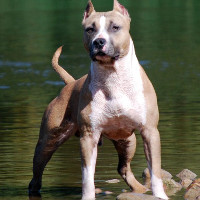
Smooth-coated, well balanced, of great strength for his size. Muscular, active and agile.

Behaviour / temperament

Traditionally of indomitable courage and tenacity. Highly intelligent and affectionate especially with children. Bold, fearless and totally reliable.

Head

Cranial region

Head
Short.
Skull
Deep through with broad skull.
Stop
Distinct.

Facial region

Nose
Black or as dark as possible in blue dogs, with open nostrils.
Muzzle
Short foreface with a minimum ratio of 1 part muzzle to 2 parts skull.
Lips
Tight and clean.
Jaws and teeth
Jaws strong, teeth large, with a perfect, regular and complete scissor bite, i. e. upper teeth closely overlapping the lower teeth and set square to the jaw.
Cheeks
Very pronounced cheek muscles.
Eyes
Dark preferred but may bear some relation to coat colour. Round, of medium size, and set to look straight ahead. Eye rims dark.
Ears
Rose or half pricked, not large or heavy. Full, drop or pricked ears highly undesirable.

Neck

Muscular, rather short, clean in outline gradually widening towards shoulders.

Body

Body
Close-coupled.
Topline
Level.
Chest
Wide front, deep brisket, well sprung ribs, being rather light in loin, muscular and well defined.

Tail

Medium length, low set, tapering to a point and carried rather low. Should not curl much and may be likened to an old-fashioned pump handle.

Limbs

Forequarters

Generality
Legs straight and well boned, set rather wide apart, showing no weakness at the pasterns, from which point feet turn out a little.
Shoulders
Well laid back.
Elbows
No looseness.

Hindquarters

Generality
Well muscled. Legs parallel when viewed from behind.
Stifle
Well bent.
Hock
Well let down.

Feet

Well padded, strong and of medium size. Nails black in solid coloured dogs.

Gait and movement

Free, powerfull and agile with economy of effort. Legs moving parallel when viewed from front or rear. Discernible drive from hindlegs.

Coat

Hair
Smooth, short and close.
Colour
White. Red, fawn, white, black or blue, or any one of these colours with white. Any shade of brindle or any shade of brindle with white. Black and tan or liver colour highly undesirable.
Any other colour, including black and tan or liver, or combination of colours unacceptable.

Size and weight

Height at withers
Desirable height at withers : 14-16 ins. (35,5 to 40,5 cm), these heights being related to the weights.
Weight
Dogs : 28-38 lbs (12,7-17 kg), bitches : 24-34 lbs (11-15,4 kg).

Faults

• Any departure from the foregoing points should be considered a fault and the seriousness with which the fault should be regarded should be in exact proportion to its degree and its effect upon the health and welfare of the dog and its ability to perform its traditional work.
• Faults listed should be in degree of seriousness.
 

Disqualifying faults

Aggressive or overly shy dogs.

NB :

• Any dog clearly showing physical or behavioural abnormalities shall be disqualified.
• The above mentioned faults when occurring to a highly marked degree or frequently are disqualifying.
• Male animals should have two apparently normal testicles fully descended into the scrotum.
• Only functionally and clinically healthy dogs, with breed typical conformation should be used for breeding.


Detailed history

It is among the old fighting dogs that we find the greatest friends of the human race: it would be wrong to see there a paradox of a rather dubious taste, because why what is granted without hesitation to the Boxer (whose forms and the past are those of a fighting dog) would not it be so to the heirs of the Pit Bulls, and especially to the Staffordshire Bull Terrier?

That this dog is recognized in Britain, where it is widespread, like a warm companion of the man and especially the little ones of man, comes to him from his double descent of Bulldog and Terrier. In fact, let us repeat once again, Terriers, quite independent and stubborn as they seem, know how to give themselves body and soul to their master.

Without showing complacency with regard to these cruel and sadistic games that consisted in having two dogs fight in a pit, we must linger for a moment, since our "Staffie" (familiar nickname Staffordshire Bull Terrier) came from the Middle Ages until 1835. It was customary to set bulls against Bulldogs (word for word: bull dogs) .It should be mentioned in passing that on the date of the prohibition of the British Parliament, these dogs were more like the Boxer than the current breed called Bulldog.It seems that the origin of these fights was the need to run and exhaust the bull so that his meat became tender, in fact, it was quickly a popular entertainment in the British countryside, and the nobility itself (even to the sovereigns) provided the most fervent supporters of this rustic diversion. put a bear, duly chained, to four, five or six of these fighting dogs. In the seventeenth century, as bears had been completely exterminated in the British Isles, they were imported, and in great numbers, from distant Russia.

Little by little, however, the gentry turned away from these sports increasingly considered barbaric and which, finally (in 1835, therefore), under the pressure of the first societies of animal protection, were declared illegal. They disappeared quickly enough because it was hardly possible to organize them "under the mantle".

One of their main attractions was the possibility of betting. This taste for games was found among the workers of the mines and mills, in the big cities and the industrial regions of England. To satisfy it, rat killing matches were also organized in which the dogs used were especially Terriers. The purpose of these competitions was to kill a maximum of rats by a dog in a given time, unless it is a question of killing a given number of these rodents in a minimum time. This sport was very successful in the 1820s - 1830s and beyond. It was legal until 1912. Among the distinguished dogs were Billy, an ancestor of the Manchester Terrier, and Jacky, who was said to be more like the Staffordshire Bull Terrier. The dogs competed in pits on the sides of planks; sometimes a gallery was built upstairs to accommodate more spectators and gamblers.

From 1835 onwards, the Bulldogs "unemployed" were crossed with Terriers (and mainly, probably, with those who competed as ratiers) to participate in a "new" sport: fighting between dogs, considered more exciting and more spectacular and also easier to organize. The dogs that exercised their talents were called Bull and Terriers, Half and Half (literally, "half-and-half"), Pit Dogs, Pit Bull Terriers, which reflects their double ancestry. They combined the power of the Bulldogs with the qualities of the Terriers: audacity, tenacity, speed. It was not a breed because there were different lineages and types, each breeder having his secret recipe for producing invincible dogs.

If the current Staffie has an undeniable kinship with the "old guy" Bulldog, do not neglect his heritage Terrier, which could also be predominant. We must not forget that the selection of Terriers was just as pitiless as that of the Bulls, because they had to be able to face wild animals; especially the badger; who defended their skin dearly when they were cornered. In addition, these Terriers, very widespread, of small size, were the favorite dogs of the modest people. This use of Terrier blood was therefore dictated by practical considerations, but it had yet another reason: the dynamism and vivacity of these dogs provided a more varied spectacle. These dog fights could easily take place without the knowledge of the authorities in any place, preferably closed for more discretion: abandoned house, warehouse, cellar, back room pub. Although illegal, everything suggests that, for a good part of the nineteenth century, they were tolerated: witness the number of engravings that were executed, the advertising and posters that accompanied the main events, the meticulousness of the organization (for example, "tasters" were responsible for ensuring that dogs were not coated with a poisonous substance.) Some aristocrats did not shy away from attending, the chronicle even mentions that a pastor protested. energetically towards the end of the nineteenth century, because the police intervened to interrupt the matches, and the active repression they were subjected to did not prevent their survival in the twentieth century, and it is not at all It is certain that they are not yet organized here and there.

Nevertheless, the Pit Bull, in this case the Staffordshire Bull Terrier, was always (more or less) a clandestine until 1935, date of its official recognition by the Kennel Club. To get to this point, dog lovers have been concerned for some years to give a breed status to a dog very typical but a little varied shapes, size and colors. If it was named Bull Terrier "Staffordshire", it is of course because this county was one of the main fiefs of the breeding of this dog, with Lancashire and Yorkshire, although the dog fights were raging in many other places, such as the London area, parts of Wales, Cornwall or Ulster. In addition, the name of Bull Terrier already designated a race known for a long time, since it was created by a certain James Hinks, between 1850 and 1870, from entirely white dogs. Some "amateurs" considered white specimens as unsurpassed in combat.

Gradually, however, this white Bull Terrier was admitted into the exhibitions and selected on its forms: its head became ovoid, and when, in 1901, the cut of the ears was forbidden (until then they were cut in peak), we even manage to produce dogs with naturally straight ears. Thus, after several decades of selection, the Bull Terrier and Staffordshire became quite distinct dogs.

As for the Stafford, a Breed Club was created at Cradley Heath in the 1930s, and the breed was given a British Book of Origins in 1938: that year, 343 subjects were registered, which suggests that the Staffordshire Bull Terrier was already well established. In 1948, the standard was changed in the direction of a slight reduction in size (about 3 to 5 centimeters). From then on, the Staffie could begin a most brilliant career as a dog of exhibitions and companionship, not without pointing out some exploits proving that his combative vigor remained unaltered. In 1957, says Dr. Ronald Delaney, a dog named Gentleman Jim of Inver came out of a badger in less than twenty-five minutes near Belfast.

Since the eve of the Second World War (340 births in 1939), the progression of this "new" race has been spectacular. At the beginning of the seventies, the figure of 2000 per year was exceeded, and in 1982, it reached 4000; three years later, there were more than 6,000 births a year, and Staffordshire was firmly established as the most popular Terrier breed in Britain, along with one of the most popular breeds (5940 dogs). were registered in 1988).

And yet, although dog fashion is generally more and more international (for example, a dog that becomes frankly popular in the United States or the United Kingdom is likely to become a few years later in other countries, including France), the popularity of Stafford in Britain has never been exported. Perhaps she could have done it in the United States, but there, there was already a "cousin": in the very year Kennel Club recognized the Staffie, the American Kennel Club admitted Staffordshire Terrier. The similarity of name indicates enough that these are close relatives, but they come from entirely different lineages; that's why the American "Staff" is both bigger and heavier.

American Staffordshire has itself been confused with the "Pit Bull" (we have heard in Europe the echoes of the virulent press campaign against this dog, set to kill by thugs and dealers). It is not surprising, therefore, that the place on the other side of the Atlantic with the British Stafford is very discreet. The breed was only recognized in 1974, at the same time as the first subject, Tinkinswood Imperial. In 1988, 222 dogs were registered.

The Staffordshire Bull Terrier thus remains exclusively British, or nearly so: before it can become popular in France, it would be necessary that other terriers less particular in their forms and the less marked past precede it. However, despite all the efforts of enthusiasts, who can not but, Terriers are still largely unknown in France. It is therefore not before a respectable number of years that the French will be able to see classes of 150, 200, or more, Staffords' engagements in dog shows; and even fewer sixteen clubs to promote it.

If the Staffie is not better known outside of his country, it is not that he demerits in some field (except one, we will return). From his history, moreover, should we deduce that he is both Bull (that is to say, Dogue) and Terrier? It is primarily a Terrier: in Britain, where we know about Terriers, we could say that it is "in this dog that the spirit of the terrier shines most intensely". Like a majority of Terriers, he is not tall. But, relative to its size, it is tremendously powerful. For a height oscillating between 35 and 40 centimeters at the withers, he weighs between 11 and 17 kilos. As we say in dog jargon, he has "substance. In addition, her impressive musculature, which can be easily seen under her short dress, does not prevent her from being very active and even surprisingly agile.

It is first his head that strikes the observer, especially his large skull and especially the mass of his muscles masseter. Equally impressive, if not more, is his "big heart like that". He is indeed immensely devoted to his family. His love of children has become legendary (at least in Britain). Very small, he already shows an extraordinary appetite for life, and throughout his life he will remain a happy extrovert, a go-getter. That said, if he gets enough exercise, he is able to stay calm at home. One can even leave him alone without fearing that he will panic, because nothing frightens him. If he is stubborn enough, sometimes a little exclusive in his friendships, the Staffordshire is nevertheless easy to hold for who knows how to be firm. But beware ; to beat him would be a mistake, first of all because he is quite stoic in the face of the pain, but also and especially because it might wake up his aggressive background. Once he is well excited, it is very difficult to calm down. The Staffie is pugnacious and uncommonly bold. Rather than beat him if he transgresses an interdict, it is better to shake him by the skin of the neck, and to undertake his education as quickly as possible.

Its rather forbidding physique, which largely compensates for its small size, is enough to make it an excellent guard dog. Training to strengthen one's protective instinct would be completely superfluous. To discourage any malicious intent, his manner of taking a sinister and resolute look is quite effective. Moreover, teaching him to bite could be a source of trouble.

This brings us to the Stafford's chief defect: he is not very kind to his fellows. It is not that he is always trying to do battle, but he responds promptly to any threat, never fleeing and never confessing defeat. Similarly, a simple game between dogs can degenerate or excite. Any experience of this kind will awaken his fighting instinct, with the problems that will ensue whenever the opportunity arises. The master of a Stafford must therefore exercise wisdom and prudence to avoid such situations.

Knowing this, we can not; or we should not; nothing else to reproach the Staffie. Anyone who has approached him and attended a little bit will say that he has "a delicious character", that he is a "true and irresistible clown", "a heart of gold" with people in general and the children in particular. Of course, even in "the most dog-friendly country in the world", it does not seem easy to match popularity with quality. Those who recently visited a major English exhibition did not miss the fact that Staffordshire Bull Terriers rings are sometimes lacking. You can see, and hear, dogs very angry and barking. Let's hope that the very important diffusion of this race in his country will not undermine his capital of kindness.

Comments

Latest page updates

  • Yorkshire Terrier

    Yorkshire Terrier FCI Standard No. 86 Origin Great Britain Group Group 3 Terriers Section Section 4 Toy Terriers Working Without working trial Date of acceptance on a definitive basis by the FCI Saturday 30 October 1954 Date of publication of the official valid standard Tuesday 08 September 2026 Date of the last update Tuesday 06 October 2026 En...
  • West Highland White Terrier

    West Highland White Terrier FCI Standard No. 85 Origin Great Britain Group Group 3 Terriers Section Section 2 Small-sized Terriers Working Without working trial Date of acceptance on a definitive basis by the FCI Friday 29 October 1954 Date of publication of the official valid standard Tuesday 08 September 2026 Date of the last update Tuesday 06...
  • Welsh Terrier

    Welsh Terrier FCI Standard No. 78 Origin Great Britain Group Group 3 Terriers Section Section 1 Large- and medium sized Terriers Working Without working trial Date of acceptance on a definitive basis by the FCI Saturday 23 October 1954 Date of publication of the official valid standard Tuesday 08 September 2026 Date of the last update Tuesday 06...
  • Welsh Springer Spaniel

    Welsh Springer Spaniel FCI Standard No. 126 Origin Great Britain Group Group 8 Retrievers-Flushing Dogs-Water Dogs Section Section 2 Flushing Dogs Working With working trial Date of acceptance on a definitive basis by the FCI Thursday 30 December 1954 Date of publication of the official valid standard Tuesday 08 September 2026 Date of the last...
  • Welsh Corgi Pembroke

    Welsh Corgi Pembroke FCI Standard No. 39 Origin Great Britain Group Group 1 Sheepdogs and Cattle Dogs (except Swiss Cattle Dogs) Section Section 2 Cattledogs (except Swiss Cattledogs) Working Without working trial Date of acceptance on a definitive basis by the FCI Wednesday 13 November 1963 Date of publication of the official valid standard Tuesday 08...
  • Welsh Corgi Cardigan

    Welsh Corgi Cardigan FCI Standard No. 38 Origin Great Britain Group Group 1 Sheepdogs and Cattle Dogs (except Swiss Cattle Dogs) Section Section 2 Cattledogs (except Swiss Cattledogs) Working Without working trial Date of acceptance on a definitive basis by the FCI Tuesday 12 November 1963 Date of publication of the official valid standard Tuesday 08...
  • Sussex Spaniel

    Sussex Spaniel FCI Standard No. 127 Origin Great Britain Group Group 8 Retrievers, Flushing dogs, Water dogs. Section Section 2 Flushing dogs Working With working trial Date of acceptance on a definitive basis by the FCI Friday 31 December 1954 Date of publication of the official valid standard Tuesday 08 September 2026 Date of the last update Tuesday 06...
  • Skye Terrier

    Skye Terrier FCI Standard No. 75 Origin Great Britain Group Group 3 Terriers Section Section 2 Small-sized Terriers Working Without working trial Date of acceptance on a definitive basis by the FCI Wednesday 20 October 1954 Date of publication of the official valid standard Tuesday 08 September 2026 Date of the last update Tuesday 06 October 2026 En...
  • Shetland Sheepdog

    Shetland Sheepdog FCI Standard No. 88 Origin Great Britain Group Group 1 Sheepdogs and Cattle Dogs Section Section 1 Sheepdogs Working Without working trial Date of acceptance on a definitive basis by the FCI Tuesday 09 November 1954 Date of publication of the official valid standard Tuesday 08 September 2026 Date of the last update Tuesday 06...
  • Sealyham Terrier

    Sealyham Terrier FCI Standard No. 74 Origin Great Britain Group Group 3 Terriers Section Section 2 Small sized Terriers Working Without working trial Date of acceptance on a definitive basis by the FCI Tuesday 19 October 1954 Date of publication of the official valid standard Tuesday 08 September 2026 Date of the last update Tuesday 06 October...
  • Scottish Terrier

    Scottish Terrier FCI Standard No. 73 Origin Great Britain Group Group 3 Terriers Section Section 2 Small-sized Terriers Working Without working trial Date of acceptance on a definitive basis by the FCI Monday 18 October 1954 Date of publication of the official valid standard Tuesday 08 September 2026 Date of the last update Tuesday 06 October...
  • Old English Sheepdog (Bobtail)

      Old English Sheepdog (Bobtail) FCI Standard No. 16     Origin   Great Britain Group   Group 1 Sheepdogs and Cattle Dogs (except Swiss Cattle Dogs) Section   Section 1 Sheepdogs Working   Without working trial Date of acceptance on a definitive basis by the FCI   Monday 25 November 1963 Date of publication of the official valid standard   Tuesday 08 September...
  • Norwich Terrier

    Norwich Terrier FCI Standard No. 72 Origin Great Britain Group Group 3 Terriers Section Section 2 Small-sized Terriers Working Without working trial Date of acceptance on a definitive basis by the FCI Saturday 16 October 1954 Date of publication of the official valid standard Tuesday 08 September 2026 Date of the last update Tuesday 06 October...
  • Norfolk Terrier

    Norfolk Terrier FCI Standard No. 272 Origin Great Britain Group Group 3 Terriers Section Section 2 Small-sized Terriers Working Without working trial Date of acceptance on a definitive basis by the FCI Saturday 01 October 1966 Date of publication of the official valid standard Tuesday 08 September 2026 Date of the last update Tuesday 06 October...
  • Manchester Terrier

    Manchester Terrier FCI Standard No. 71 Origin Great Britain Group Group 3 Terriers Section Section 1 Large and medium sized Terriers Working Without working trial Date of acceptance on a definitive basis by the FCI Friday 15 October 1954 Date of publication of the official valid standard Tuesday 08 September 2026 Date of the last update Tuesday 06 October...
  • Lakeland Terrier

    Lakeland Terrier FCI Standard No. 70 Origin Great Britain Group Group 3 Terriers Section Section 1 Large and medium-sized Terriers Working Without working trial Date of acceptance on a definitive basis by the FCI Thursday 14 October 1954 Date of publication of the official valid standard Tuesday 08 September 2026 Date of the last update Tuesday 06 October...
  • Labrador Retriever

      Labrador Retriever FCI Standard No. 122     Origin   Canada Group   Group 8 Retrievers, Flushing dogs, Water dogs Section   Section 1 Retrievers Working   With working trial Date of acceptance on a definitive basis by the FCI   Friday 24 December 1954 Date of publication of the official valid standard   Tuesday 08 September 2026 Date of the last update   Tuesday 06...
  • King Charles Spaniel

    King Charles Spaniel FCI Standard No. 128 Origin Great Britain Group Group 9 Companion and Toy Dogs Section Section 7 English Toy Spaniels Working Without working trial Date of acceptance on a definitive basis by the FCI Monday 03 January 1955 Date of publication of the official valid standard Tuesday 08 September 2026 Date of the last update Tuesday 06...
  • Harrier

      Harrier FCI Standard No. 295     Origin   Great Britain Translation   Mrs. Peggy Davis, brought up to day by Dr. Paschoud Group   Group 6 Scenthounds and related breeds Section   Section 1.2 Medium-sized Hounds Working   With working trial Date of acceptance on a definitive basis by the FCI   Wednesday 27 November 1974 Date of publication of the official valid...
  • Greyhound

    Greyhound FCI Standard No. 158 Origin Great Britain Group Group 10 Sighthounds Section Section 3 Short-haired sighthounds Working Without working trial Date of acceptance on a definitive basis by the FCI Saturday 23 April 1955 Date of publication of the official valid standard Tuesday 08 September 2026 Date of the last update Tuesday 06 October...
  • Gordon Setter

    Gordon Setter FCI Standard No. 6 Origin Great Britain Group Group 7 Pointing Dogs Section Section 2.2 British and Irish Pointers and Setters; Setters Working With working trial Date of acceptance on a definitive basis by the FCI Tuesday 28 May 1963 Date of publication of the official valid standard Tuesday 08 September 2026 Date of the last...
  • Golden Retriever

    Golden Retriever FCI Standard No. 111 Origin Great Britain Group Group 8 Retrievers, Flushing Dogs, Water Dogs Section Section 1 Retrievers Working With working trial Date of acceptance on a definitive basis by the FCI Thursday 02 December 1954 Date of publication of the official valid standard Tuesday 28 July 2009 Date of the last update Wednesday...
  • Fox Terrier Wire

    Fox Terrier Wire FCI Standard No. 169 Origin Great Britain Group Group 3 Terriers Section Section 1 Large and medium-sized Terriers Working Working trial optional Date of acceptance on a definitive basis by the FCI Friday 13 May 1955 Date of publication of the official valid standard Tuesday 08 September 2026 Date of the last update Tuesday 06...
  • Fox Terrier Smooth

    Fox Terrier Smooth FCI Standard No. 12 Origin Great Britain Group Group Terriers Section Section 1 Large and medium sized Terriers Working Working trial optional Date of acceptance on a definitive basis by the FCI Wednesday 26 June 1963 Date of publication of the official valid standard Tuesday 08 September 2026 Date of the last update Tuesday 06...
  • Flat Coated Retriever

    Flat Coated Retriever FCI Standard No. 121 Origin Great Britain Group Group 8 Retrievers-Flushing Dogs-Water Dogs Section Section 1 Retrievers Working With working trial Date of acceptance on a definitive basis by the FCI Thursday 23 December 1954 Date of publication of the official valid standard Tuesday 08 September 2026 Date of the last update Tuesday...
  • Field Spaniel

    Field Spaniel FCI Standard No. 123 Origin Great-Britain Group Group 8 Retrievers, Flushing Dogs, Water Dogs Section Section 2 Flushing Dogs Working With working trial Date of acceptance on a definitive basis by the FCI Monday 27 December 1954 Date of publication of the official valid standard Tuesday 08 September 2026 Date of the last update Tuesday...
  • English Toy Terrier

    English Toy Terrier FCI Standard No. 13 Origin Great Britain Group Group 3 Terriers Section Section 4 Toy Terriers Working Without working trial Date of acceptance on a definitive basis by the FCI Tuesday 17 September 1963 Date of publication of the official valid standard Tuesday 08 September 2026 Date of the last update Tuesday 06 October 2026 En...
  • English Springer Spaniel

    English Springer Spaniel FCI Standard No. 125 Origin Great Britain Group Group 8 Retrievers-Flushing Dogs-Water Dogs Section Section 2 Flushing Dogs Working With working trial Date of acceptance on a definitive basis by the FCI Wednesday 29 December 1954 Date of publication of the official valid standard Tuesday 08 September 2026 Date of the last...
  • English Setter

    English Setter FCI Standard No. 2 Origin Great Britain Group Group 7 Pointing Dogs Section Section 2.2 British and Irish Pointers and Setters, Setter Working With working trial Date of acceptance on a definitive basis by the FCI Wednesday 06 March 1963 Date of publication of the official valid standard Tuesday 08 September 2026 Date of the last...
  • English Pointer

    English Pointer FCI Standard No. 1 Origin Great Britain Group Group 7 Pointing Dogs Section Section 2.1 British and Irish Pointers and Setters, Pointer Working With working trial Date of acceptance on a definitive basis by the FCI Tuesday 05 March 1963 Date of publication of the official valid standard Tuesday 08 September 2026 Date of the last...
  • English Foxhound

    English Foxhound FCI Standard No. 159 Origin Great Britain Group Group 6 Scenthounds and related breeds Section Section 1.1 Large-sized Scent hounds Working With working trial Date of acceptance on a definitive basis by the FCI Monday 25 April 1955 Date of publication of the official valid standard Thursday 26 March 2009 Date of the last update Wednesday...
  • English Cocker Spaniel

    English Cocker Spaniel FCI Standard No. 5 Origin Great Britain Group Group 8 Retrievers, Flushing Dogs, Water Dogs Section Section 2 Flushing dogs Working With working trial Date of acceptance on a definitive basis by the FCI Wednesday 10 April 1963 Date of publication of the official valid standard Tuesday 08 September 2026 Date of the last...
  • Tibetan Mastiff

    Tibetan Mastiff FCI Standard No. 230 Origin Tibet (China)Patronage FCI Group Group 2 Pinscher and Schnauzer- Molossoid breeds- Swiss Mountain and Cattle Dogs Section Section 2.2 Molossoid breeds, Mountain type Working Without working trial Date of acceptance on a definitive basis by the FCI Tuesday 22 August 1961 Date of publication of the...
  • Deerhound

    Deerhound FCI Standard No. 164 Origin Great Britain Group Group 10 Sighthounds Section Section 2 Rough-haired Sighthounds Working Without working trial Date of acceptance on a definitive basis by the FCI Friday 29 April 1955 Date of publication of the official valid standard Tuesday 08 September 2026 Date of the last update Tuesday 06 October...
  • Dandie Dinmont Terrier

    Dandie Dinmont Terrier FCI Standard No. 168 Origin Great Britain Group Group 3 Terriers Section Section 2 Small-sized Terriers Working Without working trial Date of acceptance on a definitive basis by the FCI Thursday 12 May 1955 Date of publication of the official valid standard Tuesday 08 September 2026 Date of the last update Tuesday 06...
  • Curly Coated Retriever

    Curly Coated Retriever FCI Standard No. 110 Origin Great Britain Group Group 8 Retrievers, Flushing Dogs, Water Dogs Section Section 1 Retrievers Working With working trial Date of acceptance on a definitive basis by the FCI Friday 10 December 1954 Date of publication of the official valid standard Tuesday 08 September 2026 Date of the last...
  • Collie Smooth

    Collie Smooth FCI Standard No. 296 Origin Great Britain Group Group 1 Sheepdogs and Cattle Dogs (except Swiss Cattle Dogs) Section Section 1 Sheepdogs Working Without working trial Date of acceptance on a definitive basis by the FCI Wednesday 18 December 1974 Date of publication of the official valid standard Tuesday 08 September 2026 Date of the...
  • Collie Rough

    Collie Rough FCI Standard No. 156 Origin Great Britain Group Group 1 Sheepdogs and Cattle Dogs (except Swiss Cattle Dogs) Section Section 1 Sheepdogs Working Without working trial Date of acceptance on a definitive basis by the FCI Wednesday 13 April 1955 Date of publication of the official valid standard Tuesday 08 September 2026 Date of the...
  • Clumber Spaniel

    Clumber Spaniel FCI Standard No. 109 Origin Great Britain Group Group 8 Retrievers, Flushing dogs, Water dogs Section Section 2 Flushing dogs Working With working trial Date of acceptance on a definitive basis by the FCI Thursday 09 December 1954 Date of publication of the official valid standard Tuesday 08 September 2026 Date of the last update Tuesday...
  • Chow Chow

    Chow Chow FCI Standard No. 205 Origin China, patronage : Great Britain Group Group 5 Spitz and primitive type Section Section 5 Asian Spitz and related breeds Working Without working trial Date of acceptance on a definitive basis by the FCI Tuesday 10 December 1957 Date of publication of the official valid standard Tuesday 08 September 2026 Date...
  • Chinese Crested Dog

    Chinese Crested Dog FCI Standard No. 288 Origin China, patronage Great Britain Group Group 9 Companion and Toy Dogs Section Section 4 Hairless breeds Working Without working trial Date of acceptance on a definitive basis by the FCI Monday 17 July 1972 Date of publication of the official valid standard Tuesday 08 September 2026 Date of the last...
  • Cairn Terrier

    Cairn Terrier FCI Standard No. 4 Origin Great Britain Group Group 3 Terriers Section Section 2 Small-sized Terriers Working Without working trial Date of acceptance on a definitive basis by the FCI Saturday 06 April 1963 Date of publication of the official valid standard Tuesday 08 September 2026 Date of the last update Tuesday 06 October 2026 En...
  • Bullmastiff

    Bullmastiff FCI Standard No. 157 Origin Great Britain Group Group 2 Pinscher and Schnauzer Molossoid breeds - Swiss Mountain and Cattle Dogs Section Section 2.1 Molossoid breeds, Mastiff Type Working Without working trial Date of acceptance on a definitive basis by the FCI Saturday 23 April 1955 Date of publication of the official valid standard Tuesday...
  • English Bulldog

    English Bulldog FCI Standard No. 149 Origin Great Britain Group Group 2 Pinscher and Schnauzer Molossoid breeds-Swiss Mountain and Cattle Dogs Section Section 2.1 Molossoid breeds, Mastiff Type Working Without working trial Date of acceptance on a definitive basis by the FCI Monday 14 March 1955 Date of publication of the official valid standard Tuesday...
  • Bull Terrier

    Bull Terrier FCI Standard No. 11 Origin Grande-Bretagne Group Group 3 Terriers Section Section 3 Bull type Terriers Working Working trial optional Date of acceptance on a definitive basis by the FCI Saturday 26 June 1993 Date of publication of the official valid standard Tuesday 08 September 2026 Date of the last update Tuesday 06 October 2026 En...
  • Border Terrier

    Border Terrier FCI Standard No. 10 Origin Great Britain Group Group 3 Terriers Section Section 1 Large and medium-sized terriers Working Without working trial Date of acceptance on a definitive basis by the FCI Wednesday 26 June 1963 Date of publication of the official valid standard Tuesday 08 September 2026 Date of the last update Tuesday 06...
  • Bedlington Terrier

    Bedlington Terrier FCI Standard No. 9 Origin Great Britain Group Group 3 Terriers Section Section 1 Large and medium sized Terriers Working Without working trial Date of acceptance on a definitive basis by the FCI Thursday 20 June 1963 Date of publication of the official valid standard Tuesday 08 September 2026 Date of the last update Tuesday 06...
  • Bearded Collie

    Bearded Collie FCI Standard No. 271 Origin Great-Britain Group Group 1 Sheepdogs and Cattle Dogs (except Swiss Cattle Dogs) Section Section 1 Sheepdogs Working Without working trial Date of acceptance on a definitive basis by the FCI Wednesday 30 August 1967 Date of publication of the official valid standard Tuesday 08 September 2026 Date of the...
  • Beagle

    Beagle FCI Standard No. 161 Origin Great Britain Translation Prof. R. Triquet Group Group 6 Scent hounds and related breeds Section Section 1.3 Small-sized hounds Date of acceptance on a definitive basis by the FCI Tuesday 26 April 1955 Date of publication of the official valid standard Tuesday 08 September 2026 Date of the last update Tuesday 06...
  • Basset Hound

    Basset Hound FCI Standard No. 163 Origin Great Britain Group Group 6 Scent hounds and related breeds Section Section 1.3 Small-sized hounds Working With working trial Date of acceptance on a definitive basis by the FCI Thursday 28 April 1955 Date of publication of the official valid standard Tuesday 08 September 2026 Date of the last update Tuesday...
  • Basenji

    Basenji FCI Standard No. 43 Origin Democratic Republic of Congo, under the patronage of Great Britain Group Group 5 Spitz and primitive types Section Section 6 Primitive type Working Without working trial Date of acceptance on a definitive basis by the FCI Thursday 26 March 1964 Date of publication of the official valid standard Tuesday 08...
  • Airedale Terrier

    Airedale Terrier FCI Standard No. 7 Origin Great Britain Group Group 3 Terriers Section Section 1 Large and medium sized Terriers Working Working trial optional Date of acceptance on a definitive basis by the FCI Tuesday 28 May 1963 Date of publication of the official valid standard Tuesday 08 September 2026 Date of the last update Tuesday 06...
  • Afghan Hound

    Afghan Hound FCI Standard No. 228 Origin AfghanistanPatronage Great Britain Group Group 10 Sighthounds Section Section 1 Long-haired or fringed sighthounds Working Without working trial Date of acceptance on a definitive basis by the FCI Tuesday 12 December 1961 Date of publication of the official valid standard Tuesday 08 September 2026 Date of the...
  • Romagna Water Dog

    Romagna Water Dog FCI Standard No. 298 Origin Italy Translation Antonio Morsiani, Renée Sporre-Willes and Prof. R. TriquetRevised by ENCI and Renée Sporre-WillesRevised by the FCI Head OfficeOfficial language (EN). Group Group 8 Retrievers –Flushing Dogs –Water Dogs Section Section 3 Water Dogs Working Working trial optional Date of acceptance on a...
  • Whippet

    Whippet FCI Standard No. 162 Origin Great Britain Group Group 10 Sighthounds Section Section 3 Short-haired Sighthounds Working Without working trial Date of acceptance on a definitive basis by the FCI Wednesday 27 April 1955 Date of publication of the official valid standard Tuesday 08 September 2026 Date of the last update Tuesday 06 October...
  • Tibetan Terrier

    Tibetan Terrier FCI Standard No. 209 Origin Tibet, patronage Great Britain Group Group 9 Companion and Toy Dogs Section Section 5 Tibetan breeds Working Without working trial Date of acceptance on a definitive basis by the FCI Wednesday 18 December 1957 Date of publication of the official valid standard Tuesday 08 September 2026 Date of the last...
  • Tibetan Spaniel

    Tibetan Spaniel FCI Standard No. 231 Origin Tibet (China)Patronage Great Britain Group Group 9 Companion and Toy Dogs Section Section 5 Tibetan breeds Working Without working trial Date of acceptance on a definitive basis by the FCI Tuesday 22 August 1961 Date of publication of the official valid standard Tuesday 08 September 2026 Date of the...
  • Shih Tzu

    Shih Tzu FCI Standard No. 208 Origin Tibet, patronage Great Britain Group Group 9 Companion and Toy Dogs Section Section 5 Tibetan breeds Working Without working trial Date of acceptance on a definitive basis by the FCI Monday 16 December 1957 Date of publication of the official valid standard Tuesday 08 September 2026 Date of the last update Tuesday 06...
  • Pug

    Pug FCI Standard No. 253 Origin China, patronage Great Britain Group Group 9 Companion and Toy Dogs Section Section 11 Small Molossian type dogs Working Without working trial Date of acceptance on a definitive basis by the FCI Friday 04 November 1966 Date of publication of the official valid standard Tuesday 08 September 2026 Date of the last...
  • Pharaoh Hound

    Pharaoh Hound FCI Standard No. 248 Origin Malta, patronage Great Britain Group Group 5 Spitz and primitive types Section Section 6 Primitive type Working Without working trial Date of acceptance on a definitive basis by the FCI Friday 09 August 1963 Date of publication of the official valid standard Tuesday 08 September 2026 Date of the last...
  • Pekingese

    Pekingese FCI Standard No. 207 Origin China, patronage Great Britain Group Group 9 Companion and Toy Dogs Section Section 8 Japan Chin and Pekingese Working Without working trial Date of acceptance on a definitive basis by the FCI Thursday 03 November 1966 Date of publication of the official valid standard Tuesday 08 September 2026 Date of the last...
  • Parson Russell Terrier

    Parson Russell Terrier FCI Standard No. 339 Origin Great Britain Group Group 3 Terriers Section Section 1 Large and medium sized Terriers Working Working trial optional Date of acceptance on a definitive basis by the FCI Monday 04 June 2001 Date of acceptance on a provisional basis by the FCI Monday 02 July 1990 Date of publication of the...
  • Otterhound

    Otterhound FCI Standard No. 294 Origin Great Britain Group Group 6 Scenthounds and related breeds Section Section 1.1 Large-sized hounds Working Without working trial Date of acceptance on a definitive basis by the FCI Thursday 12 September 1974 Date of publication of the official valid standard Tuesday 08 September 2026 Date of the last update Tuesday 06...
  • Miniature Bull Terrier

    Miniature Bull Terrier FCI Standard No. 359 Origin Grande-Bretagne Group Group 3 Terriers Section Section 3 Bull type Terriers Working Working trial optional Date of acceptance on a definitive basis by the FCI Tuesday 05 July 2011 Date of acceptance on a provisional basis by the FCI Tuesday 05 July 2011 Date of publication of the official valid...
  • Mastiff

    Mastiff FCI Standard No. 264 Origin Great Britain Group Group 2 Pinscher and Schnauzer – Molossoid breeds - Swiss Mountain and Cattle Dogs Section Section 2.1 Molossoid breeds, Mastiff Type Working Without working trial Date of acceptance on a definitive basis by the FCI Thursday 05 November 1964 Date of publication of the official valid standard Tuesday 08...
  • Lhassa Apso

    Lhassa Apso FCI Standard No. 227 Origin Tibet (China)Patronage Great Britain Group Group 9 Companion and Toy Dogs Section Section 5 Tibetan breeds Working Without working trial Date of acceptance on a definitive basis by the FCI Saturday 19 November 1960 Date of publication of the official valid standard Tuesday 08 September 2026 Date of the last...
  • Lancashire-Heeler

    Lancashire-Heeler FCI Standard No. 360 Origin England, patronage : FCI Group Group 1 Sheepdogs and Cattle Dogs (except Swiss Cattle Dogs) Section Section 1 Sheepdogs Working Without working trial Date of acceptance on a provisional basis by the FCI Sunday 01 May 2016 Date of publication of the official valid standard Tuesday 08 September 2026 Date...

© 2026 Groupe Milouchouchou ASBL. Tous droits réservés. En savoir plus

Protected by Copyright01
