
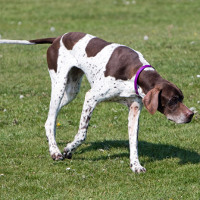
English Pointer

FCI standard Nº 1

Origin
Great Britain
Group
Group 7 Pointing Dogs
Section
Section 2.1 British and Irish Pointers and Setters, Pointer
Working
With working trial
Acceptance on a definitive basis by the FCI
Tuesday 05 March 1963
Publication of the official valid standard
Tuesday 28 July 2009
Last update
Monday 23 November 2009
En français, cette race se dit
Pointer anglais
Diese Norm ist in deutscher Sprache sichtbar
Englischer Pointer
En español, esta raza se dice
Pointer inglés
In het Nederlands, wordt dit ras gezegd
Engelse Pointer

Usage

Pointing dog.

General appearance

Symmetrical and well built all over, general outline a series of graceful curves. A strong but lissom appearance.

Behaviour / temperament

Aristocratic. Alert with appearance of strength, endurance and speed. Kind, even disposition.

Head

Cranial region

Skull
Of medium breadth, in proportion to length of foreface. Pronounced occipital bone. 
Stop
Well defined.

Facial region

Nose
Dark, but may be lighter in the case of a lemon and white coloured dog. Nostrils wide, soft and moist.
Muzzle
Somewhat concave, ending on level with nostrils, giving a slightly dish-faced appearance. Slight depression under the eyes.
Lips
Well developed, soft.
Jaws and teeth
Jaws strong, with perfect, regular and complete scissor bite, i.e. upper teeth closely overlapping lower teeth and set square to the jaws.
Cheeks
Cheek bones not prominent.
Eyes
Same distance from occiput as from nostrils, bright and kindly in expression. Either hazel or brown according to colour of coat. Neither bold nor staring, not looking down the nose. Eye rims dark, but may be lighter in the case of a lemon and white coloured dog.
Ears
Leathers thin, set on fairly high, lying close to head, of medium length, slightly pointed at tips.

Neck

Long, muscular, slightly arched, springing cleanly from shoulders and free from throatiness.

Body

Loin
Strong muscular and slightly arched. Short coupled.
Chest
Just wide enough for plenty of heart room. Brisket well let down, to level with elbows. Ribs well sprung and carried well back, gradually falling away at loin.

Tail

Medium length, thick at root, tapering gradually to a point. Well covered with close hair, carried on a level with back, with no upward curl. In movement, tail should lash from side to side.

Limbs

Forequarters

Generality
Forelegs straight and firm, with good oval bone, with back sinews strong and visible.
Shoulders
Long, sloping and well-laid back.
Carpal
Flat with front leg and protruding very little on inside.
Pastern
Lengthy, strong and resilient. Slightly sloping.
Forefeet
Oval, well knit, arched toes, well cushioned.

Hindquarters

Generality
Very muscular. The haunch bones well spaced and prominent, not above level of back.
Upper thigh
Good expanse of first thigh.
Lower thigh
Good expanse.
Stifle
Well turned.
Hock
Well let down.
Hind feet
Oval, well knit, arched toes, well cushioned.

Gait and movement

Smooth, covering plenty of ground. Driving hind action, elbows neither in nor out. Definitely not a hackney action.

Coat

Hair
Fine, short, hard and evenly distributed, perfectly smooth and straight with decided sheen.
Colour
Usual colours are lemon and white, orange and white, liver and white, and black and white. Self colours and tricolours are also correct.

Size and weight

Height at withers
Dogs 63 - 69 cm, bitches 61 - 66 cm.

Faults

• Any departure from the foregoing points should be considered a fault and the seriousness with which the fault should be regarded should be in exact proportion to its degree and its effect upon the health and welfare of the dog and its ability to perform its traditional work.
• Faults listed should be in degree of seriousness.

Disqualifying faults

 Aggressive or overly shy.

NB :

• Any dog clearly showing physical or behavioural abnormalities shall be disqualified.
• The above mentioned faults when occurring to a highly marked degree or frequently are disqualifying.
• Male animals should have two apparently normal testicles fully descended into the scrotum.
• Only functionally and clinically healthy dogs, with breed typical conformation should be used for breeding.

Bibliography

https://www.fci.be/


Additional information from visitors

The most famous of the pointing gundogs, the English Pointer is descended from Spanish and Portuguese pointers introduced to the British Isles in the 1600's, as well as a variety of common French and English foxhounds and setters. The blood of Talbot Hounds, St.Hubert Bloodhounds, English Greyhounds and English Bullterriers also played a role in the development of this great bird dog. During the 1800's, when the Dalmatian breed was being established in Britain, many crosses with the Pointer were made, leading some to suggest that the similar colouring encountered in some English Pointers is a direct result of these matings, although most fanciers dismiss these claims, pointing out that the colour was common in the breed long before the Dalmatian appeared. The popularity of this hard worker was immediate, due to its outstanding scenting abilities and serious nature. The English Pointer was instrumental in the creation of quite a few other dogs, from various hunters to many bully breeds. The breed was never expected to actually hunt the hares by itself, but was rather used to find and point to the game, leaving it for the Greyhounds to chase the prey down. Its friendly and relaxed personality made the breed a common companion in England and it eventually found acceptance in many countries around the globe, retaining its fair popularity to this day. The English Pointer was recognized in the early 20th century by the United Kennel Club and has remained a well-loved breed in America ever since. In the United States, it was given the nickname "The Cadillac Of Bird Dogs" for its superb hunting qualities and was always distinguished from the common, but unrecognized American Pointer breed, to which it is related.
The English Pointer is an even-tempered and loving family pet and can live quite comfortably in urban environments, if provided with sufficient excercise. Its alert personality makes it an effective watchdog, although the breed generally isn't very territorial. This is a handsome, balanced and dignified breed, although some poorly bred specimens have uncharacteristic temperaments and can be overly shy and even vicious. Lightly built, muscled and agile, this is a very fast and athletic dog. The body is fairly square, with long legs and a deep chest. The head is elegantly chiseled, with the trademark "dish face" features and slightly pendant lips. The nose can be both black or flesh-coloured. The tail is relatively short and is famously known as the "bee sting". The coat is short, smooth and fine, coming in a variety of white-based bicolours, with black, brown and yellow markings being the only one accepted at Shows. Average height is around 25 inches.

Detailed history

If it is customary to say that the Pointer is the thoroughbred of the dogs, it is not because the other breeds are less pure, and that does not mean that it has been free, in the distant past, a few crossings intended to hasten its improvement. Moreover, its origins keep, even today, a good part of their mystery.

No, if the Pointer is a thoroughbred, it is by the perfection of its lines, exactly adapted to what is asked on the ground. It is by the very high level of its performances: speed, endurance, delicacy of the flair. He appears as the aristocrat in his field, or better, as the "formula one" of the dog.

Admittedly, very few people could manage a race car correctly, but it would be a serious mistake to deduce that the Pointer can only be driven by an elite of hunters or professional trainers, or that it would not be appropriate. than the circuits that are the spring field trials.

The past of this marvelous mechanism, its genesis, in fact, deserve to be stopped, if only by the questions they ask. One thing is certain: the Pointer is a continental. For him, as for the Braques, it is necessary to go back to the "dog hunting in the plain far from the men" which Arrian states in the second century of our era. The paradox is that, after passing into expert hands, he was considered 100% English, and that he served to improve most of his cousins.

This dog is continental, but is it Italian, French or Iberian? On this subject, a few decades ago, innumerable pages were written. It is therefore little to say that the opinions diverge. Naturally, Italian specialists would like to bring down such an esteemed race from their Braque, and some French writers have argued that our National Watch is no stranger to the improvement of the Pointer. Proponents of Spanish origin, however, are in the majority. The Spanish Braque was imported into Great Britain between 1705 and 1713 (the date of the Treaty of Utrecht), by English officers and soldiers engaged following the Earl of Peterborough in the War of the Spanish Succession. Then, from 1720, the British hunters would have endeavored to improve the Spanish pointers.

Even if we take into account the fact that this selection lasted a good century, we remain amazed at the radical transformation that has taken place: the Spanish Perdiguero (or Perdiguero de Burgos) is indeed the largest and heaviest Continental Braques, with its loose body and head, covered with loose skin; he is very flirtatious, but very slow and calm, questing near the hunter.

The skill, even the genius of canine breeders across the Channel is not questionable. What a curious choice, all the same, that to take the most debonair and heaviest dog, to make a racer very racy! We have tried to explain the metamorphosis by wise crosses, in which the Bloodhound, the Fox-Hound, the Greyhound, the Bull Terrier or the Bulldog would have intervened. But, as we will see later, this list is quite amazing.

It is certain, in any case, that the Pointer has long been called Old Spanish Pointer, and that there must be a reason for that. So ? The patient researches of M. Martineau, former president of the French Pointer Club, lead to a hypothesis more than plausible and which agrees at the same time with the primitive name of the race: it would not be so much the Braque Spaniard who would have constituted the base of the Pointer than its Portuguese counterpart, in other words the Perdiguero Portugues. In any case, it will be said, these dogs are first cousins, and this is the objection that has long been made.

However, the Portuguese dog has characteristics very different from those of the Spaniard, and, what is even more interesting, relatively close to those of the modern Pointer. It is essentially a dog with petulant character, the morphology rather nervous and light, with attitudes marked by great flexibility. Its head is not heavy, although it is quite square, and its main feature consists in a marked stop: it is close enough to the concave profile of the Pointer! As for his paces, they are those of a fast trotter. Her dress further reinforces the probability of filiation Perdiguero Portuguès Pointer: yellow or brown unicoloured or spotted. From Portuguese yellow to lemon or English orange, there is only one step, while the Perdiguero de Burgos, like other Braques, is most often heavily speckled with brown.

Moreover, this assumption is not in contradiction with the information provided by William Arkwright, a great English breeder who strongly influenced the breeding of the Pointer and who wrote, in 1902, a book on the race, became the Bible pointermen. According to Arkwright, the first Spanish Pointer arrived in England in 1705 was brought by a Portuguese merchant who sold it to a baron named Beekhill, Norfolk - an original character: completely ruined, he mainly relied on the product of his hunts for live. The same anecdote is found at Seydeman in 1805.

The Portuguese descent of the first Pointers would then have gone unnoticed because all Perdigueros were indiscriminately designated as Spaniards. Moreover, it must be remembered that, shortly before (from 1580 to 1640), Portugal had been united with Spain, which could have increased confusion. In addition, since the beginning of the eighteenth century, especially, trade relations between Portugal and Britain were very strong, more than the Anglo-Spanish relations.

Mr. Martineau pushed his research further. He thus found striking analogies between the Pointer and some bronze statuettes depicting hunting dogs with a partridge at their foot, and which come from the Tenerife islands: the Perdiguero Portugues would have passed through this archipelago before setting foot across the Channel.

The earliest evidence of the presence of the Old Spanish Pointer in England appears to be a Stubbs painting, dated 1768, showing a white dog with brown spots. It may be thought that from that time English breeders had resorted to various other breeds to accelerate their development.

W. Arkwright does not refute the existence of the crossings mentioned above, while judging their negative effects. Thus, the Bloodhound could have given away some of its legendary flair, but would it not have affected the lightening of the dog? Similarly, it is conceivable that the Foxhound, the famous English current dog, could have given speed and endurance, but that would not have been at the expense of the ability to stop and the receptivity to dressage, two essential qualities of the Pointer? It is probable that these tests did not bring anything good, and that it was necessary above all to erase the traces.

One could speak of a miracle when one has noticed the superiority of the English dog over the continental Braques of the end of the nineteenth century. But, rather than explain it by crossings for the least strange and heterogeneous, it is necessary above all to invoke a consanguinity well conducted. In addition, it will be remembered that English hunters, often wealthy, have not favored the versatility of their pointers, preferring to have specialists for each phase of the hunt. Thus, from the middle of the nineteenth century, they created Retrievers for the search and the ratio of the game drawn. This evolution could only facilitate the selection of the Pointer.

If we come now to a much less confused period, that of the first dog shows, which was also that of the first field-trials, all in Great Britain, of course, it is not not exaggerate to say that these events were born to the benefit of Pointers and other rifle hounds! It was inevitable, first of all, that breeders and hunters wanted to present and compare the merits of their creations and their pupils. It was therefore under their impulse that dog shows were organized. The first (in the world) took place at Newcastle on the 28th and 29th of June, 1859, and the sixty dogs which were engaged there belonged exclusively to two races: Pointer and Setter. Only during the third dog show were sections for non-sporting dogs (non-hunting dogs) added. Thus, the beginnings of the cynophilie are due to the pointermen and the settermen.

Soon it was necessary to check on the ground the skills of the breeds created for the rifle hunt, which is why the field-trials were developed, only six years after the first exhibition. The first work trial was held on April 18, 1865 at Mr. S. Whitbread's Castle, Southill, Bedford-shire. For the record, it was a very unusual heat, which, if it made the dogs very uncomfortable (Pointers and Setters, of course), did not cause the enthusiasm of the organizers and participants.

The institution of the field-trials made without a doubt to accomplish to the breeding of the dogs of stop English of big and rapid progress: nothing of such, to be able to make a reasoned selection, than to have at its disposal a base of results , precise notes on the qualities and defects of all (or nearly all) specimens. These field trials were the best way to verify the validity of such a coupling, the use of such a standard. The Pointer, in particular, made a decisive leap thanks to them.

When British dogs arrived in France at the end of the nineteenth century (it was not long too soon to import the field-trials), they had benefited, for fifteen or twenty years, from a rigorous and unknown selection method on the Continent. It is understandable that their performances aroused amazement and admiration. Soon, any hunter, a little enlightened and wealthy, had to possess a Pointer to beat the plain.

However, if he was praised, the Pointer was also the subject of the sharpest criticism. For example, the Marquis de Cherville could predict: "Our breeds of dogs are disappearing and in a quarter of a century, the national dog of the French will be the Fox-Hound, or rather the Pointer with a predominance of the qualities of the dog. Fox-Hound. As for the Comte de Grammont, the translator of the works of the English cynologist Hugh Dalziel, he thought himself obliged to warn the French readers about the Pointers: "It must be said that they are often useless and tiring, and they can not replace the best French breeds."

This controversy must be placed in context. The English had then gained an undeniable advance in the breeding of purebred animals. This know-how had begun to produce its first results in the late eighteenth century, with the selection of the Dishley sheep breed, but it was above all the breeding of the thoroughbred horse that had acquired considerable prestige. For the most part, hunting-dog lovers were at the same time men on horseback. To be convinced of this, it is enough to remember that, originally, the Central Canine Society was an emanation of the Jockey Club, noting also that the doggie jargon is still impregnated with hippology.

Moreover, this vogue of British hunting dogs, especially the Pointer, is the illustration of "anglomania" which prevailed at the end of the nineteenth century, Anglomania which had begun to manifest itself as soon as the emigrants returned. England, which eventually reached the entire bourgeoisie of the Second Empire (Napoleon III himself gave the example of dogs: his packs were exclusively composed of Fox-Hounds and Bloodhounds). Of course, such enthusiasm had its defectors, who tried to defend the old French breeds, from "country dogs", and who strove to leave them a regional character.

Comparing Pointer and French Braque breeds, as was often done, implied a fundamental misunderstanding. The first had been designed for hunters with large, well-kept and guarded hunts, with advanced rifles, and with the help of several specialized dogs, depending on the territory and the game, and assigned to different tasks: a luxury hobby, meticulously organized. The latter were intended for hunters modestly equipped, operating in very fragmented territories, and whose dog, who was the only one to do everything, had to have a very moderate pace, a very restricted search.

The French dogs (the other mainlanders too, for that matter) and the British dogs were thus at the antipodes. But this did not prevent, in the inter-war period, as one tried to make the French races more and more sporting, that the Pointer became the example to follow. However, no one could claim to compete in a few years with several decades of selection, so the Pointer served more to improve other breeds. It is a fact that, in the exhibitions and in the fields, a certain number of Braques were strongly infused with Pointer, as evidenced by the anecdote reported by EL Blat about the Braque d'Auvergne: In his book published the day after Of the war, Oberthur already mentions this abusive point of view and tells how he bought, in the thirties, a bitch who won the exhibition at the Orangerie des Tuileries where the Paris exhibition was held at the time. Surprised by one of his stallions, he had the unpleasant surprise of getting puppies white and liver in his litter.

This pointing had its disadvantages. On the one hand, the result was the production of bad Braques, of a temperament too ardent for their physical qualities or too fast for their nose, but was it necessary to conclude that the Pointer brought nothing good ?

On the other hand, we noticed the appearance of bad short-tailed Pointers. In fact, it is not enough for a dog to cross the English Channel to make it excellent, and it is obvious that, in a fashionable way, not all imported Pointers were of high quality.

In France, the establishment of the breed was fast and solid, since the French Pointer Club was created in 1891! First adopted by the elite hunters, the Pointer did not fail, then, to take advantage of the development of field-trials. It is indisputable, however, that it has been destined a little too exclusively for competitions, especially those called "grand quest" which do not quite correspond to the imperatives of practical hunting, and that its diffusion is found somewhat hampered. This opinion is corroborated by a former president of the French Club, J. - P. Bouin: "Unfortunately, by a short-sighted policy and perhaps too focused on the great quest and not enough on the practical hunt, the club in charge This wonderful breed has not known how, for too many years, to popularize it in the noble sense of the term, I mean to make it better known and appreciated."

It is not surprising that the Pointer has long kept this image of great trialer, high level athlete reserved for a minority of hunters.

Comments

Latest page updates

  • Samusky

    Samusky He is not recognized by the F.C.I. Origin Northern Russia and Siberia <> Siberia -> North America Translation Francis Vandersteen En français, cette race se dit Samusky Diese Norm ist in deutscher Sprache sichtbar Samusky En español, esta raza se dice Samusky In het Nederlands, wordt dit ras gezegd Samusky This breed is also known as SamhuskySamsky     A...
  • Agouti Husky

    Agouti Husky FCI standard Nº 270 Origin Siberian Translation Francis Vandersteen En français, cette race se dit Husky Agouti Diese Norm ist in deutscher Sprache sichtbar Agouti-Husky En español, esta raza se dice Husky Agouti In het Nederlands, wordt dit ras gezegd Agouti Husky   The "Agouti" Husky is not a distinct breed but a rare color variant...
  • White Husky

    White Husky   FCI standard Nº 270       Origin Siberia Translation Francis Vandersteen En français, cette race se dit Husky blanc Diese Norm ist in deutscher Sprache sichtbar Weißer Husky En español, esta raza se dice Husky blanco In het Nederlands, wordt dit ras gezegd Witte Husky   The white Husky is not a distinct breed, but rather a rare and striking...
  • Taimyr Wolf

    Taimyr Wolf He is not recognized by the F.C.I. Origin Siberia Translation Francis Vandersteen En français, cette race se dit Loup de Taïmyr Diese Norm ist in deutscher Sprache sichtbar Taimyr-Wolf En español, esta raza se dice Lobo de Taimyr In het Nederlands, wordt dit ras gezegd Taimyr-wolf   The Taimyr Wolf is no longer an extant breed, but it...
  • Manchurian Spitz

    Manchurian Spitz He is not recognized by the F.C.I. Origin Manchuria and Siberia region Translation Francis Vandersteen En français, cette race se dit Spitz de Mandchourie Diese Norm ist in deutscher Sprache sichtbar Mandschurischer Spitz En español, esta raza se dice Spitz de Manchuria In het Nederlands, wordt dit ras gezegd Mantsjoerije-spits   The...
  • White Swedish Elkhound

    White Swedish Elkhound He is not recognized by the F.C.I. Origin Sweden Translation Francis Vandersteen En français, cette race se dit Chien d'élan suédois blanc Diese Norm ist in deutscher Sprache sichtbar Schwedischer weißer Elchhund En español, esta raza se dice Perro de alce sueco blanco In het Nederlands, wordt dit ras gezegd Witte Zweedse...
  • Turkish Spitz

    Turkish Spitz He is not recognized by the F.C.I. Origin Turkey Translation Francis Vandersteen En français, cette race se dit Spitz turc Diese Norm ist in deutscher Sprache sichtbar Türkischer Spitz En español, esta raza se dice Spitz turco In het Nederlands, wordt dit ras gezegd Turkse spits This breed is also known as Tonya FinosuFino TonyaKobi   The Tonya...
  • Hunters Creek Feist

    Hunters Creek Feist He is not recognized by the F.C.I. Origin U.S.A. Translation Francis Vandersteen En français, cette race se dit Hunters Creek Feist Diese Norm ist in deutscher Sprache sichtbar Hunters Creek Feist En español, esta raza se dice Hunters Creek Feist In het Nederlands, wordt dit ras gezegd Hunters Creek Feist   The Hunters Creek Feist is...
  • Gray’s Mountain Feist

    Gray’s Mountain Feist He is not recognized by the F.C.I. Origin U.S.A. Translation Francis Vandersteen En français, cette race se dit Gray’s Mountain Feist Diese Norm ist in deutscher Sprache sichtbar Gray’s Mountain Feist En español, esta raza se dice Gray’s Mountain Feist In het Nederlands, wordt dit ras gezegd Gray’s Mountain Feist   The Gray’s...
  • Thornburg Feist

    Thornburg Feist He is not recognized by the F.C.I. Origin U.S.A. Translation Francis Vandersteen En français, cette race se dit Thornburg Feist Diese Norm ist in deutscher Sprache sichtbar Thornburg Feist En español, esta raza se dice Thornburg Feist In het Nederlands, wordt dit ras gezegd Thornburg Feist   The Thornburg Feist is a specialized line of...
  • Mullins Feist

    Mullins Feist He is not recognized by the F.C.I. Origin U.S.A. Translation Francis Vandersteen En français, cette race se dit Mullins Feist Diese Norm ist in deutscher Sprache sichtbar Mullins Feist En español, esta raza se dice Mullins Feist In het Nederlands, wordt dit ras gezegd Mullins Feist   The Mullins Feist is an American hunting dog breed...
  • Kemmer Stock Hybrid Squirrel Dog

    Kemmer Stock Hybrid Squirrel Dog He is not recognized by the F.C.I. Origin U.S.A. Translation Francis Vandersteen En français, cette race se dit Kemmer Stock Hybrid Squirrel Dog Diese Norm ist in deutscher Sprache sichtbar Kemmer Stock Hybrid Squirrel Dog En español, esta raza se dice Kemmer Stock Hybrid Squirrel Dog In het Nederlands, wordt dit...
  • Buckley Mountain Feist

    Buckley Mountain Feist He is not recognized by the F.C.I. Origin U.S.A. Translation Francis Vandersteen En français, cette race se dit Buckley Mountain Feist Diese Norm ist in deutscher Sprache sichtbar Buckley Mountain Feist En español, esta raza se dice Buckley Mountain Feist In het Nederlands, wordt dit ras gezegd Buckley Mountain Feist   The...
  • Charlie Feist

    Charlie Feist He is not recognized by the F.C.I. Origin United Kingdom, U.S.A. Translation Francis Vandersteen En français, cette race se dit Charlie Feist Diese Norm ist in deutscher Sprache sichtbar Charlie Feist En español, esta raza se dice Charlie Feist In het Nederlands, wordt dit ras gezegd Charlie Feist   The charming Charlie Feist is one of...
  • Barger Stock Feist

    Barger Stock Feist He is not recognized by the F.C.I. Origin U.S.A. Translation Francis Vandersteen En français, cette race se dit Barger Stock Feist Diese Norm ist in deutscher Sprache sichtbar Barger Stock Feist En español, esta raza se dice Barger Stock Feist In het Nederlands, wordt dit ras gezegd Barger Stock Feist   The Barger Stock Feist is a...
  • Toy Manchester Terrier

    Toy Manchester Terrier He is not recognized by the F.C.I. Origin U.S.A. Translation Francis Vandersteen En français, cette race se dit Manchester Terrier miniature Diese Norm ist in deutscher Sprache sichtbar Miniatur-Manchester-Terrier En español, esta raza se dice Manchester Terrier miniatura In het Nederlands, wordt dit ras gezegd Miniatuur-Manchesterterriër   The Toy...
  • Donggyeongi

    Donggyeongi He is not recognized by the F.C.I. Origin South Korea Translation Francis Vandersteen En français, cette race se dit Donggyeongi Diese Norm ist in deutscher Sprache sichtbar Donggyeongi En español, esta raza se dice Donggyeongi In het Nederlands, wordt dit ras gezegd Donggyeongi This breed is also known as Daeng GyeonDonggyeong Gae   The...
  • Mackenzie River Husky

    Mackenzie River Husky He is not recognized by the F.C.I. Origin Canada, U.S.A. Translation Francis Vandersteen En français, cette race se dit Husky du fleuve Mackenzie Diese Norm ist in deutscher Sprache sichtbar Mackenzie-River-Husky En español, esta raza se dice Husky del río Mackenzie In het Nederlands, wordt dit ras gezegd Mackenzie-rivier...
  • Danish Spitz

    Danish Spitz He is not recognized by the F.C.I. Origin Denmark Translation Francis VandersteenAuthoritative language (DK) Working No working trial required En français, cette race se dit Spitz danois Diese Norm ist in deutscher Sprache sichtbar Dänischer Spitz En español, esta raza se dice Spitz danés In het Nederlands, wordt dit ras gezegd Deense...
  • Hällefors Elkhound

    Hällefors Elkhound He is not recognized by the F.C.I. Origin Sweden Translation Francis Vandersteen En français, cette race se dit Chien d'élan de Hällefors Diese Norm ist in deutscher Sprache sichtbar Hällefors Elchhund En español, esta raza se dice Elkhound de Hällefors In het Nederlands, wordt dit ras gezegd Hällefors Elkhound   The Hällefors...
  • Great Fauve of Brittany

    Great Fauve of Brittany He is not recognized by the F.C.I. Origin France Translation Francis Vandersteen En français, cette race se dit Grand Fauve de Bretagne Diese Norm ist in deutscher Sprache sichtbar Großer Fauve der Bretagne En español, esta raza se dice Gran Fauve de Bretaña In het Nederlands, wordt dit ras gezegd Grote Fauvist van...
  • Timmon’s Biter Herding Dog

    Timmon’s Biter Herding Dog He is not recognized by the F.C.I. Origin Australia Translation Francis Vandersteen En français, cette race se dit Chien de berger Timmon’s Biter Diese Norm ist in deutscher Sprache sichtbar Timmon’s-Biter-Schäferhund En español, esta raza se dice Perro pastor Timmon’s Biter In het Nederlands, wordt dit ras gezegd Timmon’s...
  • Montemboeuf Dog

    Montemboeuf Dog He is not recognized by the F.C.I. Origin France Translation Francis Vandersteen En français, cette race se dit Chien Montemboeuf Diese Norm ist in deutscher Sprache sichtbar Montemboeuf-Hund En español, esta raza se dice Perro Montemboeuf In het Nederlands, wordt dit ras gezegd Montemboeuf-hond   The Montemboeuf is an extinct dog breed, developed...
  • Leauvenaar Dog

    Leauvenaar Dog He is not recognized by the F.C.I. Origin Belgium Translation Francis Vandersteen En français, cette race se dit Chien Leauvenaar Diese Norm ist in deutscher Sprache sichtbar Leauvenaar-Hund En español, esta raza se dice Perro Leauvenaar In het Nederlands, wordt dit ras gezegd Leauvenaar Hond   The Leauvenaar is an extinct dog breed that...
  • Larye Dog

    Larye Dog He is not recognized by the F.C.I. Origin France Translation Francis Vandersteen En français, cette race se dit Chien de Larye Diese Norm ist in deutscher Sprache sichtbar Larye-Hund En español, esta raza se dice Perro de Larye In het Nederlands, wordt dit ras gezegd Larye-hond This breed is also known as Layrre   The Larye is a...
  • Happa Dog

    Happa Dog He is not recognized by the F.C.I. Origin China Translation Francis Vandersteen En français, cette race se dit Chien Happa Diese Norm ist in deutscher Sprache sichtbar Happa-Hund En español, esta raza se dice Perro Happa In het Nederlands, wordt dit ras gezegd Happa-hond   The Happa Dog was a dog breed originating in China. Closely...
  • Han Epoch Dog

    Han Epoch Dog He is not recognized by the F.C.I. Origin China Translation Francis Vandersteen En français, cette race se dit Chien de l'époque Han Diese Norm ist in deutscher Sprache sichtbar Hund der Han-Zeit En español, esta raza se dice Perro de la época Han In het Nederlands, wordt dit ras gezegd Hond uit de Han-periode This breed is also known...
  • Stable Griffon

    Stable Griffon He is not recognized by the F.C.I. Origin Belgium Translation Francis Vandersteen En français, cette race se dit Griffon d’écurie Diese Norm ist in deutscher Sprache sichtbar Stallgriffon En español, esta raza se dice Grifón de establo In het Nederlands, wordt dit ras gezegd Stalgriffon   The Stable Griffon was developed to hunt rats...
  • Red Decoy Dog

    Red Decoy Dog He is not recognized by the F.C.I. Origin England Translation Francis Vandersteen En français, cette race se dit Chien d'appel rouge Diese Norm ist in deutscher Sprache sichtbar Roter Lockhund En español, esta raza se dice Perro de reclamo rojo In het Nederlands, wordt dit ras gezegd Lokjachthond This breed is also known as Decoy...
  • Coton from Réunion

    Coton from Réunion He is not recognized by the F.C.I. Origin Réunion Island En français, cette race se dit Coton de Réunion Diese Norm ist in deutscher Sprache sichtbar Coton von Réunion En español, esta raza se dice Cotón de Reunión In het Nederlands, wordt dit ras gezegd Coton van Réunion This breed is also known as Réunion Dog   The Coton from...
  • Céris Dog

    Céris Dog He is not recognized by the F.C.I. Origin France Translation Francis Vandersteen En français, cette race se dit Chien Céris Diese Norm ist in deutscher Sprache sichtbar Céris Hund En español, esta raza se dice Perro Céris In het Nederlands, wordt dit ras gezegd Céris Hond   The Céris is an extinct dog breed, created in France by Monsieur de...
  • Roulers Cattle Dog

    Roulers Cattle Dog He is not recognized by the F.C.I. Origin Belgium Translation Francis Vandersteen En français, cette race se dit Bouvier des Roulers Diese Norm ist in deutscher Sprache sichtbar Roulers Treibhund En español, esta raza se dice Boyero de Roulers In het Nederlands, wordt dit ras gezegd Roulers Koehond   The Roulers Cattle Dog was...
  • Paret Cattle Dog

    Paret Cattle Dog He is not recognized by the F.C.I. Origin Belgium Translation Francis Vandersteen En français, cette race se dit Bouvier des Paret Diese Norm ist in deutscher Sprache sichtbar Paret Treibhund En español, esta raza se dice Boyero de Paret In het Nederlands, wordt dit ras gezegd Paret Koehond   The Paret Cattle Dog was one of five...
  • Moerman Cattle Dog

    Moerman Cattle Dog He is not recognized by the F.C.I. Origin Belgium Translation Francis Vandersteen En français, cette race se dit Bouvier des Moerman Diese Norm ist in deutscher Sprache sichtbar Moerman Treibhund En español, esta raza se dice Boyero de Moerman In het Nederlands, wordt dit ras gezegd Moerman Koehond   The Moerman Cattle Dog was...
  • Blanquito de la Habana

    Blanquito de la Habana He is not recognized by the F.C.I. Origin Cuba Translation Francis Vandersteen En français, cette race se dit Blanquito de la Habana Diese Norm ist in deutscher Sprache sichtbar Blanquito de la Habana En español, esta raza se dice Blanquito de La Habana In het Nederlands, wordt dit ras gezegd Blanquito de la Habana   The...
  • Black and Tan Terrier

    Black and Tan Terrier He is not recognized by the F.C.I. Origin United Kingdom Translation Francis Vandersteen En français, cette race se dit Terrier noir et feu Diese Norm ist in deutscher Sprache sichtbar Schwarzer und feuriger Terrier En español, esta raza se dice Terrier Negro y Fuego In het Nederlands, wordt dit ras gezegd Zwart-bruine...
  • Saintonge Hound

    Saintonge Hound He is not recognized by the F.C.I. Origin France Translation Francis Vandersteen En français, cette race se dit Chien de Saintonge Diese Norm ist in deutscher Sprache sichtbar Saintonge-Laufhund En español, esta raza se dice Perro de Saintonge In het Nederlands, wordt dit ras gezegd Saintonge-hond   The Saintonge Hound is an extinct breed that...
  • Basset Saintongeois

    Basset Saintongeois He is not recognized by the F.C.I. Origin France Translation Francis Vandersteen En français, cette race se dit Basset saintongeois Diese Norm ist in deutscher Sprache sichtbar Basset Saintongeois En español, esta raza se dice Basset saintongeois In het Nederlands, wordt dit ras gezegd Basset Saintongeois   The Basset...
  • Basset Normand

    Basset Normand He is not recognized by the F.C.I. Origin France Translation Francis Vandersteen En français, cette race se dit Basset normand Diese Norm ist in deutscher Sprache sichtbar Basset Normand En español, esta raza se dice Basset normando In het Nederlands, wordt dit ras gezegd Basset Normand   The Basset Normand was a Basset-type hound...
  • Basset d'Artois

    Basset d'Artois He is not recognized by the F.C.I. Origin France Translation Francis Vandersteen En français, cette race se dit Basset d'Artois Diese Norm ist in deutscher Sprache sichtbar Basset d’Artois En español, esta raza se dice Basset de Artois In het Nederlands, wordt dit ras gezegd Basset d'Artois   The Basset d’Artois was a basset-type hound...
  • Tenerife Dog

    Tenerife Dog He is not recognized by the F.C.I. Origin Island of Tenerife (Canary Islands) Translation Francis Vandersteen En français, cette race se dit Chien de Tenerife Diese Norm ist in deutscher Sprache sichtbar Teneriffa-Hund En español, esta raza se dice Perro de Tenerife In het Nederlands, wordt dit ras gezegd Tenerife-hond This breed is also known...
  • Welsh Hillman

    Welsh Hillman He is not recognized by the F.C.I. Origin Wales Translation Francis Vandersteen En français, cette race se dit Welsh Hillman Diese Norm ist in deutscher Sprache sichtbar Welsh Hillman En español, esta raza se dice Welsh Hillman In het Nederlands, wordt dit ras gezegd Welsh Hillman   The Welsh Hillman was an old local breed or type of...
  • Turnspit Dog

    Turnspit Dog He is not recognized by the F.C.I. Origin United Kingdom Translation Francis Vandersteen En français, cette race se dit Chien de tournebroche Diese Norm ist in deutscher Sprache sichtbar Rotisserie-Hund En español, esta raza se dice Perro asador In het Nederlands, wordt dit ras gezegd Turnspit-hond   The Turnspit dog was a...
  • Toy Trawler Spaniel

    Toy Trawler Spaniel He is not recognized by the F.C.I. Origin United Kingdom Translation Francis Vandersteen En français, cette race se dit Epagneul Miniature Trawler Diese Norm ist in deutscher Sprache sichtbar Miniatur-Trawler-Spaniel En español, esta raza se dice Spaniel de Trawler en miniatura In het Nederlands, wordt dit ras gezegd Miniatuur...
  • Cão de Fila da Terceira

    Cão de Fila da Terceira He is not recognized by the F.C.I. Origin Terceira Island in the Azores Translation Francis Vandersteen The Terceira Mastiff (Portuguese : Cão de Fila da Terceira) is a local Portuguese dog breed, also known as the Rabo Torto (rabo = tail, torto = twisted). Neither the Fédération Cynologique Internationale nor the Local...
  • Talbot Hound

    Talbot Hound He is not recognized by the F.C.I. Origin France Translation Francis Vandersteen En français, cette race se dit Chien de Talbot Diese Norm ist in deutscher Sprache sichtbar Talbot-Hund En español, esta raza se dice Sabueso Talbot In het Nederlands, wordt dit ras gezegd Talbot-hond This breed is also known as Talbot BloodhoundFrench...
  • English Staghound

    English Staghound He is not recognized by the F.C.I. Origin England Translation Francis Vandersteen En français, cette race se dit Staghound anglais Diese Norm ist in deutscher Sprache sichtbar Englischer Staghound En español, esta raza se dice Staghound inglés In het Nederlands, wordt dit ras gezegd Engelse Staghound   The Staghound is an extinct...
  • Southern Hound

    Southern Hound He is not recognized by the F.C.I. Origin Great Britain Translation Francis Vandersteen En français, cette race se dit Chien du Sud Diese Norm ist in deutscher Sprache sichtbar Südlicher Laufhund En español, esta raza se dice Sabueso del sur In het Nederlands, wordt dit ras gezegd Zuidelijke Hond   The Southern Hound was a large...
  • St. John's Water Dog

    St. John's Water Dog He is not recognized by the F.C.I. Origin Canada Translation Francis Vandersteen En français, cette race se dit Chien d’eau de St. John's Diese Norm ist in deutscher Sprache sichtbar St. John's Wasserhund En español, esta raza se dice Perro de aguas de San Juan In het Nederlands, wordt dit ras gezegd St. John's Water Dog The St...
  • Rache Hound

    Rache Hound He is not recognized by the F.C.I. Origin Middle Ages Translation Francis Vandersteen En français, cette race se dit Chien courant Rache Diese Norm ist in deutscher Sprache sichtbar Rache-Laufhund En español, esta raza se dice Sabueso Rache In het Nederlands, wordt dit ras gezegd Rache-hond This breed is also known as RacchRachRatch   The term...
  • Welsh Grey Sheepdog

    Welsh Grey Sheepdog He is not recognized by the F.C.I. Origin Wales Translation Francis Vandersteen En français, cette race se dit Chien de berger gallois gris Diese Norm ist in deutscher Sprache sichtbar Waliser Grauer Schäferhund En español, esta raza se dice Pastor Gris Galés In het Nederlands, wordt dit ras gezegd Welsh Grey Herdershond This breed is...
  • Old Croatian Sighthound

    Old Croatian Sighthound He is not recognized by the F.C.I. Origin Croatia Translation Francis Vandersteen En français, cette race se dit Lévrier croate ancien Diese Norm ist in deutscher Sprache sichtbar Alter kroatischer Windhund En español, esta raza se dice Viejo lebrel croata In het Nederlands, wordt dit ras gezegd Oude Kroatische Windhond This...
  • Norman Hound

    Norman Hound He is not recognized by the F.C.I. Origin France Translation Francis Vandersteen En français, cette race se dit Chien normand Diese Norm ist in deutscher Sprache sichtbar Normannischer Laufhund En español, esta raza se dice Sabueso Normando In het Nederlands, wordt dit ras gezegd Normandische Brak   Little is known about the origins of...
  • Moscow Water Dog

    Moscow Water Dog He is not recognized by the F.C.I. Origin Russia Translation Francis Vandersteen En français, cette race se dit Chien d'eau de Moscou Diese Norm ist in deutscher Sprache sichtbar Moskauer Wasserhund En español, esta raza se dice Perro de agua de Moscú In het Nederlands, wordt dit ras gezegd Moskou-waterhond This breed is also...
  • Tracking Hound

    Tracking Hound He is not recognized by the F.C.I. Origin Middle Ages Translation Francis Vandersteen En français, cette race se dit Chien pisteur Diese Norm ist in deutscher Sprache sichtbar Spürhund En español, esta raza se dice Sabueso de rastro In het Nederlands, wordt dit ras gezegd Speurhond This breed is also known as LimerLymerLyam...
  • Laconian

    Laconian He is not recognized by the F.C.I. Origin Ancient Laconia, Greece Translation Francis Vandersteen En français, cette race se dit Laconien Diese Norm ist in deutscher Sprache sichtbar Lakonier En español, esta raza se dice Laconio In het Nederlands, wordt dit ras gezegd Laconisch This breed is also known as SpartanCastorian   The Laconian is an...
  • Halls Heeler

    Halls Heeler He is not recognized by the F.C.I. Origin Australia Translation Francis Vandersteen En français, cette race se dit Halls Heeler Diese Norm ist in deutscher Sprache sichtbar Halls Heeler En español, esta raza se dice Halls Heeler In het Nederlands, wordt dit ras gezegd Halls Heeler   The Halls Heeler is the presumed ancestor of two...
  • Dogo Cubano

    Dogo Cubano He is not recognized by the F.C.I. Origin Cuba Translation Francis Vandersteen The Dogo Cubano, also known as the Cuban Dogue, Cuban Bloodhound and Cuban Mastiff, is an extinct breed of dog from Cuba. It was of the Bullmastiff type and was used for bull and dog fighting. The breed was introduced to Cuba to capture runaway slaves...
  • Dalbo Dog

    Dalbo Dog He is not recognized by the F.C.I. Origin Sweden Translation Francis Vandersteen En français, cette race se dit Chien de Dalbo Diese Norm ist in deutscher Sprache sichtbar Dalbo-Hund En español, esta raza se dice Perro Dalbo In het Nederlands, wordt dit ras gezegd Dalbo-hond This breed is also known as DalbohundDalsland Mastiff   Icelandic...
  • Cordoba Fighting Dog

    Cordoba Fighting Dog He is not recognized by the F.C.I. Origin Argentina Translation Francis Vandersteen En français, cette race se dit Chien de combat de Cordoue Diese Norm ist in deutscher Sprache sichtbar Córdoba-Kampfhund En español, esta raza se dice Perro de pelea de Córdoba In het Nederlands, wordt dit ras gezegd Cordoba-vechthond This breed is...
  • Celtic Greyhound

    Celtic Greyhound He is not recognized by the F.C.I. Origin Celtic Mythology Translation Francis Vandersteen En français, cette race se dit Lévrier celte Diese Norm ist in deutscher Sprache sichtbar Keltische Windhund En español, esta raza se dice Lebrel celta In het Nederlands, wordt dit ras gezegd Keltische windhond   The Celtic Greyhound is an...
  • Belgian Mastiff

    Belgian Mastiff He is not recognized by the F.C.I. Origin Belgium Translation Francis VandersteenOrigin SRSH-KMSH - Belgian Royal Canine SocietyAuthentic language FR Group Group 2 : Pinscher and Schnauzer - Molossoid and Swiss Mountain and Cattle Dogs Section Section 2.1 : Molossoids, mastiff type Working Without working trial En français, cette...
  • Argentine polar dog

    Argentine polar dog He is not recognized by the F.C.I. Origin Argentina Translation Francis Vandersteen The Argentine polar dog (perro polar argentino) was a breed of Argentine dog that is now extinct. Argentine polar dogs were developed by the Argentine army to provide sled dogs for their Antarctic bases. The breed was the result of a cross...
  • Alaunt

    Alaunt He is not recognized by the F.C.I. Origin Central Asia Translation Francis Vandersteen This breed is also known as Kavkaz AlauntCaucasian AlauntAlan DoggePersian AlauntContinental AlauntEnglish AlauntFrench AlauntSpanish AlauntAlan DogArnaut Dogge The legendary Alaunt is one of the most important Molosse breeds in history, but also one of...
  • Small Dutch Hound

    Small Dutch Hound He is not recognized by the F.C.I. Origin The Netherlands Translation Francis Vandersteen En français, cette race se dit Petit Chien courant néerlandais Diese Norm ist in deutscher Sprache sichtbar Kleiner niederländischer Brackenhund En español, esta raza se dice Sabueso holandés pequeño In het Nederlands, wordt dit ras gezegd Kleine...
  • Sri Lankan Hound

    Sri Lankan Hound He is not recognized by the F.C.I. Origin Sri Lankan Translation Francis Vandersteen En français, cette race se dit Chien courant du Sri Lanka Diese Norm ist in deutscher Sprache sichtbar Sri-Lanka-Hund En español, esta raza se dice Sabueso de Sri Lanka In het Nederlands, wordt dit ras gezegd Sri Lankaanse Brak This breed is also...
  • Bulgarian Tricolour Hound

    Bulgarian Tricolour Hound He is not recognized by the F.C.I. Origin Bulgaria Translation Francis Vandersteen En français, cette race se dit Chien courant tricolore bulgare Diese Norm ist in deutscher Sprache sichtbar Bulgarischer Dreifarbiger Laufhund En español, esta raza se dice Sabueso tricolor búlgaro In het Nederlands, wordt dit ras gezegd Bulgaarse...
  • Međimurje Small Dog

    Međimurje Small Dog He is not recognized by the F.C.I. Origin Northwestern Croatia Translation Francis Vandersteen En français, cette race se dit Petit chien du Međimurje Diese Norm ist in deutscher Sprache sichtbar Međimurje-Kleinhund En español, esta raza se dice Perro pequeño de Međimurje In het Nederlands, wordt dit ras gezegd Međimurje-hondje This...
  • Serbian Yellow Hound

    Serbian Yellow Hound He is not recognized by the F.C.I. Origin Serbia (Balkans, Southeast Europe) Translation Francis Vandersteen En français, cette race se dit Chien jaune serbe Diese Norm ist in deutscher Sprache sichtbar Serbischer Gelber Laufhund En español, esta raza se dice Sabueso Amarillo Serbio In het Nederlands, wordt dit ras gezegd Servische...
  • Gotland Hound

    Gotland Hound He is not recognized by the F.C.I. Origin Sweden Translation Francis Vandersteen En français, cette race se dit Chien de chasse de Gotland Diese Norm ist in deutscher Sprache sichtbar Gotlandhund En español, esta raza se dice Sabueso de Gotland In het Nederlands, wordt dit ras gezegd Gotlandhond This breed is also known as Gotland...
  • Westerwald Mountain Dog

    Westerwald Mountain Dog He is not recognized by the F.C.I. Origin Germany Translation Francis Vandersteen En français, cette race se dit Bouvier du Westerwald Diese Norm ist in deutscher Sprache sichtbar Westerwalder Sennenhund En español, esta raza se dice Perro de Montaña de Westerwald In het Nederlands, wordt dit ras gezegd Westerwaldse...
  • Carnia Hound

    Carnia Hound He is not recognized by the F.C.I. Origin Italy Translation Francis Vandersteen En français, cette race se dit Chien courant de Carnia Diese Norm ist in deutscher Sprache sichtbar Carnia-Hund En español, esta raza se dice Sabueso de Carnia In het Nederlands, wordt dit ras gezegd Carnia-hond This breed is also known as Segugio Carnico   The...
  • Kemmer Feist

    Kemmer Feist He is not recognized by the F.C.I. Origin Southern United States Translation Francis Vandersteen En français, cette race se dit Kemmer Feist Diese Norm ist in deutscher Sprache sichtbar Kemmer Feist En español, esta raza se dice Kemmer Feist In het Nederlands, wordt dit ras gezegd Kemmer Feist   The Kemmer Feist originates from the...
  • Alpine Spaniel

    Alpine Spaniel He is not recognized by the F.C.I. Origin Switzerland Translation Francis Vandersteen En français, cette race se dit Epagneul Alpin Diese Norm ist in deutscher Sprache sichtbar Alpenspaniel En español, esta raza se dice Spaniel Alpino In het Nederlands, wordt dit ras gezegd Alpenspaniël   Alpine Spaniels were bred by canons in Alpine...
  • Alpine Mastiff

    Alpine Mastiff He is not recognized by the F.C.I. Origin Switzerland Translation Francis Vandersteen En français, cette race se dit Mâtin alpin Diese Norm ist in deutscher Sprache sichtbar Alpenmastiff En español, esta raza se dice Mastín Alpino In het Nederlands, wordt dit ras gezegd Alpenmastiff   The Alpine Mastiff was an ancient, giant working...
  • Hairless Chihuahua

    Hairless Chihuahua He is not recognized by the F.C.I. Origin Mexico Translation Francis Vandersteen En français, cette race se dit Chihuahua nu Diese Norm ist in deutscher Sprache sichtbar Nackter Chihuahua En español, esta raza se dice Chihuahua sin pelo In het Nederlands, wordt dit ras gezegd Haarloze Chihuahua   The Chihuahua is a small, lively,...
  • Argentine Pila

    Argentine Pila He is not recognized by the F.C.I. Origin Argentina Translation Francis Vandersteen En français, cette race se dit Pila Argentin Diese Norm ist in deutscher Sprache sichtbar Argentinischer Pila En español, esta raza se dice Pila Argentino In het Nederlands, wordt dit ras gezegd Argentijnse Pila This breed is also known as Perro...
  • Ecuadorian Hairless Dog

    Ecuadorian Hairless Dog He is not recognized by the F.C.I. Origin Ecuador Translation Francis Vandersteen En français, cette race se dit Chien nu équatorien Diese Norm ist in deutscher Sprache sichtbar Ecuadorianischer Nackthund En español, esta raza se dice Perro sin pelo ecuatoriano In het Nederlands, wordt dit ras gezegd Ecuadoriaanse...
  • Tesem

    Tesem He is not recognized by the F.C.I. Origin Egypt Translation Francis Vandersteen En français, cette race se dit Tesem Diese Norm ist in deutscher Sprache sichtbar Tesem En español, esta raza se dice Tesem In het Nederlands, wordt dit ras gezegd Tesem   The Tesem was a hunting dog from ancient Egypt. Now extinct, its ancestry is believed to...
  • Salish Woolly Dog

    Salish Woolly Dog He is not recognized by the F.C.I. Origin British Columbia, Canada Translation Francis Vandersteen En français, cette race se dit Chien laineux Salish Diese Norm ist in deutscher Sprache sichtbar Salish-Wollhund En español, esta raza se dice Perro Lanudo Salish In het Nederlands, wordt dit ras gezegd Salish wollige hond This...
  • Tierra del Fuego Dog

    Tierra del Fuego Dog He is not recognized by the F.C.I. Origin South America Translation Francis Vandersteen En français, cette race se dit Chien de Terre de Feu Diese Norm ist in deutscher Sprache sichtbar Feuerlandhund En español, esta raza se dice Perro de Tierra del Fuego In het Nederlands, wordt dit ras gezegd Tierra del Fuego-hond This...
  • Techichi

    Techichi He is not recognized by the F.C.I. Origin Mexico Translation Francis Vandersteen En français, cette race se dit Techichi Diese Norm ist in deutscher Sprache sichtbar Techichi En español, esta raza se dice Techichi In het Nederlands, wordt dit ras gezegd Techichi   The Techichi was an indigenous dog of Mesoamerica, specifically associated...
  • Hare Indian Dog

    Hare Indian Dog He is not recognized by the F.C.I. Origin Canada Translation Francis Vandersteen The Hare Indian Dog is an extinct domesticated dog; possibly a breed of domestic dog, hybrid coyote/dog or domestic coyote; previously found and originally bred in northern Canada by the Hare Indians for hunting. It had the speed and certain...
  • Tahitian Dog

    Tahitian Dog He is not recognized by the F.C.I. Origin Tahiti Translation Francis Vandersteen En français, cette race se dit Chien de Tahiti Diese Norm ist in deutscher Sprache sichtbar Tahiti-Hund En español, esta raza se dice Perro Tahitiano In het Nederlands, wordt dit ras gezegd Tahitiaanse hond   The Tahitian Dog is an extinct Polynesian breed,...
  • Polynesian Dog

    Polynesian Dog He is not recognized by the F.C.I. Origin Polynesia Translation Francis Vandersteen En français, cette race se dit Chien polynésien Diese Norm ist in deutscher Sprache sichtbar Polynesischer Hund En español, esta raza se dice Perro polinesio In het Nederlands, wordt dit ras gezegd Polynesische hond   The term "Polynesian dog" does...
  • Marquesan Dog

    Marquesan Dog He is not recognized by the F.C.I. Origin Marquesas Islands Translation Francis Vandersteen En français, cette race se dit Chien des Marquises Diese Norm ist in deutscher Sprache sichtbar Marquesas-Hund En español, esta raza se dice Perro Marquesano In het Nederlands, wordt dit ras gezegd De Marquesaanse hond This breed is also...
  • Kuri

    Kuri He is not recognized by the F.C.I. Origin New Zealand, between "Waikava" & Mataura plains, Catlins Translation Francis Vandersteen This breed is also known as Maori dog Kurī, or Pacific dog, were a unique breed, brought to Aotearoa New Zealand by ancestors of Māori. These animals were prized – not necessarily as friends, but as valuable...
  • Chiribaya Dog

    Chiribaya Dog He is not recognized by the F.C.I. Origin Peru Translation Francis Vandersteen The Chiribaya Dog (perro Chiribaya) or Peruvian Shepherd Dog (perro pastor Peruano) was a pre-Columbian breed of dog from southwestern Peru, identified by the 42 mummies discovered by anthropologist Sonia Guillén Oneglio in the Ilo district, Moquegua...
  • Philippine Forest Dog

    Philippine Forest Dog He is not recognized by the F.C.I. Origin Philippines Translation Francis Vandersteen En français, cette race se dit Chien des forêts des Philippines Diese Norm ist in deutscher Sprache sichtbar Philippinischer Waldhund En español, esta raza se dice Perro del Bosque Filipino In het Nederlands, wordt dit ras gezegd Filipijnse...
  • Lai Dog

    Lai Dog He is not recognized by the F.C.I. Origin Vietnam Translation Francis Vandersteen En français, cette race se dit Chien de Lai Diese Norm ist in deutscher Sprache sichtbar Lai-Hund En español, esta raza se dice Perro Lai In het Nederlands, wordt dit ras gezegd Lai-hond   With its unique appearance and hunting dog origins, the Lai Dog is...
  • Pampas Hound

    Pampas Hound He is not recognized by the F.C.I. Origin Brazil, Argentina, and Uruguay Translation Francis Vandersteen En français, cette race se dit Chien de chasse des Pampas Diese Norm ist in deutscher Sprache sichtbar Pampashund En español, esta raza se dice Sabueso de las Pampas In het Nederlands, wordt dit ras gezegd Pampashond   The Pampas Hound...
  • Zerdava

    Zerdava He is not recognized by the F.C.I. Origin Turkey and Georgia Translation Francis Vandersteen En français, cette race se dit Zerdava Diese Norm ist in deutscher Sprache sichtbar Zerdava En español, esta raza se dice Zerdava In het Nederlands, wordt dit ras gezegd Zerdava This breed is also known as Eastern Black Sea SpitzKapi Kopegi   The...
  • I-Twina

    I-Twina He is not recognized by the F.C.I. Origin Southern/Eastern Africa Translation Francis Vandersteen En français, cette race se dit I-Twina Diese Norm ist in deutscher Sprache sichtbar I-Twina En español, esta raza se dice I-Twina In het Nederlands, wordt dit ras gezegd I-Twina   The I-Twina is a specific variety of Africanis, an ancient dog breed...
  • Greek Greyhound

    Greek Greyhound He is not recognized by the F.C.I. Origin Greece Translation Francis Vandersteen En français, cette race se dit Lévrier grec Diese Norm ist in deutscher Sprache sichtbar Griechischer Windhund En español, esta raza se dice Galgo Griego In het Nederlands, wordt dit ras gezegd Griekse Windhond   The Greek Greyhound is medium-sized, and its...
  • Khoikhoi Hottentot Dog

      Khoikhoi Hottentot Dog He is not recognized by the F.C.I. Origin South Africa Translation Francis Vandersteen En français, cette race se dit Chien Khoïkhoï Hottentot Diese Norm ist in deutscher Sprache sichtbar Khoikhoi-Hottentottenhund En español, esta raza se dice Perro Hotentote Khoikhoi In het Nederlands, wordt dit ras gezegd Khoikhoi...
  • Santal Hound

    Santal Hound He is not recognized by the F.C.I. Origin India Translation Francis Vandersteen En français, cette race se dit Chien de chasse Santal Diese Norm ist in deutscher Sprache sichtbar Santal-Hund En español, esta raza se dice Sabueso Santal In het Nederlands, wordt dit ras gezegd Santal jachthond   The Santal Hound is an indigenous Indian...
  • Middle Eastern Village Dog

    Middle Eastern Village Dog He is not recognized by the F.C.I. Origin Middle East Translation Francis Vandersteen En français, cette race se dit Chien de village du Moyen-Orient Diese Norm ist in deutscher Sprache sichtbar Dorfhund aus dem Nahen Osten En español, esta raza se dice Perro de aldea de Oriente Medio In het Nederlands, wordt dit ras...
  • Avuvi

    Avuvi He is not recognized by the F.C.I. Origin Ghana and Togo Translation Francis Vandersteen En français, cette race se dit Avuvi Diese Norm ist in deutscher Sprache sichtbar Avuvi En español, esta raza se dice Avuvi In het Nederlands, wordt dit ras gezegd Avuvi This breed is also known as Ghana Stray Dog   Ghana stray dogs are free-roaming dogs that...
  • Old Spanish Pointer

    Old Spanish Pointer He is not recognized by the F.C.I. Origin Spain Translation Francis Vandersteen En français, cette race se dit Braque espagnol ancien Diese Norm ist in deutscher Sprache sichtbar Altspanischer Vorstehhund En español, esta raza se dice Pointer Español Antiguo In het Nederlands, wordt dit ras gezegd Oude Spaanse Pointer This breed...
  • Paisley Terrier

    Paisley Terrier He is not recognized by the F.C.I. Origin Scotland Translation Francis Vandersteen The Paisley Terrier is a descendant of its ancestor, the Skye Terrier, with a similar temperament and appearance.Records from 1440 use the word terrier, telling us that the Skye Terrier was not the first of this group, although we have little...
  • Blue Bay Shepherd

    Blue Bay Shepherd He is not recognized by the F.C.I. Origin U.S.A. Translation Francis Vandersteen En français, cette race se dit Berger de la Baie Bleue Diese Norm ist in deutscher Sprache sichtbar Blue Bay Schäferhund En español, esta raza se dice Pastor Azul de la Bahía In het Nederlands, wordt dit ras gezegd Blauwe Baai Herdershond   The Blue...
  • Tweed Water Spaniel

    Tweed Water Spaniel He is not recognized by the F.C.I. Origin Great Britain Translation Francis Vandersteen En français, cette race se dit Epagneul d'eau du Tweed Diese Norm ist in deutscher Sprache sichtbar Tweed Wasserspaniel En español, esta raza se dice Spaniel de Agua del Tweed In het Nederlands, wordt dit ras gezegd Tweed Waterspaniël   The...
  • Old English Terrier

    Old English Terrier He is not recognized by the F.C.I. Origin Great Britain Translation Francis Vandersteen En français, cette race se dit Terrier anglais ancien Diese Norm ist in deutscher Sprache sichtbar Alte Englische Terrier En español, esta raza se dice Terrier Inglés Antiguo In het Nederlands, wordt dit ras gezegd Oude Engelse Terriër   Also...

© 2026 Groupe Milouchouchou ASBL. Tous droits réservés. En savoir plus

Protected by Copyright01

