English Setter

FCI Standard No. 2

Origin
Great Britain
Group
Group 7 Pointing Dogs
Section
Section 2.2 British and Irish Pointers and Setters, Setter
Working
With working trial
Date of acceptance on a definitive basis by the FCI
Wednesday 06 March 1963
Date of publication of the official valid standard
Tuesday 08 September 2026
Date of the last update
Tuesday 06 October 2026
En français, cette race se dit
Setter anglais
Diese Norm ist in deutscher Sprache sichtbar
Englischer Setter
En español, esta raza se dice
Setter inglés
In het Nederlands, wordt dit ras gezegd
Engelse Setter

Usage

Pointing dog.
 

General appearance

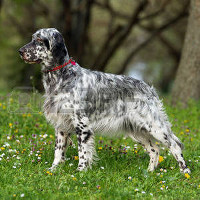
Of medium height, clean in outline, elegant in appearance and movement.

Behaviour / temperament

Very active with a keen game sense. Intensely friendly and good natured.

Head

Cranial region

Head
Carried high; long and reasonably lean.
Skull
Oval from ear to ear, showing plenty of brain room; occipital protuberance well-defined.
Stop
Well defined.

Facial region

Nose
Colour of nose black or liver, according to colour of coat. Nostrils wide.
Muzzle
Moderately deep and fairly square, from stop to point of nose should be equal to length of skull from occiput to eyes.
Lips
Not too pendulous.
Jaws and teeth
Jaws strong and of nearly equal length, with a perfect, regular and complete scissor bite, i.e. upper teeth closely overlapping the lower teeth and set square to the jaws. Full dentition desirable.
Eyes
Bright, mild and expressive. Colour ranging between hazel and dark brown, the darker the better. In liver beltons only, a lighter eye acceptable. Eyes oval and not protruding.
Ears
Moderate length, set on low, and hanging in neat folds close to cheek, tip velvety, upper part clothed in fine silky hair.

Neck

Rather long, muscular and lean, slightly arched at crest, and clean cut where it joins head, towards shoulder larger and very muscular, never throaty nor pendulous below throat, but elegant in appearance.

Body

Body
Moderate length.
Back
Short and level.
Loin
Wide, slightly arched, strong and muscular.
Chest
Deep in brisket, very good depth and width between shoulder blades. Ribs good round, widely sprung and deep in back ribs, i.e. well ribbed up.

Tail

Set almost in line with back, medium length, not reaching below hock, neither curly nor ropy, slightly curved or scimitar-shaped but with no tendency to turn upwards : flag or feathers hanging in long pendant flakes. Feather commencing slightly below the root, and increasing in length towards middle, then gradually tapering towards end; hair long, bright, soft and silky, wavy but not curly. Lively and slashing in movement and carried in a plane not higher than level of back.

Limbs

Forequarters

Shoulders
Well set back or oblique.
Elbows
Well let down close to body.
Forearm
Straight and very muscular with rounded bone.
Pastern
Short, strong, round and straight.
Forefeet
Well padded, tight, with close well arched toes protected by hair between them.

Hindquarters

Generality
Legs well muscled including second thigh. Long from hip to hock.
Upper thigh
Long.
Stifle
Well bent.
Hock
Inclining neither in nor out and well let down.
Hind feet
Well padded, tight, with close well arched toes protected by hair between them.

Gait and movement

Free and graceful action, suggesting speed and endurance. Free movement of the hock showing powerful drive from hindquarters. Viewed from rear, hip, stifle and hock joints in line. Head naturally high.

Coat

Hair
From back of head in line with ears slightly wavy, not curly, long and silky, as is coat generally, breeches and forelegs nearly down to feet well feathered.
Colour

Black and white (blue belton), orange and white (orange belton), lemon and white (lemon belton), liver and white (liver belton) or tricolour, that is blue belton and tan or liver belton and tan, those without heavy patches of colour on body but flecked (belton) all over preferable.
Any other colour or combination of colours unacceptable.

NOTE OF THE STANDARD COMMITTEE
« Belton » is the customary term used for the description of the distinctive coat-ticking of the English Setter. Belton is a village in Northumberland. This expression has been created and spread out by the book about the English Setter written by Mr. Edward Lavarack, breeder who has had a preponderant influence upon the actual appearance of the breed.

Size and weight

Height at withers
Dogs 65-68 cm (25,5-27 ins), bitches 61-65 cm (24-25,5 ins).

Faults

• Any departure from the foregoing points should be considered a fault and the seriousness with which the fault should be regarded should be in exact proportion to its degree and its effect upon the health and welfare of the dog and its ability to perform its traditional work.
• Faults listed should be in degree of seriousness.
 

Disqualifying faults

Aggressive or overly shy.

NB :

• Any dog clearly showing physical or behavioural abnormalities shall be disqualified.
• The above mentioned faults when occurring to a highly marked degree or frequently are disqualifying.
• Male animals should have two apparently normal testicles fully descended into the scrotum.
• Only functionally and clinically healthy dogs, with breed typical conformation should be used for breeding.


Additional information related to this breed English Setter

The modern English Setter breed was created in 1825 by a hunting enthusiast named Edward Laverack, who crossed a variety of old English spaniels, retrievers, mastiffs and setters with the intention of developing an all-around gundog, capable of both setting and retrieving a variety of game. From Laverack's stock and other working British hunting dogs, the English Setter evolved into a wonderful companion and worker that it is today. Easy to train, friendly and loving of children, this is an excellent family pet. However, some specimens can be prone to health issues, like blindness and skin allergies. Athletic, driven and very strong, the English Setter requires plenty of excercise and training. The coat is long, wavy and silky in texture, accepted in a variety of white-based colourings, usually with black, orange, yellow and liver markings. Average height is around 25 inches.

Detailed history

The Setters, and the English Setter in particular, have ancestral Oyster Dogs or Sitting Dogs. On the other side of the Channel, hunting dogs of this type were called "Setting Spaniels", before the term "Setters" was imposed. These words could come from the verb ta set, in its sense of being put in place, or freezing. Set is the stop, in English.

From any country, bird dogs, wading dogs, snares or guard dogs keep, and for a long time, the mystery surrounding their origin. No more than for our Spaniels, who were also Dogs of Oysels, it is impossible to say whether the Setters come from Spain or not. And the fact that the oldest British records of these dogs are after the hunting treaties of Gaston Phoebus and Henri de Ferrieres (published at the end of the 14th century) does not necessarily indicate that they are Spaniels of the continent.

What we can understand, however, is the process that led to the birth of the retrievers. The starting point was probably falconry. To be able to garnish their game birds' table, the medieval lords had to resort to a dog endowed with particular qualities. Instead of using a Greyhound to make the birds fly away, the raptor was added to a dog that could find, thanks to its flair, the hidden game. But to take partridge companies, it was no longer the falcon that needed: a leaded net was more effective. The dog was then asked to take the lying down, as much to avoid that he was hurt by the weights weighing the net that not to be embarrassed by his presence at the launch of the latter. In addition to the passion for hunting and a strong sense of flair, such a dog had to show some skill in training, because he had to learn to leave the hair and stop while lying down. The dog was born.

This receptivity to dressage is one of the oldest British Setter documents.

In 1485, a notarial act informs us that a certain John Harris, against the sum of ten shillings of money, agreed to take a board and train, for a period of six months, a "Setting Spaniel". It is also known that in 1555, Robbey Dudley, Duke of Northumberland, had dogs lying down.

Setters are also mentioned in the first treatises on dogs and hunting. Thus, Dr. Johannes Caius included them in his famous classification of dog breeds in the UK, in 1570. Hans Bols, in 1585, refers to its use in his book on hunting partridge.

Over the centuries, many varieties of these Setters were selected. They were not, properly speaking, distinct, well-defined races, but lineages raised by or for the great aristocrats. We could mention a good dozen, distinguished by their dress and the length of their hair. There were the Setters of Norworth Castle and Feather Castle, with thick, white and brown hair, reputed to be descended from a very old family raised by the Earl of Carlisle. Those of Lord Lovat were black and white or tricolor, thus distinguishing themselves from the dogs of Lord Seafield and the Earl of Southesk, with a white coat with orange or yellow spots. As for Lord Ossulton's Setters, they were known for their all-black livery, like those of the Count of Tankerville, while those of Mr. Lord had white spots. Other famous Setter lines were bred by Earl of Derby and Earl Anson. There were even some whites in Wales, and others with extremely rich hair, called Russian Setters, although their Russian nationality was not proven.

At the beginning of the nineteenth century, either because of excessive consanguinity or lack of selection, a certain number of these lines withered or were threatened with extinction. Without doubt, among those who managed to pass this difficult course, the cynophiles could have created several local breeds or regional Setters, as happened in the farnilleSpaniel. But in the case of the Setters, a certain Edward Laverack intervened.

. The reputation of this breeder was so great that one could call the English Setter "Setter Laverack". Even better, this denomination has crossed the borders and is still used today (but it is often restricted to only English setters wearing a blue belton dress.) This phenomenon is rather surprising, because the English Setter existed well before Laverack - it has just been to see - and perfected himself well after him: that is what we are going to examine.

For twenty years, from 1825 to 1845, Laverack searched for the best Setters, traveling all over the country. He also conducted many breeding trials, before settling on a very old lineage, saved by the Reverend A. Harrison, from whom he acquired two subjects, brother and sister: a male, Ponto, and a female, Old Moll. By pairing these two dogs and systematically resorting to close consanguinity, he created his own line (and not a breed), which became, after a decade of selection, very famous.

During the first dog shows, which were invented around 1860 for the sole purpose of comparing the merits of the best dogs, Laverack won a number of first prizes. And when, five years later, the first work trials, the field-trials, were developed, he continued to truster the awards. Laverack accumulated more than thirty titles of champion, which is all the more considerable as the competitions were much less numerous than today. Such hegemony had a great impact, and its Setters were wresting for gold, far beyond the borders of Great Britain.

Laverack was the first great breeder, and that is probably why his name was attached to the English Setter. But he never claimed to have created a new race. His book The Setters (1872) is explicit about this. He even admitted to having failed.

The merits of Laverack are immense. Indeed, it is him who fixed the English Setter in its modern type, that is to say a dog of high nose and quêtant quickly. However, as a breeder, he could no longer advance his lineage, which was probably close to extinction. At the same time, the beauty and work competitions had multiplied and had created a tremendous emulation among breeders of Setters and other breeds (the Pointer had at the same time acquired a great reputation). Moreover, the hunting of the pointer evolved: practiced in a more and more sporting optics, with more and more powerful weapons, on a game becoming scarce, it required specialized dogs in a very large search and conducted very actively, with olfactory qualities related to this speed.

Fortunately, another breeder, Purcell Llewelyn, would allow the English Setter to make another leap forward. His breeding, begun in 1869, took as base three Laverack subjects. Using other streams of blood without neglecting inbreeding, he managed to maintain the race at the top level. Finally, a third breeder worked in direct continuity with Llewelyn, when the latter ceased its activity in 1925: William Humphrey, who took over his breeding and made it last until 1964. As summarized by J.-M. Pilard, President of the French Race Club, "Laverack" set the English Setter, Llewelyn rescued him, Humphrey said. We are far enough from the Laverack myth.

This trilogy of great breeders proves that the destiny of the races is not similar to that of great fortunes (the grandfather creates it, the father keeps it, the son spends it). It also appears that a race of utility is in perpetual evolution: if one wants to definitively fix it, it dies. The most curious, in the case of the English Setter, is that its standard is fixed, in some ways, on the model of the dog of the beginning of the century! But we will come back to it.

It is certain, however, that to constantly want to be at the forefront of progress, a race can lose its identity and end up disappearing as inevitably as if it remains frozen. Thus, the English Setter, by conforming to the requirements of the races of speed that became the field-trials, could have become a long-haired Pointer. This danger does not date from yesterday, since, in an article published in 1889 in the magazine La Chasse Illustrée, Emile Frachon could write: "If I were allowed to make a reservation about the way in which are appreciated, in England and on the mainland, the qualities of the competitors, I would simply express regret at seeing speed become more and more important in the minds of judges and often eclipse other qualities of a more practical order. " . Some English Setters thus became higher on their legs at the same time as they lightened themselves, their ribcage grew heavier, their rich fur became poor, while the breed must be "close to the ground, dressed with magnificent silks. And shine by its endurance as well as its speed, that is to say, show a certain power.

Of course, the race was not long in establishing itself in France, from 1880. Its start was certainly a little hesitant, partly because several names referred to it: Setter Laverack, but also, for a moment, English Spaniel. Its success coincided with the appearance of the first field trials in France. Indeed, it is an English Setter, Prieffet Prince Fred, belonging to Mr. Grassal, who won the first such contest, organized in 1887 by the central canine society in Esclimont in the Oise, facing, in particular, several competitors British (who could still go to France because there was no quarantine back in Britain).

This success proves that the English dogs imported into our country were of excellent quality, and in the hands of connoisseurs, among whom we may mention the names of MM. Bellecroix, Gauthier, Mulard, Colombel; the best dogs were, notably, Royal Champion IV, Telamont, Sir Gilbert, Lord Tom, Royal Prince ...

If the English Setter was so quickly and firmly implanted, it was because he was a dog at once brilliant, fast, spectacular, the "gentleman of the dogs", and likely to hunt on very varied grounds ; plain, wood, swamp, without fatigue or fear of vegetation or bad weather. However, the supporters of the old French breeds did not fail to criticize the English Setter (while using it to regenerate several breeds of Spaniels), like other British breeds (and especially the Pointer). Very early, it seems that French hunters regretted the first Setters, more massive, so less swift and more enduring, corresponding more to their habits. We did not approve of the high awards given to the short-haired Setters who appear to be Pointers dressed in Setters.

The English Setter is no longer the Setter of the past, at least in its great majority, wrote Paul Mégnin in 1934. It is true that, at a certain moment, an unfortunate tendency to point the Setter developed: we saw heads with converging upper lines, more square shapes, dresses almost without fringes. This was due as much to crosses with the Pointer as to a genetic drift of the breed.

In the meantime, English specialists had split into two camps. Some, taking as models the classic Setter, the one that had defined Laverack in his book, had opted for a type of exhibitions, of good size, with very developed fringes, with a marked preference for uniformly speckled dresses (or note that this exhibition Setter benefits from a grooming). The others, trusting only the teachings of the field-trials, made the race evolve towards a clearly lightened, sporty, full of influx, of average size.

The French amateurs, faithful to the hunting vocation of the English Setter, stayed closer to this last category, while trying to preserve the characteristic power of the race (allowing its use in practical hunting). In France, there is only one type of English Setter, and this, thanks to a policy carried out with constancy and obstinacy by the various leaders of the French Club of the race: MM. Bordeau, Resnier, Guillaumin, Pilard. The spirit of the FCI standard, which is the translation of the English "beauty" standard, is respected, except in terms of measurements, where the French authorities recommend a size between 53 and 62 centimeters, whereas the ideal of the standard is between 61 and 58 centimeters. The partition of the race between two very different dogs, a dog very elegant but of a constitution not sporty and a dog excellent worker but with the model most often neglected, is, on the whole, avoided.

It may be useful to outline the "setter mechanics", which does not appear explicitly from the text of the standard. This ideal dog construction underpins the breed's distinctive appearance and style, which distinguishes it from all other breeds.

The English Setter must give the impression of a dog near the ground, with a body inscribed in a rectangle, of an animal in every respect solid, powerful, but by no means heavy. Its back is firm and horizontal, its thoracic cage very wide, in width (its perimeter, for a subject of 60 cm at the withers, must reach 75 cm) and in length (it is generally said depth). The kidney is very muscular, which makes it look almost as wide as it is long. But it is the conformation of the forearm that requires special attention: besides being heavily muscled, without being loaded, we find that the length of the arm is greater than that of the forearm. And that is what allows these grazing paces, called feline, peculiar to the race.

As for the style of the English Setter, it can be summed up in three expressions, corresponding to three phases of the hunt. A smooth and grazing gallop in the quest, a serpentine look when it perceives the emanations, a feline casting which follows a spectacular stop.

The English Setter is naturally a galler, but there is no trace of frenzy in him. His gallop, close to the ground, seems to be restrained, and the head is tense, revealing all the concentration of the animal in search of the emanation. As soon as he perceives the effluvium, he shaves the ground zigzagging, to locate it more precisely, and his pace stiffens as he gets closer to the game. Taking the judgment, he enters a second state, and, according to the consecrated expression, he "drinks" the emanation, he is hypnotized by it. Finally, after the hunter's order, he runs towards the prey, crawling with a really feline suppleness.

That the English Setter is super efficient and truly versatile no longer needs to be proven, as his service record is praiseworthy, both in hunting and competitions. But this dog offers a "plus", by its way, its incomparable style that makes vibrate the least emotional, most jaded hunters. It is a little symbol of the hunting dog of the future, a picture that a parenthesis about the current design of the hunt may explain better. Hunting, in its most noble, has nothing to do with the traditional Sunday walk or with the final painting. Become a sport, and more an art, it is not its conclusion that matters, but the intense pleasure of the search for a wild game in a preserved environment. Then arises, rid of all accessories, the man's predatory instinct, expressed and magnified by the action of the dog. Pure and profound aesthetic emotion for the hunter.

Of course, this feeling does not have so much to chance as to a real skill. To the knowledge of the game and hunting territories, it is necessary to join the ability to train a dog, that is to say, to understand and direct his instincts and his intelligence.

Comments

Latest page updates

  • Yorkshire Terrier

    Yorkshire Terrier FCI Standard No. 86 Origin Great Britain Group Group 3 Terriers Section Section 4 Toy Terriers Working Without working trial Date of acceptance on a definitive basis by the FCI Saturday 30 October 1954 Date of publication of the official valid standard Tuesday 08 September 2026 Date of the last update Tuesday 06 October 2026 En...
  • West Highland White Terrier

    West Highland White Terrier FCI Standard No. 85 Origin Great Britain Group Group 3 Terriers Section Section 2 Small-sized Terriers Working Without working trial Date of acceptance on a definitive basis by the FCI Friday 29 October 1954 Date of publication of the official valid standard Tuesday 08 September 2026 Date of the last update Tuesday 06...
  • Welsh Terrier

    Welsh Terrier FCI Standard No. 78 Origin Great Britain Group Group 3 Terriers Section Section 1 Large- and medium sized Terriers Working Without working trial Date of acceptance on a definitive basis by the FCI Saturday 23 October 1954 Date of publication of the official valid standard Tuesday 08 September 2026 Date of the last update Tuesday 06...
  • Welsh Springer Spaniel

    Welsh Springer Spaniel FCI Standard No. 126 Origin Great Britain Group Group 8 Retrievers-Flushing Dogs-Water Dogs Section Section 2 Flushing Dogs Working With working trial Date of acceptance on a definitive basis by the FCI Thursday 30 December 1954 Date of publication of the official valid standard Tuesday 08 September 2026 Date of the last...
  • Welsh Corgi Pembroke

    Welsh Corgi Pembroke FCI Standard No. 39 Origin Great Britain Group Group 1 Sheepdogs and Cattle Dogs (except Swiss Cattle Dogs) Section Section 2 Cattledogs (except Swiss Cattledogs) Working Without working trial Date of acceptance on a definitive basis by the FCI Wednesday 13 November 1963 Date of publication of the official valid standard Tuesday 08...
  • Welsh Corgi Cardigan

    Welsh Corgi Cardigan FCI Standard No. 38 Origin Great Britain Group Group 1 Sheepdogs and Cattle Dogs (except Swiss Cattle Dogs) Section Section 2 Cattledogs (except Swiss Cattledogs) Working Without working trial Date of acceptance on a definitive basis by the FCI Tuesday 12 November 1963 Date of publication of the official valid standard Tuesday 08...
  • Sussex Spaniel

    Sussex Spaniel FCI Standard No. 127 Origin Great Britain Group Group 8 Retrievers, Flushing dogs, Water dogs. Section Section 2 Flushing dogs Working With working trial Date of acceptance on a definitive basis by the FCI Friday 31 December 1954 Date of publication of the official valid standard Tuesday 08 September 2026 Date of the last update Tuesday 06...
  • Staffordshire Bull Terrier

    Staffordshire Bull Terrier FCI Standard No. 76 Origin Great Britain Group Group 3 Terriers Section Section 3 Bull type Terriers Working Without working trial Date of acceptance on a definitive basis by the FCI Thursday 21 October 1954 Date of publication of the official valid standard Tuesday 08 September 2026 Date of the last update Tuesday 06...
  • Skye Terrier

    Skye Terrier FCI Standard No. 75 Origin Great Britain Group Group 3 Terriers Section Section 2 Small-sized Terriers Working Without working trial Date of acceptance on a definitive basis by the FCI Wednesday 20 October 1954 Date of publication of the official valid standard Tuesday 08 September 2026 Date of the last update Tuesday 06 October 2026 En...
  • Shetland Sheepdog

    Shetland Sheepdog FCI Standard No. 88 Origin Great Britain Group Group 1 Sheepdogs and Cattle Dogs Section Section 1 Sheepdogs Working Without working trial Date of acceptance on a definitive basis by the FCI Tuesday 09 November 1954 Date of publication of the official valid standard Tuesday 08 September 2026 Date of the last update Tuesday 06...
  • Sealyham Terrier

    Sealyham Terrier FCI Standard No. 74 Origin Great Britain Group Group 3 Terriers Section Section 2 Small sized Terriers Working Without working trial Date of acceptance on a definitive basis by the FCI Tuesday 19 October 1954 Date of publication of the official valid standard Tuesday 08 September 2026 Date of the last update Tuesday 06 October...
  • Scottish Terrier

    Scottish Terrier FCI Standard No. 73 Origin Great Britain Group Group 3 Terriers Section Section 2 Small-sized Terriers Working Without working trial Date of acceptance on a definitive basis by the FCI Monday 18 October 1954 Date of publication of the official valid standard Tuesday 08 September 2026 Date of the last update Tuesday 06 October...
  • Old English Sheepdog (Bobtail)

      Old English Sheepdog (Bobtail) FCI Standard No. 16     Origin   Great Britain Group   Group 1 Sheepdogs and Cattle Dogs (except Swiss Cattle Dogs) Section   Section 1 Sheepdogs Working   Without working trial Date of acceptance on a definitive basis by the FCI   Monday 25 November 1963 Date of publication of the official valid standard   Tuesday 08 September...
  • Norwich Terrier

    Norwich Terrier FCI Standard No. 72 Origin Great Britain Group Group 3 Terriers Section Section 2 Small-sized Terriers Working Without working trial Date of acceptance on a definitive basis by the FCI Saturday 16 October 1954 Date of publication of the official valid standard Tuesday 08 September 2026 Date of the last update Tuesday 06 October...
  • Norfolk Terrier

    Norfolk Terrier FCI Standard No. 272 Origin Great Britain Group Group 3 Terriers Section Section 2 Small-sized Terriers Working Without working trial Date of acceptance on a definitive basis by the FCI Saturday 01 October 1966 Date of publication of the official valid standard Tuesday 08 September 2026 Date of the last update Tuesday 06 October...
  • Manchester Terrier

    Manchester Terrier FCI Standard No. 71 Origin Great Britain Group Group 3 Terriers Section Section 1 Large and medium sized Terriers Working Without working trial Date of acceptance on a definitive basis by the FCI Friday 15 October 1954 Date of publication of the official valid standard Tuesday 08 September 2026 Date of the last update Tuesday 06 October...
  • Lakeland Terrier

    Lakeland Terrier FCI Standard No. 70 Origin Great Britain Group Group 3 Terriers Section Section 1 Large and medium-sized Terriers Working Without working trial Date of acceptance on a definitive basis by the FCI Thursday 14 October 1954 Date of publication of the official valid standard Tuesday 08 September 2026 Date of the last update Tuesday 06 October...
  • Labrador Retriever

      Labrador Retriever FCI Standard No. 122     Origin   Canada Group   Group 8 Retrievers, Flushing dogs, Water dogs Section   Section 1 Retrievers Working   With working trial Date of acceptance on a definitive basis by the FCI   Friday 24 December 1954 Date of publication of the official valid standard   Tuesday 08 September 2026 Date of the last update   Tuesday 06...
  • King Charles Spaniel

    King Charles Spaniel FCI Standard No. 128 Origin Great Britain Group Group 9 Companion and Toy Dogs Section Section 7 English Toy Spaniels Working Without working trial Date of acceptance on a definitive basis by the FCI Monday 03 January 1955 Date of publication of the official valid standard Tuesday 08 September 2026 Date of the last update Tuesday 06...
  • Harrier

      Harrier FCI Standard No. 295     Origin   Great Britain Translation   Mrs. Peggy Davis, brought up to day by Dr. Paschoud Group   Group 6 Scenthounds and related breeds Section   Section 1.2 Medium-sized Hounds Working   With working trial Date of acceptance on a definitive basis by the FCI   Wednesday 27 November 1974 Date of publication of the official valid...
  • Greyhound

    Greyhound FCI Standard No. 158 Origin Great Britain Group Group 10 Sighthounds Section Section 3 Short-haired sighthounds Working Without working trial Date of acceptance on a definitive basis by the FCI Saturday 23 April 1955 Date of publication of the official valid standard Tuesday 08 September 2026 Date of the last update Tuesday 06 October...
  • Gordon Setter

    Gordon Setter FCI Standard No. 6 Origin Great Britain Group Group 7 Pointing Dogs Section Section 2.2 British and Irish Pointers and Setters; Setters Working With working trial Date of acceptance on a definitive basis by the FCI Tuesday 28 May 1963 Date of publication of the official valid standard Tuesday 08 September 2026 Date of the last...
  • Golden Retriever

    Golden Retriever FCI Standard No. 111 Origin Great Britain Group Group 8 Retrievers, Flushing Dogs, Water Dogs Section Section 1 Retrievers Working With working trial Date of acceptance on a definitive basis by the FCI Thursday 02 December 1954 Date of publication of the official valid standard Tuesday 28 July 2009 Date of the last update Wednesday...
  • Fox Terrier Wire

    Fox Terrier Wire FCI Standard No. 169 Origin Great Britain Group Group 3 Terriers Section Section 1 Large and medium-sized Terriers Working Working trial optional Date of acceptance on a definitive basis by the FCI Friday 13 May 1955 Date of publication of the official valid standard Tuesday 08 September 2026 Date of the last update Tuesday 06...
  • Fox Terrier Smooth

    Fox Terrier Smooth FCI Standard No. 12 Origin Great Britain Group Group Terriers Section Section 1 Large and medium sized Terriers Working Working trial optional Date of acceptance on a definitive basis by the FCI Wednesday 26 June 1963 Date of publication of the official valid standard Tuesday 08 September 2026 Date of the last update Tuesday 06...
  • Flat Coated Retriever

    Flat Coated Retriever FCI Standard No. 121 Origin Great Britain Group Group 8 Retrievers-Flushing Dogs-Water Dogs Section Section 1 Retrievers Working With working trial Date of acceptance on a definitive basis by the FCI Thursday 23 December 1954 Date of publication of the official valid standard Tuesday 08 September 2026 Date of the last update Tuesday...
  • Field Spaniel

    Field Spaniel FCI Standard No. 123 Origin Great-Britain Group Group 8 Retrievers, Flushing Dogs, Water Dogs Section Section 2 Flushing Dogs Working With working trial Date of acceptance on a definitive basis by the FCI Monday 27 December 1954 Date of publication of the official valid standard Tuesday 08 September 2026 Date of the last update Tuesday...
  • English Toy Terrier

    English Toy Terrier FCI Standard No. 13 Origin Great Britain Group Group 3 Terriers Section Section 4 Toy Terriers Working Without working trial Date of acceptance on a definitive basis by the FCI Tuesday 17 September 1963 Date of publication of the official valid standard Tuesday 08 September 2026 Date of the last update Tuesday 06 October 2026 En...
  • English Springer Spaniel

    English Springer Spaniel FCI Standard No. 125 Origin Great Britain Group Group 8 Retrievers-Flushing Dogs-Water Dogs Section Section 2 Flushing Dogs Working With working trial Date of acceptance on a definitive basis by the FCI Wednesday 29 December 1954 Date of publication of the official valid standard Tuesday 08 September 2026 Date of the last...
  • English Pointer

    English Pointer FCI Standard No. 1 Origin Great Britain Group Group 7 Pointing Dogs Section Section 2.1 British and Irish Pointers and Setters, Pointer Working With working trial Date of acceptance on a definitive basis by the FCI Tuesday 05 March 1963 Date of publication of the official valid standard Tuesday 08 September 2026 Date of the last...
  • English Foxhound

    English Foxhound FCI Standard No. 159 Origin Great Britain Group Group 6 Scenthounds and related breeds Section Section 1.1 Large-sized Scent hounds Working With working trial Date of acceptance on a definitive basis by the FCI Monday 25 April 1955 Date of publication of the official valid standard Thursday 26 March 2009 Date of the last update Wednesday...
  • English Cocker Spaniel

    English Cocker Spaniel FCI Standard No. 5 Origin Great Britain Group Group 8 Retrievers, Flushing Dogs, Water Dogs Section Section 2 Flushing dogs Working With working trial Date of acceptance on a definitive basis by the FCI Wednesday 10 April 1963 Date of publication of the official valid standard Tuesday 08 September 2026 Date of the last...
  • Tibetan Mastiff

    Tibetan Mastiff FCI Standard No. 230 Origin Tibet (China)Patronage FCI Group Group 2 Pinscher and Schnauzer- Molossoid breeds- Swiss Mountain and Cattle Dogs Section Section 2.2 Molossoid breeds, Mountain type Working Without working trial Date of acceptance on a definitive basis by the FCI Tuesday 22 August 1961 Date of publication of the...
  • Deerhound

    Deerhound FCI Standard No. 164 Origin Great Britain Group Group 10 Sighthounds Section Section 2 Rough-haired Sighthounds Working Without working trial Date of acceptance on a definitive basis by the FCI Friday 29 April 1955 Date of publication of the official valid standard Tuesday 08 September 2026 Date of the last update Tuesday 06 October...
  • Dandie Dinmont Terrier

    Dandie Dinmont Terrier FCI Standard No. 168 Origin Great Britain Group Group 3 Terriers Section Section 2 Small-sized Terriers Working Without working trial Date of acceptance on a definitive basis by the FCI Thursday 12 May 1955 Date of publication of the official valid standard Tuesday 08 September 2026 Date of the last update Tuesday 06...
  • Curly Coated Retriever

    Curly Coated Retriever FCI Standard No. 110 Origin Great Britain Group Group 8 Retrievers, Flushing Dogs, Water Dogs Section Section 1 Retrievers Working With working trial Date of acceptance on a definitive basis by the FCI Friday 10 December 1954 Date of publication of the official valid standard Tuesday 08 September 2026 Date of the last...
  • Collie Smooth

    Collie Smooth FCI Standard No. 296 Origin Great Britain Group Group 1 Sheepdogs and Cattle Dogs (except Swiss Cattle Dogs) Section Section 1 Sheepdogs Working Without working trial Date of acceptance on a definitive basis by the FCI Wednesday 18 December 1974 Date of publication of the official valid standard Tuesday 08 September 2026 Date of the...
  • Collie Rough

    Collie Rough FCI Standard No. 156 Origin Great Britain Group Group 1 Sheepdogs and Cattle Dogs (except Swiss Cattle Dogs) Section Section 1 Sheepdogs Working Without working trial Date of acceptance on a definitive basis by the FCI Wednesday 13 April 1955 Date of publication of the official valid standard Tuesday 08 September 2026 Date of the...
  • Clumber Spaniel

    Clumber Spaniel FCI Standard No. 109 Origin Great Britain Group Group 8 Retrievers, Flushing dogs, Water dogs Section Section 2 Flushing dogs Working With working trial Date of acceptance on a definitive basis by the FCI Thursday 09 December 1954 Date of publication of the official valid standard Tuesday 08 September 2026 Date of the last update Tuesday...
  • Chow Chow

    Chow Chow FCI Standard No. 205 Origin China, patronage : Great Britain Group Group 5 Spitz and primitive type Section Section 5 Asian Spitz and related breeds Working Without working trial Date of acceptance on a definitive basis by the FCI Tuesday 10 December 1957 Date of publication of the official valid standard Tuesday 08 September 2026 Date...
  • Chinese Crested Dog

    Chinese Crested Dog FCI Standard No. 288 Origin China, patronage Great Britain Group Group 9 Companion and Toy Dogs Section Section 4 Hairless breeds Working Without working trial Date of acceptance on a definitive basis by the FCI Monday 17 July 1972 Date of publication of the official valid standard Tuesday 08 September 2026 Date of the last...
  • Cairn Terrier

    Cairn Terrier FCI Standard No. 4 Origin Great Britain Group Group 3 Terriers Section Section 2 Small-sized Terriers Working Without working trial Date of acceptance on a definitive basis by the FCI Saturday 06 April 1963 Date of publication of the official valid standard Tuesday 08 September 2026 Date of the last update Tuesday 06 October 2026 En...
  • Bullmastiff

    Bullmastiff FCI Standard No. 157 Origin Great Britain Group Group 2 Pinscher and Schnauzer Molossoid breeds - Swiss Mountain and Cattle Dogs Section Section 2.1 Molossoid breeds, Mastiff Type Working Without working trial Date of acceptance on a definitive basis by the FCI Saturday 23 April 1955 Date of publication of the official valid standard Tuesday...
  • English Bulldog

    English Bulldog FCI Standard No. 149 Origin Great Britain Group Group 2 Pinscher and Schnauzer Molossoid breeds-Swiss Mountain and Cattle Dogs Section Section 2.1 Molossoid breeds, Mastiff Type Working Without working trial Date of acceptance on a definitive basis by the FCI Monday 14 March 1955 Date of publication of the official valid standard Tuesday...
  • Bull Terrier

    Bull Terrier FCI Standard No. 11 Origin Grande-Bretagne Group Group 3 Terriers Section Section 3 Bull type Terriers Working Working trial optional Date of acceptance on a definitive basis by the FCI Saturday 26 June 1993 Date of publication of the official valid standard Tuesday 08 September 2026 Date of the last update Tuesday 06 October 2026 En...
  • Border Terrier

    Border Terrier FCI Standard No. 10 Origin Great Britain Group Group 3 Terriers Section Section 1 Large and medium-sized terriers Working Without working trial Date of acceptance on a definitive basis by the FCI Wednesday 26 June 1963 Date of publication of the official valid standard Tuesday 08 September 2026 Date of the last update Tuesday 06...
  • Bedlington Terrier

    Bedlington Terrier FCI Standard No. 9 Origin Great Britain Group Group 3 Terriers Section Section 1 Large and medium sized Terriers Working Without working trial Date of acceptance on a definitive basis by the FCI Thursday 20 June 1963 Date of publication of the official valid standard Tuesday 08 September 2026 Date of the last update Tuesday 06...
  • Bearded Collie

    Bearded Collie FCI Standard No. 271 Origin Great-Britain Group Group 1 Sheepdogs and Cattle Dogs (except Swiss Cattle Dogs) Section Section 1 Sheepdogs Working Without working trial Date of acceptance on a definitive basis by the FCI Wednesday 30 August 1967 Date of publication of the official valid standard Tuesday 08 September 2026 Date of the...
  • Beagle

    Beagle FCI Standard No. 161 Origin Great Britain Translation Prof. R. Triquet Group Group 6 Scent hounds and related breeds Section Section 1.3 Small-sized hounds Date of acceptance on a definitive basis by the FCI Tuesday 26 April 1955 Date of publication of the official valid standard Tuesday 08 September 2026 Date of the last update Tuesday 06...
  • Basset Hound

    Basset Hound FCI Standard No. 163 Origin Great Britain Group Group 6 Scent hounds and related breeds Section Section 1.3 Small-sized hounds Working With working trial Date of acceptance on a definitive basis by the FCI Thursday 28 April 1955 Date of publication of the official valid standard Tuesday 08 September 2026 Date of the last update Tuesday...
  • Basenji

    Basenji FCI Standard No. 43 Origin Democratic Republic of Congo, under the patronage of Great Britain Group Group 5 Spitz and primitive types Section Section 6 Primitive type Working Without working trial Date of acceptance on a definitive basis by the FCI Thursday 26 March 1964 Date of publication of the official valid standard Tuesday 08...
  • Airedale Terrier

    Airedale Terrier FCI Standard No. 7 Origin Great Britain Group Group 3 Terriers Section Section 1 Large and medium sized Terriers Working Working trial optional Date of acceptance on a definitive basis by the FCI Tuesday 28 May 1963 Date of publication of the official valid standard Tuesday 08 September 2026 Date of the last update Tuesday 06...
  • Afghan Hound

    Afghan Hound FCI Standard No. 228 Origin AfghanistanPatronage Great Britain Group Group 10 Sighthounds Section Section 1 Long-haired or fringed sighthounds Working Without working trial Date of acceptance on a definitive basis by the FCI Tuesday 12 December 1961 Date of publication of the official valid standard Tuesday 08 September 2026 Date of the...
  • Romagna Water Dog

    Romagna Water Dog FCI Standard No. 298 Origin Italy Translation Antonio Morsiani, Renée Sporre-Willes and Prof. R. TriquetRevised by ENCI and Renée Sporre-WillesRevised by the FCI Head OfficeOfficial language (EN). Group Group 8 Retrievers –Flushing Dogs –Water Dogs Section Section 3 Water Dogs Working Working trial optional Date of acceptance on a...
  • Whippet

    Whippet FCI Standard No. 162 Origin Great Britain Group Group 10 Sighthounds Section Section 3 Short-haired Sighthounds Working Without working trial Date of acceptance on a definitive basis by the FCI Wednesday 27 April 1955 Date of publication of the official valid standard Tuesday 08 September 2026 Date of the last update Tuesday 06 October...
  • Tibetan Terrier

    Tibetan Terrier FCI Standard No. 209 Origin Tibet, patronage Great Britain Group Group 9 Companion and Toy Dogs Section Section 5 Tibetan breeds Working Without working trial Date of acceptance on a definitive basis by the FCI Wednesday 18 December 1957 Date of publication of the official valid standard Tuesday 08 September 2026 Date of the last...
  • Tibetan Spaniel

    Tibetan Spaniel FCI Standard No. 231 Origin Tibet (China)Patronage Great Britain Group Group 9 Companion and Toy Dogs Section Section 5 Tibetan breeds Working Without working trial Date of acceptance on a definitive basis by the FCI Tuesday 22 August 1961 Date of publication of the official valid standard Tuesday 08 September 2026 Date of the...
  • Shih Tzu

    Shih Tzu FCI Standard No. 208 Origin Tibet, patronage Great Britain Group Group 9 Companion and Toy Dogs Section Section 5 Tibetan breeds Working Without working trial Date of acceptance on a definitive basis by the FCI Monday 16 December 1957 Date of publication of the official valid standard Tuesday 08 September 2026 Date of the last update Tuesday 06...
  • Pug

    Pug FCI Standard No. 253 Origin China, patronage Great Britain Group Group 9 Companion and Toy Dogs Section Section 11 Small Molossian type dogs Working Without working trial Date of acceptance on a definitive basis by the FCI Friday 04 November 1966 Date of publication of the official valid standard Tuesday 08 September 2026 Date of the last...
  • Pharaoh Hound

    Pharaoh Hound FCI Standard No. 248 Origin Malta, patronage Great Britain Group Group 5 Spitz and primitive types Section Section 6 Primitive type Working Without working trial Date of acceptance on a definitive basis by the FCI Friday 09 August 1963 Date of publication of the official valid standard Tuesday 08 September 2026 Date of the last...
  • Pekingese

    Pekingese FCI Standard No. 207 Origin China, patronage Great Britain Group Group 9 Companion and Toy Dogs Section Section 8 Japan Chin and Pekingese Working Without working trial Date of acceptance on a definitive basis by the FCI Thursday 03 November 1966 Date of publication of the official valid standard Tuesday 08 September 2026 Date of the last...
  • Parson Russell Terrier

    Parson Russell Terrier FCI Standard No. 339 Origin Great Britain Group Group 3 Terriers Section Section 1 Large and medium sized Terriers Working Working trial optional Date of acceptance on a definitive basis by the FCI Monday 04 June 2001 Date of acceptance on a provisional basis by the FCI Monday 02 July 1990 Date of publication of the...
  • Otterhound

    Otterhound FCI Standard No. 294 Origin Great Britain Group Group 6 Scenthounds and related breeds Section Section 1.1 Large-sized hounds Working Without working trial Date of acceptance on a definitive basis by the FCI Thursday 12 September 1974 Date of publication of the official valid standard Tuesday 08 September 2026 Date of the last update Tuesday 06...
  • Miniature Bull Terrier

    Miniature Bull Terrier FCI Standard No. 359 Origin Grande-Bretagne Group Group 3 Terriers Section Section 3 Bull type Terriers Working Working trial optional Date of acceptance on a definitive basis by the FCI Tuesday 05 July 2011 Date of acceptance on a provisional basis by the FCI Tuesday 05 July 2011 Date of publication of the official valid...
  • Mastiff

    Mastiff FCI Standard No. 264 Origin Great Britain Group Group 2 Pinscher and Schnauzer – Molossoid breeds - Swiss Mountain and Cattle Dogs Section Section 2.1 Molossoid breeds, Mastiff Type Working Without working trial Date of acceptance on a definitive basis by the FCI Thursday 05 November 1964 Date of publication of the official valid standard Tuesday 08...
  • Lhassa Apso

    Lhassa Apso FCI Standard No. 227 Origin Tibet (China)Patronage Great Britain Group Group 9 Companion and Toy Dogs Section Section 5 Tibetan breeds Working Without working trial Date of acceptance on a definitive basis by the FCI Saturday 19 November 1960 Date of publication of the official valid standard Tuesday 08 September 2026 Date of the last...
  • Lancashire-Heeler

    Lancashire-Heeler FCI Standard No. 360 Origin England, patronage : FCI Group Group 1 Sheepdogs and Cattle Dogs (except Swiss Cattle Dogs) Section Section 1 Sheepdogs Working Without working trial Date of acceptance on a provisional basis by the FCI Sunday 01 May 2016 Date of publication of the official valid standard Tuesday 08 September 2026 Date...

© 2026 Groupe Milouchouchou ASBL. Tous droits réservés. En savoir plus

Protected by Copyright01
