
 |
Welsh Shepherd Dog |
|
He is not recognized by the F.C.I. |
Origin |
Great Britain | |
Translation |
Francis Vandersteen | |
This breed is also known as |
Welsh Collie
|
A brief presentation of the Welsh Shepherd Dog |
| The Welsh Shepherd Dog is a rare breed that has existed in one form or another for at least 800 years. Kept almost exclusively as a working dog, little effort has been made to standardize the breed, its ability to herd being far more important to its owners than its looks. In general, most dogs closely resemble the more popular and infallible Border Collie, although the average Welsh Sheepdog is a sturdier, taller, broader and stronger dog. It was traditionally used as a carriage dog, although it can also act as a guard dog in times of need. If kept as a pet, the breed responds best to an experienced, assertive owner who does not allow the dog's highly independent nature to run unchecked, as this extremely intelligent breed is capable of learning all the wrong things if its energy is not disciplinedly channeled into activity. They require a lot of exercise and should not be considered suitable for indoor living. The Welsh Shepherd Dog can be a wonderfully responsive companion, but it is difficult to provide sufficient stimulation when kept as a pet. They suffer from some of the problems common to other herding breeds, but are generally very healthy and have a life expectancy of 12 to 14 years. |
History of the Welsh Shepherd Dog |
| No definitive written history exists for the breed, and its origins are rather hazy. However, many believe that an ancient Welsh hunting dog, known as a hound, or gellgi, kept by Welsh nobles for use in hunting may have been part of the breed's foundation. In Welsh legal manuscripts dating from the 13th century, mention is made of a sheepdog that also herded cattle, which may refer to the Welsh Sheepdog, although many types of dog were used on farms in the region for hundreds of years and there is no way of knowing which type of dog it was or from which type the modern breed was derived. It was used to both herd and protect various types of livestock, most often sheep, although sometimes cattle, pigs and poultry. Having a group of guard dogs on hand would also have been invaluable for farmers' security, as thieves and bandits were almost as numerous as the farmers themselves. From the 18th century onwards, changes in farming practices meant that the role of the Welsh Shepherd also changed, forcing him to work as a cattle dog, driving cattle and sheep over great distances, sometimes hundreds of miles, to reach the important English trading markets. Due to the large number of animals being moved in this way at any given time, the dogs had to be ever vigilant and able to work with or without direction, sometimes a long way from their master. The breed's working style is suited to this role; it is said to be blurry-eyed, meaning that its gaze wanders over the whole scene around it, rather than the fixed eye seen in the Border Collie, which focuses on one animal or a group of animals with great intensity when working. The more recent decline in displacement, coupled with the widespread introduction of sheepdog trials, at which the Border Collie excels, has ultimately led to a significant reduction in the popularity of the Welsh Shepherd, and although it may be considered the more versatile of the two breeds, it seems likely that this decline in its fortunes has led to a cross between the increasingly rare Welsh breed and its more popular successor. As such, we don't know how faithful the modern Welsh Shepherd remains to its ancestors, but it clearly remains a distinct entity, whose characteristics can be traced back to its ancestors. |
Appearance of the Welsh Shepherd Dog |
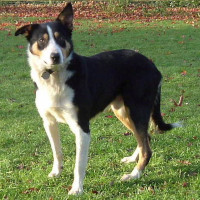
| If what follows is a general description of the breed, it should be stressed once again that appearance is of very minor importance to the Welsh Shepherd Dog fraternity. The Welsh Shepherd is, and always has been, a working dog, and is judged on ability and temperament above any physical characteristics. In general, its shape and coloring resemble those of a large Border Collie, although its coat is often a little shorter. Although the head is generally collie-shaped, it is fairly broad and flat between the ears, and the moderate stop leads to a broad, strong muzzle. The jaw is also fairly wide, with a bone structure that can withstand a blow from small cattle. The lips are tight and clean, and the nose is generally black. The eyes are medium-sized and oval-shaped. They are generally brown, although merle-colored dogs can have very light or striking blue irises. The ears vary from medium to large and are set fairly high on the head. They are generally held upright, although their tips are bent. The dog's body shape is that of an athlete, with a well-muscled, broad neck and back, and a well-set croup that leads to a moderately long tail with an ascending curve. The chest is large, reasonably deep and very broad, and the abdomen is firm and tucked up. Welsh Sheepdogs have fairly long legs, with moderately angulated to well erect limbs, well boned on the lower legs and muscular on the shoulders and thighs. Its well arched toes rest on sturdy oval legs, well adapted to rugged terrain. Coat length varies from short to medium, and can be coarse or soft. Many different color combinations are seen, the following being the most common: black and white, red and white, and robin. The red and white marking pattern is thought to be more faithful to the Welsh sheepdogs of yesteryear, as there are several references to red and white dogs in 17th and 18th century writings. Although they also vary greatly in size, the average Welsh Sheepdog is around 56 cm in height and can weigh between 18 and 25 kg, with females being smaller, around 50 cm in height and 16 to 23 kg. |
Temperament of the Welsh Shepherd Dog |
| The breed is highly intelligent and inquisitive, and always seems to be one step ahead of its owners, anticipating their next move. As a farm dog, they're always ready to start their next job, and are happiest when they're busy. As a pet, he also needs to be assigned a job, whether it's raising the family chickens in the garden or picking up dirty laundry around the house. He quickly becomes bored without adequate stimulation, often leading to complaints of destructive behavior. The Welsh Shepherd Dog is a natural protector, and will be quick to raise the alarm if he hears any suspicious activity in or around the house. However, the breed can also develop aggressive tendencies towards strangers and requires a lot of socialization and correction if necessary. With an inexperienced owner, it's the dog that's likely to have the upper hand in the relationship, as it's an assertive and independent breed, and not a good choice for a family with young children, as it can be quick to show, and use, its teeth when hurt. However, the breed's strong personality can also be an asset in the right hands, and owners with the experience, time and energy to devote to their dog may find the Welsh Shepherd a rewarding breed to own. |
Needs and activities of the Welsh Shepherd Dog |
| The Welsh Shepherd Dog is a working dog through and through. They are at their best when they have a job to do. Pure energy runs through their veins, which is why they are ideal in a rural environment where they can work the land or at least be taken for long walks. Because of their willingness to please, they are ideal dogs to train. They follow commands well, but have the ability to make decisions for themselves if their owner isn't around. The Welsh Shepherd Dog can be a bit strong-willed and savvy and is best with an experienced owner who can manage this dog. Without guidance, this dog can become strong-willed and self-important. Keep an eye on this energy in a fair but firm manner. They'd love to run alongside you or your bike, walk for hours, whatever the weather, and are great at gently herding your children. Their benevolent nature makes them ideal for a family, but once again, keep this dog busy so he can be at his best. |
Maintenance of the Welsh Shepherd Dog |
| The Welsh Shepherd Dog is a working dog, they love to be given a job and just want to get on with it. They don't have time for grooming, they can't wait to get going. Therefore, a little more than a good weekly brushing is all that's needed to prevent matting of the coat, especially on the long-haired varieties. This dog doesn't need to be bathed, especially if it's a working dog, as it tends to take care of itself. Wet grass, rain showers and stream crossings will take care of the coat. If you need to wash them to remove dirt and mud, use a very mild dog shampoo to protect the natural oils in the coat, which will help them cope with the elements. You should check your active dog for parasites such as ticks and fleas, especially around the ears. Gently wipe the inside of the ear to avoid the build-up of dirt and wax that can cause inflammation. Whether they're a pet or a working dog, they need to be trained to sit quietly, let their teeth be brushed and their nails clipped. Then set that impatient beaver free to return to work or a hunting trip. |



 English (United Kingdom)

Comments