
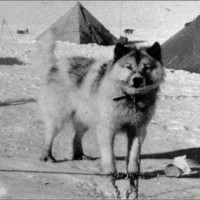
 |
Argentine polar dog |
|
He is not recognized by the F.C.I. |
Origin |
Argentina | |
Translation |
Francis Vandersteen |
| The Argentine polar dog (perro polar argentino) was a breed of Argentine dog that is now extinct. Argentine polar dogs were developed by the Argentine army to provide sled dogs for their Antarctic bases. The breed was the result of a cross between a Siberian Husky, a Greenland Dog, an Alaskan Malamute and a Manchurian Spitz. However, the breed became extinct in 1994 when it was moved out of Antarctica under the Protocol on Environmental Protection to the Antarctic Treaty (PEPAT). The need to travel quickly, cheaply and safely to Antarctica prompted a team of over thirty Argentine army NCOs, led by Hector Martin and Felix Daza Rodriguez, to develop a breed of dog that could carry heavy loads over long distances, was easy to breed and maintain, and could perform operational functions similar to those of mechanical tracked transports. The Argentine Polar Dog is descended from the main Arctic dog breeds. Forming its genetic base and stabilizing its standards took 31 years of military work. Specially trained for walking or mushing with sledges, these dogs glide easily over snowy or icy surfaces. With the identification of Argentina as a bicontinental country, the exploration and conquest of Antarctica began in the 1950s, and with it came the desire to reach the South Pole. General Hernán Pujato brought the first sled dogs from Alaska and Greenland, thus beginning the crossings. Argentina's polar dogs are protected from low temperatures by their triple layer of wool, hair and undercoat, plus a 2 cm-thick layer of subcutaneous fat. The dogs had four sharp canine teeth or fangs in their mouths that tore, incisors that enabled them to cut and molars to grind. This enabled the dogs to tear flesh easily. The Argentine Polar Dogs' sled tractor capacity was twice that of any other dog. A group of 11 Argentine Polar Dogs could pull a loaded sled weighing 1.1 tons (1,000 kg) at 35 km/h on flat ground and 50 km/h downhill, in both cases without rest for 6 hours at a time. The dogs' normal working temperature was -70°C. It has been documented that they were visiting and quietly waiting outside the Soviet Vostok station on the day the world record was set (-89.2° C, or -128.6° F). Argentina's polar dogs have the vital function of helping soldiers to avoid cracks and death traps in the ice, and to detect them when nothing else allows. They also had a good sense of direction and were reliable in rescue operations, even during major storms. The dogs were able to move quickly and easily over unconsolidated roads or thin ice sheets unable to support the weight of motorized tractors. Argentinian polar dogs were fed once a day (twice as often as Siberian Huskies), but they were highly valued because their maintenance costs were far lower than the fuel costs of diesel tractors carrying the same loads. Argentinian polar dogs were not given water to drink, as they were able to drink snow. The first food brought by Hernán Pujato to start the race was pemmican, a tablet prepared with powdered meat, fat and cereals containing beef protein, calories from fat and vitamins from various berries. The advantage of using pemmican food concentrate was that it could be stored for long periods without taking up much space. The inhabitants of Argentine Antarctic bases at the time mixed the food with leftover meat, enabling the Argentine polar dog to grow stronger and larger than its original breeds. By 1967, Argentine polar dogs had adapted to the cold temperatures of Antarctica and began to reject the pemmican whose formula had changed. Before the possibility of rejection and weight loss, the dogs began to be fed a more conventional food in its premium version. This was transported in twenty-kilogram bags, which were stored in sheds until needed. However, leftover human food continued to be mixed in. Veterinarians and doctors at Antarctic bases were responsible for delivering or injuring dogs. The main cause of death in Argentine Polar Dogs was fighting, due to their breed's aggressiveness towards their peers. The average weight of Argentine polar dogs was 60 kilograms, that of Argentine polar bitches 52 kilograms. Argentine polar dogs could be sacrificed and used as food for humans, or the dogs as a means of survival. |



 English (United Kingdom)
Comments