 |
Snowshoe |
|
TranslationFrancis Vandersteen |
||
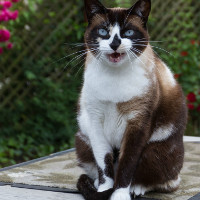
OriginThe Snowshoe is a breed of cat that originated in the United States. |
| This cat is a cross between a Siamese and an American shorthair. |
A brief historical overview |
| In the 1960s, Philadelphia breeder Dorothy Hinds-Daugherty created this cat breed. She wanted to create white-footed Siamese, as she had seen in old Victorian photographs. To achieve this, she crossed moderate-type Siamese with a bicolor American shorthair and then with a Sacred Birman. She named this new breed “Snowshoe”, and it was recognized by The International Cat Association (TICA) in the 1980s. In France, the first litter was born in 2006 by breeder Vanille Mazuel. This is a breed that is still rare, despite the small increase in numbers in the United States. There are very few living in Europe. |
Behavior / characteristics |
| Character traits, however, are entirely individual and depend above all on the history of each cat, whatever the breed. They are not described in standards, but are temperaments generally observed in the breed. The Snowshoe is described as a loyal cat, very attached to its owner, but not as exclusive as the Siamese. The Snowshoe is said to be lively, with a strong character. It is also intelligent and adaptable. This strong-tempered, extremely lively cat is a good hunter. Sociable, it gets on well with other cats and dogs. Playful, it is an excellent companion for children. They are gentle and very affectionate with their owners. Less demanding than the Siamese, they are more talkative than the American Shorthair. |
Head |
||
Cranial region |
||
Head |
Shaped like an equilateral triangle, the head has rounded contours. From the front, the space between the ears appears flat. | |
Facial region |
||
Forehead |
In profile, the forehead is straight and extends into a slight dip at the nose. The nose, of medium width, is usually straight. A small bump is acceptable. | |
Muzzle |
Of medium length, the muzzle is rounded with a slight pinch. | |
Chin |
The chin is strong. | |
Cheeks |
The cheekbones are high, and the bone structure should be visible, even in adult males with more developed cheeks. | |
Eyes |
Fairly large, the eyes are oval to round in shape. They are slightly slanted without being oriental. All shades of blue are acceptable. | |
Ears |
Of medium size and set in line with the triangle of the head, the ears are moderately wide at the base. The tips are rounded. | |
Neck |
| Of medium length, the neck is strong and muscular. |
Body |
||
Generality |
Of semi-foreign type, the body is harmonious and muscular. Dense, it appears lighter than it actually is. Females are smaller and lighter than males. | |
Tail |
| Of medium length, the tail is fairly thick at the base and tapers slightly to the tip. |
Limbs |
| The legs are quite long, with relatively fine bones but well-developed musculature. | ||
Forequarters |
Hindquarters |
Feet |
| Feet are oval-shaped and well-proportioned to the body. |
Coat |
||
Coat and texture |
Short to medium-short, the fur is soft and silky. Dense, it is not close to the body. | |
Patterns |
Two marking patterns are accepted: mitted and bicolor. Mitted Bicolor |
|
Tolerances |
| As with all colorpoints, the body color darkens with age.Significant shading or contrast with the white markings should not be penalized in mature cats.Ghost tabby markings are tolerated in kittens. Seasonal variations are acceptable without penalizing the cat. |
Penalties |
 Fully colored feet. Plush, double, long, or woolly fur. Non-compliance with mitted and bicolor patterns. Massive or oriental body. Fully colored feet. Plush, double, long, or woolly fur. Non-compliance with mitted and bicolor patterns. Massive or oriental body. |
Refusal of any title |
| Non-parti-colored cat. Eyes of a color other than blue. General faults and defects that disqualify it from showing. |
Authorized marriages |
| Despite the cat's rarity, breeding with other breeds is not permitted. This is because most of the Snowshoe's specific characteristics are due to recessive genes, which can only be expressed if present on both chromosomes. As each parent gives a chromosome to the new being, both must be Snowshoes. |



 English (United Kingdom)

Comments