Kuri

He is not recognized by the F.C.I.

Origin
New Zealand, between "Waikava" & Mataura plains, Catlins
Translation
Francis Vandersteen
This breed is also known as
Maori dog
Kurī, or Pacific dog, were a unique breed, brought to Aotearoa New Zealand by ancestors of Māori. These animals were prized – not necessarily as friends, but as valuable provisions. The meat was a delicacy, the pelts made into cloaks that could only be worn by rangatira (leaders), the teeth fashioned into ornaments, and the bones made into matau (fishhooks).

They even appear in early Māori art, in charcoal-rendered drawings found on rock overhangs in the South Island. Early Europeans settlers recognised them as a distinct breed.

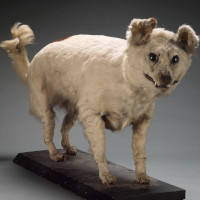
Europeans also brought their own breeds of dog and this spelled the end of the kurī. Interbreeding meant that kurī eventually no longer existed as a separate breed. Many were also shot by early run holders to protect livestock. This kurī was shot along with her pup by a farmer in 1867, and is one of only a few taxidermised kurī in existence, therefore a valuable record. Its poor condition is due to the fact that some time had elapsed between the animal being killed and it being mounted. Her pup was sent to the British Museum.

From the journal Transactions of the New Zealand Institute; vol 9; 1876 :

"A bitch and full- grown pup were known for several years in the densely wooded country between Waikava [Waikawa] and the Mataura plains, and did great damage among the flocks of sheep, but exhibited such cunning and daring that it was not till after hunting them for two years that they were shot by Mr Anderson, who presented them to the Colonial Museum. Of the smaller specimen both skin and skeleton were taken to the British Museum by Sir Grey, and the skin of the mother was preserved here, and has been recognized by many old Māoris as a genuine Kurī or ancient Māori dog"

"The skull, which is the only part of the skeleton preserved, proves it to have been a very old individual, the canines being worn down to their stumps, and the processes and ridges of the cranium strongly developed"

Comments

Latest page updates

  • Telomian

    Telomian He is not recognized by the F.C.I. Origin Malaysia Translation Francis Vandersteen A brief presentation of the Telomian The Telomian is a very rare breed of dog, and the only one native to Malaysia to have been bred outside the country. They were originally bred by the indigenous people of Malaysia to combat parasites such as snakes, rats,...
  • King Wheaten -- Cavalier King Charles Spaniel X Irish Soft Coated Wheaten Terrier

    King Wheaten He is not recognized by the F.C.I. Origin Great Britain <> Ireland -> U.S.A. Translation Francis Vandersteen A brief presentation of the King Wheaten The King Wheaten is a small dog with a heart this big and a playful disposition. Borrowing the energy and soft-coated waves of the Irish Soft Coated Wheaten Terrier and the size and...
  • Spanierd -- English Springer Spaniel X German Shepherd

    Spanierd He is not recognized by the F.C.I. Origin Great Britain <> Germany -> U.S.A. Translation Francis Vandersteen A brief presentation of the Spanierd The Spanierd is a hybrid dog. Its parent breeds are the English Springer Spaniel and the German Shepherd. They have an affable personality. He's known for entertaining family and friends with his...
  • Alaskan Goldenmute -- Alaskan Malamute X Golden Retriever

    Alaskan Goldenmute He is not recognized by the F.C.I. Origin U.S.A. <> Great Britain -> U.S.A. Translation Francis Vandersteen This breed is also known as Alaskan GoldenGoldenmuteAlaskan Gold Retriever     A brief presentation of the Alaskan Goldenmute The Alaskan Goldenmute is a descendant of two great dog breeds: the Alaskan Malamute and the Golden...
  • French pointing dog Pyrenean type

    French pointing dog Pyrenean type FCI standard Nº 134 Origin France Translation Mrs. Peggy Davis Group Group 7 Pointing Dogs Section Section 1.1 Continental Pointing Dogs « Braque » Type Working With working trial Acceptance on a definitive basis by the FCI Tuesday 18 January 1955 Publication of the official valid standard Tuesday 01 August 2023 Last...
  • French pointing dog Gascogne type

    French pointing dog Gascogne type FCI standard Nº 133 Origin France Translation Mrs. Peggy Davis Group Group 7 Pointing Dogs Section Section 1.1 Continental Pointing Dogs « Braque » Type Working With working trial Acceptance on a definitive basis by the FCI Monday 17 January 1955 Publication of the official valid standard Tuesday 01 August 2023 Last...
  • Vucciriscu

    Vucciriscu He is not recognized by the F.C.I. Origin Sicily Translation Francis Vandersteen En français, cette race se dit Vucciriscu Diese Norm ist in deutscher Sprache sichtbar Vucciriscu En español, esta raza se dice Vucciriscu In het Nederlands, wordt dit ras gezegd Vucciriscu This breed is also known as Sicilian Vucciriscu Sicilian Butcher...

© 2026 Groupe Milouchouchou ASBL. Tous droits réservés. En savoir plus

Protected by Copyright01
We use cookies

We use cookies on our website. Some of them are essential for the operation of the site, while others help us to improve this site and the user experience (tracking cookies). You can decide for yourself whether you want to allow cookies or not. Please note that if you reject them, you may not be able to use all the functionalities of the site.

Ok

