 |
Moscow Dragon |
|
He is not recognized by the F.C.I. |
Origin |
Russia | |
Translation |
Francis Vandersteen | |
En français, cette race se dit |
 |
Dragon de Moscou |
Diese Norm ist in deutscher Sprache sichtbar |
 |
Moskauer Drache |
En español, esta raza se dice |
 |
Dragón de Moscú |
In het Nederlands, wordt dit ras gezegd |
 |
Moskou Draak |
Preambule |
| The breed was created in the 1980s. Its lifespan is between 12 and 14 years. |
Brief historical summary |
| An ancestor of the Moscow Dragon clan, Kari was a stray mutt. The miniature dog was rescued by dog ??trainer Zoya Kosygina. His rare, shaggy coat and assertive temperament so captivated the breeder that she decided to experiment with breeding. For Kari, they selected another mutt named Mikron and bred him. The puppies born to the pair inherited their parents' looks and even some of their personality traits. It turned out that one dog named Krosh was particularly successful. He became the sire of all subsequent Kari litters. Krosh was also bred to Fenya, one of Kari's daughters. The puppies from this union displayed equally successful phenotypes and were used in subsequent breedings. Today, Moscow Dragons are considered a breed group and are not registered with most kennel clubs, with the exception of the Union Canine International (UCI). Furthermore, breeders are often criticized for popularizing mixed-breed dogs. Nevertheless, the breed continues to grow and its numbers are gradually increasing. |
Behaviour / temperament |
| A typical representative of the breed, the personality is multifaceted and contradictory. A true Moscow Dragon adores its owner, but this doesn't prevent it from being extremely wary of strangers. This canine companion will also not be pleased with other dogs it happens to meet on the street. At the same time, the breed is generally happy to share a home with another dog. Despite its modest size, the Moscow Dragon behaves as if it lords it over the rest of the family, which is why breed experts recommend raising the dog with the utmost care. Cases of these miniature dogs turning into arrogant autocrats are not uncommon. The breed's intelligence is above average, so from time to time, this "tail" will surprise you with its resourcefulness and cunning. It is very important to guide your dog's intelligence in the right direction; otherwise, everything will unfold according to the scenario described above, and you will end up with a selfish little scoundrel who masterfully circumvents any prohibition. |
Head |
||
Cranial region |
||
Head |
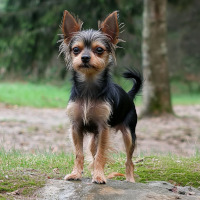
The shape of the skull is moderately rounded, lacking a prominent occipital tuberosity, but with convex brow ridges and a deep snout. The muzzle is shorter than the rest of the head, has a well-developed chin, and is not pointed. The Moscow Dragon's twitching lips are uniformly black, as is the earlobe. | |
Facial region |
||
Jaws and teeth |
The teeth are white and of medium size. Reference Bite Type: Straight, dense scissor bite. |
|
Eyes |
Two small, regular ovals set well apart. Eyelid skin with uniform pigmentation and a tight fit. | |
Ears |
The Moscow Dragon family may include individuals with erect and semi-erect ears. The ear tissue should be fine, long, and mobile, but never broad. | |
Neck |
| Long, lean, and set high. |
Body |
||
Body |
The body is small, with a horizontal top and almost no visible wrinkles. | |
Back |
The dog's back is also straight, and the lumbar region is moderately convex. | |
Croup |
The croup is straight and short. | |
Chest |
The pectoral bones are long, and the chest itself is deep and oval-shaped. | |
Ribs |
The false ribs are well-defined. | |
Underline and belly |
The stomach is normally tucked up. | |
Tail |
| Tails come in a wide variety of shapes, from sickle and half-ring to full ring. This part of the body is set high and bounds joyfully or throws itself over the back. |
Limbs |
| The dog's movements are free and flowing. | ||
Forequarters |
||
Generality |
The forelegs are held upright. The front legs are close together and visible. | |
Shoulders |
The shoulder bones are slightly curved. | |
Elbows |
The elbows are held firmly against the sides. | |
Forearm |
Forearms without curvature. | |
Hindquarters |
||
Generality |
The hind legs are parallel to each other and set well apart. The hind legs are oval-shaped. | |
Lower thigh |
The lower legs and thighs are of equal length. | |
Stifle |
The corners of the knees do not show a noticeable curve to the sides. | |
Metatarsus |
The metatarsals are of medium length. | |
Coat |
||
Hair |
The coat is straight or with a pronounced break, and fairly stiff. The head has a crest, a mustache, and a goatee. Along the crest, on the neck, and on the tail, the hair is as coarse and long as possible. Guard hair is rare. The undercoat is normal. | |
Colour |
Any combination is permitted, but white and spotted individuals must have exposed skin pigmentation. | |
Size and weight |
||
Height at withers |
From 25 to 30 cm. | |
Weight |
A dog can weigh from 1.5 kg to 4 kg, while breeders strive to ensure maximum uniformity within the breeding stock. In this regard, Moscow Dragons weighing 2 to 3.5 kg are selected for breeding purposes. | |
Faults |
| • Any departure from the foregoing points should be considered a fault and the seriousness with which the fault should be regarded should be in exact proportion to its degree and its effect upon the health and welfare of the dog and its ability to perform its traditional work. • Faults listed should be in degree of seriousness. |
Disqualifying faults |
 Blue or heterochromatic eyes. Body weight less than 1 kg and more than 5 kg. Presence of bald patches on the skull. Short tail. A deficiency of 2 mm or more. Absence or minimal hair decoration. Drooping ear position. Blue or heterochromatic eyes. Body weight less than 1 kg and more than 5 kg. Presence of bald patches on the skull. Short tail. A deficiency of 2 mm or more. Absence or minimal hair decoration. Drooping ear position. |
NB : |
| • Any dog clearly showing physical or behavioural abnormalities shall be disqualified. • The above mentioned faults when occurring to a highly marked degree or frequently are disqualifying. • Male animals should have two apparently normal testicles fully descended into the scrotum. • Only functionally and clinically healthy dogs, with breed typical conformation should be used for breeding. |
Additional information related to this breed Moscow Dragon |
Training and EducationMoscow Dragons are trained in the same way as representatives of all ornamental breeds, that is, without using the contrast method. Any kind of mechanical impact on the animal must be avoided due to its delicate build. Furthermore, training follows the classic pattern: socialization, basic training, and formal training. The main role is given to positive reinforcement and encouragement. For any success, the dog must be "fed and praised."It is not recommended to take such a pet to training grounds. It is better to work with a representative of the breed at home, in the yard, or during a walk in the nearest park. As for sports, they must also be "selected" based on their physical characteristics. For example, Moscow Dragons can perform well in agility in the S size category (an animal measuring up to 35 cm at the withers). Care and MaintenanceDespite their recent past on the streets, modern representatives of this breed are typical decorative pets. This means their place is indoors. Adult dogs should be taken for walks two to three times a day. Puppies, up to five times, if you plan to housetrain them. If you don't have much time for walks, you can train your dog to use a special tray with a side. Choose trays designed for small dogs.Hygiene and Coat CareMake it a rule to maintain a minimum level of grooming regularly. Start your morning by examining your dog's eyes. Remove any dust and mucus clumps from the corners promptly. If you notice any discharge or unusual symptoms, consult a veterinarian without delay. Once a week, you can remove the sulfur from its ears. Special ear lotions or a clean cloth wrapped around a finger will do the trick. It can be impossible to persuade a Moscow Dragon to maintain good oral hygiene. If you have such an unruly "tail," look for alternatives. These could include special solutions to add to the water, treats made from the veins, and even tomato juice. The breed's harsh coat is delicate, so you must carefully measure out dog shampoos for swimming. Otherwise, the fur will become soft and frizzy, and you'll no longer have a Moscow Dragon, but a mutt of unknown appearance. Otherwise, minimal coat maintenance is required. Brush the "coat" cosmetically every day during shedding season, and twice a week the rest of the time.DietThe breed's undemanding nature has given rise to the myth that its members can be fed from their own table. In fact, the digestion of mixed-breed dogs is no different from that of members of purebred breeds. Of course, dogs cannot eat borscht, cutlets, or biscuits. But high-quality dry food containing a probiotic complex can be a good alternative to a natural diet.If you still prefer a "straight-feeding" diet, keep in mind that this diet will need to be supplemented with vitamins and minerals. It's also best to avoid the BARF (Biologically Appropriate Raw Food) system. Moscow Dragons don't have the strongest teeth, which can easily be lost prematurely by gnawing on bones and dense cartilage. It's best to feed them frozen raw meat cut into small pieces. The low temperatures will kill any pathogens that may be present in the meat. Otherwise, the diet consists of standard products for all dogs. Health and DiseasesThe true "noble" lineage gave the dragons excellent immunity and no predisposition to incurable diseases. However, as the breed is still in its early stages, it is too early to make predictions about the health of all future generations. To date, the following characteristic has been observed: at the age of four, many dogs lose some teeth. This is even reflected in the breed standard and is not considered a serious condition. Some individuals may become bald. Hair loss can be caused by various factors, and sometimes it can actually be stopped.How to Choose a PuppyUnder the guise of a Moscow Dragon, it's easy to buy an ordinary stray dog. Before buying, verify the seller's honesty in all permitted ways. Find out if they have their own registered kennel name, how long they've been involved with the breed, and what guarantees they offer the buyer.For your information: although major kennel clubs don't officially register the breed, shows are held periodically for its representatives. This allows breeders to classify their dogs according to the breed standard: companion animal, show dog, or purebred. Hence the wide variation in dog prices. Be sure to look for the antennae, beard, and "dragon's crest" on the puppies' backs, identifying the characteristics of a purebred individual. Remember to draw up a purchase and sale contract and, of course, read all the points carefully before signing it. Appearance and health of puppies are among the most important selection criteria. You shouldn't buy lethargic, unattractive dogs with suspicious nasal discharge, even at a reduced price. PriceThe cost of a puppy depends entirely on the breeder. Sometimes there are quite reasonable offers. Some breeders charge very high fees. It's best to look for free Moscow Dragon puppies for adoption not on classified ad websites, but on social media. Monitor breed enthusiast groups and contact breeders; this way, you're less likely to buy a dog from a stranger. |



 English (United Kingdom)

Comments