 |
Schnottie |
|
He is not recognized by the F.C.I. |
Origin |
Germany -> U.S.A. | |
Translation |
Francis Vandersteen |
A brief presentation of the Schnottie |
| The Schnottie is a hybrid between the standard Schnauzer and the pure-bred Rottweiler. This hybridization is rare, and there isn't much documentation on the breed. In addition, the name is sometimes confused with the hybridization between the Scottish Terrier and the Miniature Schnauzer. People considering adopting a Schnottie should be cautious and ask lots of questions about parent breeds before committing to an adoption. The Schnottie is an intelligent, loyal hybrid with great guarding skills. He has medium to high energy, depending on which breed he most resembles, but a glance is all it takes to know that he's both a Schnauzer and a Rottweiler. |
History of the Schnottie |
| The Schnottie mix is a recent hybridization between the standard Schnauzer and the Rottweiler. Sometimes a Giant Schnauzer can be used, but this considerably increases the Schnottie's standard size and weight. At present, not much is known about the Schnottie, and there are no written standards for the breed. Owners who wish to better understand their Schnottie can consult the respective histories of the two related breeds. |
A little of the Schnauzer |
||
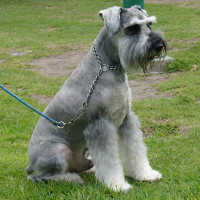
| The Standard Schnauzer is the first and oldest of the Schnauzer breeds. Its long history began in Germany around the 1500s, where it was used to guard farms, herd livestock and help control vermin. Before twentieth-century standards were developed, the standard Schnauzer was called the Wirehaired Pinscher, which described the qualities of its coat and its Terrier-like roots; Pinscher is German for bite or Terrier. The breed name became Schnauzer in the 1900s, a German word used to describe a beard or moustache. German immigrants introduced the Schnauzer to the United States in the 1900s, but the breed's popularity only increased after the First World War, although the American Kennel Club recognized the breed in 1904. | ||
 |
||
| Standard of the Schnauzer |
A little of the Rottweiler |
| The Rottweiler is also of German origin and belongs to the Molosser family, also known as Mastiffs. The Rottweiler's predecessor settled in the region with the Roman invasions and interbred with local dogs for many years. The Rottweiler takes its name from the type of red tile the Romans used on their roofs. This red tile was rediscovered over 600 years after the departure of the Roman invaders and inspired the name of the town, Rote Wil. The Rottweiler breed thrived in the area and borrowed the town's name for its own. By the late 1800s, the Rottweiler had lost much of its popularity in Germany and was almost extinct. However, a resurgence of interest in the breed occurred in the early to mid-twentieth century, allowing the breed to make a strong comeback. The Rottweiler did well in the USA and was a recognized breed by the American Kennel Club in 1931. Today, the Rottweiler is still one of the ten most popular breeds. |
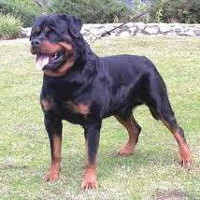 |
| Standard of the Rottweiler |
Appearance of the Schnottie |
| The Schnottie is a mix of the standard Schnauzer and the Rottweiler. The Giant Schnauzer can be used, but this parent will add considerable size and weight to the Schnottie. Owners should be well informed of their Schnottie's parentage when adopting a new puppy. The Schnottie carries the traits of both parents, and is said to resemble the standard Schnauzer with the coat and markings of the Rottweiler. The Schnottie's head is block-shaped, with a long, square muzzle and a large black nose. The eyes are round and brown. The Schnottie has a bearded muzzle, like the Schnauzer, and a medium, harsh coat, but generally carries the Rottweiler's black and tan markings, including tan points on its face. |
Temperament of the Schnottie |
| The Schnottie is a loyal, reliable guardian whose parental roots are those of guardian and protector. This hybrid is very protective of its family and affectionate with children; however, the Schnottie can develop aggressive or timid behaviors if not properly socialized and trained. The Schnottie does not tolerate solitude well, and needs plenty of mental and physical stimulation to stay healthy. The Schnottie is not particularly friendly towards strangers or other dogs, but with proper socialization, this hybrid can live in harmony with other pets and treat strangers with the appropriate level of caution without showing signs of aggression or shyness. |
Needs and activities of the Schnottie |
| The Schnottie is an active dog with a medium to high energy level. They are easy to train and eager to please their owners. The Schnauzer parent provides most of the high energy, while the Rottweiler parent softens energy levels a little. This is a playful breed that loves to run and play with rope, toys or sticks. The Schnottie needs daily outdoor exercise and is equally at home in the city or the country, provided it has enough time to exercise outside. A house with a backyard is ideal for this large dog. The Schnottie prefers warm to cold climates, but should never be left alone outdoors. In addition, owners should divide meals into two or three portions a day and refrain from exercise for at least an hour after their Schnottie has eaten, to prevent gastric dilatation and volvulus, also known as bloat. |
Maintenance of the Schnottie |
| The Schnottie can be a hypoallergenic dog if its coat resembles that of the standard Schnauzer. In most cases, the Schnottie is not a dog that sheds a lot, but if the coat is short and smooth, like that of the Rottweiler, owners can expect more shedding. Weekly brushing will remove dead or loose hair from the coat and keep it clean and free of tangles. Schnotties have sensitive skin and should only be bathed when necessary. Otherwise, the Schnottie can develop skin problems, including allergies. The Schnottie is known to drool more than other large dogs and may develop a slight odor. Cleansing the Schnottie's face with a pet wipe or warm washcloth helps limit drool odors. |



 English (United Kingdom)

Comments